

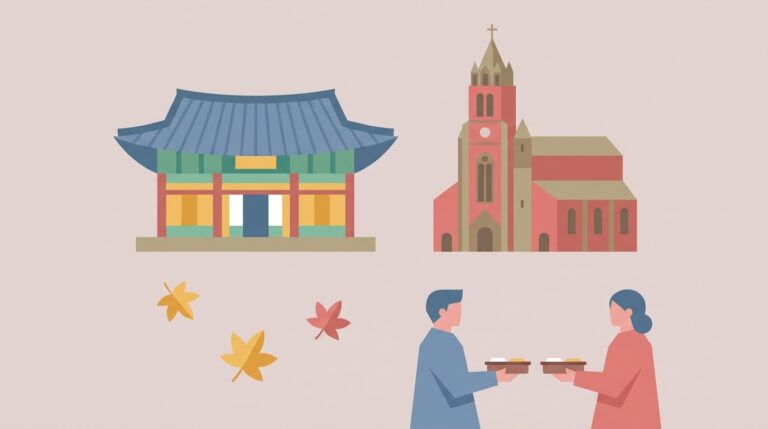
Beyond the Sanctuary: Understanding the Civic Heart of Korean Religious Spaces (C1)
Phase 1: 공감 (Story Immersion Opening)
안녕하세요! 매일한글 에디터입니다.
If you have watched the hit K-drama The Fiery Priest (열혈사제) or the poignant classic My Mister (나의 아저씨), you might have noticed a curious recurring scene: troubled protagonists do not merely retreat into religious spaces to chant scriptures or whisper confessions in isolation. Instead, temples and cathedrals are depicted serving steaming bowls of sujebi (hand-torn noodle soup) to displaced market vendors, sheltering striking workers, or organizing grassroots neighborhood patrols.
Many of our advanced C1 learners tell us: “I know the vocabulary for prayer, belief, and rituals, but whenever social issues or news discussions turn to religion, native speakers use an entirely different, civic-minded register that sounds neither strictly doctrinal nor completely secular.”
In Korea, religious facilities—whether a thousand-year-old Buddhist sanctuary perched in Bukhansan, a quiet Catholic cathedral in Myeongdong, or an urban Protestant community hub—are profoundly woven into the fabric of social welfare, civil rights history, and local care networks. Gaining fluency in this nuance moves you from merely understanding Korean religious vocabulary to grasping the sociopolitical conscience of modern Korea. Today’s guide is built on authentic field experiences and feedback from learners who wanted to comfortably navigate discussions on community service, public interest, and institutional social responsibility at an advanced level.
Phase 2: 핵심 표현 3선 심층 분석
1. 문턱을 낮추다 (Munteogeul natchuda)
- Pronunciation: [Moon-teog-eul nat-choo-da] (Sounds like “moon” + “tug” spoken crisply, followed by a soft, downward breath on “nat-choo-da”)
- Meaning: Literal: “To lower the doorsill / threshold.” | Nuanced Reality: To remove socioeconomic, psychological, or institutional barriers so that marginalized groups or ordinary citizens can easily access assistance and shelter.
- K-Culture Moment: Frequently heard in civic documentaries and news segments when religious welfare centers open free childcare, language clinics for multicultural families, or open-air musical concerts for local seniors.
- Editor’s Insight: Traditional Korean wooden gates have prominent thresholds (munteok) designed to keep outdoor elements out. Lowering this threshold symbolizes abandoning institutional exclusivity and meeting vulnerable neighbors on equal ground.
- Situation Spectrum: Casual ⚠️ | Semi-formal ✅ | Formal ✅
- 🤔 Think About It: In your home country, does a religious institution become more respected by maintaining solemn boundaries, or by actively dismantling them to blend into public civic space?
2. 사회적 약자를 보듬다 (Sahoejeok yakjareul bodeumda)
- Pronunciation: [Sa-hoe-jeok yak-ja-reul bo-deum-da] (Flows like “sa-hway-jeok”, then “yak-ja-reul”, ending with the gentle hug of “bo-deum-da”)
- Meaning: Literal: “To hold/cradle the socially weak.” | Nuanced Reality: To compassionately embrace, protect, and advocate for marginalized individuals facing societal neglect, poverty, or legal vulnerability.
- K-Culture Moment: Heard in investigative journalism pieces such as PD Note or humanitarian broadcasts when describing grassroots faith groups running unhoused shelters (no-suk-in swil-teo) during record-breaking cold waves.
- Editor’s Insight: Bodeumda conveys a motherly physical embrace. Pairing it with the academic sociological term sahoejeok yakja creates an articulate, emotionally resonant C1 expression that bridges high-register discourse with profound warmth.
- Situation Spectrum: Casual ⚠️ | Semi-formal ✅ | Formal ✅
- 🤔 Think About It: Notice the tactile verb bodeumda (to cradle/embrace) instead of bureaucratic verbs like ji-won-ha-da (to support). What does this reveal about the emotional warmth expected of social welfare in Korea?
3. 선한 영향력을 끼치다 (Seonhan yeonghyangryeogeul kkichida)
- Pronunciation: [Seon-han yeong-hyang-ryeo-geul kki-chi-da] (Crisp “seon-han”, followed by a rhythmic glide on “young-hyang-ryuk”, snapping on “kki-chi-da”)
- Meaning: Literal: “To exert good influence.” | Nuanced Reality: To trigger a ripple effect of altruism, civic duty, and social good that inspires the wider secular community to participate.
- K-Culture Moment: Heavily used across Korean media, variety shows, and civil society forums when religious initiatives rally celebrity charity drives, volunteer kimchi-making (Gimjang), or disaster relief supplies.
- Editor’s Insight: While yeonghyangryeogeul kkichida can often carry a neutral or even negative connotation (e.g., negative influence), specifying seonhan elevates it into a widely respected praise for civic-minded philanthropy.
- Situation Spectrum: Casual ✅ | Semi-formal ✅ | Formal ✅
- 🤔 Think About It: Does modern social media praise institutional charity, or does society prefer quiet grassroots altruism that spreads organic “good influence” without dogma?
Phase 3: 교과서 한국어 vs 진짜 한국어
Situation 1: Discussing institutional charity & food distribution
- 📖 교과서 한국어: “종교 시설에서 무료 급식 자선 사업을 진행하고 있습니다.” (Jonggyo siseoreseo muryo geupsik jaseon saeobeul jinhaenghago itseumnida.)
- 🗣️ 진짜 한국어: “종교 시설들이 문턱을 낮춰서, 소외된 이웃들에게 따뜻한 밥 한 끼 나누는 연대의 장을 만들고 있더라고요.” (Jonggyo siseoldeuri munteogeul natchwoseo, so-oedoe-n i-utdeurege ttatteut-han bap han kki nanuneun yeondae-ui jangeul mandeulgo itdeoragoyo.)
- 💡 왜 다를까?: Textbook Korean relies heavily on bureaucratic Sino-Korean words like jaseon saeop (charity business). Advanced native speakers prefer human-centered metaphors like bap han kki (a warm meal) and yeondae (civic solidarity), emphasizing shared humanity over top-down benevolence.
Situation 2: Describing religious spaces serving as historic or physical sanctuaries
- 📖 교과서 한국어: “그 사원은 사회적 피난처의 기능을 수행했습니다.” (Geu sawoneun sahoejeok pinancheo-ui gineungeul suhaenghaetseumnida.)
- 🗣️ 진짜 한국어: “역사의 굴곡마다 비바람을 막아주는 든든한 사회적 울타리가 되어준 셈이죠.” (Yeoksa-ui gulgongmada bibarameul magajuneun deundeunhan sahoejeok ultariga doeeojun semijyo.)
- 💡 왜 다를까?: Native C1 discourse avoids clinical phrasing like gineungeul suhaenghada (performing functions). Instead, it evokes emotional resilience through imagery such as bibarameul magajuda (shielding from harsh wind and rain) and ultari (protective fence).
Phase 4: K-Culture 딥다이브 & 비언어적 매너
4-1. 눈치(Nunchi) & Non-Verbal Manners in Korean Faith-Based Welfare Centers
When visiting or volunteering at a Korean religious institution providing public welfare—whether a Buddhist soup kitchen (Wongaksa), a Catholic homeless shelter, or a Protestant emergency relief hub—keep these three golden rules of nunchi in mind:
1. Two-Handed Humility (두 손 받침): Even if you are the one serving food or handing out relief packages, hand items over with both hands, slightly bowing your head. The underlying philosophy is nanum (sharing), not si-hye (condescending charity). Never stand upright with one hand on your hip or direct people pointedly.
2. Neutral Demeanor Regarding Dogma: Do not initiate doctrinal debates or inquire about an individual’s personal faith. Korean religious social facilities operate on public universalism; questioning a recipient’s religion violates civic trust.
3. Demure Footwear & Apparel (단정한 복장): Wear easily removable yet conservative shoes and clothing covering your shoulders and knees. Moving between wooden sanctums, linoleum community halls, and kitchen prep floors requires constant transition.
4-2. Cultural Code: The Sanctuary Legacy (명동성당과 조계사)
To comprehend why Korean religious facilities hold immense political and social authority, one must revisit Korea’s democratization struggles of the 1970s and 1980s. When military regimes suppressed public protests, Myeongdong Cathedral (명동성당) in central Seoul served as an untouchable sanctuary where student activists, labor leaders, and democracy figures could take refuge.
Similarly, Jogyesa (조계사), the head temple of the Jogye Order of Korean Buddhism, has repeatedly opened its gates to striking union workers and vulnerable whistleblowers. In modern Korea, a temple or church is historically seen not merely as an altar for transcendental salvation, but as an ultimate moral safety net when state power fails the populace.
Phase 5: 실전 롤플레이 시나리오
Setting: A vibrant, bustling community volunteer coordination office located in the basement annex of a historic Buddhist-Christian ecumenical center in Jongno, Seoul. Outside, the winter air is biting, but inside, cauldrons of winter soup steam alongside hundreds of gift boxes.
Characters:
* 한 팀장 (Team Leader Han): A seasoned 50-something social worker with a calm smile and deep understanding of grassroots community welfare.
* You (Advanced Volunteer Coordinator): A fluent speaker assisting in organizing the winter seasonal outreach initiative.
한 팀장: 이번 겨울철 쪽방촌 지원 사업, 생각보다 지원 물품이 많이 모였네요. (Ibeon gyeoulcheol jjokbangchon jiwon saeop, saenggakboda jiwon mulpumi mani moyeonneyo.)
🎭 [따뜻한 미소를 지으며 모인 방한용품 상자들을 정리한다]
“For this winter’s flophouse community relief initiative, we gathered far more donated supplies than anticipated.”
You: 네, 종교계 안팎에서 문턱을 낮추고 뜻을 모아준 덕분입니다. (Ne, jonggyogye anpakkeseo munteogeul natchugo tteuseul moajun deokbunimnida.)
🎭 [재고 목록 서류를 공손히 건네며 목소리를 차분히 낮춘다]
“Yes, it is all thanks to people both inside and outside religious circles lowering their thresholds and uniting their wills.”
한 팀장: 맞아요. 종교의 사회적 역할이란 게 결국 소외된 이들의 손을 먼저 잡아주는 데 있으니까요. (Majayo. Jonggyo-ui sahoejeok yeokhariran ge gyeolguk so-oedoe-n ideurui soneul meonjeo jabajuneun de isseunikkayo.)
🎭 [김이 모락모락 나는 보리차를 건네며 끄덕인다]
“Indeed. After all, the true social role of religion lies in reaching out first to grasp the hands of the marginalized.”
You: 단순한 시혜성 지원을 넘어서, 사회적 약자를 온전히 보듬는 연대가 느껴집니다. (Dansunhan sihyeseong jiwoneul neomeoseo, sahoejeok yakjareul onjeonhi bodeumneun yeondaega neukkyeojimnida.)
🎭 [두 손으로 차를 받으며 진지하고 존경 어린 눈빛으로 화답한다]
“Beyond mere superficial charity, I can genuinely feel a solidarity that wholeheartedly embraces the vulnerable.”
한 팀장: 그런데 현장 배분 시에 특정 종교 색채가 드러나지 않도록 각별히 유의해야 합니다. (Geureonde hyeonjang baebun si-e teukjeong jonggyo saekchaega deureonaji antorok gakbyeolhi yu-uihaeya hamnida.)
🎭 [목소리에 힘을 주며 봉사자 지침 메모를 가리킨다]
“However, we must take utmost care ensuring that no specific sectarian overtones are shown during on-site distribution.”
You: 당연하죠. 종교의 사회적 실천은 교리 전파가 아닌 순수한 이웃 사랑이어야 하니까요. (Dangyeonhajyo. Jonggyo-ui sahoejeok silcheoneun gyori jeonpaga anin sunsuhan i-ut sarang-ieoya hanikkayo.)
🎭 [단호하고 분명한 어조로 고개를 끄덕이며 원칙을 확인한다]
“Of course. The social praxis of religion must be an expression of pure neighborly love, never the dissemination of doctrine.”
한 팀장: 아주 든든합니다! 이런 건강한 시선이 우리 사회에 선한 영향력을 끼치는 밑거름이죠. (Aju deundeunhamnida! Ireon geonganghan siseoni uri sahoe-e seonhan yeonghyangryeogeul kkichineun mitgeoreumijyo.)
🎭 [환하게 웃으며 어깨를 가볍게 토닥인다]
“You give me so much confidence! This balanced perspective is precisely the fertile soil that allows good influence to ripple across society.”
You: 팀장님과 함께 현장에서 묵묵히 제 몫을 다하겠습니다. (Timjangnimgwa hamkke hyeonjangeseo mungmuki je mokseul dahagetseumnida.)
🎭 [두 손을 모아 가볍게 목례하며 결의를 다진다]
“I will quietly do my part on the ground alongside you, Team Leader.”
🔀 인터랙티브 분기점 (Choose Your Response)
At the end of the shift, Team Leader Han asks: “If a beneficiary asks why our ecumenical group does this hard work without promoting our faith, what should we emphasize?”
- Option A: “종교 시설이 가진 공공재적 성격을 강조하며, 누구나 조건 없이 기댈 수 있는 안전망임을 차분히 설명하겠습니다.”
(I will emphasize the public good nature of religious facilities, explaining calmly that we are a safety net anyone can lean on without preconditions.)
👉 [Best Choice] Feedback: Flawless C1 delivery! Terms like gonggongjaejeok seonggyeok (nature of a public good) and anjeonmang (safety net) embody the pinnacle of modern Korean civic awareness. -
Option B: “우리 종교의 도덕적 우월성을 알리고 다른 종교보다 낫다는 점을 부각시키겠습니다.”
(I will proclaim our religion’s moral superiority and highlight that we are better than other faiths.)
👉 [Bad Choice] Feedback: Highly inappropriate! This completely violates the ethos of non-proselytizing community service and is culturally tone-deaf in modern Korean civil society. -
Option C: “그냥 법적으로 예산을 지원받았으니 일하는 공무원 같은 거라고 둘러대겠습니다.”
(I will casually brush it off by saying we are like civil servants working just because we received legal budget funding.)
👉 [Risk Choice] Feedback: Grammatically correct, but socially cynical. It diminishes the dedication of voluntary civil solidarity and trivializes the human warmth (jeong) of the center.
Phase 6: 10초 감정 섀도잉 드릴
Speak out loud, mimicking native cadence, pausing at /, and matching the indicated emotion!
[🧐 진중하고 학술적인 톤으로 - Serious & Analytical]
“종교 시설은 / 단순한 예배의 처소를 넘어 / 지역사회의 복지 사각지대를 메우는 / 든든한 사회적 안전망 역할을 합니다.”
(Jonggyo siseoreun / dansunhan yebae-ui cheosoreul neomeo / jiyeok-sahoe-ui bokji sagakjidaereul me-uneun / deundeunhan sahoejeok anjeonmang yeokhareul hamnida.)
“Religious facilities go beyond mere places of worship, acting as a sturdy social safety net that fills blind spots in local welfare.”-
[😊 따뜻하고 진심 어린 어조로 - Warm & Compassionate]
“가장 낮은 곳에서 / 문턱을 낮추고 / 이웃의 아픔을 보듬는 것이야말로 / 종교의 본령이죠.”
(Gajang najeun goseseo / munteogeul natchugo / i-usui apeumeul bodeumneun geosiyamallo / jonggyo-ui bollyeong-ijyo.)
“Lowering our thresholds at the lowest places and embracing the pain of our neighbors—that is indeed the true calling of religion.” -
[🤝 결의에 차고 신뢰감 넘치는 목소리로 - Resolute & Inspiring]
“우리의 작은 실천이 / 메마른 사회에 / 선한 영향력으로 번져나가길 기대합니다.”
(Uri-ui jageun silcheoni / memareun sahoe-e / seonhan yeonghyangryeok-euro beonjyeonagagil gidaehamnida.)
“I hope our humble practice will spread as a wholesome influence across an arid, weary society.”
Phase 7: K-Culture 미니 사전 (핵심 키워드 4선)
-
사각지대 (Sagakjidae)
- Translation: Blind spot (welfare gap)
- Real-World Usage: Essential C1 sociological term. Refers to citizens who fall through statutory legal welfare criteria (e.g., paper ownership of assets prevents government aid, yet they face literal starvation). Religious shelters almost universally target this bokji sagakjidae.
- 보시 (Bosi) & 나눔 (Nanum)
- Translation: Buddhist almsgiving / Universal secular sharing
- Real-World Usage: Bosi is a traditional Buddhist term signifying selfless giving without expecting karma or praise (Mu-ju-sang-bo-si). Today, nanum has become the secular civil umbrella term across all Korean faiths for disaster relief, community blood donation, and food pantries.
- 상생 (Sangsaeng)
- Translation: Mutual coexistence / Win-win harmony
- Real-World Usage: Originally an Eastern philosophical concept (opposing mutual destruction, sang-geuk), it is heavily used in Korean socio-economic reporting when religious entities mediate disputes between corporate developers and marginalized local shopkeepers.
- 시혜 (Sihye)
- Translation: Condescending benevolence / Patronizing charity
- Real-World Usage: A critical C1 analytical term. Often used with a critical stance (sihyeseong), emphasizing that genuine community support must treat recipients as dignified rights-holders rather than passive objects of elite pity.
Phase 8: 여행자를 위한 생존 키트
서바이벌 표현 TOP 3
- “누구나 참여할 수 있는 열린 나눔 행사인가요?”
(Nuguna cham-yeohal su inneun yeollin nanum haengsa-ingayo?)
“Is this an open sharing event that anyone can participate in?”
💡 Pro Tip: Perfect when passing by a temple festival or cathedral courtyard hosting a charity bazaar or eco-market. -
“작은 정성이지만 후원이나 자원봉사에 보탬이 되고 싶습니다.”
(Jageun jeongseong-ijiman huwon-ina jawonbongsa-e botaemi doego sipseumnida.)
“It is just a modest token, but I would like to contribute to donations or volunteer service.”
💡 Pro Tip: The phrase jageun jeongseong (modest sincerity) shows pristine humility when giving monetary donations or volunteering. -
“사찰음식(혹은 종교 문화 행사)을 통해 지역사회와 소통하는 모습이 인상 깊네요.”
(Sachal-eumsik hogeun jonggyo munhwa haengsareul tonghae jiyeok-sahoewa sotonghaneun moseubi insang gimneyo.)
“It is deeply impressive how you communicate with the local community through temple food (or cultural programs).”
💡 Pro Tip: An articulate compliment guaranteed to open meaningful, warm conversations with temple monks, church pastors, or resident coordinators.
Editor’s Travel Note
- Digital Navigation: Use the Naver Map app download to search for landmark civic sanctuaries in Seoul like Jogyesa (조계사) in Insa-dong or Myeongdong Cathedral (명동성당). Type queries like
무료급식소(Free Meal Kitchen) or문화나눔(Cultural Sharing) to discover open-to-the-public weekend community programs. - Official Cultural Access: Check out the Templestay official reservation portal to experience temple stays that highlight community service, communal organic farming (Ullyeok), and eco-sustainable monastic food distribution.
Phase 9: “한 발 더 깊이” (생각 질문)
In many Western post-industrial nations, secularization frequently leads to the retreat of religious institutions from civic prominence, leaving public welfare almost entirely to bureaucratic welfare states or private philanthropic funds. In contrast, Korea’s unique historical landscape—characterized by Shamanic communal rituals (Dure), Buddhist vows of universal liberation, Confucian filial duty, and Christian civic-political activism—has fostered a culture where religious spaces remain vigorous frontline bastions of community resilience. Rather than demanding doctrinal fidelity first, these sanctuaries build legitimacy through their willingness to sweat alongside citizens in crisis.
💬 Your Turn: In your home society, do religious spaces act as frontline civic champions during crises, or are they strictly confined to spiritual ritual? Have you ever witnessed a religious venue providing unconditional public support? Share your insights in the comments below!
Phase 10: FAQ & 오해 방지 (FAQ Schema)
Q: Do I need to be a practicing believer of that specific religion to volunteer at a Korean Buddhist or Catholic welfare center?
A: Absolutely not! Korean faith-based social organizations are strictly bound by professional social welfare standards. Volunteers are welcomed based on sincerity and willingness to help, regardless of their personal religious convictions or lack thereof. Doctrinal proselytizing while volunteering is strictly discouraged.
Q: Why do people refer to Myeongdong Cathedral or Jogyesa as political symbols rather than purely sacred shrines?
A: Because both sites acted as critical physical sanctuaries during Korea’s pro-democracy movements in the 20th century. Under authoritarian rule, the police refrained from violating sacred spaces due to international scrutiny. Consequently, these venues became the epicenter where human rights lawyers, students, and displaced laborers gathered to resist authoritarianism.
Q: What is the difference between gwonseon (proselytizing/preaching) and bongsa (social service) in Korean society?
A: Gwonseon (or jeondo / pogyo) focuses on converting someone to a religious faith, which is viewed critically if forced upon people in public spaces. In contrast, bongsa (community service) and nanum (sharing) represent pure altruism without religious strings attached—which is universally applauded as an exemplary civic virtue.
🚨 흔한 실수 (Common Mistakes) 경고판
- ❌ Mistake 1: Using overtly religious conversion vocabulary when talking about social work.
Saying “불쌍한 사람들을 전도하기 위해 급식을 줍니다” (Giving meals to convert poor people) sounds tone-deaf and offensive.
✅ Correct Action: Say “소외된 이웃에게 온정을 나누고 사회적 안전망을 제공합니다” (Sharing warmth with marginalized neighbors and providing a social safety net). -
❌ Mistake 2: Confusing ‘자선’ (Charity) with ‘연대’ (Solidarity).
Overusing jaseon can sound patronizing, as if the wealthy are simply bestowing scraps on the poor.
✅ Correct Action: At C1, use yeondae (solidarity) or donghaeng (walking alongside together), which honors the equal human dignity of those supported. -
❌ Mistake 3: Bowing with prayer hands (Hapjang) in non-Buddhist settings.
Foreign learners sometimes greet Christian soup kitchen leaders with a Buddhist deep bow and palms pressed together (Hapjang).
✅ Correct Action: Keep your greeting universally polite: standard two-handed bow (gongsu-in-sa) with your hands resting gently near your waistline.
Phase 11: 액션 미션 & 참여 유도
- 🥉 Bronze Mission (Self Practice): Stand before a mirror and practice shadowing Drill #1 from Phase 6 three times. Focus on crisp diction of bokji sagakjidae and deundeunhan sahoejeok anjeonmang.
- 🥈 Silver Mission (Social Media Sharing): Post a short reflection on Instagram or Threads about a historical sanctuary (like Myeongdong Cathedral or Jogyesa) using the key phrase: “문턱을 낮추고 소외된 이웃을 보듬는 사회적 역할.”
- 🥇 Gold Mission (Real-World Application): Visit a local cultural facility, museum, or historic temple in Korea. Ask the staff in Korean: “이곳에서 지역사회를 위해 운영하는 나눔 프로그램이나 문화 행사가 있나요?” (Are there community sharing programs or cultural events run here for the local community?)
🎮 K-Culture Mission: Watch an episode of a documentary like KBS Human Theater (인간극장) or a drama episode featuring community volunteer work. Note down how many times you hear the words nanum, bap han kki, and dodeumda!
Phase 12: 인터랙티브 퀴즈 챌린지
Test your mastery of Korean religious civic discourse! Read the questions, make your pick, and click to reveal the detailed answers.
- [Situational Judgment] You are participating in a formal academic panel discussion on poverty eradication in Seoul. Which phrasing sounds most appropriate for an articulate C1 speaker?
- (A) 종교 단체들이 돈을 많이 써서 불쌍한 사람들을 구제해야 합니다.
- (B) 종교 시설들이 문턱을 낮추어 복지 사각지대에 놓인 사회적 약자를 보듬는 상생의 연대가 필요합니다.
- (C) 종교가 사람들을 자기 신도로 만들기 위해 밥을 주는 활동을 넓혀야 합니다.
- [Fill-in-the-Blank] Complete the sentence with the most natural idiom studied today:
“그 시민 단체와 종교 시설은 ( ________ )을 낮추고, 누구나 찾아와 쉴 수 있는 따뜻한 쉼터를 마련했다.” -
[True or False Cultural Fact] Historically, Korean religious facilities like Myeongdong Cathedral and Jogyesa served as physical safe havens for democratization activists because authorities recognized them as untouchable sanctuaries under international moral norms. (True / False)
👉 Click here to reveal the answers and explanations!
- Answer: (B)
Explanation: Option (B) seamlessly integrates advanced high-register sociological vocabulary: munteogeul natchuda (lowering thresholds), bokji sagakjidae (welfare blind spots), sahoejeok yakjareul bodeumda (embracing the vulnerable), and sangsaeng-ui yeondae (solidarity of mutual coexistence). Option (A) sounds too colloquial and condescending (bulsanghan saramdeul), while (C) is culturally and ethically inappropriate. -
Answer: 문턱 (Munteok)
Explanation: The idiom is 문턱을 낮추다 (to lower the threshold / make accessible to everyone). -
Answer: True
Explanation: Both Myeongdong Cathedral and Jogyesa Temple famously functioned as moral, political, and humanitarian sanctuaries during the peak decades of Korea’s authoritarian era and labor rights struggles.






