

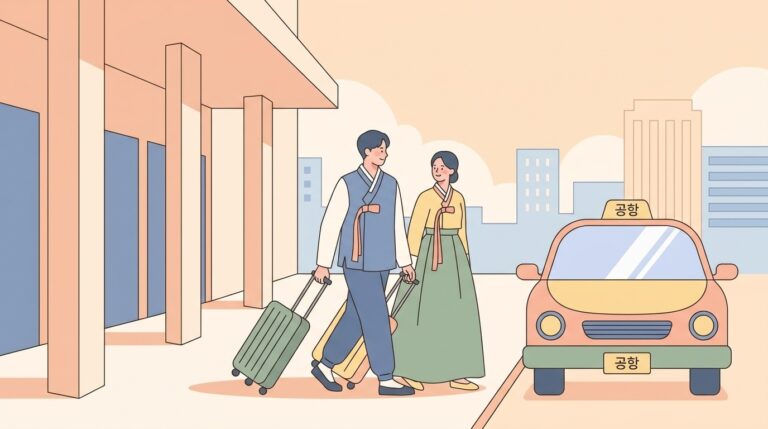
Off to the Honeymoon! Natural Korean Phrases for the Post-Wedding Dash
Phase 1: Empathy (Story-Immersive Opening)
안녕하세요! (Annyeonghaseyo!) I am your Daily Hangul editor and your 10-year local culture navigator.
Imagine this classic scene straight out of a K-drama: You just attended your close Korean friend’s glamorous wedding at an upscale Gangnam wedding hall. You took photos, devoured the grand buffet, and witnessed the emotional bows to parents. But within barely two hours of the ceremony beginning, you walk past the dressing rooms and spot the newlyweds sprinting toward the elevator. The bride is wearing comfortable track pants beneath her heavy bridal hair extensions, the groom is hauling three massive hard-shell suitcases, and a silver airport van is waiting downstairs with its hazards flashing. They are heading straight to Incheon Airport for their honeymoon flight!
You run up to give them your final blessings before they disappear into the elevator. Your mind races: What do I say? Do I say “안녕”? Do I say “Have a nice trip” like in English textbooks?
Many of our intermediate learners freeze here. A Korean wedding moves at lightning speed, and wishing newlyweds well as they rush off requires a delicate balance of warm excitement, deep empathy for their exhaustion, and seamless B1-level honorifics. In this guide, grounded in real feedback from learners navigating Korean social circles, we will master the exact expressions native speakers use when sending the happy couple off to paradise.
Phase 2: Deep Dive into 3 Core Expressions
1. 신혼여행 잘 다녀오세요! (Sinhon-yeohaeng jal danyeo-oseyo!)
- Pronunciation: [Sin-hon-yeo-haeng jal da-nyeo-oh-se-yo] (Think: Seen-hone-yuh-haeng, where “jal” flows smoothly like saying “Bon voyage” with an extra dose of homecoming warmth).
- Meaning: Literal: “Please go and return well from your newlywed trip!” / Real Nuance: “Have a wonderful, safe, and rejuvenating honeymoon!”
- K-Culture Moment: In countless Korean dramas, colleagues and college friends gather near the wedding hall exit waving their hands as the bridal car pulls out, shouting this exact line.
- Editor’s Insight: Notice the verb 다녀오다 (danyeo-oda, to go and come back). Korean culture heavily values the safe return to the social circle. Wishing someone simply to “have fun” can feel incomplete; promising their safe return seals the blessing.
- Situation Spectrum:
- Casual (to younger peers/besties): 신혼여행 잘 다녀와! (✅)
- Semi-formal (colleagues/seniors): 신혼여행 잘 다녀오세요! (✅)
- Formal (boss/formal elders): 신혼여행 조심히 잘 다녀오십시오! (✅)
- 🤔 Think About It: Why does Korean put so much conversational weight on coming back safely rather than just departing?
2. 오늘 정말 고생 많으셨어요. (Oneul jeongmal gosaeng maneusyeosseoyo.)
- Pronunciation: [Oh-neul jeong-mal go-saeng ma-neu-syeo-sseo-yo] (The “gosaeng” sound hits softly on the palate, carrying comforting empathy).
- Meaning: Literal: “You endured so much hardship today.” / Real Nuance: “You two worked incredibly hard to pull off this massive day; you did wonderfully!”
- K-Culture Moment: The moment when the parents take the couple’s hands right outside the hall, wiping away a tear while acknowledging how physically and mentally draining planning a wedding is.
- Editor’s Insight: In Western weddings, calling someone’s wedding day “hard work” or “suffering” might sound negative. In Korea, 고생 (gosaeng) is the ultimate term of validation. It acknowledges that greeting hundreds of guests on zero sleep is a heroic feat.
- Situation Spectrum:
- Casual: 오늘 진짜 고생 많았어! (✅)
- Semi-formal: 오늘 정말 고생 많으셨어요! (✅)
- Formal: 오늘 정말 고생 많으셨습니다. (✅)
- 🤔 Think About It: How does acknowledging someone’s labor foster deeper emotional bonding in high-context cultures?
3. 푹 쉬면서 좋은 추억 많이 만들고 오세요! (Puk swimyeonseo joeun chueok mani mandeulgo oseyo!)
- Pronunciation: [Pook swi-myeon-seo jo-eun chu-eok ma-ni man-deul-go oh-se-yo] (“Puk” is spoken with a short, rounded breath, mimicking collapsing into a soft hotel pillow).
- Meaning: Literal: “Rest deeply and come back making lots of great memories!” / Real Nuance: “Unplug completely, relax, and make unforgettable memories together!”
- K-Culture Moment: Written on pastel envelopes or messaged on KakaoTalk as the couple boards the airport express limousine.
- Editor’s Insight: The mimetic word 푹 (puk) means doing something thoroughly or resting deeply without interruption. Pair it with 추억 (chueok, nostalgic memories), and you provide a balanced blessing: recovery and joy.
- Situation Spectrum:
- Casual: 푹 쉬고 추억 많이 만들고 와! (✅)
- Semi-formal: 푹 쉬면서 좋은 추억 많이 만들고 오세요! (✅)
- Formal: 편히 쉬시며 소중한 추억 많이 쌓고 오시기를 바랍니다. (✅)
- 🤔 Think About It: Notice the pairing of rest (쉬다) with action (만들다). What does this reveal about the fast-paced modern Korean lifestyle?
Phase 3: Textbook Korean vs. Real Korean
Situation A: Wishing the couple a fun honeymoon flight
- 📖 교과서 한국어 (Textbook Korean): 즐거운 여행이 되기를 진심으로 기원합니다. (Jeul-geo-un yeo-haeng-i doe-gi-reul jin-sim-eu-ro gi-won-hap-ni-da.) — “I sincerely pray that your trip becomes enjoyable.”
- 🗣️ 진짜 한국어 (Real Korean): 비행기에서 기절하지 말고 푹 자면서 가요! (Bi-haeng-gi-e-seo gi-jeol-ha-ji mal-go puk ja-myeon-seo ga-yo!) — “Don’t faint from exhaustion on the plane; get some deep sleep on the way!”
- 💡 왜 다를까? (Why the difference?): Real friends playfully point out the exhaustion using hyperbole like 기절하다 (gijeolhada, to faint/pass out asleep) because couples are universally sleep-deprived on wedding days.
Situation B: Congratulating them as they finish the ceremony
- 📖 교과서 한국어 (Textbook Korean): 혼례 예식이 원만하게 종료되었음을 축하합니다. (Hon-rye ye-sig-i won-man-ha-ge jong-ryo-doe-eoss-eum-eul chuk-ha-hap-ni-da.) — “Congratulations on the harmonious conclusion of the marriage ritual.”
- 🗣️ 진짜 한국어 (Real Korean): 드디어 큰 산 하나 넘었네요! 맘 편히 떠나요! (Deu-di-eo keun san ha-na neom-eot-ne-yo! Mam pyeon-hi tteo-na-yo!) — “You finally crossed a huge mountain! Head off with a light heart!”
- 💡 왜 다를까? (Why the difference?): Pulling off a Korean wedding is widely compared to “climbing a steep mountain” (큰 산을 넘다). Using this idiom immediately resonates with the couple’s relief.
Phase 4: K-Culture Deep Dive & Non-Verbal Manners
4-1. 눈치 (Nunchi) & Gestures
- Keep Farewells Under 30 Seconds: When the couple is loading bags into a taxi or van, their clock is ticking for airport check-in. Don’t trap them in a long conversation. Deliver your warm phrase, offer a light two-handed handshake or quick side-hug (to avoid messing up bridal hair styling), and step aside.
- The Luggage Assist Rule: If you see the groom wrestling with multiple heavy suitcases while the bride manages her handbag and coat, offering to hold the trunk door or lifting a suitcase is worth ten spoken congratulations.
4-2. Cultural Code: Why the Immediate Rush?
Why do Korean newlyweds fly out on the evening of their wedding day?
1. 경조사 휴가 (Special Event Paid Leave): Korean companies typically offer 3 to 7 consecutive days of official paid leave for marriage. To maximize weekend transitions and overseas travel time (like long-haul trips to Hawaii, Europe, or Bali), couples catch the nearest red-eye.
2. The Wedding Hall Turnover: Korean wedding venues run ceremonies back-to-back every 60 to 90 minutes. Once the ceremony and buffet end, the venue must be cleared, propelling the couple directly toward their next stop: Incheon International Airport.
Phase 5: Real-Life Roleplay Scenario
Setting: Outside the underground parking garage of a Gangnam wedding venue.
Characters: You and Minho (민호), your Korean colleague who just got married and is loading luggage into a black taxi.
- Turn 1 (Minho):
민호: 와, 와줘서 진짜 고마워요! 밥은 맛있게 먹었어요?
(Wa, wa-jwo-seo jin-jja go-ma-wo-yo! Bab-eun ma-sit-ge meog-eoss-eo-yo?)
“Wow, thank you so much for coming! Did you enjoy the food at the buffet?”
🎭 Breathing heavily, adjusting his collared shirt while holding a duffel bag. -
Turn 2 (You):
당신: 네, 밥 정말 맛있었어요! 근데 민호 씨, 오늘 정말 고생 많으셨어요.
(Ne, bab jeong-mal ma-sit-eoss-eo-yo! Geun-de Min-ho ssi, oneul jeong-mal go-saeng man-eu-syeoss-eo-yo.)
“Yes, the food was delicious! But Minho, you really worked so hard today.”
🎭 Smiling warmly and offering a supportive nod. -
Turn 3 (Minho):
민호: 하하, 진짜 정신이 하나도 없네요. 발바닥도 너무 아프고요.
(Ha-ha, jin-jja jeong-sin-i ha-na-do eop-ne-yo. Bal-ba-dak-do neo-mu a-peu-go-yo.)
“Haha, my head is spinning. My feet are completely killing me too.”
🎭 Wiping sweat from his forehead with a tissue. -
Turn 4 (You):
당신: 큰 산 하나 넘었으니 이제 다 잊고 푹 쉬세요!
(Keun san ha-na neom-eoss-eu-ni i-je da it-go puk swi-se-yo!)
“You just crossed a giant mountain, so forget everything now and rest deeply!”
🎭 Pointing gently toward the packed suitcase. -
Turn 5 (Minho):
민호: 그래야겠어요. 비행기 타자마자 기절할 것 같아요.
(Geu-rae-ya-gett-eo-yo. Bi-haeng-gi ta-ja-ma-ja gi-jeol-hal geot gat-a-yo.)
“I really should. I feel like I’ll pass out the moment we board the plane.”
🎭 Laughing with palpable relief as the taxi driver opens the trunk. -
Turn 6 (You):
당신: 짐 싣는 것 좀 도와드릴까요?
(Jim sin-neun geot jom do-wa-deu-ril-kka-yo?)
“Shall I give you a hand loading the bags?”
🎭 Reaching out to steady the largest rolling suitcase. -
Turn 7 (Minho):
민호: 아니에요, 기사님이 도와주셔서 괜찮아요! 회사 복귀해서 봬요!
(A-ni-e-yo, gi-sa-nim-i do-wa-ju-syeo-seo gwaen-chan-a-yo! Hoe-sa bok-gwi-hae-seo bwae-yo!)
“No, it’s alright, the driver is helping! See you when I return to work!”
🎭 Gratefully bowing his head before stepping into the back seat. -
Turn 8 (You):
당신: 네! 신혼여행 잘 다녀오세요! 좋은 추억 많이 만들고요!
(Ne! Sin-hon-yeo-haeng jal da-nyeo-oh-se-yo! Joeun chu-eok ma-ni man-deul-go-yo!)
“Yes! Have a wonderful honeymoon! Make lots of great memories!”
🎭 Waving brightly with both hands as the taxi departs.
🔀 Interactive Decision Branch
What do you say when Minho says he is exhausted in Turn 3?
* Choice A: “신혼여행 가서 일 생각 절대 하지 마시고 푹 쉬다 오세요!” (Go on your honeymoon, don’t think about work at all, and rest deeply!)
* Choice B: “피곤해도 비행기에서 잠자지 말고 영화 보세요.” (Even if you’re tired, don’t sleep on the plane; watch movies.)
* Choice C: “결혼식 끝났으니까 저랑 2차로 술 한잔 더 하러 가요!” (Now that the wedding is over, let’s go for round two drinks together!)
Feedback:
* Choice A [BEST]: Perfect! It validates his boundary between work stress and private newlywed rest. Highly thoughtful and natural.
* Choice B [RISK]: Sounds unnatural and unhelpful. Korean wedding exhaustion is real; advising someone not to sleep shows low empathy.
* Choice C [BAD]: Major cultural blunder! Pulling newlyweds away to drink when their flight departs in three hours breaks basic social boundaries.
Phase 6: 10-Second Emotional Shadowing Drill
Practice these with the rhythm pauses (/) and emotional tone cues!
[😊 Warm & Supportive]
오늘 정말 / 고생 많으셨어요! / 이제 푹 쉬세요!
(Oneul jeongmal / gosaeng maneusyeosseoyo! / Ije puk swiseyo!)-
[✈️ Excited & Playful]
비행기 타자마자 / 기절하지 말고 / 조심히 다녀와요!
(Bihaenggi tajamaja / gijeolhaji malgo / josimhi danyeowayo!) -
[💖 Heartfelt Blessing]
신혼여행 / 잘 다녀오세요! / 예쁜 추억 / 많이 만들고 오세요!
(Sinhon-yeohaeng / jal danyeo-oseyo! / Yeppeun chueok / mani mandeulgo oseyo!)
Phase 7: K-Culture Mini Dictionary
- 신혼여행 (Sinhon-yeohaeng) | Honeymoon (lit. ‘new marriage trip’)
- Used universally when discussing post-wedding trips. You can ask: “신혼여행 어디로 가세요?” (Where are you going for your honeymoon?).
- 경조사 휴가 (Gyeongjosa hyuga) | Congratulatory & Condolence Leave
- Official employer-provided leave for life milestones. Newlyweds almost always coordinate their honeymoon around their allotted 경조사 휴가.
- 피로연 (Piroyeon) | Wedding Reception / Banquet
- The meal hall gathering where the couple walks around tables greeting diners after the main hall ceremony concludes.
- 답례품 (Dangnye-pum) | Return Gift / Token of Appreciation
- Small gifts (rice cakes, cookies, hand wash) given by the couple to guests or colleagues after returning from the honeymoon.
Phase 8: Survival Kit for Travelers
Top 3 Survival Phrases
- “공항 가시는 길 조심하세요!” (Gonghang gasineun gil josimhaseyo!)
- “Safe travels on your way to the airport!” (Use when they are stepping into their car).
- “두 분 너무 잘 어울려요!” (Du bun neomu jal eo-ul-lyeo-yo!)
- “You two look so beautiful together!” (Instant mood booster during photo ops).
- “도착해서 카톡 하나 남겨줘요!” (Dochak-hae-seo katok hana nam-gyeo-jwo-yo!)
- “Drop me a KakaoTalk message once you arrive!” (For close friends).
Editor’s Travel Note
If you attend a Korean wedding and need to quickly coordinate your own transport or catch the airport limousine to accompany friends, ensure you complete your 카카오 T 앱 다운로드 beforehand to hail reliable oversized taxis (Venti/Black) for heavy wedding luggage.
Phase 9: One Step Deeper (Reflection Essay)
In many Western cultures, weddings are relaxed, half-day or weekend-long social marathons where guests and couples party until midnight. In contrast, Korean weddings are celebrated with hyper-efficient community solidarity: hundreds of guests show up, pay respects, eat, and clear out within 90 minutes so the couple can embark on their journey. It represents Korea’s balance of 공동체의 의무 (communal duty) and 개인의 휴식 (personal retreat). The hurried farewell outside the venue is the exact hinge where societal duty ends and personal romance begins.
💬 Your Turn: In your home culture, do couples leave for their honeymoon on the exact same day of the wedding, or do they wait? Share your experiences in the comments below!
Phase 10: FAQ & Common Mistakes
Q: Can I say “안녕히 가세요” to the couple when they leave for their honeymoon?
A: While grammatically correct, “안녕히 가세요” sounds distant—like saying goodbye to a customer leaving a shop. Instead, use “신혼여행 잘 다녀오세요!” to acknowledge the specific celebration.
Q: Is it rude to ask where they are going for their honeymoon?
A: Not at all! Asking “신혼여행은 어디로 가세요?” is one of the most polite and natural small-talk topics during photo sessions or reception greetings.
Q: What if the bride or groom is younger than me?
A: If you are close, you can drop honorifics comfortably: “잘 다녀와! 가서 푹 쉬어!” If you are not close or in a professional environment, always maintain polite form (다녀오세요).
🚨 Common Mistakes TOP 3
| Mistake | Why It Fails | Correct Action |
|---|---|---|
| Saying “행복한 여행 하세요” | Sounds like a translated English brochure phrase. | Say “좋은 추억 많이 만들고 오세요!” |
| Holding the couple for long chats | They risk missing flight check-in cutoffs. | Deliver blessings in under 30 seconds and step back. |
| Using honorifics incorrectly (e.g., “고생하셨습니다” to close friends) | Creates stiff, awkward social distance. | Match speech level: use “고생 많았어!” with buddies. |
Phase 11: Action Mission & Engagement
- 🥉 Bronze Level: Read the 3 Core Expressions aloud 5 times using the slash marks in Phase 6.
- 🥈 Silver Level: Leave a comment below wishing an imaginary newlywed couple a happy trip using 푹 쉬면서 and 다녀오세요.
- 🥇 Gold Level: Next time an acquaintance on Instagram posts wedding photos before flying out, leave a comment: “오늘 너무 고생 많으셨어요! 신혼여행 잘 다녀오세요!”
- 🎮 K-Culture Mission: Watch the final episode of any romance K-drama featuring a wedding scene. Notice the exact moment the couple packs their bags or walks toward an airport gate!
Phase 12: Interactive Quiz Challenge
1. Situational Judgment
Your team manager at your Korean office just got married and is rushing toward the elevator with luggage. Which sentence is the most culturally appropriate and respectful?
* A) 팀장님, 신혼여행 잘 다녀오세요! 오늘 정말 고생 많으셨습니다!
* B) 팀장님, 비행기 놓치지 마시고 빨리 뛰세요!
* C) 팀장님, 신혼여행 가서도 이메일 확인 자주 해주세요.
2. Fill in the Blank
Complete this natural phrase: “비행기에서 _________ 자면서 가요!” (Rest/sleep deeply!)
3. True / False Cultural Check
(True or False) In Korea, telling someone who just completed their wedding “오늘 고생 많으셨어요” is considered an insult because it implies the wedding was unpleasant.
👉 Click here to reveal the answers and explanations!
- Answer: A
- Explanation: Option A delivers flawless polite honorifics (-시-) while warmly recognizing the effort of the day. Option B is blunt, and Option C is a workplace nightmare!
- Answer: 푹
- Explanation: 푹 is the quintessential Korean adverb for deep, restorative sleep or rest.
- Answer: False
- Explanation: “고생 많으셨어요” is one of the highest compliments of warm empathy you can give someone who planned and carried out a large public milestone in Korea!
- Explanation: “고생 많으셨어요” is one of the highest compliments of warm empathy you can give someone who planned and carried out a large public milestone in Korea!







