

Phase 1: Empathy (Immersive Story Opening)
안녕하세요! 매일한글 에디터입니다.
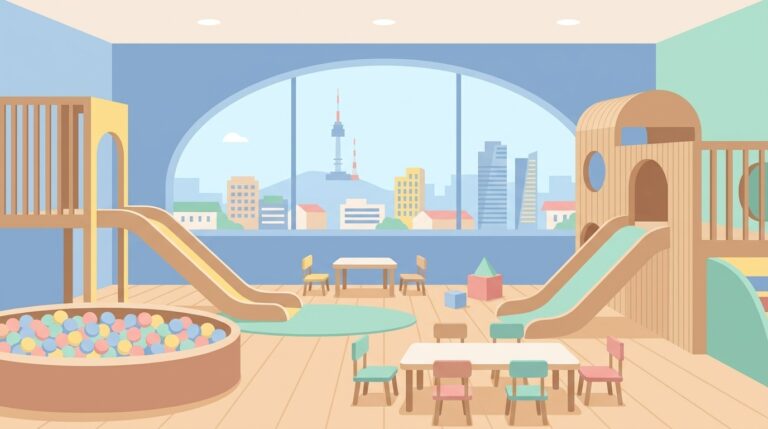
Imagine this: It is a rainy Saturday afternoon in Seoul, and your toddler is bouncing off the walls of your apartment with boundless energy. You decide it’s finally time to experience Korea’s world-famous Kids Cafe (키즈카페)—those aesthetic indoor wonderlands packed with ball pits, miniature grocery stores, trampolines, and barista-made iced Americanos for exhausted parents.
You step through the automatic glass doors of an immaculate kids cafe in Pangyo or Mapo. The scent of roasted coffee beans mingles with organic sanitizing spray. But the moment you cross the threshold, a wave of subtle anxiety hits you. Parents around you are sliding into sleek lockers, swapping their sneakers for specialized socks, registering on a touch tablet via KakaoTalk, and navigating silent playground etiquette with effortless poise. When your child races straight toward the giant slide, another child accidentally bumps into them. You want to apologize politely to the other Korean mother, ask the staff if outside baby snacks are permitted, and find out whether your entrance fee includes an espresso—yet your mind goes blank.
Korean parenting culture is warm, highly community-conscious, and governed by subtle layers of mutual consideration (nunchi). If you don’t know the local etiquette, a relaxing afternoon can quickly feel like an undercover exam. That’s why we’ve designed this B2-level cultural and conversational masterclass. Built upon real-life feedback from multicultural families and expat parents living in Korea, this guide guarantees you will navigate any Korean kids cafe with the confidence, grace, and linguistic finesse of a seasoned local parent.
Phase 2: Top 3 Core Expressions in Depth
1. 보호자도 양말 착용 필수인가요? (한글)
- Pronunciation: [Bohojado yangmal chagyong pilsu-ingayo?] (Sound analogy: Imagine saying “Bo-ho-ja-do” like ‘beau-ho-jaw-dough’, then ‘yang-mal’ like ‘yung-mull’, followed by ‘pil-soo-in-ga-yo’)
- Meaning: “Is wearing socks mandatory for guardians/parents too?” (Literal: Guardian-also sock wearing mandatory-is-it?)
- K-Culture Moment: Seen frequently in Korean parenting variety shows like The Return of Superman (슈퍼맨이 돌아왔다), where celebrity dads arrive at indoor playgrounds and frantically dig through their tote bags because staff won’t allow bare feet into the padded play zones.
- Editor’s Insight: In Korea, hygiene is paramount in shared children’s spaces. While children often wear non-slip grip socks (미끄럼 방지 양말), adults are strictly required to wear standard socks to maintain sanitary floor conditions. Asking this right at the reception counter immediately proves that you respect Korean communal hygiene norms.
- Situation Spectrum: Casual: ⚠️ | Semi-formal: ✅ | Formal: ✅
- 🤔 Think About It: In many Western indoor playgrounds, bare feet or outdoor shoes with shoe-covers are common. Why does Korean culture emphasize sock-wearing so heavily, even in heated indoor play areas?
2. 아이끼리 부딪혔는데, 다친 데는 없나요? (한글)
- Pronunciation: [Aikkiri budichyeonneunde, dachin deneun eomnayo?] (Sound analogy: ‘Eye-kki-ri boo-deet-chyeo-neun-deh, dah-cheen deh-neun um-nah-yo?’)
- Meaning: “The children bumped into each other; is your child hurt anywhere?” (Literal: Between children bumped, injured place none-is-there?)
- K-Culture Moment: A staple scene in modern family K-Dramas where two toddlers crash in a play area, and the parents quickly exchange polite bows and mutual check-ins to dissolve potential tension before either child starts crying.
- Editor’s Insight: Notice that this phrase doesn’t immediately assign blame. Instead of defensively saying “Your kid hit mine!” or overly submissive “I am sorry!”, 아이끼리 부딪혔는데 frames the incident as a neutral, mutual accident between toddlers. Following up with 다친 데는 없나요? showcases empathy and social grace.
- Situation Spectrum: Casual: ⚠️ | Semi-formal: ✅ | Formal: ✅
- 🤔 Think About It: How does phrasing an accident as a mutual event (아이끼리) reduce parental friction compared to saying “My child bumped your child”?
3. 기본 두 시간 이후 추가 요금은 어떻게 정산하나요? (한글)
- Pronunciation: [Gibon du sigan ihu chuga yogeumeun eotteoke jeongsanhanayo?] (Sound analogy: ‘Gee-bon doo she-gahn ee-hoo choo-gah yo-geum-eun uh-ttuh-keh jung-sahn-hah-nah-yo?’)
- Meaning: “How are additional charges settled after the basic two hours?” (Literal: Basic two hours after, extra fee how settle?)
- K-Culture Moment: Heard at trendy urban kids cafes where entry is tracked with digital wristbands, and families settle food, beverage, and overtime bills upon exit.
- Editor’s Insight: 정산하다 (to calculate/settle accounts) is a sophisticated B2-level business and transactional verb. Using 정산하나요? instead of the basic 내요? (pay?) makes you sound polished and fully accustomed to Korean service procedures.
- Situation Spectrum: Casual: 🚫 | Semi-formal: ✅ | Formal: ✅
- 🤔 Think About It: Why do Korean service businesses favor specific financial vocabulary like 정산 (settlement) over generic payment terms in administrative settings?
Phase 3: Textbook Korean vs. Real Korean
Situation 1: Encouraging children to take turns on a popular slide
- 📖 교과서 한국어 (Textbook): “다른 어린이에게 장난감을 양보하십시오.” (Dareun eorini-ege jangnanggameul yangbohasiipsio. / Please concede the toy to other children.)
- 🗣️ 진짜 한국어 (Real-life): “친구 먼저 타고 우리 차례 지켜볼까?” (Chingu meonjeo tago uri charye jikyeobolkka? / Let’s let our friend go first and wait for our turn, shall we?)
- 💡 왜 다를까? (Why the difference?): In Korean parenting culture, other unfamiliar children are affectionately referred to as 친구 (friend), regardless of age. Textbook commands sound like bureaucratic laws; real parents use soft, suggestive endings (~볼까?) that guide behavior through positive peer framing.
Situation 2: Asking the counter staff if food orders grant extra play time
- 📖 교과서 한국어 (Textbook): “식사를 주문하면 이용 시간이 연장됩니까?” (Siksareul jumunhamyeon iyong sigani yeonjangdoebnikka? / Does using time extend if a meal is ordered?)
- 🗣️ 진짜 한국어 (Real-life): “식사 메뉴 시키면 이용 시간 한 시간 추가되나요?” (Siksa menyu sikimyeon iyong sigan han sigan chugadoenayo? / If we order a meal item, do we get an extra hour added?)
- 💡 왜 다를까? (Why the difference?): Real conversation favors specific native phrasing (메뉴 시키면) and asks directly about the standard policy perk (한 시간 추가되나요?) common in Korean dining-kids-cafes, avoiding the stiff Sino-Korean syntax 연장됩니까.
Phase 4: K-Culture Deep Dive & Non-Verbal Manners
4-1. 눈치 (Nunchi) & Non-Verbal Gestures
- The Sock Protocol & Entry Transition: As soon as you enter, remove your shoes and place them into the numbered shoe locker (신발장). Do not step onto the cafe flooring with bare feet. Keep non-slip grip socks on your children at all times; cafe staff will actively monitor this to prevent trampoline injuries.
- The Supportive Eye Contact (방관 금지): While Korean kids cafes have dedicated safety staff (안전요원), Korean parenting community norms strictly frown upon 방관 (ignoring one’s child while buried in a smartphone). Maintain ambient peripheral awareness. When your child interacts with another, give the other parent a warm, acknowledging slight head nod (목례).
- Trash & Dish Sorting: Kids cafes operate like high-end cafes combined with preschools. Always bus your own trays to the 퇴식구 (return counter) and separate recyclables, food waste, and plastic straws accurately.
4-2. Cultural Code Analysis: The Kids Cafe as a Social Oasis
With the proliferation of “No Kids Zones” (노키즈존) in trendy Seoul cafes and restaurants to maintain quiet atmospheres, the Kids Cafe (키즈카페) has evolved into Korea’s ultimate safe haven for young families. It is not merely an indoor playground; it is a designed sanctuary of “joint parenting” (공동육아). Here, parents recharge with quality meals and Wi-Fi while knowing their children are in a child-proofed, sensorially enriching environment. Mastering the manners here means honoring the collective social contract of contemporary Korean urban parenting.
Phase 5: Real-Life Roleplay Scenario
Setting: A popular kids cafe in Bundang on a bustling Sunday morning.
Characters:
* 민지 (Min-ji): Experienced, welcoming Kids Cafe floor manager.
* 마크 (Mark): Expat dad visiting with his 4-year-old daughter, Chloe.
- 민지: 안녕하세요! 처음 방문하셨나요? 등록 도와드릴게요.
🎭 친절한 미소로 태블릿 화면을 터치하며
(Annyeonghaseyo! Cheoeum bangmunhasyeonnayo? Deungnok dowadeurilgeyo. / Hello! Is this your first visit? I’ll help you with registration.) -
마크: 네, 처음이에요. 보호자도 양말 착용 필수인가요?
🎭 본인 양말을 가리키며 조심스럽게 물어본다
(Ne, cheoeum-ieyo. Bohojado yangmal chagyong pilsu-ingayo? / Yes, it’s our first time. Is wearing socks mandatory for guardians too?) -
민지: 네, 맞습니다! 보호자분은 일반 양말, 아이는 미끄럼 방지 양말 착용하셔야 해요. 없으시면 카운터에서 구매 가능하세요.
🎭 안내판을 정중히 가리키며
(Ne, matseumnida! Bohojabuneun ilban yangmal, aineun mikkeureom bangji yangmal chagyonghasyeoya haeyo. Eopseusimyeon kaunteo-eseo gumae ganeunghaseyo. / Yes, that’s correct! Guardians need regular socks, and children must wear non-slip grip socks. If you don’t have them, you can purchase them at the counter.) -
마크: 다행히 챙겨왔어요. 기본 두 시간 이후 추가 요금은 어떻게 정산하나요?
🎭 가방에서 아기 양말을 꺼내 보여주며
(Dahaenghi chaenggyeowasseoyo. Gibon du sigan ihu chuga yogeumeun eotteoke jeongsanhanayo? / Luckily, I brought them. How are extra charges settled after the basic two hours?) -
민지: 10분당 천 원씩 자동 추가되고요, 나가실 때 이 팔찌로 한 번에 후불 결제하시면 됩니다.
🎭 바코드 팔찌를 건네며
(Sip-bundang cheon-wonssik jadong chugadoegoyo, nagasil ttae i palcchiro han beone hubul gyeoljehasimyeon doemnida. / 1,000 KRW is added automatically every 10 minutes, and you can settle the bill all at once with this wristband upon departure.) -
마크: 알겠습니다. 아, 혹시 외부 이유식이나 간식 반입도 가능한가요?
🎭 유아 간식 가방을 살짝 들며
(Algetseumnida. A, hoksi oebu iyusik-ina gansik banipdo ganeunghanayo? / Understood. Ah, by any chance, is outside baby food or snacks allowed?) -
민지: 영유아용 이유식은 휴게실 전자레인지 이용하시면 되고요, 일반 외부 음식은 반입이 어렵습니다.
🎭 카페테리아 방향을 가리키며
(Yeong-yua-yong iyusigeun hyugesil jeonjareinji iyonghasimyeon doegoyo, ilban oebu eumsigeun banibi eoryeopseumnida. / For infant baby food, you may use the microwave in the lounge, but general outside food is not permitted.) -
마크: 네, 규정 설명 감사합니다! 재미있게 놀다 갈게요.
🎭 목례를 하며 가볍게 미소 짓는다
(Ne, gyujeong seolmyeong gamsahamnida! Jaemi-itge nolda galgeyo. / Yes, thank you for explaining the rules! We’ll have a great time.)
🔀 Interactive Choice Point
While Chloe is jumping on the giant trampoline (트램펄린/방방이), she gets excited and bumps into another child, who falls onto the soft mat and looks startled.
- Option A: Call out across the room: “괜찮아! 그냥 일어나!” (Gwaenchana! Geunyang ireona! / It’s fine! Just get up!)
- Option B: Immediately walk over, check both kids gently, and say to the other parent: “아이끼리 부딪혔는데, 다친 데는 없나요? 죄송합니다.” (Aikkiri budichyeonneunde, dachin deneun eomnayo? Joesonghamnida.)
- Option C: Quickly pull your child away without making eye contact with anyone to avoid an awkward confrontation.
Detailed Feedback:
* Option A [Bad]: Shouting across the play zone disrupts the peaceful atmosphere and signals indifference toward the other family’s child.
* Option B [Best]: Perfect execution of Korean parental nunchi. You check physical safety first, acknowledge mutual impact neutrally, and offer a courteous apology. The other parent will likely smile and say, “아이들은 놀다 보면 그렇죠, 괜찮아요!” (Kids do that when playing, it’s totally fine!).
* Option C [Risk]: Running away creates unnecessary suspicion and makes you appear irresponsible in a close-knit community setting.
Phase 6: 10-Second Emotion Shadowing Drill
Practice reading these out loud, observing pauses (/) and matching the emotional tone indicators!
[😊 밝고 공손하게 - Bright & Courteous]
저기요, / 보호자 양말 / 여기서 바로 살 수 있나요?
(Jeogiyo, / bohoja yangmal / yeogiseo baro sal su innayo? / Excuse me, can I buy adult socks right here?)-
[😰 조심스럽고 배려심 넘치게 - Gentle & Empathetic]
아이쿠, / 아이끼리 부딪혔네요. / 혹시 다친 데는 / 없나요?
(Aiku, / aikkiri budichyeonneyo. / Hoksi dachin deneun / eomnayo? / Oh dear, the kids bumped into each other. Are they hurt anywhere?) -
[😌 차분하고 똑 부러지게 - Calm & Clear Transactional]
기본 시간 끝났는데, / 음료 주문하면 / 추가 시간 연장되나요?
(Gibon sigan kkeutnanneunde, / eumryo jumunhamyeon / chuga sigan yeonjangdoenayo? / Our basic time has ended; if we order drinks, is the stay extended?)
Phase 7: K-Culture Mini Dictionary
-
미끄럼 방지 양말 (Mikkeureom bangji yangmal)
- Translation: Grip socks / Non-slip socks for children.
- Nuance & Usage: Essential gear featuring rubber silicone grips on the soles. Almost 99% of modern Korean kids cafes enforce wearing these to prevent falls on slick slides and trampolines.
- 공동육아 (Gongdong-yuka)
- Translation: Community / Co-parenting.
- Nuance & Usage: A cultural buzzword describing mothers and fathers banding together to share child-rearing burdens. Kids cafes are the primary venue for 공동육아 meetups.
- 돌봄 서비스 (Dolbom seobiseu)
- Translation: Childcare / Drop-off supervision service.
- Nuance & Usage: High-end kids cafes (such as Champion 1250 or Caliclub) offer staff-led supervision for children aged 5+, allowing parents to shop or take a break alone in adjacent mall facilities.
- 후불 결제 (Hubul gyeolje)
- Translation: Post-pay settlement.
- Nuance & Usage: The default payment system in kids cafes. You receive a barcode wristband or locker key at entry, charge food, arcade games, and overtime to it, and pay the entire bill at check-out.
Phase 8: Traveler’s Survival Kit
Top 3 Survival Phrases
- “아기 의자 어디에 있나요?” (Agi uija eodie innayo? / Where are the high chairs?)
- Pro Tip: High chairs in Korea are usually stacked neatly near the cafeteria corner. Staff will gladly unlock one for you if asked.
- “기저귀 갈이대 어디 있어요?” (Gijeogwi garidae eodi isseoyo? / Where is the diaper changing station?)
- Pro Tip: Look for the door labeled 수유실 (nursing room), which typically contains a padded changing table, wet wipes, and an air purifier.
- “아이 음료는 어떤 게 제일 잘 나가요?” (Ai eumryoneun eotteon ge jeil jal nagayo? / Which kids’ drink is the most popular?)
- Pro Tip: Use 잘 나가요 (sells well) to discover what Korean kids currently love—usually fruit pouches like Pororo Juice (뽀로로 음료).
Editor’s Travel Note
- Essential Navigation: Use the Naver Map app download to search for nearby options by typing
키즈카페or대형 키즈카페(large-scale kids cafe). Korean parents rely heavily on Naver visitor reviews and blog entries (방문자 리뷰) to check cleanliness and age suitability. - Sock Preparedness: Always carry an extra pair of adult ankle socks and toddler grip socks in your day bag to avoid paying a 2,500–4,000 KRW markup at the reception desk.
- Smart Reservation: Some boutique or sensory kids cafes require time-slot booking via Naver Booking (네이버 예약) on weekends. Check before traveling across the city!
Phase 9: A Step Deeper (Cultural Reflection)
Korean kids cafes reflect the ingenuity of a densely populated, high-rise apartment society. In a country where noise complaints between apartment floors (층간소음) represent a significant social pressure, children rarely have the freedom to sprint and jump without restriction at home. Kids cafes are designed architectural solutions that liberate children while offering a peaceful respite for parents. When entering this space, mutual hyper-consideration is the unspoken currency: we grant our children energetic freedom, but we anchor it with collective vigilance.
💬 Your Turn: What does indoor play culture look like in your home country? Have you ever visited a Korean-style kids cafe, and what surprised you most about the etiquette? Share your thoughts in the comments below!
Phase 10: FAQ & Misconception Clarifications
Q: Can parents enter barefoot during hot summer months?
A: No. Even if you arrive wearing summer sandals or flip-flops, you must put on socks before stepping past the check-in gate. Most kids cafes sell plain adult socks at the front counter for around 2,000 to 3,000 KRW if you forget.
Q: Can I bring my child’s favorite snack or homemade lunchbox?
A: As a general rule, outside food and beverages (외부 음식) are prohibited because kids cafes operate their own kitchens and cafes. However, exceptions are universally made for baby formula, baby food puree (이유식), and infant water bottles.
Q: What happens if my child stays 10 minutes over the 2-hour limit?
A: You don’t need to panic. Time is measured digitally down to the minute via your barcode tag. Overtime is simply billed in 10-minute increments (usually 1,000–2,000 KRW per 10 mins) upon checkout.
🚨 Common Mistakes Warning Board
- Mistake: Letting your child wear regular slippery cotton socks on the wooden play structures.
Correct Action: Buy or bring certified non-slip grip socks (미끄럼 방지 양말). Staff will intervene if a child runs on trampolines with regular socks. - Mistake: Leaving dirty diapers in the general play area trash bins.
Correct Action: Dispose of all diapers exclusively in the designated diaper trash cans inside the 수유실 (nursing room), which are usually sealed sanitary bins (매직캔). - Mistake: Completely ignoring staff announcements because they are in Korean.
Correct Action: Listen for the chime followed by words like 기본 시간 (basic time) or 정리 시간 (cleanup time). If you hear your locker number called over the speaker, head to the front desk.
Phase 11: Action Missions
- 🥉 Bronze Level Mission: Stand in front of your mirror and practice asking for grip socks with natural intonation: “아이 미끄럼 방지 양말 하나 주세요.” (Ai mikkeureom bangji yangmal hana juseyo.)
- 🥈 Silver Level Mission: Look up a famous Korean kids cafe on Instagram or Naver (e.g., 바운스 트램폴린 파크, 챔피언 더 블랙벨트) and note three Korean facility keywords you recognize in the photos.
- 🥇 Gold Level Mission: Next time you are in Korea or at a Korean establishment, ask the staff whether an extra charge applies for overtime using “추가 요금은 어떻게 정산하나요?” with a gentle head nod.
- 🎮 K-Culture Mission: Watch an episode of KBS’s The Return of Superman (슈퍼맨이 돌아왔다) and spot at least two instances where parents use the word 친구 (friend) when addressing someone else’s toddler!
Phase 12: Interactive Quiz Challenge
1. Situational Judgment
Your child wants to ride the electric mini-train inside the kids cafe, but there is already a line of children waiting. What is the most culturally natural Korean phrase to say to your child?
* (A) “빨리 가서 앞에 서!” (Ppalli gaseo ape seo!)
* (B) “친구들 뒤에서 차례차례 줄 서볼까?” (Chingudeul dwieseo charyecharye jul seobolkka?)
* (C) “선생님한테 태워달라고 떼써봐.” (Seonsaengnimhante taewodallago ttesseobwa.)
🔍 Click to view Answer & Explanation
Correct Answer: (B)
Explanation: 차례차례 줄 서다 means “to line up in orderly turns.” Referring to waiting peers as 친구들 (friends) softens instructions and teaches community manners in a warm, encouraging manner.
2. Fill-in-the-Blank
Complete the sentence asked at the reception desk:
“보호자도 ( ) 착용 필수인가요?”
* Hint: Footwear worn inside shoes to keep clean!
🔍 Click to view Answer & Explanation
Correct Answer: 양말 (Yangmal – Socks)
Full Sentence: 보호자도 양말 착용 필수인가요? (Is wearing socks mandatory for guardians too?)
3. True or False Cultural Quiz
Statement: In Korean kids cafes, you must pay for your food, snacks, and extra hours upfront in cash each time you make an order.
* (True / False)
🔍 Click to view Answer & Explanation
Correct Answer: False
Explanation: Most modern Korean kids cafes utilize a wristband or locker key with an electronic barcode for post-billing (후불 정산). You settle everything together at the front counter when preparing to leave.







