

Phase 1: 공감 (Story-Immersive Opening)
안녕하세요! 매일한글 에디터입니다.
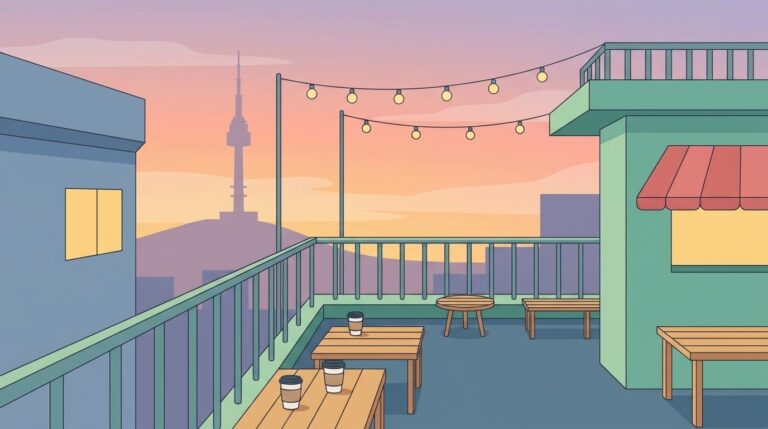
Imagine this: after a long afternoon wandering through the charming, steep alleys of Haebangchon (HBC) near Namsan, the sun begins to melt into a warm golden orange. You spot a hidden gem—a multi-story brick cafe with fairy lights twinkling on the top terrace. Your heart races with excitement: you want that dreamy K-drama rooftop shot overlooking the Seoul skyline with an iced coffee in hand.
But as you step past the entrance door on the first floor, a sudden wave of panic hits. The ordering counter is right in front of you, but the rooftop is three flights of stairs up. Do you order first? Can you just walk up to check if there are seats available? What if you order a fragile glass mug and they don’t allow it on the windy rooftop terrace? You freeze, fumble your phone, and end up mumbling words you learned in a robotic textbook app three years ago.
Don’t worry, you are not alone! Over the past five years running Daily Hangul, hundreds of students told us that rooftop cafes (루프탑 카페) were their ultimate Seoul dream—and their most intimidating real-life speaking challenge. Today, we’ll turn that anxiety into pure confidence. With just three intuitive, A2-level Korean phrases and insider cultural navigation tips, you will claim the best sunset view in Seoul effortlessly.
Phase 2: 핵심 표현 3선 심층 분석 (Top 3 Core Expressions)
1. 루프탑 자리 있어요? (Ruptap jari isseoyo?)
- Pronunciation: [rup-tap ja-ri i-sseo-yo] (Think: “Roop-top” like the English word, “ja-ri” sounds like jar-ree, and “i-sseo-yo” flows like ee-suh-yo)
- Meaning: Literal: “Is there a rooftop seat?” | Nuance: “Are there any open tables upstairs on the terrace right now?”
- K-Culture Moment: Just like Park Sae-royi looking out over the glittering Seoul skyline in Itaewon Class, this phrase is your golden ticket to unlocking Korea’s iconic hillside terrace culture.
- Editor’s Insight: Korean cafes often span several vertical floors. If you order before checking the roof, you might get stuck holding a tray with nowhere to sit! Staff appreciate it when you ask this right before ordering.
- Situation Spectrum: Casual (✅ 루프탑 자리 있어? with close friends) | Semi-formal (✅ 루프탑 자리 있어요? to cafe staff) | Formal (⚠️ 루프탑 자리가 있습니까? too stiff for modern cafes)
- 🤔 Think About It: In many Western cafes, people order first and find a table later. Why do Koreans prioritize securing a seat (자리 잡기) before paying?
2. 위층으로 가져가도 돼요? (Wicheung-euro gajyeogado dwaeyo?)
- Pronunciation: [wi-cheung-eu-ro ga-jyeo-ga-do dwae-yo] (Think: “wi” like wee, “cheung” like chung in chunky, “ga-jyeo-ga-do” like gah-jyor-gah-doh, “dwae-yo” like dweh-yo)
- Meaning: Literal: “May I take it upstairs?” | Nuance: “Is it okay to bring this drink and food up to the rooftop terrace?”
- K-Culture Moment: Seen in cozy romance K-dramas where the lead couple carefully carries a wooden tray loaded with iced Americanos and fresh croffles up a steep spiral staircase.
- Editor’s Insight: Korea enforces strict eco-regulations regarding disposable plastic cups inside cafes. However, for outdoor safety, many rooftops require paper cups or plastic lids instead of heavy glass. Asking this ensures the barista prepares your drink in the right container!
- Situation Spectrum: Casual (✅ 위층 가져가도 돼?) | Semi-formal (✅ 위층으로 가져가도 돼요?) | Formal (✅ 위층으로 가져가도 되겠습니까? polite hospitality Korean)
- 🤔 Think About It: How does your home country’s cafe system balance eco-friendly tableware with outdoor terrace safety?
3. 담요 어디에 있어요? (Dam-yo eodi-e isseoyo?)
- Pronunciation: [dam-yo eo-di-e i-sseo-yo] (Think: “dam” like the English dam, “yo” like yo-yo, “eo-di-e” like uh-dee-eh)
- Meaning: Literal: “Where is the blanket?” | Nuance: “Where can I grab a lap blanket for the chilly rooftop breeze?”
- K-Culture Moment: A quintessential K-drama romantic trope—handing your companion a soft fleece blanket while watching the city lights on a chilly spring evening.
- Editor’s Insight: Almost every stylish Korean rooftop cafe has a woven basket (담요 바구니) near the glass doors stocked with clean, folded fleece blankets. They are 100% free to use!
- Situation Spectrum: Casual (✅ 담요 어디 있어?) | Semi-formal (✅ 담요 어디에 있어요?) | Formal (✅ 담요는 어디에 비치되어 있습니까?)
- 🤔 Think About It: Free lap blankets are standard in Korean outdoor dining. What does this reveal about Korean ideas of attentive hospitality (배려, baeryeo)?
Phase 3: 교과서 한국어 vs 진짜 한국어 (Textbook vs. Real Korean)
Situation 1: Inquiring about outdoor rooftop seating
- 📖 교과서 한국어: 옥상에 빈 좌석이 존재합니까? (Oksang-e bin jwaseogi jonjaehamnikka? – Does an empty seat exist on the rooftop?)
- 🗣️ 진짜 한국어: 루프탑에 자리 있어요? (Ruptabe jari isseoyo? – Are there seats on the rooftop?)
- 💡 왜 다를까?: While oksang (옥상) literally means roof, it often sounds like an industrial building rooftop where clothes are hung to dry. Modern Koreans use the loanword 루프탑 (rooftop) for trendy cafes and casual 자리 (seat) instead of formal 좌석 (seat).
Situation 2: Asking for an iced coffee safely prepped for outdoor steps
- 📖 교과서 한국어: 차가운 아메리카노 한 잔을 외부에서 마시겠습니다. (Chagaun amerikano han janeul oebu-eseo masigesseumnida. – I shall consume one cold Americano coffee outdoors.)
- 🗣️ 진짜 한국어: 아아 한 잔 테이크아웃잔에 주실 수 있어요? (A-a han jan teikeu-aut-jane jusil su isseoyo? – Could I get one iced Americano in a takeout cup?)
- 💡 왜 다를까?: Textbook Korean builds stiff, overly complete sentences. Real Koreans use the beloved abbreviation 아아 (A-Ah = Iced Americano) and directly specify the cup type (테이크아웃잔) for safety when climbing outdoor stairs.
Phase 4: K-Culture 딥다이브 & 비언어적 매너 (Deep Dive & Non-verbal Manners)
4-1. 눈치 (Nunchi) & Essential Cafe Gestures
- The Two-Handed Tray Rule: Korean rooftop stairs—especially in historic areas like Ikseon-dong or HBC—can be dizzyingly narrow and steep. Always carry your tray with both hands, elbows slightly tucked in. Using your smartphone while climbing these stairs breaks cafe etiquette and invites dangerous spills!
- The Coat-on-the-Chair Trick (자리 찜하기): Wondering if it’s safe to claim a rooftop table before ordering? In South Korea, it is completely normal to walk upstairs first, leave a jacket, scarf, or even a notebook on a table, and then come downstairs to order. Your items won’t be stolen, and it signals to other patrons that the table is occupied.
- The Buzzer Watch (진동벨, Jindongbel): When you order, you will receive a buzzing pager. Don’t hike all the way up to the 4th floor terrace until you collect your drinks! Wait near the counter or pick-up zone on the 1st floor until it buzzes, then take your drinks up in one easy trip.
4-2. Culture Code: The “Insta Gamseong” & Sunset Rush
In Korea, rooftop cafes are not merely places to ingest caffeine; they are curated aesthetic experiences known as 인스타 감성 (Instagram vibe). Koreans plan their visits around 골든아워 (Golden Hour)—roughly 30 to 40 minutes before sunset. During this window, everyone shifts outdoors to capture soft, glowing portraits with Seoul’s mountain ridges in the background. Understanding this cultural rhythm helps you arrive 30 minutes early to snag front-row terrace seating before the crowd arrives!
Phase 5: 실전 롤플레이 시나리오 (Interactive Roleplay Scenario)
Setting: 6:15 PM on a crisp Friday afternoon. You arrive at Cafe Sanmaru, a trendy cafe nestled on the hills of Huam-dong. Min-woo, a warm barista with a linen apron, greets you from behind the espresso bar.
- Turn 1 (Min-woo): 어서 오세요! 주문 도와드릴까요? (Eoseo oseyo! Jumun dowadeurilkkayo?)
🎭 Smiling warmly while wiping the counter.
(“Welcome! May I help you with your order?”) -
Turn 2 (You): 안녕하세요! 저 혹시 루프탑 자리 있어요? (Annyeonghaseyo! Jeo hoksi ruptap jari isseoyo?)
🎭 Glancing politely toward the staircase.
(“Hello! By any chance, are there seats available on the rooftop?”) -
Turn 3 (Min-woo): 네! 방금 한 테이블 빠져서 뷰 좋은 창가 자리 있어요. (Ne! Banggeum han teibeul ppajyeoseo byu joeun changga jari isseoyo.)
🎭 Nodding and pointing toward the 3rd floor terrace stairs.
(“Yes! A table just opened up, so there’s a nice window/terrace seat with a great view.”) -
Turn 4 (You): 다행이네요! 아이스 아메리카노 두 잔 위층으로 가져가도 돼요? (Dahaeng-ineyoo! A-i-seu a-me-ri-ka-no du jan wicheung-euro gajyeogado dwaeyo?)
🎭 Tapping your card lightly on your wallet, speaking clearly.
(“What a relief! Can I take two iced Americanos upstairs?”) -
Turn 5 (Min-woo): 네, 가능해요! 위층은 바람 불어서 테이크아웃 컵에 담아드릴게요. (Ne, ganeunghaeyo! Wicheung-eun baram bureoseo teikeu-aut keobe dam-adeurilgeyo.)
🎭 Punching the register and prepping plastic dome lids.
(“Yes, you can! It’s breezy upstairs, so I’ll put them in takeout cups for you.”) -
Turn 6 (You): 감사합니다! 아, 그런데 위에 담요 어디에 있어요? (Gamsahamnida! A, geureonde wie dam-yo eodi-e isseoyo?)
🎭 Curious expression, rubbing hands together lightly.
(“Thank you! Oh, by the way, where are the blankets upstairs?”) -
Turn 7 (Min-woo): 3층 문 바로 옆 바구니에 준비되어 있어요. 편하게 쓰세요! (Sam-cheung mun baro yeop baguni-e junbidoeeo isseoyo. Pyeonhage sseuseyo!)
🎭 Hands you a vibrating bell pager with a friendly nod.
(“They’re prepared in a basket right next to the 3rd floor door. Please feel free to use them!”) -
Turn 8 (You): 친절하게 알려주셔서 감사합니다! 진동벨 울리면 올게요. (Chinjeolhage allyeojusyeoseo gamsahamnida! Jindongbel ullimyeon olgeyo.)
🎭 Receiving the pager with two hands.
(“Thank you for your kind help! I’ll come down when the buzzer rings.”)
🔀 Interactive Decision Point
After Min-woo says a table just opened up (Turn 3), what would you say next?
- Choice A: “위층으로 가져가도 돼요? 아이스 아메리카노 두 잔 주세요.” (Wicheung-euro gajyeogado dwaeyo? A-i-seu a-me-ri-ka-no du jan juseyo.)
👉 Feedback (Best!): Polite, proactive, and ensures your cups match terrace safety rules while locking in your drink order seamlessly. - Choice B: “루프탑 갈 거니까 밖에서 그냥 마실게요.” (Ruptap gal geonikka bakk-eseo geunyang masilgeyo.)
👉 Feedback (Bad): Grammatically awkward and sounds demanding. Cafe staff need to know specifically whether you want sit-in tableware or outdoor cups. - Choice C: (Run upstairs immediately without ordering or saying anything to check the seat yourself.)
👉 Feedback (Risk): While saving seats is common, walking straight past the counter without greeting the barista who is speaking to you feels abrupt. A quick “자리 먼저 보고 올게요!” (Jari meonjeo bogo olgeyo! – I’ll go check the seats first!) keeps you respectful!
Phase 6: 10초 감정 섀도잉 드릴 (10-Second Emotional Shadowing Drill)
Practice these lines out loud! Follow the pauses (/) and embody the exact emotional cue.
[😊 설레고 밝게 / Excited & Sunny]
저기요, / 루프탑에 / 자리 있어요?
(Jeogiyo, / ruptabe / jari isseoyo?)
“Excuse me, / on the rooftop / are there seats?”-
[☕ 조심스럽고 공손하게 / Careful & Inquiring]
이 음료 / 위층으로 / 가져가도 돼요?
(I eumryo / wicheung-euro / gajyeogado dwaeyo?)
“These drinks / upstairs / can I bring them up?” -
[🌬️ 쌀쌀함을 느끼며 다정하게 / Chilly & Grateful]
혹시 / 담요 / 어디에 있어요?
(Hoksi / dam-yo / eodi-e isseoyo?)
“By any chance, / blankets / where are they located?”
Phase 7: K-Culture 미니 사전 (Mini Dictionary)
-
루프탑 (Ruptap)
Meaning: Rooftop cafe / open terrace.
Usage: Used for trendy cafes with elevated scenic views. In conversation: “오늘 날씨 좋은데 루프탑 갈래?” (The weather is nice today, wanna go to a rooftop cafe?) -
뷰 맛집 (Byu Matjib)
Meaning: “View Gourmet Restaurant” — a venue famous primarily for its breathtaking visual scenery.
Usage: Koreans describe hillside cafes in Namsan or Gwangalli Beach as 뷰 맛집. In conversation: “여기 커피도 맛있고 완전 뷰 맛집이야!” (The coffee is good here and the view is absolutely stunning!) -
진동벨 (Jindongbel)
Meaning: Cafe buzzer pager / vibrating bell.
Usage: Handed out immediately after ordering at Korean counters. In conversation: “진동벨 울리면 커피 받아올게.” (I’ll pick up the coffee when the pager buzzes.) -
담요 (Dam-yo)
Meaning: Lap blanket / fleece throw.
Usage: Ubiquitous at Korean outdoor cafes and drafty restaurants. In conversation: “바람 부니까 담요 한 장 챙기자.” (It’s windy, let’s grab a blanket.)
Phase 8: 여행자를 위한 생존 키트 (Traveler’s Survival Kit)
Survival Expressions TOP 3
-
사진 좀 찍어 주실 수 있어요? (Sajin jom jjigeo jusil su isseoyo?)
Translation: Could you take a photo for me?
Pro Tip: Rooftop visitors love photos! Ask another customer holding a phone. In Korea, people will happily take 10+ photos from various flattering angles for you. -
몇 시에 마감해요? (Myeot sie magamhaeyo?)
Translation: What time do you close?
Pro Tip: Many rooftop terraces close 30 to 60 minutes earlier than indoor cafe floors due to neighborhood noise regulations. -
진동벨 울리면 오면 돼요? (Jindongbel ullimyeon omyeon dwaeyo?)
Translation: Should I come down when the buzzer rings?
Pro Tip: Ideal if you are unsure whether staff bring the tray upstairs or if it is 100% self-service.
Editor’s Travel Note
- Navigation Guide: Finding Seoul’s top rooftop hotspots (Huam-dong, Haebangchon, Changsin-dong) requires navigating hilly mazes. Google Maps frequently fails on steep Korean footpaths. Make sure to download the 네이버 지도 앱 다운로드 (Naver Map app) for pinpoint stair-by-stair walking navigation.
- Cashless Reality: Most hillside rooftop cafes are completely cashless (카드 전용 매장). Always carry a foreign travel credit card, debit card, or local transit-linked card (such as WOWPASS/Namane card).
Phase 9: “한 발 더 깊이” (Thoughtful Cultural Reflection)
In hyper-dense metropolises like Seoul, vertical space defines daily recreation. Because city apartments and offices can feel tight and uniform, the rooftop (루프탑) serves as an open-air sanctuary where young Koreans momentarily pause the hurried pace of everyday life (빨리빨리 문화). Sharing a sunset view from a wooden bench, wrapped under matching fleece blankets, turns an ordinary cup of coffee into an intentional, collective memory. When you visit a rooftop cafe, you are participating in a cherished modern Korean ritual of reclaiming skyline peace.
💬 Your Turn: Have you ever experienced a cafe rooftop in your home country? How does the atmosphere compare to Seoul’s vibrant terrace culture? Share your stories in the comments below!
Phase 10: FAQ & 흔한 실수 (FAQ & Common Mistakes)
Q: Can I bring my laptop to a rooftop cafe to work?
A: While you can, outdoor rooftops are usually designed for socializing, photo-taking, and relaxing. Strong sunlight makes screens difficult to read, power outlets outdoors are scarce, and sudden breezes can blow papers away. If you need to study or work, use indoor cafe seating on the 2nd floor, then take a study break on the roof!
Q: Do I have to clean up and bring my tray back down?
A: Yes! Almost all Korean rooftop cafes operate on a self-service basis. Do not leave your dirty mugs, straw wrappers, or used blankets on outdoor tables when leaving. Carry your tray safely downstairs to the return station (반납대, Bannap-dae) located on the main ordering floor.
Q: Is there an extra fee or minimum order for rooftop access?
A: Generally, there is no cover charge to sit on the roof. However, standard Korean cafe policy requires “1 person, 1 drink” (1인 1음료). Every adult in your party must order at least one beverage or designated menu item.
🚨 흔한 실수 (Common Mistakes) Warning Board
- Mistake: Carrying fragile glass mugs up windy, steep metal staircases.
Correct Action: Ask the barista at the counter: “위층으로 가져가도 돼요?” They will advise if takeout paper cups are safer. - Mistake: Taking a lap blanket home thinking it’s a gift or souvenir.
Correct Action: Cafe blankets belong to the cafe! Always fold your blanket neatly and return it to the basket (바구니) when you finish. - Mistake: Ordering downstairs and hiking up to the roof without waiting for the vibrating buzzer to ring.
Correct Action: Wait on the 1st or 2nd floor near the pickup counter. When your pager buzzes, collect your full tray, and make a single careful ascent.
Phase 11: 액션 미션 & 참여 유도 (Action Missions)
- 🥉 Bronze Mission (Solo Shadowing): Look in the mirror and practice saying: “루프탑 자리 있어요?” with a bright, welcoming smile 5 times until it rolls off your tongue without hesitation.
- 🥈 Silver Mission (Social Share): The next time you grab coffee outdoors, snap an aesthetic drink photo and post it to your Instagram story with the Korean hashtag:
#루프탑카페and tag@DailyHangul! - 🥇 Gold Mission (Real-life Execution): On your next trip to Korea (or at a local Korean bakery/cafe), ask the counter staff: “위층으로 가져가도 돼요?” or “담요 어디에 있어요?” entirely in Korean!
- 🎮 K-Culture Mission: Watch an episode of a Seoul-based drama (like Record of Youth or Run On). Spot an outdoor terrace scene and listen closely for the words 루프탑 (rooftop) or 옥상 (terrace)!
Phase 12: 인터랙티브 퀴즈 챌린지 (Interactive Quiz Challenge)
Test what you’ve learned today! Click each question to reveal the answers and explanations.
Quiz 1: Situation Judgement
You walk into a 4-story cafe in Seoul at 6:30 PM on a Saturday. What should you do first?
* (A) Order three hot lattes in ceramic mugs immediately.
* (B) Ask the barista “루프탑 자리 있어요?” or politely walk upstairs to confirm open tables.
* (C) Take a free blanket from the basket and leave the cafe.
👉 Click to see the Answer & Explanation
Answer: (B)
Explanation: Rooftop terrace seats fill up fast during sunset hours! Asking “루프탑 자리 있어요?” or briefly checking upstairs prevents you from being stranded holding hot drinks with nowhere to sit.
Quiz 2: Fill in the Blank
Complete the natural Korean sentence asking for a lap blanket on a chilly rooftop:
“날씨가 조금 쌀쌀한데, ________ 어디에 있어요?”
* (A) 진동벨 (jindongbel)
* (B) 담요 (dam-yo)
* (C) 테이크아웃잔 (teikeu-aut-jan)
👉 Click to see the Answer & Explanation
Answer: (B) 담요 (Dam-yo)
Explanation: “담요” means blanket! The sentence translates to: “The weather is a bit chilly, where are the blankets?”
Quiz 3: True or False (Culture Check)
Question: In Korea, it is considered rude to leave your jacket or tote bag on an empty rooftop table to save your seat while ordering downstairs.
👉 Click to see the Answer & Explanation
Answer: False!
Explanation: In South Korea, saving your seat (자리 잡기) with personal belongings like a jacket, bag, or umbrella before ordering is standard, accepted cafe etiquette.







