

Surviving Spring in Korea: How to Handle Pollen Allergies and Sneezing Like a Local
Phase 1: Empathy (Story-immersive opening)
안녕하세요! 매일한글 에디터입니다. Picture this: You are strolling under the dreamy pink canopy of cherry blossoms along the Yeouido Han River Park, holding an iced Americano just like a character in a classic romance K-drama. The soft spring breeze blows, petals swirl across the air—and then, your nose itches violently. ACHOO! You sneeze three times in a row. Your eyes water, and your nose runs like a faucet. Nearby picnickers look over with subtle curiosity. Is it a sudden cold? Nope, it is Korea’s notorious seasonal tag-team: yellow dust (황사) and microscopic pollen (꽃가루)!
As a Korean language tutor who has coached hundreds of international students through their first Seoul spring, I have seen this exact panic countless times. Getting struck by seasonal allergies in another country feels intimidating, especially when you are unsure how to explain your symptoms at a local pharmacy or worry about breaking public transit manners. This guide is crafted from real classroom feedback and native everyday encounters. By the end of this lesson, you will comfortably describe allergy symptoms, navigate Korean pharmacy counters with zero stress, and sneeze with impeccable nunchi!
Phase 2: Core Expressions (Top 3)
1. 꽃가루 알레르기가 있어요. (Kkotgaru allereugiga isseoyo.)
- Pronunciation: [Kkot-ga-ru al-le-reu-gi-ga it-sseo-yo] (Think: “Kkot” rhymes with “boat” with a sharp K sound, and “allereugi” sounds like “allergy” with a rolled ‘r’ and French-style ‘eu’ ending)
- Meaning: Literal: “Pollen allergy exists [for me].” / Nuance: “I have a pollen allergy.”
- K-Culture Moment: In Our Beloved Summer, when characters sit outside on grass during spring shoots and one starts sniffling, politely letting their date know it is just seasonal pollen, not an infectious flu.
- Editor’s Insight: In Korean, you do not use the verb “to have” (가지다 – gajida) for medical conditions. Instead, you state that the condition “exists” using the existence verb 있어요 (isseoyo).
- Situation Spectrum: Casual: ✅ (꽃가루 알레르기 있어) | Semi-formal: ✅ (꽃가루 알레르기가 있어요) | Formal: ✅ (꽃가루 알레르기가 있습니다)
- 🤔 Think About It: Notice how Korean states the condition as an objective presence (
[Condition] + 이/가 있어요) rather than personal ownership (“I have an allergy”). How does shifting ownership change the feeling of vulnerability when talking about health?2. 재채기가 멈추지 않아요. (Jaechaegiga meomchuji anayo.)
- Pronunciation: [Jae-chae-gi-ga meom-chu-ji a-na-yo] (Sounds like: “Jae-chey-ghee-gah mum-chu-jee ah-nah-yo”)
- Meaning: Literal: “Sneezing does not stop.” / Nuance: “I can’t stop sneezing.”
- K-Culture Moment: Commonly heard in variety shows like Running Man when cast members undergo penalty games outdoors in blooming flower fields and burst into uncontrollable sneezing fits.
- Editor’s Insight: 재채기 (jaechaegi) specifically means “sneeze”. Combining it with ~지 않아요 (~ji anayo – does not) emphasizes that the involuntary reaction is continuing against your will.
- Situation Spectrum: Casual: ✅ (재채기가 안 멈춰) | Semi-formal: ✅ (재채기가 멈추지 않아요) | Formal: ✅ (재채기가 멈추지 않습니다)
- 🤔 Think About It: English speakers usually say “I can’t stop sneezing,” focusing on the person’s inability to stop. Korean makes the sneeze itself the subject (
재채기가). Why do you think Korean often attributes physical symptoms to autonomous body reactions?3. 안 졸린 알레르기 약 있어요? (An jollin allereugi yak isseoyo?)
- Pronunciation: [An jol-lin al-le-reu-gi yak it-sseo-yo?] (Think: “Ahn jole-leen ahl-leh-roo-ghee yahk ee-soh-yoh?”)
- Meaning: Literal: “Is there a non-drowsy allergy medicine?” / Nuance: “Do you have non-drowsy allergy pills?”
- K-Culture Moment: Every busy Seoul office worker in April dashing into a station pharmacy before a big presentation to avoid falling asleep at their desk.
- Editor’s Insight: Traditional first-generation antihistamines cause severe drowsiness (졸음). In fast-paced Korean society, asking specifically for 안 졸린 약 (an jollin yak – medicine that doesn’t make you sleepy) is the golden key at every counter.
- Situation Spectrum: Casual: ⚠️ (안 졸린 약 있어? – Only to close friends) | Semi-formal: ✅ (안 졸린 알레르기 약 있어요?) | Formal: ✅ (졸리지 않는 알레르기 약이 있습니까?)
- 🤔 Think About It: Korea’s “Palli-Palli” (빨리빨리 – hurry, hurry) work-study culture demands staying alert. Notice how the function of the medicine (not causing sleepiness) is prioritized over complex pharmacological brand names.
Phase 3: Textbook Korean vs Real Korean
Situation 1: Describing a sudden allergy flare-up
- 📖 교과서 한국어 (Textbook): “저는 봄철 알레르기성 비염을 앓고 있습니다.” (Jeoneun bomcheol allereugiseong biyeomeul alko itseumnida. – I am suffering from springtime allergic rhinitis.)
- 🗣️ 진짜 한국어 (Real-Life Native): “저 요즘 비염 터졌어요!” (Jeo yojeum biyeom teojyeosseoyo! – My rhinitis completely blew up these days!)
- 💡 왜 다를까? (Why the difference?): While textbooks use stiff medical terminology like “앓다 (to suffer from disease)”, real Koreans use the dramatic colloquial verb 터지다 (to burst/explode) to describe chronic allergies flaring up violently with the sudden spring weather change.
Situation 2: Asking for daytime medicine at the pharmacy
- 📖 교과서 한국어 (Textbook): “수면 유도 성분이 없는 약을 주십시오.” (Sumyeon yudo seongbuni eomneun yageul jusipsio. – Please give me medicine without sleep-inducing ingredients.)
- 🗣️ 진짜 한국어 (Real-Life Native): “낮에 먹을 거라 안 졸린 약으로 주세요.” (Naje meogeul geora an jollin yageuro juseyo. – I need to take it during the day, so please give me non-drowsy ones.)
- 💡 왜 다를까? (Why the difference?): Koreans state their immediate life context (
낮에 먹을 거라– because I will take it in the daytime) rather than chemical ingredients, enabling the pharmacist to instantly select the right second- or third-generation antihistamine.
Phase 4: K-Culture Deep Dive & Non-verbal Manners
4-1. 눈치 (Nunchi) & Sneezing Etiquette in Public
In Western countries, sneezing aloud often invites a friendly chorus of “Bless you!” In Korea, however, there is no direct cultural equivalent to “Bless you.” In fact, making sudden, loud bodily noises on packed subways or quiet cafes is considered a minor disruption.
* The Inner-Elbow Reflex: Never cover your sneeze with your bare palms. Koreans strictly practice coughing or sneezing into their inner sleeve/elbow (옷소매).
* The Silent Apology (목례): If you sneeze loudly on Line 2 during morning rush hour, catch the eye of nearby commuters, offer a quick slight head bow (목례), and quietly say “죄송합니다” (Joesonghamnida – I am sorry). Wearing a KF94 mask during spring is universally respected and signals high civic consideration.
4-2. Culture Code: Yellow Dust & Pine Pollen (송홧가루)
Korean spring is magical, but nature brings two unexpected guests:
1. 황사 (Hwangsa – Yellow Dust): Fine desert sands carried by seasonal winds from the Gobi Desert.
2. 송홧가루 (Songhwagaru – Pine Pollen): Around late April and May, Korean pine trees release thick yellow-golden dust. You will notice parked cars covered in fine yellow powder overnight! Pharmacies (약국) display allergy eye drops and nasal sprays front-and-center during this window.
Phase 5: Real-Life Roleplay Scenario
Setting: A cozy neighborhood pharmacy near Yeouido Station during peak cherry blossom festival season.
Characters:
* You (민우 / Alex): An exchange student suffering from sudden watery eyes and sneezes.
* 약사님 (Pharmacist Min-ji): A warm, perceptive local pharmacist wearing a white coat and glasses.
- Turn 1 (Alex):
안녕하세요, 약사님. 저 꽃가루 때문에 재채기가 멈추지 않아요.
(Annyeonghaseyo, yaksanim. Jeo kkotgaru ttaemune jaechaegiga meomchuji anayo.)
“Hello, pharmacist. My sneezing won’t stop because of the pollen.”
🎭 Action cue: (Sniffling softly, pressing a clean tissue to the nose) -
Turn 2 (Pharmacist):
아이고, 눈물도 나시네요! 봄철이라 비염 환자가 진짜 많아요. 콧물도 나요?
(Aigo, nunmuldo nasineyo! Bomcheorira biyeom hwanjaga jinjja manayo. Konmuldo nayo?)
“Oh dear, your eyes are watering too! We have so many rhinitis patients this spring. Do you have a runny nose too?”
🎭 Action cue: (Glancing sympathetically at Alex's red nose and reaching toward the shelf) -
Turn 3 (Alex):
네, 콧물도 계속 흐르고 눈도 너무 가려워요.
(Ne, konmuldo gyesok heureugo nundo neomu garyeowoyo.)
“Yes, my nose keeps running and my eyes are so itchy.” -
Turn 4 (Pharmacist):
알레르기성 비염 증상이네요. 하루 한 번 먹는 알약 드릴까요?
(Allereugiseong biyeom jeungsang-ineyo. Haru han beon meongneun alyak deurilkkayo?)
“Those are allergic rhinitis symptoms. Shall I give you a once-a-day tablet?” -
Turn 5 (Alex):
네! 그런데 오늘 공부해야 해서, 혹시 안 졸린 약으로 주실 수 있나요?
(Ne! Geurende oneul gongbuhaeya haeseo, hoksi an jollin yageuro jusil su innayo?)
“Yes! But I have to study today, so could you give me non-drowsy medicine?”
🎭 Action cue: (Looking earnest while tapping study notebook in bag) -
Turn 6 (Pharmacist):
그럼요. 이 약은 2세대 항히스타민제라 덜 졸려요. 물이랑 같이 한 알만 드세요.
(Geureomyo. I yageun ise-dae hang-his-tamin-je-ra deol jollyeoyo. Murirang gachi han al-man deuseyo.)
“Of course. This is a second-generation antihistamine, so it causes much less drowsiness. Take just one pill with water.” -
Turn 7 (Alex):
감사합니다! 얼마예요?
(Gamsahamnida! Eolmayeyo?)
“Thank you! How much is it?”
🎭 Action cue: (Taking out credit card ready to tap) -
Turn 8 (Pharmacist):
3,000원입니다. 밖에 나가실 땐 마스크 꼭 쓰세요!
(Sam-cheon-won-imnida. Bakke nagasil ttaen maseukeu kkok sseuseyo!)
“That will be 3,000 won. Make sure to wear a mask when going outdoors!”
🔀 Interactive Branching Moment
After taking your pill, you are on the packed subway returning home. Your nose suddenly prickles fiercely. What do you do?
- Choice A: Sneeze directly into both palms and smile warmly at the person seated in front of you.
- Choice B: Turn your head toward your shoulder, sneeze firmly into your inner elbow sleeve, and offer a small nod of apology.
- Choice C: Hold your breath forcefully to completely stop the sneeze until your face turns bright red.
Feedback:
* Choice A [Bad]: Covering sneezes with bare hands spreads droplets to subway handrails. People will back away uncomfortably!
* Choice B [Best!]: Textbook Korean transit manners. Sneeze into your inner sleeve, do not make eye contact drama, and a gentle nod acknowledges shared public space.
* Choice C [Risk]: Suppressing sneezes violently can hurt your eardrums and nasal passages. Just sneeze safely into your inner sleeve!
Phase 6: 10-Second Emotion Shadowing Drill
Practice saying these lines with natural breathing, pauses (/), and authentic emotion!
- [🤧 Sniffling, congested, and slightly distressed]
저 요즘 / 꽃가루 때문에 / 비염 터졌어요…
(Jeo yojeum / kkotgaru ttaemune / biyeom teojyeosseoyo…)
“Lately… because of the pollen… my rhinitis completely flared up…” -
[🥺 Earnest, desperate for relief at the pharmacy counter]
재채기가 안 멈춰서요, / 제일 잘 듣는 / 안 졸린 약 주세요!
(Jaechaegiga an meomchwoseoyo, / jeil jal deunneun / an jollin yak juseyo!)
“My sneezing won’t stop, so / please give me the most effective / non-drowsy medicine!” -
[🙏 Courteous, slightly apologetic on the quiet train]
죄송합니다, / 감기는 아니고 / 꽃가루 알레르기예요.
(Joesonghamnida, / gamgineun anigo / kkotgaru allereugiyeyo.)
“I apologize, / it’s not a cold, / it’s just a pollen allergy.”
Phase 7: K-Culture Mini Dictionary
- 꽃가루 (Kkotgaru) | Pollen
Usage: Made of “꽃” (flower) and “가루” (powder). Essential in daily weather forecasts: “오늘 꽃가루 농도가 높습니다” (Pollen levels are high today). - 비염 (Biyeom) | Rhinitis / Sinus irritation
Usage: Nearly everyone in Seoul claims to have seasonal 비염 in spring or autumn. Mentioning “비염 환자예요” instantly gains sympathetic nods. - 약국 (Yakguk) | Pharmacy
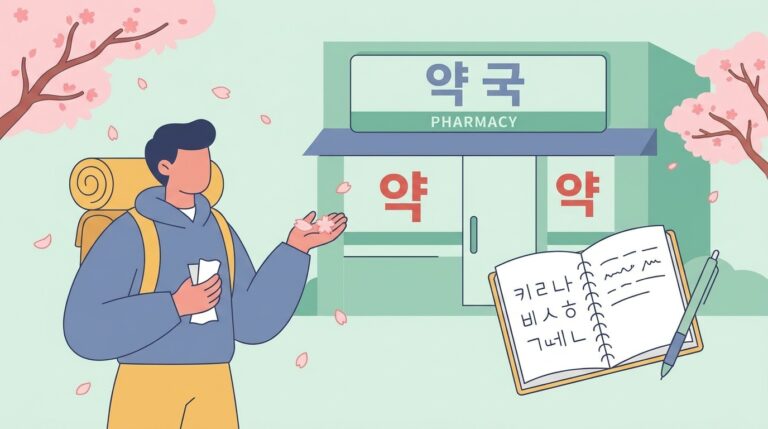
Usage: Marked with a bold red “약” sign on nearly every shopping street. In Korea, you buy effective antihistamines directly over the counter without a doctor’s prescription. - 송홧가루 (Songhwagaru) | Pine tree pollen
Usage: Culturally unique to Korea’s heavy pine forests. It creates a yellow dust blanket in May. Historically used in traditional Korean rice sweets (다식), but the arch-nemesis of spring allergy sufferers!
Phase 8: Survival Kit for Travelers
Top 3 Survival Phrases
- 1. 알레르기 약 있어요? (Allereugi yak isseoyo?)
Pro Tip: The single most important phrase. Walk into any store with a red 약 sign and say this. - 2. 마스크 하나 주세요. (Maseukeu hana juseyo.)
Pro Tip: Pharmacies and convenience stores sell KF94 and KF80 masks right at the checkout counter. - 3. 눈약도 같이 주세요. (Nunyakdo gachi juseyo.)
Pro Tip: “눈약” (eye medicine) is the casual native word for antihistamine eye drops (안약) to calm itching eyes fast.
Editor’s Travel Note
- Finding Open Pharmacies: Google Maps has limited walking accuracy in Korea. Use 네이버 지도 앱 다운로드 to search “약국” (pharmacy) or find late-night pharmacies (휴일지킴이약국).
- Payment & Cost: OTC allergy pills typically cost between 3,000 KRW to 5,000 KRW (~$2.50 to $4.00 USD) for a 10-capsule box. International credit cards (Visa, Mastercard) and T-money or mobile payment options are accepted everywhere.
Phase 9: “One Step Deeper” (Reflective Prompt)
In Western societies, sneezing is an individualized event that prompts verbal social bonding (“Bless you!” / “Thank you!”). In contrast, Korean public culture is deeply shaped by communal consideration and personal modesty. Bodily fluids and involuntary sounds are viewed as small intrusions upon public peace; therefore, the polite response is not drawing vocal attention to the sneeze, but rather minimizing its impact through masks, inner-elbow shields, and quiet discretion. It is a quiet language of mutual respect where silence is kindness.
💬 Your Turn: Does your home culture have a custom like saying “Bless you,” or do you prefer quiet discretion like in Korea? How would you feel if a stranger on the subway didn’t say anything after you sneezed? Share your thoughts in the comments below!
Phase 10: FAQ & Avoiding Misunderstandings (FAQ Schema)
Q: Do I need a doctor’s prescription to get allergy medicine in Korea?
A: No! For common seasonal allergies, you can walk directly into any pharmacy (약국) and ask the pharmacist for over-the-counter (일반의약품) antihistamines. They will hand you a box immediately for around 3,000 to 5,000 KRW.
Q: Why didn’t anyone say “Bless you” when I sneezed three times in my Korean office?
A: Please do not feel offended! Koreans do not have an equivalent phrase for “Bless you.” Saying something aloud might make the sneezer feel more self-conscious. Staying politely quiet is the standard Korean way of showing courtesy.
Q: What is the difference between KF94 and normal dental masks in spring?
A: KF stands for “Korean Filter.” While regular dental masks block saliva droplets, a KF94 mask filters out 94% of micro-particles (including yellow dust and microscopic pollen). When pollen counts peak, always buy a KF94 or KF80 mask.
🚨 Common Mistakes Warning Board
- Mistake 1: Saying “알레르기를 가졌어요” (Translating “I have an allergy” word-for-word).
Correct Action: Say 꽃가루 알레르기가 있어요 (Pollen allergy exists for me). Use있어요, not가졌어요. - Mistake 2: Blowing your nose loudly at a dinner table or quiet cafe.
Correct Action: Loud nose blowing (코 풀기) during meals is considered impolite. Excuse yourself to the restroom (화장실) to blow your nose with running water or tissues. - Mistake 3: Forgetting to mention daytime activities at the pharmacy.
Correct Action: First-generation Korean allergy pills will knock you out! Always explicitly ask for 안 졸린 약 (an jollin yak) if you plan to travel, study, or work.
Phase 11: Action Mission & Engagement
- 🥉 Bronze Mission (Solo Practice): Stand in front of your mirror and practice saying: “약사님, 안 졸린 알레르기 약 주세요!” with confident pronunciation three times.
- 🥈 Silver Mission (SNS Community): Take a photo of spring blossoms or your travel bag, post it on Instagram or Threads, and write the caption: “꽃가루 조심하세요! (Watch out for pollen!)”.
- 🥇 Gold Mission (Real-World Execution): Walk into a local Korean convenience store or pharmacy in Korea, purchase a mask or allergy eye drops, and say “감사합니다!” with a slight bow.
- 🎮 K-Culture Mission: Watch an outdoor spring episode of any Korean reality show (like 2 Days & 1 Night or I Live Alone). Spot whether anyone sneezes or wears a mask, and observe how their co-hosts react!
Phase 12: Interactive Quiz Challenge
1. Situation Judgement:
You are having lunch with Korean colleagues, and your nose suddenly runs uncontrollably due to spring pollen. What is the most culturally polite action?
(A) Blow your nose loudly right at the dining table with a paper napkin.
(B) Say “실례합니다” (Excuse me), step away to the restroom, and blow your nose quietly.
(C) Sneeze onto your napkin and ask someone to say “Bless you”.
👉 Click to reveal Answer & Explanation
Correct Answer: (B)
In Korea, blowing your nose loudly at a dining table is considered unhygienic and off-putting to fellow diners. Stepping into the restroom for a minute is the gold-standard etiquette!
2. Fill-in-the-Blank:
Complete the pharmacy request for non-drowsy pills:
“낮에 일해야 해서 (________) 알레르기 약으로 주세요.”
(A) 매운 (Maeun)
(B) 안 졸린 (An jollin)
(C) 비싼 (Bissan)
👉 Click to reveal Answer & Explanation
Correct Answer: (B) 안 졸린
“안 졸린” means “non-drowsy” (not sleepy). “낮에 일해야 해서 안 졸린 알레르기 약으로 주세요” means “I have to work during the day, so please give me non-drowsy allergy medicine.”
3. True or False Cultural Quiz:
True or False: When someone sneezes on the Seoul subway, you should immediately look at them and say an English “Bless you!” to make them feel comfortable.
👉 Click to reveal Answer & Explanation
Correct Answer: False
In Korea, drawing attention to another person’s public sneeze can cause unnecessary embarrassment. A polite, indifferent silence (nunchi) is the customary etiquette.







