

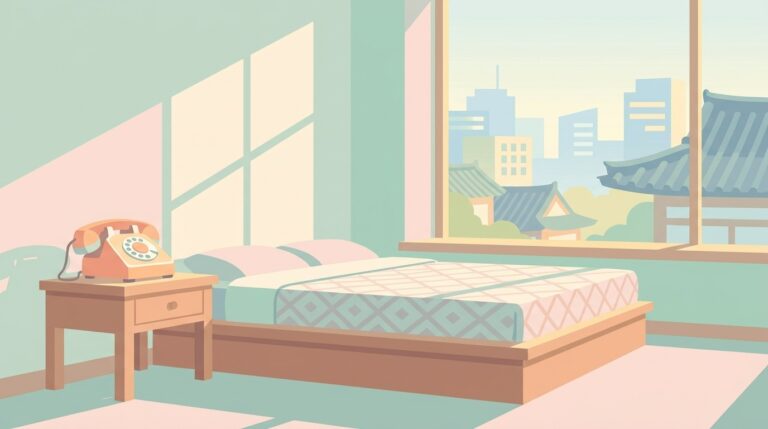
Master the Morning: How to Request a Hotel Wake-Up Call in Natural Korean
Phase 1: Empathy (Story-Immersive Opening)
안녕하세요! 매일한글 에디터입니다. (Hello! I’m your Daily Hangul editor.)
Picture this: You are nestled in a cozy boutique hotel overlooking the sparkling neon lights of Myeongdong. It is your first night in Seoul, and you have an action-packed day planned tomorrow. Perhaps you secured a coveted ticket for an early morning KTX train down to Busan, or maybe you are lining up at 7:00 AM for that viral salt bread bakery in Seongsu-dong. You set three alarms on your smartphone, but jet lag is relentless, your phone battery is draining fast, and that nagging voice in your head whispers: What if I oversleep?
You glance over at the vintage cream-colored landline telephone sitting on the nightstand. You know the front desk offers wake-up calls. In K-Dramas like King the Land, the concierge glides effortlessly through requests with polished warmth. Yet, picking up that receiver suddenly feels intimidating. Your heart races: What if they don’t speak English? Do I say “깨워주세요”? Does that sound rude or childish?
Over the past ten years of coaching foreign travelers and K-Culture fans, “hotel telephone anxiety” ranks among the top three real-world communication blocks. Speaking over the phone removes facial cues and hand gestures, making learners feel vulnerable. But here is the good news: Korean hotel communication follows a rhythmic, predictable, and incredibly polite formula. By mastering just a few authentic phrases tailored to the B1 level, you will effortlessly turn that stressful wake-up call into an empowering cultural win. Let’s make sure you never sleep through an exciting Seoul morning again!
Phase 2: Core Expressions Deep Dive
Here are three essential expressions you need when arranging your morning wake-up call at any accommodation in Korea.
1. 내일 아침 7시에 모닝콜 부탁드려요. (Naeil achim ilgop-sie moningkol butakdeuryeoyo.)
- Pronunciation: [Nae-il ah-chim il-gop-she-eh moh-ning-kohl boo-tahk-deu-ryeo-yo] (Think of ‘moningkol’ just like the English words “morning call” spoken with crisp, flat Korean vowels).
- Meaning: “Could you please set a wake-up call for 7:00 AM tomorrow?” (Literal: “Tomorrow morning at 7 o’clock, wake-up call request.”)
- K-Culture Moment: In luxury hotel K-Dramas, guests effortlessly dial ‘0’ from their suites and deliver this exact sentence to the concierge.
- Editor’s Insight: Koreans almost universally use the Konglish term 모닝콜 (moningkol) rather than pure Korean terms like “기상 전화” (wake-up phone call). Pairing it with 부탁드려요 (butakdeuryeoyo) hits the exact sweet spot of polite intermediate Korean—respectful without being stiff.
- Situation Spectrum: Casual 🚫 | Semi-formal ✅ | Formal ✅
- 🤔 Think About It: In English, we say “wake-up call,” focusing on the action of waking up. Why do you think Korean adopted “morning call” (focusing on the time of day and the medium)?
2. 혹시 10분 뒤에 한 번 더 울려주실 수 있나요? (Hoksi sip-bun dwie han beon deo ullyeojusil su innayo?)
- Pronunciation: [Hohk-shee sheep-boon dwee-eh hahn beon deoh ool-lyeo-joo-sheel soo een-nah-yoh?]
- Meaning: “By any chance, could you ring me one more time 10 minutes later?” (Snooze request nuance).
- K-Culture Moment: For travelers who are heavy sleepers after a late-night feast of Chimaek (fried chicken and beer) along the Han River.
- Editor’s Insight: Starting with 혹시 (hoksi – by any chance) acts as a linguistic cushion. Koreans value nunchi (tact) and indirectness when asking for extra service; this phrase softens your request so you don’t sound demanding.
- Situation Spectrum: Casual 🚫 | Semi-formal ✅ | Formal ⚠️
- 🤔 Think About It: How does your native language handle polite buffers compared to Korean’s versatile magic word “혹시”?
3. 모닝콜 신청한 것 취소할 수 있을까요? (Moningkol sincheonghan geot chwisohal su isseulkkayo?)
- Pronunciation: [Moh-ning-kohl sheen-cheong-hahn geot chwee-soh-hahl soo ees-seul-kkah-yoh?]
- Meaning: “Would it be possible to cancel the wake-up call I requested?”
- K-Culture Moment: You wake up naturally early, refreshed and ready, and want to spare the front desk staff the trouble of calling your room.
- Editor’s Insight: The ending ~ㄹ 수 있을까요? (~l su isseulkkayo?) is an indispensable B1 grammar pattern. It shifts an imperative command into a gentle hypothetical query, showcasing high emotional intelligence.
- Situation Spectrum: Casual 🚫 | Semi-formal ✅ | Formal ✅
- 🤔 Think About It: Notice how Korean uses nominalization (“신청한 것” – the thing I applied for) to refer to a previous action instead of stating “cancel my reservation.”
Phase 3: Textbook Korean vs. Real Korean
Let’s see how stiff textbook translations compare to how real Koreans speak at modern hotels.
Situation 1: Setting the wake-up time
- 📖 교과서 한국어 (Textbook): 내일 아침 6시에 저를 깨워 주십시오. (Naeil achim yeoseot-sie jeoreul kkaeweo jusipsio.) — “Please awaken me tomorrow morning at 6 o’clock.”
- 🗣️ 진짜 한국어 (Real-Life): 내일 6시에 모닝콜 부탁드릴게요. (Naeil yeoseot-sie moningkol butakdeurilgeyo.) — “I’d like to ask for a wake-up call at 6 tomorrow.”
- 💡 왜 다를까? (Why the difference?): Saying “저를 깨워 주십시오” sounds like an order from a military commander or a historical period drama. Real native speakers use the loanword “모닝콜” paired with the smooth, promising ending “~드릴게요.”
Situation 2: Asking if the service is provided
- 📖 교과서 한국어 (Textbook): 귀 호텔에서는 모닝콜 서비스를 제공합니까? (Gwi hotereseoneun moningkol seobiseureul jegonghamnikka?) — “Does your esteemed hotel provide wake-up call services?”
- 🗣️ 진짜 한국어 (Real-Life): 혹시 여기 모닝콜 서비스도 되나요? (Hoksi yeogi moningkol seobiseudo doenayo?) — “Excuse me, is wake-up call service available here too?”
- 💡 왜 다를까? (Why the difference?): Using “귀 호텔” (honorable hotel) is strictly reserved for written business contracts. In spoken Korean, “여기 ~ 되나요?” (Does ~ work here?) is the gold-standard phrase for checking amenities.
Phase 4: K-Culture Deep Dive & Non-Verbal Manners
4-1. 눈치 (Nunchi) & Phone Body Language
Even though the front desk clerk cannot see you through the telephone, Korean non-verbal etiquette still applies! If you observe native Koreans on the phone with client services, you will notice something fascinating: they nod and bow slightly while speaking.
* The Head Tilt & Two-Hand Rule: When you lift the receiver or press ‘0’ on the speakerphone, maintain an attentive posture. Dropping your head into a gentle 15-degree nod when saying “감사합니다” (Gamsahamnida) physically changes your vocal cords, making your voice sound warmer and more polite.
* Clear Number Articulation: Koreans use native Korean numbers for hours (한 시, 두 시, 일곱 시) and Sino-Korean numbers for minutes (십 분, 삼십 분). When stating your time over the phone, speak slowly and pause slightly between the hour and minute to prevent mishearing.
4-2. Cultural Code: The Rhythm of “Bbali-Bbali” and Precision Hospitality
Korea’s hospitality industry runs on hyper-efficiency. Front desk staff appreciate clarity because morning routines operate like clockwork. Whether guests are catching early flights at Incheon International Airport or joining an early morning hiking group up Bukhansan, hotel staff pride themselves on punctual service. A wake-up call in Korea is not treated as a casual automated chime; hotel staff will often personally call your room phone and greet you with polite honorifics.
Phase 5: Real-Life Roleplay Scenario
Setting: 10:30 PM. You are staying at a modern boutique hotel in Hongdae. You pick up the in-room telephone and press ‘0’ to connect with the front desk.
Characters: You (민아 / Min-a) & Front Desk Clerk (민우 / Min-woo, an immaculate and polite concierge).
- Turn 1 (Min-woo):
네, 프런트 데스크입니다. 무엇을 도와드릴까요?
(Ne, peureonteu deseuku-imnida. Mueoseul dowadeurilkkayo?)
“Yes, this is the front desk. How may I help you?”
🎭 Speaking clearly with professional warmth over the line. -
Turn 2 (You):
안녕하세요! 혹시 내일 아침 모닝콜 서비스 가능한가요?
(Annyeonghaseyo! Hoksi naeil achim moningkol seobiseu ganeunghangayo?)
“Hello! By any chance, is wake-up call service available tomorrow morning?”
🎭 Polite, steady voice, holding the receiver close. -
Turn 3 (Min-woo):
네, 고객님. 몇 시에 모닝콜 맞춰 드릴까요?
(Ne, gogaeknim. Myeot sie moningkol matchwo deurilkkayo?)
“Yes, valued guest. What time would you like us to set the wake-up call for?”
🎭 Rustling of pen on memo pad in the background. -
Turn 4 (You):
내일 아침 6시 30분에 부탁드려요.
(Naeil achim yeoseot-si samsip-bune butakdeuryeoyo.)
“Could you please set it for 6:30 tomorrow morning?”
🎭 Carefully pronouncing ‘yeoseot-si’ and ‘samsip-bun’. -
Turn 5 (Min-woo):
6시 30분 말씀이시죠? 객실 번호가 704호 맞으실까요?
(Yeoseot-si samsip-bun malsseum-isijyo? Gaeksil beonhoga chil-baek-sa-ho majeusilkkayo?)
“6:30, correct? And you are in room 704, right?”
🎭 Confirming details with an upward rising intonation. -
Turn 6 (You):
네, 맞아요. 혹시 제가 안 받으면 5분 뒤에 한 번 더 전화 주실 수 있나요?
(Ne, majayo. Hoksi jega an badeumyeon o-bun dwie han beon deo jeonhwa jusil su innayo?)
“Yes, that’s right. If I don’t answer, could you call me once more 5 minutes later?”
🎭 Asking apologetically with a polite smile in your tone. -
Turn 7 (Min-woo):
물론입니다. 6시 30분에 전화드리고, 안 받으시면 35분에 다시 연결해 드리겠습니다.
(Mullonimnida. Yeoseot-si samsip-bune jeonhwadeurigo, an badeusimyeon samsip-o-bune dasi yeongyeolhae deurigessumnida.)
“Of course. We will call you at 6:30, and if unanswered, reconnect at 6:35.”
🎭 Crisp, reassuring confirmation. -
Turn 8 (You):
정말 감사합니다. 좋은 밤 되세요!
(Jeongmal gamsahamnida. Joeun bam doeseyo!)
“Thank you so much. Have a good night!”
🎭 Subtly bowing your head as you hang up the receiver.
🔀 Interactive Choice Point
Imagine the front desk clerk asks: “모닝콜 시간에 바로 체크아웃 준비 도와드릴까요?” (Shall we prepare your check-out process at that time?) How do you respond?
- Option A: “아니요, 체크아웃은 11시까지 할게요. 모닝콜만 부탁드려요.” (No, I will check out by 11. Just the wake-up call, please.)
- Feedback (Best!): Crystal clear and polite. You establish your plan without creating confusion.
- Option B: “싫어요. 왜 물어봐요?” (I don’t like it. Why do you ask?)
- Feedback (Bad!): Highly confrontational and uses childish, inappropriate vocabulary with hotel staff.
- Option C: “네, 내일 나가요.” (Yes, leaving tomorrow.)
- Feedback (Risk!): Ambiguous. The clerk might assume you are checking out at 6:30 AM and prepare your bill immediately.
Phase 6: 10-Second Emotional Shadowing Drill
Read these lines aloud, paying attention to natural pauses (/) and emotional tone indicators.
[😊 공손하고 명확하게 / Polite & Clear]
저 / 내일 아침 7시에 / 모닝콜 부탁드려요.
(Jeo / naeil achim ilgop-sie / moningkol butakdeuryeoyo.)-
[🥺 조심스럽고 부탁하듯이 / Soft & Inquiring]
혹시 / 10분 뒤에 / 한 번 더 깨워주실 수 있나요?
(Hoksi / sip-bun dwie / han beon deo kkaewojusil su innayo?) -
[🙏 안도하며 밝은 목소리로 / Relieved & Cheerful]
네, 확인 감사합니다! / 편안한 밤 되세요.
(Ne, hwagin gamsahamnida! / Pyeon-an-han bam doeseyo.)
Phase 7: K-Culture Mini Dictionary
- 모닝콜 (Moningkol) | Noun | Konglish term for a hotel wake-up call. Widely used in Korean hospitality, travel blogs, and daily life.
- 프런트 (Peureonteu) | Noun | Short for “front desk.” In Korean hotels, dial ‘0’ or look for the button labeled “프런트” on your phone.
- 연타 알람 (Yeonta allam) | Noun (Slang) | Setting multiple alarms at short intervals (e.g., 6:50, 6:55, 7:00). Koreans often joke about their “연타 알람” habits on social media.
- 체크아웃 연장 (Chekeuaut yeonjang) | Noun Phrase | Late check-out. If your wake-up call reveals you are too exhausted to move, you can ask for this!
Phase 8: Traveler’s Survival Kit
Top 3 Emergency Phrases
- 전화벨 소리를 좀 더 크게 해 주실 수 있나요? (Jeonhwabel sorireul jom deo keuge hae jusil su innayo?)
- “Could you make the phone ring volume a bit louder?”
- Pro Tip: Useful if the room phone has a subtle or muted ringer.
- 방 번호는 502호예요. (Bang beonhoneun o-baek-i-hoyeyo.)
- “My room number is 502.”
- Pro Tip: Numbers for rooms use Sino-Korean digits followed by -호 (ho).
- 제 폰 알람이 고장 났어요. (Je pon allami gojang nasseoyo.)
- “My phone alarm is broken/malfunctioning.”
- Pro Tip: A handy excuse if you want to explain why you desperately need a front desk wake-up call.
Editor’s Travel Note
When traveling across South Korea, seamless scheduling is key. Ensure you have the 네이버 지도 앱 다운로드 ready on your phone to calculate the exact subway transit times before deciding on your morning call hour. Furthermore, if you are catching an early morning train, check your timetable beforehand using the 코레일톡 기차표 예매 사이트 so you don’t calculate your wake-up time based on guesswork!
Phase 9: A Step Deeper (Reflective Essay)
In Korean society, the boundary between personal autonomy and mutual care (jeong) is deeply woven into service interactions. When you ask a hotel concierge for a “모닝콜,” it is rarely treated as a cold automated transaction. In many boutique or traditional hotels, staff take personal responsibility for your morning itinerary, often feeling apologetic if a guest seems hurried. The language itself reflects this: by pairing 부탁드립니다 (I make this request with care) with humble honorifics, you invite the listener into a momentary partnership of hospitality.
💬 Your Turn: Have you ever experienced a funny or nerve-wracking wake-up call situation in a foreign country? Share your story in the comments below!
Phase 10: FAQ & Avoiding Misunderstandings
Q: Can I use “웨이크업 콜” (Wake-up call) instead of “모닝콜”?
A: While 5-star global chain hotel staff will understand “웨이크업 콜,” local boutique hotels, motels, and Hanok stays will recognize 모닝콜 (moningkol) much faster. Stick with 모닝콜 for natural communication.
Q: Do Korean hotels charge extra for wake-up call services?
A: No. Wake-up calls (모닝콜) are considered a standard complimentary amenity in virtually all Korean accommodations, from business hotels to luxury resorts.
Q: How do I tell the clerk to wake me up in the afternoon instead of morning?
A: Swap “아침” (morning) with “오후” (afternoon). For example: 오늘 오후 3시에 모닝콜 부탁드려요. (Yes, Koreans still use the word “모닝콜” even for afternoon nap calls!)
🚨 Common Mistakes Warning Board
- Saying “깨워라” (Kkaewora): This is blunt informal language (반말) that will shock the front desk clerk. Correct Action: Always use 깨워주세요 (kkaewojuseyo) or 모닝콜 부탁드려요 (moningkol butakdeuryeoyo).
- Confusing Native and Sino-Korean numbers: Saying “칠 시” instead of “일곱 시” (7 o’clock). Correct Action: Hours always take native numbers (한 시, 두 시, 세 시… 일곱 시).
- Hanging up immediately without acknowledging: In Korea, closing greetings like “감사합니다” (Thank you) or “수고하세요” (Keep up the good work) are expected before ending a phone call.
Phase 11: Action Mission & Engagement
- 🥉 Bronze Mission: Stand in front of a mirror, pick up an imaginary telephone, and say: “내일 아침 7시에 모닝콜 부탁드려요” smoothly in one breath.
- 🥈 Silver Mission: Post an Instagram story or leave a comment below telling us what time you would set your morning call for your dream Seoul itinerary.
- 🥇 Gold Mission: On your next trip to Korea, do not use your smartphone alarm for one single morning—rely entirely on the front desk wake-up call using our script!
- 🎮 K-Culture Mission: Watch an episode of a hotel-themed drama like King the Land or Hotel Del Luna and spot how the staff answer the telephone with “무엇을 도와드릴까요?”.
Phase 12: Interactive Quiz Challenge
1. Situational Judgment: You want to ask the front desk to ring you again if you don’t wake up after the first call. What is the most natural B1 expression?
* A) 더 전화해. (Deo jeonhwahae.)
* B) 혹시 안 받으면 한 번 더 울려주실 수 있나요? (Hoksi an badeumyeon han beon deo ullyeojusil su innayo?)
* C) 전화벨을 계속 치세요. (Jeonhwabeleul gyesok chiseyo.)
2. Fill-in-the-Blank: Complete the polite sentence to request a 6:00 AM call:
“내일 아침 6시에 _________ 부탁드려요.”
3. True or False: In Korea, saying “모닝콜” for an afternoon nap wake-up call is completely unacceptable.
👉 Click here to reveal Answers & Explanations!
- Answer: B — Feedback: Option B uses polite cushioning (혹시), conditional grammar (~면), and respectful requests (~주실 수 있나요?). Option A is impolite banmal, and Option C is an unnatural direct translation.
- Answer: 모닝콜 — Feedback: The Konglish term “모닝콜” is the gold standard for wake-up calls in everyday Korean.
- Answer: False — Feedback: Surprisingly, Koreans frequently use “모닝콜” to mean any planned wake-up telephone call, even if requested in the afternoon!







