

Phase 1: Empathy (Story-Driven Opening)
안녕하세요! 매일한글 에디터입니다. (Hello! This is your Daily Hangul editor.)
Picture this: You just woke up in a chic boutique hotel in Hongdae, Seoul. Sunlight streams through the blinds, and outside, the bustling city is starting to wake up. Your stomach gives an unmistakable rumble. You suddenly remember booking a room that includes the famous hotel morning spread—steaming miyeok-guk (seaweed soup), savory side dishes, fluffy scrambled eggs, and freshly baked pastries.
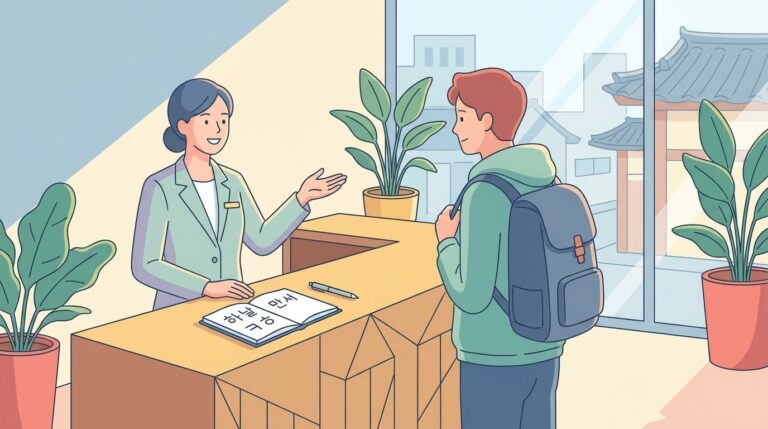
You glance at the clock: 8:45 AM. Panic hits! Does breakfast wrap up at 9:30? Or maybe 10:00? You rush to the elevator and head to the lobby. The concierge is smiling politely at you, but your mind freezes. How do you ask when breakfast ends without scrambling for a translation app or feeling awkward?
Don’t worry, you are not alone! In our Daily Hangul tutoring community, asking about hotel amenities—especially breakfast times—is among the top 3 anxiety-inducing hurdles for travelers. Today, we will equip you with warm, natural A2-level phrases so you will never miss a hot morning meal in Korea again. Let’s dive right in!
Phase 2: Core Expressions Deep Dive
1. 조식 몇 시까지예요? (Josik myeot sikkajiyeyo?)
- Pronunciation: [Jo-sik myeot shi-kka-ji-ye-yo?] (Think: “Joe-seek” + “myut” + “she-caw-jee-ye-yo”)
- Meaning: Literal: “Breakfast until what hour is it?” | Actual: “Until what time is breakfast served?”
- K-Culture Moment: In workplace and luxury romance K-Dramas like King the Land, you often see guests walking up to pristine marble front desks asking this exact question before their morning schedules start.
- Editor’s Insight: While textbooks teach you “몇 시부터 몇 시까지예요?” (From what time to what time?), locals cut straight to the chase with 몇 시까지예요? (Until what time?). Finding out the cutoff time is what truly saves your meal!
- Situation Spectrum: Casual: 🚫 | Semi-formal: ✅ | Formal: ✅
- 🤔 Think About It: In English, we often ask “When is breakfast?” In Korean, pinpointing the endpoint (~까지, until) reflects a culture focused on precise planning and punctuality.
2. 조식 식당이 어디예요? (Josik sikdangi eodiyeyo?)
- Pronunciation: [Jo-sik shik-dang-i eo-di-ye-yo?] (Think: “Joe-seek sleek-dong-ee uh-dee-ye-yo”)
- Meaning: Literal: “Breakfast dining room where is it?” | Actual: “Where is the breakfast restaurant located?”
- K-Culture Moment: Modern Korean hotels often have dining halls hidden on the 2nd floor, the basement lounge, or even the top-floor sky lounge, leaving hotel guests looking puzzled near the elevators.
- Editor’s Insight: Adding the noun 식당 (restaurant/dining hall) makes your question crystal clear. The hotel staff will immediately give you floor directions (e.g., “2층입니다” – It is on the 2nd floor).
- Situation Spectrum: Casual: 🚫 | Semi-formal: ✅ | Formal: ✅
- 🤔 Think About It: Notice how Korean drops prepositions like “at” or “in” here. You simply attach the subject marker ~이 to the location and finish with 어디예요? (Where is it?).
3. 방 번호만 말하면 돼요? (Bang beonhoman malhamyeon dwaeyo?)
- Pronunciation: [Bang beon-ho-man mal-ha-myeon dwae-yo?] (Think: “Bahng bun-ho-mahn mahl-hah-myun dway-yo?”)
- Meaning: Literal: “Room number only if I speak, is it okay?” | Actual: “Is it enough to just give my room number?”
- K-Culture Moment: In Korea’s digital-first hospitality scene, paper breakfast coupons have almost vanished; hotel staff verify guest entries digitally via a tablet.
- Editor’s Insight: The grammatical pattern -만 ~하면 돼요? (Is it okay to just do…?) is an A2 superpower. It saves you from rummaging through your pockets for vouchers that do not exist!
- Situation Spectrum: Casual: 🚫 | Semi-formal: ✅ | Formal: ⚠️ (Use -말씀드리면 될까요 for very high luxury hotels)
- 🤔 Think About It: Korean services value streamlined speed (ppalli-ppalli). Asking if a simple step suffices shows you respect smooth operational flow.
Phase 3: Textbook Korean vs Real Korean
- Situation 1: Asking about operating hours
- 📖 교과서 한국어: 조식 이용 시간을 알려주시겠습니까? (Josik 이용 siganeul allyeojusigessseumnikka? / Would you please inform me of the breakfast service hours?)
- 🗣️ 진짜 한국어: 조식 몇 시부터예요? (Josik myeot sibuteoyeyo? / What time does breakfast start?)
- 💡 왜 다를까?: While textbook sentences use extremely formal grammatical forms like -시겠습니까, actual hotel guests in Korea speak politely yet concisely using the standard polite -요 form.
- Situation 2: Checking if breakfast is included in your booking
- 📖 교과서 한국어: 제 숙박 요금에 조식이 포함되어 있습니까? (Je sukbak yogeume josigi pohamdoeeo itseumnikka? / Is breakfast included in my accommodation fee?)
- 🗣️ 진짜 한국어**: 조식 포함되어 있어요? (Josik pohamdoeeo isseoyo? / Is breakfast included?)
- 💡 왜 다를까?: In real spoken Korean, redundant words like 숙박 요금 (accommodation fee) are dropped when context already makes the meaning obvious.
Phase 4: K-Culture Deep Dive & Non-verbal Manners
4-1. 눈치 (Nunchi) & Gestures at the Concierge Desk
When walking up to a front desk in Korea, non-verbal etiquette speaks before you do:
* Two-Handed Presentation: If the staff asks for your room keycard to check your details, always hand it over with both hands, or support your right wrist with your left hand. It conveys genuine respect.
* The 15-Degree Nod: When approaching, offer a slight, gentle head bow. It instantly warms up the interaction.
* Reading the Room (Nunchi): If the front desk clerk is on a phone call or typing furiously on their reservation terminal, pause half a step back and wait for eye contact before speaking.
4-2. Culture Code: The Korean Hotel Breakfast Craze (호스피탈리티 & 조식 뷔페)
In Korean travel culture, a hotel’s quality is often judged by its 호텔 조식 (hotel breakfast). Unlike quick grab-and-go Western continental breakfasts, Korean hotels take immense pride in their buffet lines. Alongside bakery items, you will almost always find fresh white rice, comforting soups, artisan kimchi, and seasoned side dishes. Missing breakfast is seen by domestic travelers as missing out on half the hotel experience!
Phase 5: Real-Life Roleplay Scenario
Setting: 8:30 AM at the front lobby of a modern hotel in Myeongdong.
Characters: Alex (A traveler preparing for a day trip) & Min-ji (The smiling front desk agent).
- Alex: 저기요, 조식 시간 좀 물어봐도 될까요? (Jeogiyo, josik sigan jom mureobwado doelkkayo? / Excuse me, could I ask about the breakfast hours?)
🎭 [Approaching the counter with a warm smile, holding the room card] - Min-ji: 네, 고객님! 조식은 2층 레스토랑에서 드실 수 있습니다. (Ne, gogaeknim! Josigeun icheung reseutorang-eseo deusi su itseumnida. / Yes, guest! You can have breakfast at the 2nd-floor restaurant.)
🎭 [Bowing gently with hands clasped together] - Alex: 몇 시부터 몇 시까지예요? (Myeot sibuteo myeot sikkajiyeyo? / From what time to what time is it?)
🎭 [Leaning in slightly with an inquisitive tilt of the head] - Min-ji: 아침 7시부터 10시까지예요. 마지막 입장은 9시 30분입니다. (Achim ilgopsibuteo yeolsikkajiyeyo. Majimak ipjangeun ahopsi samsibun-imnida. / It runs from 7:00 AM to 10:00 AM. Last entry is at 9:30 AM.)
🎭 [Gently pointing to the printed information card on the counter] - Alex: 아, 9시 30분 전에는 가야겠네요! 쿠폰이 따로 있나요? (A, ahopsi samsibun jeon-eneun gayagessneyo! Kuponei ttaro innayo? / Ah, I should get there before 9:30! Is there a separate voucher?)
🎭 [Checking pockets to see if a ticket was handed over during check-in] - Min-ji: 아닙니다. 레스토랑 입구에서 방 번호만 말씀하시면 됩니다. (Animnida. Reseutorang ipgueoseo bang beonhoman malsseumhasimyeon doemnida. / No need. You can simply give your room number at the restaurant entrance.)
🎭 [Smiling reassuringly with open palms] - Alex: 다행이네요! 감사합니다. 좋은 하루 보내세요! (Dahaeng-ineyoyo! Gamsahamnida. Joeun haru bonaeseyo! / What a relief! Thank you. Have a great day!)
🎭 [Offering a bright nod and turning toward the lift] - Min-ji: 감사합니다, 고객님. 맛있는 식사 되세요! (Gamsahamnida, gogaeknim. Masinneun siksa doeseyo! / Thank you, guest. Enjoy your delicious meal!)
🎭 [Bowing politely in send-off]
🔀 Interactive Decision Point: Choose Your Response!
If you arrived at the lobby at 9:35 AM and wondered if you could still get in, what would you say?
* Option A: 지금 들어가도 돼요? (Jigeum deureogado dwaeyo? / Can I enter now?)
👉 [Best Choice]: Direct, polite, and natural. The staff will immediately check with the kitchen if entry is still possible.
* Option B: 밥 언제 줘요? (Bap eonje jwoyo? / When do you give rice/food?)
👉 [Risk/Awkward]: Grammatically understandable, but sounds like a toddler demanding food at home. Avoid using 밥 줘요 at hotels!
* Option C: 아침 먹고 싶어요. (Achim meokgo sipeoyo. / I want to eat morning food.)
👉 [Bad/Vague]: Expresses your personal desire, but does not ask a clear operational question.
Phase 6: 10-Second Emotion Shadowing Drill
Read these out loud, matching the emotion tags and following the pause slashes (/):
[😊 Polite & Inquiring]
저기요, / 조식 몇 시까지예요?
(Jeogiyo, / josik myeot sikkajiyeyo? / Excuse me, / until what time is breakfast?)-
[🧐 Double-Checking]
9시 30분까지 / 가면 돼요?
(Ahopsi samsibunkkaji / gamyeon dwaeyo? / Do I just need to arrive / by 9:30?) -
[😄 Relieved & Confident]
방 번호만 / 말하면 되죠?
(Bang beonhoman / malhamyeon doejo? / I just give my room number, / right?)
Phase 7: K-Culture Mini Dictionary
- 조식 (Josik): Breakfast. Specifically used in hotel, accommodation, or travel packages (unlike informal daily “아침”).
- 마지막 입장 (Majimak Ipjang): Last admission. In buffet setups, this denotes the time after which new guests are no longer seated.
- 뷔페 (Bwip-pe): Buffet. Korean pronunciation adapts the French loanword cleanly into two syllables.
- 룸서비스 (Rum-seobiseu): Room service. A handy backup when you miss the morning restaurant hours entirely.
Phase 8: Traveler’s Survival Kit
-
Survival Expressions TOP 3:
- 조식 식당 몇 층이에요? (Josik sikdang myeot cheung-ieyo? / What floor is the breakfast restaurant on?)
- Pro Tip: Listen for numbers followed by 층 (e.g., 일층 = 1st floor, 이층 = 2nd floor, 지하 일층 = B1).
- 방 번호는 502호예요. (Bang beonhoneun obaeg-i-hoyeyo. / My room number is 502.)
- Pro Tip: Room numbers are read digit-by-digit: 오-공-이-호 (O-gong-i-ho).
- 커피 테이크아웃 돼요? (Keopi teikeuaut dwaeyo? / Can I take coffee to-go?)
- Pro Tip: Many Korean hotel buffets provide paper cups at the exit so you can take an Americano back up to your room.
- Editor’s Travel Note:
If you ever end up sleeping in and miss the breakfast window completely, do not despair! Fire up your phone and use the 네이버 지도 앱 다운로드 to search for 브런치 (brunch) or 해장국 (comfort soup spots) within walking distance of your hotel.
Phase 9: 한 발 더 깊이 (A Deeper Look)
In Korean culture, food is far more than physical sustenance—it is an emblem of caring for another person’s well-being. This is why Koreans habitually greet one another with 밥 먹었어요? (Have you eaten?). In Korean hotels, staff rarely treat breakfast as a transactional service; they treat it as an essential expression of hospitality. When the concierge ends a conversation with “맛있는 식사 되세요” (Have a delicious meal), it is a heartfelt blessing for your day’s journey.
💬 Your Turn: What is your absolute favorite item to look for at a hotel breakfast buffet? Have you ever tried Korean breakfast dishes like miyeok-guk or juk (rice porridge)? Let us know in the comments below!
Phase 10: FAQ & Common Mistakes
Q: Can I wear the hotel bathrobes and indoor slippers down to the breakfast restaurant?
A: In almost all Korean hotels, wearing indoor bedroom slippers and bathrobes outside your guest room is strictly considered a cultural faux pas. Please dress in neat, casual daytime clothes before heading down to eat!
Q: What is the main difference between ‘조식’ (Josik) and ‘아침’ (Achim)?
A: While 아침 (or 아침 식사) refers to breakfast in daily home conversation, 조식 is the formal Sino-Korean term used across hotels, airlines, and business contexts.
Q: How do I tell the host my room number if it has numbers like 1408?
A: You can read it as individual Sino-Korean digits: 일-사-공-팔-호 (Il-sa-gong-pal-ho). This digit-by-digit method is standard and avoids any misunderstanding.
🚨 Common Mistakes TOP 3
- Arriving right at closing time: Showing up at 10:00 AM when the buffet closes at 10:00 AM means food stations will already be cleared.
Correct Action: Always plan your arrival before the 마지막 입장 (last admission) time. - Asking for take-out boxes at buffet lines: Walking around filling personal boxes at a hotel buffet is strictly forbidden for food safety regulations.
Correct Action: Enjoy your meal at the table; only take-away coffee is typically permitted at the exit. - Using informal speech (Banmal) with front desk clerks: Dropping the polite -요 or -습니다 ending creates an uncomfortable tone.
Correct Action: Always maintain the polite ending with phrases like 조식 몇 시까지예요?
Phase 11: Action Missions
- 🥉 Bronze Mission (Solo Practice): Stand in front of your mirror and say “저기요, 조식 몇 시까지예요?” three times with a confident, pleasant nod.
- 🥈 Silver Mission (Social Share): Share this guide to your travel itinerary or study story and tag your travel buddy with the phrase “방 번호만 말하면 돼요!”
- 🥇 Gold Mission (Real-World Challenge): On your upcoming trip to Korea, speak this phrase directly to the front desk agent without switching to English first!
- 🎮 K-Culture Mission: Next time you watch a modern K-Drama, listen closely for the word 조식 whenever characters stay at a resort or hotel.
Phase 12: Interactive Quiz Challenge
1. Situation Question: You want to ask the front desk until what time breakfast is available. Which sentence is the most natural?
* A) 조식 밥 언제 줘요?
* B) 조식 몇 시까지예요?
* C) 아침 식사 먹을 수 있을까요 없을까요?
2. Fill in the Blank: Complete the sentence meaning “Where is the breakfast restaurant?”
* 조식 식당이 ________? (Where is it?)
3. True or False: In Korean hotels, it is completely acceptable to wear provided white bathrobes to the breakfast buffet.
* [True / False]
👉 Click here to reveal the answers and explanations!
-
Answer: B) 조식 몇 시까지예요?
Explanation: It is polite, concise, and clearly asks for the end time of the meal service. -
Answer: 어디예요? (Eodiyeyo?)
Explanation: The full sentence is 조식 식당이 어디예요? -
Answer: False
Explanation: Wearing bathrobes and bedroom slippers in public hotel zones like dining halls is considered impolite in Korea.







