

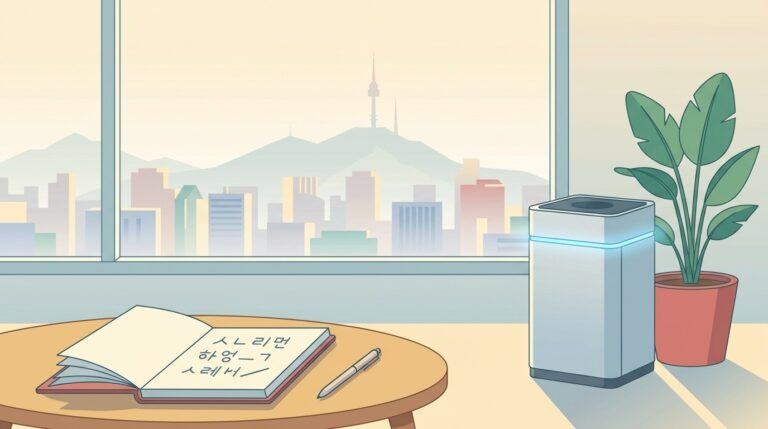
안녕하세요! 매일한글 에디터입니다.
Have you ever looked out the window in Seoul expecting clear blue skies, only to find the entire skyline swallowed by a mysterious, apocalyptic gray-yellow fog? Welcome to Korea’s misemeonji (fine dust) season. When I first hosted my international friends in Hongdae, they thought a massive barbecue was happening outside! Soon enough, their throats were scratchy, their eyes were stinging, and they were trapped indoors wondering: How on earth do I ask my Korean host to turn on that sleek, spaceship-looking machine in the corner?
That machine is Korea’s ultimate indoor lifesaver: the 공기청정기 (air purifier). As an A1 beginner, speaking up in a shared guesthouse, an Airbnb, or a friend’s studio apartment can feel intimidating. You don’t want to sound demanding, but you also really want to breathe clean air! This guide is crafted directly from our classroom trials with over 500 beginner learners. By the end of this post, you will comfortably spot, talk about, and politely ask to turn on an air purifier like a true local.
Phase 2: Core Expressions Deep Dive
1. 공기청정기 켜 주세요 (Gong-gi-cheong-jeong-gi kyeo ju-se-yo)
- Pronunciation: [Gong-gi-cheong-jeong-gi kyeo ju-se-yo] (Sound analogy: Gong-gi sounds like a bell sound ‘gong’ plus ‘geese’; kyeo sounds like the English word ‘cute’ if you cut off the ‘t’ at the end).
- Meaning: Literal: “Air purifier, please turn on.” / Nuance: “Could you please turn on the air purifier?”
- K-Culture Moment: You will spot this in almost every Korean variety show or vlogger apartment tour. A guest walks in, glances at the air purifier’s glowing red LED warning light, and asks the host to switch it on.
- Editor’s Insight: The verb 켜다 (kyeoda) means to switch on an electrical device (lights, TV, heaters). Adding ~어 주세요 (~eo ju-se-yo) turns a direct command into a respectful request.
- Situation Spectrum: Casual: ⚠️ (too formal for close siblings) | Semi-formal: ✅ (perfect for Airbnb hosts, roommates, cafes) | Formal: ✅
- 🤔 Think About It: In English, we often ask “Can you…?” focusing on ability. Korean focuses on the action being done for someone’s benefit (주세요 = please give/do for me). Notice how polite actions emphasize mutual care!
2. 미세먼지 심해요 (Mi-se-meon-ji sim-hae-yo)
- Pronunciation: [Mi-se-meon-ji sim-hae-yo] (Sound analogy: Mi-se rhymes with ‘pizza’ without the ‘p’; sim sounds like the game ‘The Sims’).
- Meaning: Literal: “Fine dust is severe.” / Nuance: “The air quality is really bad today.”
- K-Culture Moment: Every morning in Korean office K-Dramas, coworkers greet each other while coughing lightly, checking their phone apps, and saying this exact phrase before swapping into indoor slippers.
- Editor’s Insight: 심하다 (simhada) means intense, heavy, or severe. Instead of saying “The air is dirty,” Koreans naturally describe the dust condition as simhaeyo.
- Situation Spectrum: Casual: ⚠️ (drop yo for friends: simhae) | Semi-formal: ✅ (universal icebreaker) | Formal: ✅
- 🤔 Think About It: Small talk in English often starts with “Nice weather, isn’t it?” In modern Korea, checking fine dust levels has replaced routine weather chats. What is the go-to weather complaint in your hometown?
3. 창문 닫아 주세요 (Chang-mun dad-a ju-se-yo)
- Pronunciation: [Chang-mun dad-a ju-se-yo] (Sound analogy: Chang rhymes with ‘song’; mun sounds like ‘moon’; dad-a sounds like ‘tada!’ with a ‘d’).
- Meaning: Literal: “Window, please close.” / Nuance: “Could you please close the window?”
- K-Culture Moment: Running an air purifier with the window open is a major faux pas in Korean households! Whenever someone turns on the purifier, this sentence follows like clockwork.
- Editor’s Insight: The final consonant (받침) t/d sound in 닫 (dad) links smoothly into the next vowel, sounding like [다다 (da-da)]. Smooth linking is the secret to natural Korean pronunciation!
- Situation Spectrum: Casual: ⚠️ | Semi-formal: ✅ | Formal: ✅
- 🤔 Think About It: Closing windows to keep dust out versus opening windows for ventilation (환기, hwangi) is a daily debate in Korea. How does your culture balance fresh outdoor air with indoor heating or cooling?
Phase 3: Textbook Korean vs. Real-World Korean
Situation 1: Asking someone to start an appliance
- 📖 교과서 한국어 (Textbook): 공기청정기를 가동하십시오. (Gong-gi-cheong-jeong-gi-reul ga-dong-hap-si-ni-da.) — Please operate the air purification system.
- 🗣️ 진짜 한국어 (Real-World): 공기청정기 좀 켜 주세요! (Gong-gi-cheong-jeong-gi jom kyeo ju-se-yo!) — Could you turn on the air purifier, please?
- 💡 왜 다를까? (Why is it different?): Textbook Korean loves formal Sino-Korean mechanical terms like 가동 (gadong – operation). Real Koreans use the cozy native verb 켜다 (kyeoda) paired with 좀 (jom – a little/softener) to make requests sound gentle and considerate.
Situation 2: Remarking on dirty outdoor air
- 📖 교과서 한국어 (Textbook): 대기 오염 수치가 기준치를 초과했습니다. (Dae-gi o-yeom su-chi-ga gi-jun-chi-reul cho-gwa-haet-seum-ni-da.) — Atmospheric pollution values have exceeded standard parameters.
- 🗣️ 진짜 한국어 (Real-World): 오늘 미세먼지 진짜 심해요. (O-neul mi-se-meon-ji jin-jja sim-hae-yo.) — The fine dust is crazy bad today.
- 💡 왜 다를까? (Why is it different?): Unless you are a news anchor delivering the 9 PM broadcast, everyday conversation favors conversational sensory descriptions using 진짜 (jinjja – really/truly) rather than meteorological statistics.
Phase 4: K-Culture Deep Dive & Non-Verbal Manners
4-1. 눈치 (Nunchi) & Gestures
In Korea, touching somebody else’s home electronics without asking can come across as boundary-crossing. When entering an Airbnb, study cafe, or friend’s house on a smoggy day, practice polite 눈치 (nunchi – situational awareness):
1. Check the Status Ring: Most modern Korean air purifiers (like LG PuriCare or Winix) have an LED color indicator: Blue = Good, Green = Moderate, Yellow = Bad, Red = Dangerously Bad. If it’s glowing Red or Yellow, everyone in the room is secretly thinking the exact same thing.
2. The Soft Two-Hand Point: Rather than jabbing the power button yourself, gesture softly toward the device with an open palm (fingers together) while tilting your head slightly: “공기청정기 켜도 돼요?” (May I turn on the air purifier?).
3. Cough Etiquette: Never cough directly into the room. Turn away slightly, cover your mouth with your inner elbow or sleeve, and clear your throat gently before bringing up the air quality.
4-2. The Cultural Code: “Mise-Tech” and Cafe Aesthetics
Fine dust (미세먼지) has completely altered contemporary Korean lifestyle and interior design. Korean homes take clean indoor air as seriously as high-speed internet. Walk into any trendy cafe in Seongsu-dong or Yeonnam-dong, and you will notice towering aesthetic purifiers tucked artfully beside monstera plants.
Furthermore, Koreans check dedicated air-quality mobile widgets before ever checking the temperature. Living with fine dust is not considered a personal nuisance; it is a shared national experience that binds people together in mutual empathy.
Phase 5: Real-World Role-Play Scenario
Setting: You are visiting your Korean friend Minji’s (민지) cozy apartment in Mapo-gu on an overcast Saturday afternoon. The sky outside looks dingy, and both of your throats are starting to tickle.
- Turn 1 (Minji): 밖이 완전 뿌옇네요. 목 안 아파요? (Bakk-i wan-jeon bbu-yeot-ne-yo. Mok an a-pa-yo?)
🎭 Looking out the window, sighing and rubbing her neck.
“It’s completely hazy outside. Doesn’t your throat hurt?” -
Turn 2 (You): 네, 목이 좀 아파요. 오늘 미세먼지 심해요. (Ne, mok-i jom a-pa-yo. O-neul mi-se-meon-ji sim-hae-yo.)
🎭 Nodding sympathetically and clearing your throat softly.
“Yes, my throat hurts a bit. The fine dust is really bad today.” -
Turn 3 (Minji): 맞아요, 오늘 ‘매우 나쁨’ 단계예요. (Maj-a-yo, o-neul ‘mae-u na-bbeum’ dan-gye-ye-yo.)
🎭 Checking her smartphone dust app and showing you the frowning red icon.
“Right, today is ranked ‘Very Bad’ level.” -
Turn 4 (You): 저기… 창문 닫아 주세요. (Jeo-gi… chang-mun dad-a ju-se-yo.)
🎭 Pointing gently toward the cracked balcony sliding door.
“Um… could we close the window, please?” -
Turn 5 (Minji): 어머, 창문이 열려 있었네요! 바로 닫을게요. (Eo-meo, chang-mun-i yeol-lyeo it-seot-ne-yo! Ba-ro dad-eul-ge-yo.)
🎭 Quickly sliding the balcony glass window shut with a click.
“Oh goodness, the window was open! I will shut it right away.” -
Turn 6 (You): 고마워요. 공기청정기 켜 주세요! (Go-ma-wo-yo. Gong-gi-cheong-jeong-gi kyeo ju-se-yo!)
🎭 Smiling politely with palms resting loosely together, gesturing toward the corner machine.
“Thank you. Please turn on the air purifier!” -
Turn 7 (Minji): 네! 얼른 켤게요. 리모컨이 어디 있더라… (Ne! Eol-leun kyeol-ge-yo. Ri-mo-keon-i eo-di it-deo-ra…)
🎭 Pressing the glowing power button; the machine sings a cheerful startup melody.
“Yes! Turning it on right now. Where was that remote…” -
Turn 8 (You): 와, 이제 안심이에요. 고마워요, 민지 씨! (Wa, i-je an-sim-i-e-yo. Go-ma-wo-yo, Minji ssi!)
🎭 Taking a deep breath of fresh filtered air and smiling.
“Phew, what a relief now. Thank you, Minji!”
🔀 Interactive Decision Point
The air purifier starts whirring loudly, and its front circular ring turns crimson RED. What do you say to Minji?
- Option A: “야! 이거 고장 났어!” (Ya! I-geo go-jang nat-seo!) — Hey! This is broken!
- Feedback (Bad): Using informal 야 (ya) sounds rude, and jumping to the conclusion that her appliance is broken might embarrass your host.
- Option B: “빨간 불이에요. 먼지가 진짜 많네요!” (Bbal-gan bul-i-e-yo. Meon-ji-ga jin-jja man-ne-yo!) — It’s a red light. There really is a lot of dust!
- Feedback (Best): Spot on! Friendly, polite semi-formal (~요), and acknowledges the reality of the machine doing its job.
- Option C: “창문 다시 열어요.” (Chang-mun da-si yeol-eo-yo.) — Let’s open the window again.
- Feedback (Risk): Opening the window when the purifier is in red mode will let in tons more fine dust, defeating the whole purpose!
Phase 6: 10-Second Emotion Shadowing Drill
Practice saying these lines with the emotional cadence markings! Slanted bars / represent tiny micro-pauses.
[🥺 목이 답답하고 걱정스럽게 / Concerned & husky throat]
“오늘 / 미세먼지 / 진짜 심해요…” (O-neul / mi-se-meon-ji / jin-jja sim-hae-yo…)-
[🙏 조심스럽고 공손하게 / Soft, polite request]
“창문 좀 / 닫아 주시겠어요?” (Chang-mun jom / dad-a ju-si-get-seo-yo?) -
[😊 안도하며 상냥하게 / Relieved & warm smile]
“공기청정기 / 켜 주세요! / 고마워요.” (Gong-gi-cheong-jeong-gi / kyeo ju-se-yo! / Go-ma-wo-yo.)
Phase 7: K-Culture Mini Dictionary
- 공기청정기 (Gong-gi-cheong-jeong-gi) | Air Purifier
- Usage: Found in homes, schools, buses, and offices across Korea. Often shortened casually among young housemates to just “청정기” (cheong-jeong-gi).
- 미세먼지 (Mi-se-meon-ji) | Fine Dust (PM10 / PM2.5)
- Usage: Everyday meteorological vocabulary. Used to explain headaches, coughs, or why plans to visit the Han River park got postponed.
- 마스크 (Ma-seu-keu) | Protective Mask
- Usage: Specifically, high-grade KF94 (Korean Filter 94%) masks purchased at local convenience stores to block micro-particles.
- 환기 (Hwan-gi) | Ventilation / Airing out a room
- Usage: Opening windows briefly to circulate oxygen. Koreans frequently say “환기 좀 시키자” (Let’s air this place out) once dust levels drop back to blue/green.
Phase 8: Survival Kit for Travelers
Top 3 Survival Phrases
- 공기청정기 있어요? (Gong-gi-cheong-jeong-gi it-seo-yo?)
- Pro Tip: Ask this at hotel front desks or Airbnb check-in: “Do you have an air purifier?”
- KF94 마스크 주세요. (Ke-i-ep-gu-sip-sa ma-seu-keu ju-se-yo.)
- Pro Tip: Walk into any CU or GS25 convenience store and show this sentence to grab the medical-grade dust mask locals swear by.
- 목 아파요. (Mok a-pa-yo.)
- Pro Tip: Essential at Korean pharmacies (약국, yakguk) if fine dust leaves you with a scratchy throat; pharmacists will hand you throat lozenges (목캔디) or propolis spray.
Editor’s Travel Note
Before stepping outside your hotel in Seoul, don’t rely solely on default global weather apps—they often average data over wide geographic zones. Download the local Korean favorite via the MiseMise Fine Dust App Download for color-coded real-time street sensors. When taking the subway, look for the clean air cars labeled with green air purification symbols on line numbers 2 and 9!
Phase 9: One Step Deeper (Reflection)
In Korean society, managing air quality inside a communal space is not simply a matter of personal comfort; it is an act of communal mindfulness (배려, baeryeo). Because everyone experiences the physical burden of fine dust together, requesting clean air is rarely seen as complaining or high-maintenance. Instead, turning on an air purifier shows that you care about the health of everyone sharing that breathing space.
💬 Your Turn: Have you ever experienced a sudden weather or environmental condition in another country that surprised you? Drop your story in the comments below! Let’s practice saying “공기청정기 켜 주세요” together!
Phase 10: FAQ & Common Mistakes
Q: What is the difference between 켜다 (kyeoda) and 틀다 (teulda)?
A: Great question! 켜다 (kyeoda) applies broadly to electrical devices with an on/off switch (lights, TVs, monitors, air purifiers). 틀다 (teulda) originally meant to turn or twist (like a water tap or knob), but colloquially Koreans frequently use 틀다 for air conditioners, fans, music, and purifiers! Both 공기청정기 켜 주세요 and 공기청정기 틀어 주세요 are 100% natural.
Q: Can I use 끄다 (kkeuda) to turn it off?
A: Yes! 끄다 (kkeuda) is the exact opposite of 켜다. If the room feels cold or the machine is noisy at bedtime, simply say: “공기청정기 꺼 주세요” (Gong-gi-cheong-jeong-gi kkeo ju-se-yo – Please turn off the air purifier).
Q: Do cafes mind if I ask them to turn on their air purifier?
A: Most cafes already run them automatically during high dust days. However, if you are seated right next to one that is unplugged or switched off, pointing politely and asking “이거 켜도 돼요?” (May I turn this on?) is warmly welcomed.
🚨 Common Mistakes Warning Board
- Mistake: Saying “열어 주세요” (Open please) for machines.
- Wrong: 공기청정기 열어 주세요. ❌
- Correct Action: Machines are turned on (켜다), not opened like doors. Say: 공기청정기 켜 주세요. ✅
- Mistake: Forgetting the polite buffer 좀 (jom).
- Rough: 공기청정기 켜. (Sounds like ordering a servant around!)
- Correct Action: Always add 좀 and ~주세요: 공기청정기 좀 켜 주세요. ✅
- Mistake: Pronouncing ‘미세먼지’ as ‘Mise-monji’.
- Wrong: 미세몬지 ❌
- Correct Action: Keep the vowel sound open as meon (rhymes with ‘sun’): 미세먼지 (Mi-se-meon-ji). ✅
Phase 11: Action Missions & Community Engagement
- 🥉 Bronze Mission (Solo): Look at any home appliance nearby (a fan, lamp, or PC) and say aloud 3 times: “[Device name] 켜 주세요!”
- 🥈 Silver Mission (Social): Leave a comment below translating this English phrase into Korean: “The fine dust is bad today. Please close the window!”
- 🥇 Gold Mission (Real World): During your next stay in Korea or at a Korean friend’s place, spot the air purifier and ask: “공기청정기 켜도 돼요?”
🎮 K-Culture Mission: Watch an episode of the variety show I Live Alone (나 혼자 산다). Count how many celebrity studio apartments feature a glowing air purifier in the living room!
Phase 12: Interactive Quiz Challenge
1. Situational Judgment
You are sitting in a shared guesthouse lounge. The air purifier’s LED indicator changes from calming green to bright red, and people are starting to cough. What is the most natural sentence to say to the host?
a) 공기청정기 닫아 주세요.
b) 오늘 미세먼지 심해요. 공기청정기 좀 켜 주세요!
c) 창문 다 열어 주세요!
Click for Answer & Explanation
Correct Answer: b) 오늘 미세먼지 심해요. 공기청정기 좀 켜 주세요!
Explanation: Option (a) incorrectly uses the verb ‘close’ (닫다) for an appliance. Option (c) suggests opening all windows, which would flood the room with dust. Option (b) politely explains the situation and asks to turn on the machine using the softening word 좀!
2. Fill in the Blank
Complete the sentence to politely ask someone to close the window:
“미세먼지 심해요. 창문 ________ 주세요.”
Click for Answer & Explanation
Correct Answer: 닫아 (dad-a)
Explanation: The verb stem of 닫다 (to close) is 닫-. Because the root vowel is ‘ㅏ’, it pairs with ~아 주세요 to create 닫아 주세요 (dad-a ju-se-yo).
3. True or False Culture Check
Statement: In Korea, asking to turn on the air purifier in an Airbnb or office is considered rude because it implies the host’s house is dirty.
Click for Answer & Explanation
Correct Answer: False (F)
Explanation: Everyone understands that fine dust comes from outside environmental weather patterns, not from a host’s housekeeping! Asking to turn on the air purifier is considered a normal, healthy, and mutually beneficial request.







