

Phase 1: Empathy & Narrative Opening
안녕하세요! 매일한글 에디터입니다.
Picture this: You are meeting your Korean colleagues at a high-end multiplex in Gangnam, or perhaps an underground pocha tucked away in a bustling Hongdae alleyway. As you sip your drink or wait for the movie trailers to conclude, you notice building administrators conducting an unannounced fire inspection. A safety officer speaks swiftly into his transceiver, quoting civic ordinances, firebreak partitions, and non-compliance fines. You understand the basic words for ‘fire’ and ‘exit,’ yet the intricate legal terminology, regulatory nuances, and heightened safety directives swirling around multi-use establishments sound like an impenetrable code.
In contemporary South Korea, the societal conversation surrounding disaster prevention has fundamentally shifted. Following major municipal wake-up calls, public sentiment demands uncompromising safety standards for multi-use facilities (다중이용시설). For high-functioning expats, diplomats, corporate managers, and advanced learners operating at a CEFR C2 level, superficial fluency is no longer enough. You need the precision to navigate building codes, comprehend emergency broadcasts without latency, and articulate institutional accountability. Based on feedback from our advanced learners working across Seoul’s corporate and civic sectors, this guide provides the master-level vocabulary and contextual instincts you need to command fire safety discussions with native-level authority.
Phase 2: In-Depth Analysis of 3 Core Expressions
1. 다중이용업소의 비상구 폐쇄 및 훼손 행위는 엄연한 불법입니다 (Dajung-iyong-eopso-ui bisang-gu pyesoe mit hweson haengwi-neun eom-yeonhan bulbeop-imnida)
- Pronunciation: [Da-jung-i-yong-eop-so-ui bi-sang-gu pye-soe mit hwe-son haeng-wi-neun eom-yeon-han bul-beop-im-ni-da] (Think of pyesoe sounding crisp like “pyeh-seh” and bulbeop landing firmly like “bool-bup”).
- Meaning: “Blocking or damaging emergency exits in multi-use establishments is strictly against the law.”
- K-Culture Moment: Frequently heard in administrative safety inspections or gripping investigative crime series like The First Responders (소방서 옆 경찰서), where municipal inspectors clamp down on negligent warehouse or club proprietors.
- Editor’s Insight: The adverb 엄연한 (eom-yeon-han) elevates this sentence from a mundane rule to an incontestable legal reality. It signals that no administrative excuses or customary corner-cutting will be tolerated.
- Situation Spectrum: Casual 🚫 | Semi-formal ⚠️ | Formal ✅
- 🤔 Think About It: In your native language, do public safety statements invoke moral obviousness like 엄연한, or do they lean exclusively on cold bureaucratic penal codes?
2. 화재안전기준 강화 조치에 따라 피난유도선과 스프링클러 설치가 의무화되었습니다 (Hwajae-anjeon-gijun ganghwa jochi-e ttara pinan-yudoseon-gwa seupeuringkeulleo seolchiga uimuhwadoeeosseumnida)
- Pronunciation: [Hwa-jae-an-jeon-gi-jun gang-hwa jo-chi-e tta-ra pi-nan-yu-do-seon-gwa seu-peu-ring-keul-leo seol-chi-ga ui-mu-hwa-doe-eot-seum-ni-da] (Pinan sounds like “pee-nahn” with an assertive glide into yudo).
- Meaning: “In accordance with reinforced fire safety standards, the installation of luminous evacuation route markings and sprinkler systems has become mandatory.”
- K-Culture Moment: Often broadcast during formal municipal press briefings by the National Fire Agency (소방청) or integrated into corporate orientation safety videos for mega-complexes like Starfield or Lotte World Mall.
- Editor’s Insight: 의무화되다 (uimuhwadoeda, to be made mandatory) carries statutory power. Notice the compound 피난유도선 (escape guidance track/strip), which refers specifically to photoluminescent or LED pathways set into floors to guide evacuations through dense smoke.
- Situation Spectrum: Casual 🚫 | Semi-formal ⚠️ | Formal ✅
- 🤔 Think About It: How does the passive-agent construction (-에 따라 … 의무화되었습니다) reflect the institutional nature of Korean regulatory governance?
3. 골든타임 확보를 위해 소방차 전용구역 확보 및 불법 주정차 단속을 대폭 강화하고 있습니다 (Goldeunta-im hwakboreul wihae sobangcha jeonyong-guyeok hwakbo mit bulbeop jujeongcha dansog-eul daepok ganghwahago isseumnida)
- Pronunciation: [Gol-deun-ta-im hwak-bo-reul wi-hae so-bang-cha jeon-yong-gu-yeok hwak-bo mit bul-beop ju-jeong-cha dan-so-geul dae-pok gang-hwa-ha-go it-seum-ni-da] (Pronounce hwakbo with a punchy glottal stop: “hwahk-boh”).
- Meaning: “To secure the critical golden time, we are aggressively stepping up enforcement against illegal parking and securing dedicated fire lane zones.”
- K-Culture Moment: Featured routinely in prime-time investigative news segments covering neighborhood apartment disputes or crowded commercial district bottlenecks.
- Editor’s Insight: 골든타임 (golden time) is a quintessential Korean loanword loaded with urgency, referring to the critical window (usually 5 to 7 minutes) before flashover occurs or asphyxiation peaks. Pairing it with 대폭 강화하다 (drastically strengthen) conveys aggressive civic oversight.
- Situation Spectrum: Casual ⚠️ | Semi-formal ✅ | Formal ✅
- 🤔 Think About It: Notice the repetition of 확보 (securing/guaranteeing). Why does administrative Korean favor rhythmic substantive repetitions when stressing critical responsibilities?
Phase 3: Textbook Korean vs. Real Native Korean
Situation 1: Pointing out that boxes are cluttering the fire exit corridor
- 📖 교과서 한국어: 복도에 있는 상자를 치워 주십시오. 불이 나면 위험합니다. (Bokdoe inneun sangjareul chiwo jusipsio. Buri namyeon wiheomhamnida. – “Please clear the boxes in the corridor. It is dangerous if a fire breaks out.”)
- 🗣️ 진짜 한국어: 비상계단 방화문 앞 적치물은 즉시 이동 조치해 주세요. 소방 점검 시 과태료 부과 대상입니다. (Bisanggyedan banghwamun ap jeokchimureun jeuksi idong jochihae juseyo. Sobang jeomgeom si gwataeryo bugwa daesang-imnida. – “Please remove the obstructions in front of the fire doors on the emergency stairwell immediately. This is subject to an administrative fine during fire inspections.”)
- 💡 왜 다를까?: Native C2 communication in facility management balances direct legal consequences with practical jargon. Real-world Korean replaces generic terms like ‘상자’ (box) with legal administrative vocabulary like ‘적치물’ (accumulated obstructions), motivating compliance through specific regulatory accountability.
Situation 2: Inquiring about a commercial venue’s emergency escape compliance
- 📖 교과서 한국어: 비상구가 어디에 있는지 알려주시겠습니까? (Bisang-guga eodie inneunji allyeojusigesseumnikka? – “Could you tell me where the emergency exit is located?”)
- 🗣️ 진짜 한국어: 여기 비상대피로 안내도랑 피난유도선 작동 여부 확인 가능한가요? (Yeogi bisangdaepiro annaedorang pinan-yudoseon jakdong yeobu hwagin ganeunghangayo? – “Can we check the emergency evacuation route map and whether the luminous escape path is operational here?”)
- 💡 왜 다를까?: Advanced native speakers scrutinize the systemic features of an establishment rather than simply looking for an open door. Mentioning ‘피난안내도’ and ‘피난유도선’ highlights an awareness of statutory facility standards.
Phase 4: K-Culture Deep Dive & Non-Verbal Protocol
4-1. Nunchi & Crisis Body Language
In high-density Korean facilities—such as underground PC rooms, escape room cafes (방탈출 카페), or coin karaoke rooms (코인노래방)—spatial vigilance is paramount. If you observe an inspection underway or smell burning wiring, dynamic situational assessment (눈치, nunchi) requires immediate, low-panic compliance. When safety personnel make announcements, do not argue or demand personalized English interpretations. Maintain direct, attentive eye contact, keep physical gestures controlled, and swiftly orient your head toward the overhead illuminated exit sign (비상유도등). Demonstrating calm compliance aligns with collective survival solidarity (공동체적 안전의식).
4-2. Cultural Code: Overcoming ‘안전불감증’ (Safety Insensitivity)
Contemporary South Korean safety legislation has been forged through national introspection following catastrophic historical accidents. The public lexicon frequently references 안전불감증 (anjeon-bulgamjeung)—the societal tendency to grow numb to risk and prioritize rapid convenience (빨리빨리) over strict safety protocols. Today, the pendulum has swung decisively: authorities conduct merciless spot-checks on multi-use commercial structures. Failure to maintain fire dampers or keep fire doors closed now sparks public outrage and immediate administrative strikes, illustrating how national memory reshapes modern commercial vigilance.
Phase 5: Real-Life Roleplay Scenario
Setting: The bustling basement concourse of a multi-story commercial complex in Gangnam. Chief Inspector Park (소방특별사법경찰관 – Fire Special Judicial Police) is conducting a sudden compliance audit with Facility Manager Lee.
- Manager Lee: 안녕하십니까, 점검관님. 오늘 지하 1층 다중이용시설 위주로 점검 진행하시겠습니까? (Annyeonghasimnikka, jeomgeomgwannim. Oneul jiha il-cheung dajung-iyong-siseol wiju-ro jeomgeom jinhaenghasigesseumnikka? – “Good morning, Inspector. Will you focus the inspection on the multi-use facilities on Basement Level 1 today?”)
🎭 다소 긴장한 표정으로 클립보드를 고쳐 쥐며 - Inspector Park: 네, 그렇습니다. 특히 코인노래방과 실내 스크린골프장의 피난유도선 및 방화구획 유지 상태를 집중적으로 확인할 방침입니다. (Ne, geureoseumnida. Teukhi koinnoraebanggwa silnae seukeurin-golpeujang-ui pinan-yudoseon mit banghwaguhoek yuji sangtaereul jipjungjeog-euro hwag-inhal bangchim-imnida. – “Yes, precisely. We plan to focus intensively on the illuminated evacuation paths and the maintenance of fire-rated compartments in the coin karaoke rooms and indoor screen golf facilities.”)
🎭 냉철한 눈빛으로 태블릿 PC의 점검 목록을 훑어보며 - Manager Lee: 해당 구역들은 지난달 소방시설 성능위주설계 기준에 맞춰 개보수를 완료했습니다. (Haedang guyeokdeureun jinandal sobangsiseol seongneungwiju-seolgye gijun-e matchwo gaebosureul wallyo-haesseumnida. – “Those zones completed renovations last month in alignment with performance-based fire protection design standards.”)
🎭 안도감을 드러내며 안내판을 가리킨다 - Inspector Park: 그런데 여기 비상구 앞 복도에 대형 입간판과 물류 상자들이 방치되어 있군요. 이는 피난 방해 행위에 해당합니다. (Geureonde yeogi bisang-gu ap bokdoe daehyeong ipganpan-gwa mullyu sangjadeuri bangchidoeeo itgunyo. Ineun pinan banghae haengwi-e haedanghamnida. – “However, large standing signboards and logistics boxes are abandoned here in the hallway before the emergency exit. This constitutes an obstruction of evacuation.”)
🎭 미간을 찌푸리며 카메라로 현장을 채증한다 - Manager Lee: 아, 입점 업체에서 방금 임시로 적치한 모양입니다. 지금 즉각 폐기 및 이동 조치하도록 지시하겠습니다. (A, ipjeom eopche-eseo banggeum imsi-ro jeokchihan moyang-imnida. Jigeum jeukgak pyegi mit idong jochihadorok jisihagesseumnida. – “Ah, it appears a tenant store temporarily placed them there just now. I will order their immediate disposal and removal.”)
🎭 다급히 무전기를 들며 송신 버튼을 누른다 - Inspector Park: 단순 이동 권고로 끝날 사안이 아닙니다. 비상구 폐쇄·훼손·변경 및 물건 적치 행위는 예외 없이 즉각 과태료 부과 대상입니다. (Dansun idong gwongoro kkeutnal sa-ani animnida. Bisang-gu pyesoe·hweson·byeon-gyeong mit mulgeon jeokchi haengwineun yewoe eopsi jeukgak gwataeryo bugwa daesang-imnida. – “This is not an issue that concludes with a simple recommendation to move them. Blocking, damaging, altering, or cluttering fire exits is unconditionally subject to an administrative fine.”)
🎭 단호한 어조로 위반 확인서를 작성하며 - Manager Lee: 철저히 관리하지 못한 점 송구합니다. 전 층 임차인 대상 소방 안전 간담회를 재소집하여 재발 방지 대책을 세우겠습니다. (Cheoljeohi gwanlihaji mothan jeom song-guhamnida. Jeon cheung imchain daesang sobang anjeon gandamhoereul jaesojibhayeo jaebal bangji daechaegeul se-ugetseumnida. – “I sincerely apologize for failing to supervise thoroughly. I will reconvene a tenant fire safety committee across all floors and establish preventative recurrence measures.”)
🎭 정중히 고개 숙여 사과한다 - Inspector Park: 소방 시설은 타협할 수 없는 생명선입니다. 방화문 자동폐쇄장치와 도어릴리즈 정상 작동 여부까지 꼼꼼히 대조하십시오. (Sbang siseoreun tahyeophal su eomneun saengmyeongseon-imnida. Banghwamun jadongpyesoe-jangchiwa doeorillijeu jeongsang jakdong yeobukkaji kkomkkomhi daejohasipsio. – “Fire safety infrastructure is an uncompromising lifeline. Thoroughly cross-check the automatic closing mechanisms and magnetic door releases of all fire doors.”)
🎭 무거운 책임감을 담아 당부하며
🔀 Interactive Decision Point
If you were accompanying Manager Lee as the building’s foreign corporate liaison, how would you address Inspector Park’s citation?
- Option A: “규정이 지나치게 가혹하니 이번 한 번만 구두 경고로 넘어가 주실 수 없습니까?” (The regulations are too harsh; could you let this slide just this once with a verbal warning?)
- Option B: “적발된 위반 사항을 인정하며, 즉각적인 시정 조치 이행 보고서와 방화구획 전수 점검 결과를 금일 내 제출하겠습니다.” (We acknowledge the detected violation, and will submit an immediate corrective action implementation report alongside full firebreak inspection results within the day.)
- Option C: “이건 복도 끝 입점 점포 책임이니 저희 관리단에는 과태료를 청구하지 마세요.” (This is the responsibility of the tenant shop at the end of the hall, so do not bill our management committee with the fine.)
Strategic Feedback:
- Option A (Bad): Pleading for exceptions in official safety inspections shows a blatant lack of civic literacy and can be perceived as an improper solicitation attempt under the Improper Solicitation and Graft Act (김영란법).
- Option B (Best): Demonstrates flawless executive composure at a C2 level. Accepting statutory fault while committing to formal paperwork (시정 조치 이행 보고서) defuses regulatory tension professionally.
- Option C (Risk): Deflecting blame to individual shopkeepers ignores the joint regulatory obligations imposed upon facility management committees by South Korean safety law.
Phase 6: 10-Second Emotion Shadowing Drill
- Drill 1
[🚨 비장하고 단호하게 - Grave and resolute]
“화재 발생 시 / 방화문이 개방되어 있으면 / 유독가스 확산을 / 결코 막을 수 없습니다.”
(Hwajae balsaeng si / banghwamuni gaebangdoeeo isseumyeon / yudokgaseu hwaksaneul / gyeolko mageul su eopseumnida.)
“If a fire breaks out / and the fire doors are wedged open / toxic smoke propagation / can never be contained.” -
Drill 2
[⚠️ 침착하고 명료하게 - Calm and authoritative]
“모든 재실자는 / 안내방송에 따라 / 젖은 수건으로 코와 입을 막고 / 비상계단으로 신속히 피난하십시오.”
(Modeun jaesiljaneun / annaebangsonge ttara / jeojeun sugeoneuro kowa ibeul makgo / bisanggyedaneuro sinsokhi pinanhasipsio.)
“All occupants / following the guidance broadcast / cover your nose and mouth with wet towels / and evacuate swiftly via the emergency stairs.” -
Drill 3
[🏛️ 공무적이고 엄격하게 - Bureaucratic and strict]
“비상대피로 장애물 설치 행위는 / 소방시설법 위반으로 / 예외 없이 / 행정 처분이 집행됩니다.”
(Bisangdaepiro jang-aemul seolchi haengwineun / sobangsiseolbeop wibaneuro / yewoe eopsi / haengjeong cheobuni jiphaengdoemnida.)
“Setting up obstructions on emergency escape pathways / constitutes a violation of the Fire Facility Act / and without exception / administrative penalties will be enforced.”
Phase 7: K-Culture Mini Dictionary
- 안전불감증 (An-jeon-bul-gam-jeung) | Insensitivity to Safety Hazards
- Context: Frequently cited in media editorials when evaluating corners cut in construction or commercial logistics. Denotes the psychological habit of assuming “nothing bad will happen to me.”
- 다중이용시설 (Da-jung-i-yong-si-seol) | Multi-Use Facility
- Context: A legal categorization encompassing venues serving substantial general foot traffic—cinemas, bathhouses (찜질방), Hagwons, internet cafes, and retail arcades—subject to the most stringent fire inspection criteria.
- 피난유도선 (Pi-nan-yu-do-seon) | Photoluminescent Evacuation Route Track
- Context: Luminous floor guide strips mandatory in multi-use basements and venues to shepherd evacuees under thick, blinding smoke.
- 방화구획 (Bang-hwa-gu-hoek) | Fire-Rated Compartment
- Context: Structural architectural sections sealed by automatic fire doors and fire dampers designed to compartmentalize heat, flames, and toxic gas for specified hourly thresholds.
Phase 8: Traveler’s Survival Kit
Top 3 Survival Expressions for High-Rise & Underground Facilities
- 비상벨 울리면 지체 없이 대피하세요. (Bisangbel ullimyeon jiche eopsi daepihaseyo. – “When the emergency bell sounds, evacuate without hesitation.”)
- Pro Tip: Never wait to confirm smoke visually. Modern South Korean structures feature advanced sensor arrays; evacuate immediately before elevators halt automatically.
- 젖은 수건으로 호흡기를 보호하세요. (Jeojeun sugeoneuro hoheupgireul bohohaseyo. – “Protect your respiratory tract with a damp towel.”)
- Pro Tip: In public venues, look for the orange emergency supply box (비상구급함) which contains fire-escape hoods (방연마스크).
- 완강기 위치를 미리 파악해 두세요. (Wan-gang-gi wichireul miri pa-akhae duseyo. – “Identify the location of the descending life line in advance.”)
- Pro Tip: A 완강기 is a mechanical descent device found on walls of buildings from levels 3 to 10. Learn the term to locate private emergency descent gear in hotels and studios.
Editor’s Travel Note
When navigating dense downtown corridors, download the National Emergency Disaster Portal App (안전디딤돌 앱 다운로드 안내) to receive instant emergency push alerts in English and Korean. Keep in mind that when sirens sound across major urban centers, elevators are programmed to drop to ground level and lock down; always proceed directly to fire stairs (피난계단).
Phase 9: “One Step Deeper” (Reflective Prompt)
South Korea’s modern skyline presents an extraordinary architectural paradox: breathtaking ultra-dense high-rises coexisting with vibrant underground sub-cities. In such intense spatial configurations, individual safety cannot exist independently of community vigilance. Modern Korean fire safety codes reflect a profound societal consensus: freedom of business enterprise ends the precise moment it compromises communal egress routes. True cultural integration means moving past mere passive survival to embodying collective protective stewardship.
💬 Your Turn: How does your home country balance commercial property freedoms with uncompromising emergency mandates? Drop your perspective in the comments below!
Phase 10: FAQ & Misconception Prevention
Q: What should I do if I see boxes wedging open a heavy steel door in an officetel stairwell?
A: That heavy steel door is a legal 방화문 (fire door). It must stay closed (or connected to an automatic magnetic release) at all times to seal off deadly fumes. You can notify the building management office (관리사무소) using this phrase: “계단실 방화문이 고임목으로 고정되어 열려 있는데, 화재 시 위험하니 즉각 닫아 주십시오.” (The stairwell fire door is propped open with a wedge; it is hazardous in a fire, so please close it immediately.)
Q: Why do Korean fire trucks struggle to navigate through traditional villa alleys (빌라촌)?
A: Older residential quarters feature narrow streets frequently congested with parallel parking. Korean law now mandates designated 소방차 전용구역 (Dedicated Fire Truck Zones) in apartment complexes. Blocking these zones or failing to yield carries severe fines and aggressive towing operations under revised emergency dispatch acts.
Q: Are escape room cafes and underground bars held to the same safety standards as major department stores?
A: Yes, and in many respects, even stricter scrutiny applies under the Special Act on Safety Management of Multi-Use Establishments. They are legally compelled to maintain dual egress exits, install photoluminescent guidance systems, hold mandatory liability insurance, and conduct regular employee emergency training.
🚨 흔한 실수 (Common Mistakes) Warning Board
- Mistake: Using elevators (승강기) during an evacuation alarm because no smoke is visible in the lobby.
- Correct Action: Never enter elevators during an alarm. Shafts act as chimneys for lethal upward smoke draft; take the fire stairs (피난계단).
- Mistake: Assuming a closed fire door is locked from the inside.
- Correct Action: Korean fire doors are designed to open smoothly with push bars or latches outward toward egress routes, even when closed. Push firmly.
- Mistake: Ignoring the overhead emergency lighting arrow directions.
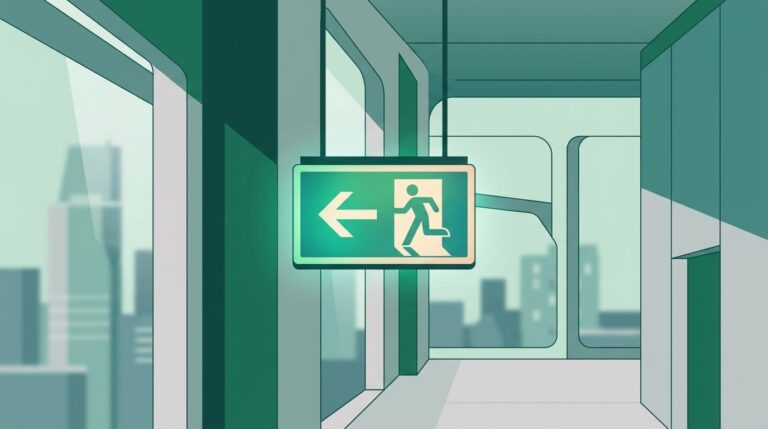
- Correct Action: Luminous green exit indicators (피난구유도등) point toward external safety; follow the direction of the arrow immediately.
Phase 11: Action Missions & Community Engagement
- 🥉 Bronze Level Mission: The next time you visit a Korean cinema or large cafe, locate the floor’s 피난안내도 (Evacuation Route Map) and spot the two distinct exit routes and fire extinguisher locations.
- 🥈 Silver Level Mission: Review your residential building’s emergency staircase. Confirm that the 방화문 (fire door) is unblocked and latching properly shut. Practice saying: “방화문 자동폐쇄장치가 정상 작동하는지 확인했습니다.” (I confirmed that the fire door automatic closer functions normally.)
- 🥇 Gold Level Mission: In a formal business or residential setting, review emergency equipment locations and comfortably use the terms 완강기 (descending life line) and 비상유도등 (emergency exit light) with local facility coordinators.
- 🎮 K-Culture Mission: Watch an episode of a Korean municipal rescue documentary or safety inspection segment (e.g., S.O.S. 24 or disaster emergency clips on YouTube). Transcribe whenever you hear the terms 과태료 (administrative fine), 골든타임 (golden time), or 소방통로 (fire lane).
Phase 12: Interactive Quiz Challenge
1. Contextual Judgment
You manage an international language academy in a multi-tenant commercial building. A commercial tenant places large flower pots and advertisement banners across the hallway leading to the fire escape stairs. What is the most legally and culturally appropriate response?
- (A) Leave them alone since they make the entrance look more welcoming.
- (B) Request immediate removal, noting that under the Fire Facility Act, obstruction of evacuation pathways incurs administrative fines up to 3 million won.
- (C) Move the banners inside the fire stairwell itself to clear the hallway.
2. Fill-in-the-Blank
화재안전기준 개정안에 따라 지하 다중이용시설 바닥에 어둠 속에서도 대피로를 알려주는 (______) 설치가 의무화되었습니다.
(Hint: Luminous evacuation guidance track)
3. True or False Cultural Safety Check
- Statement: In South Korea, it is legally acceptable for building superintendents to wedge open firebreak doors with wooden doorstops during hot summer days to improve cross-ventilation.
- Answer: [True / False]
👉 Click here to reveal the answers and explanations!
1. Answer: (B)
Explanation: Obstruction of egress pathways (피난통로 적치물 설치) violates fire safety codes unconditionally. Moving items into the stairwell (C) is equally illegal, as stairwells are critical smoke-free pressurized exit zones.
2. Answer: 피난유도선 (Photoluminescent/illuminated evacuation guide line)
Explanation: 피난유도선 is the precise statutory term for floor-integrated tracks guiding safe evacuation when visibility is compromised by toxic smoke.
3. Answer: False
Explanation: Propping open firebreak doors (방화문 고임목 설치 및 개방 고정) is one of the most heavily penalized violations during fire safety inspections. Fire doors must remain closed at all times to halt the draft of toxic smoke and flames.






