

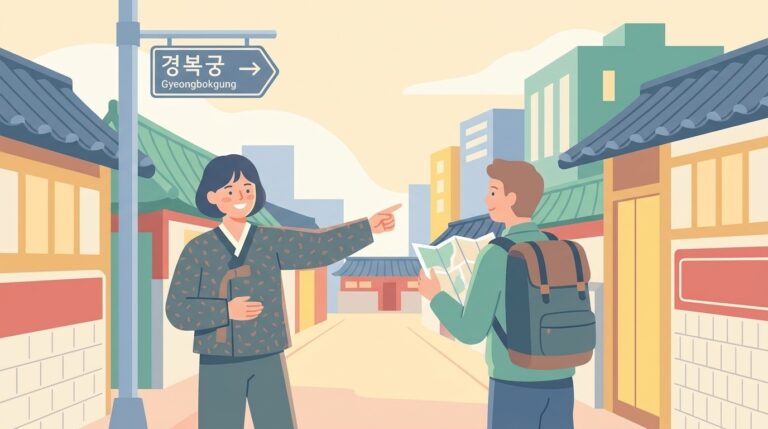
Master How to Ask for Help in Korean: The Friendly Beginner’s Survival Guide
Phase 1: Empathy (Story Immersion Opening)
안녕하세요! 매일한글 에디터입니다.
Picture this: It is your first evening in Seoul. You just stepped out of the bustling maze of Hongdae Station. Around you, street performers sing acoustic covers, sizzling aromas drift from street food carts, and neon signs flicker to life. Dazzled by the excitement, you walk through the winding alleyways until you realize you have completely lost your bearings. You pull out your smartphone to check the map, but the screen flickers black—0% battery. You are stuck in an unfamiliar city, carrying a heavy backpack, and the crowds are rushing past.
A sudden wave of helplessness hits. You want to ask someone for directions, but your mind freezes. Do you yell “Help” in English? Do you grab a passerby by the arm? In K-dramas, a charming local always swoops in just in time with a friendly smile, but in reality, you wonder: What do I actually say without sounding rude?
Asking for help in an unfamiliar culture is one of the most intimidating hurdles for travelers and beginner learners. If your tone is too blunt, you might feel self-conscious; if you stay silent, you remain lost. But here is the comforting truth: Korean society possesses a deep, instinctive culture of warmth and mutual care called jeong (정). Once you know just a few respectful, easy-to-remember phrases, everyday Koreans will happily stop in their tracks to guide you. Developed from real-life experiences and questions from our beginner students at Daily Hangul, this guide will give you the confidence to ask for help smoothly, politely, and naturally wherever your Korean adventures take you.
Phase 2: Core Expressions In-Depth Analysis
1. 도와주세요 (Dowajuseyo)
- Pronunciation: [Do-wa-ju-se-yo] (Sounds like: “Dough-wah-joo-say-yo”)
- Meaning: Literal: “Please give help” | Actual Nuance: A clear, polite, and universal plea for assistance when you genuinely need someone’s hand.
- K-Culture Moment: In the hit romance drama Crash Landing on You, whenever someone faces an unexpected emergency, they earnestly call out “도와주세요!” It is the universal phrase understood by everyone from young school kids to grandparents.
- Editor’s Insight: This expression is formed by merging the verb 돕다 (dopda – to help), 주다 (juda – to give), and the polite honorific ending -세요 (-seyo). It literally means “Please grant me help.” Because of its polite honorific structure, it is safe, clear, and immediately understood without being disrespectful.
- Situation Spectrum: Casual: ⚠️ (too polite for very close peers) | Semi-formal: ✅ (ideal for locals, shopkeepers, travelers) | Formal: ✅
- 🤔 Think About It: In English, we often ask “Can you help me?” (focusing on the other person’s ability), whereas Korean literally frames help as a gift to be given (“Please give help”). How does framing assistance as a gift change the emotional warmth of asking for a favor?
2. 저기요, 이것 좀 도와주시겠어요? (Jeogiyo, igeot jom dowajusigesseoyo?)
- Pronunciation: [Jeo-gi-yo, i-geot jom do-wa-ju-si-ge-sseo-yo] (Sounds like: “Juh-ghee-yo, ee-gut johm dough-wah-joo-she-gess-uh-yo”)
- Meaning: Literal: “Excuse me over there, could you please give a little help with this?” | Actual Nuance: A gentle, courteous way to ask a stranger to look at something specific, such as a ticket machine or a subway map.
- K-Culture Moment: In Korean variety shows like Running Man, cast members on outdoor missions frequently approach neighborhood store owners with a polite bow, holding out a clue or mission card while saying, “저기요, 이것 좀 도와주시겠어요?”
- Editor’s Insight: The real superpower in this sentence is the tiny word 좀 (jom). While it literally translates to “a little bit,” in Korean daily conversation it acts as a magical politeness cushion. It shows humility by implying, “I know you are busy, so I will only take a tiny bit of your time.”
- Situation Spectrum: Casual: 🚫 (sounds overly stiff for close friends) | Semi-formal: ✅ (perfect for public transport, subway counters, and cafes) | Formal: ✅
- 🤔 Think About It: Why do you think Korean conversational etiquette emphasizes minimizing your request with words like “a little bit”? Notice how it protects the other person from feeling burdened.
3. 길을 잃어버렸어요 (Gireul ireobeoryeosseoyo)
- Pronunciation: [Gi-reul i-reo-beo-ryeo-sseo-yo] (Sounds like: “Ghee-reul ee-ruh-buh-ryuh-ssuh-yo”)
- Meaning: Literal: “I have lost the path/way” | Actual Nuance: “I am lost and need help finding my direction.”
- K-Culture Moment: Think of travel reality shows where cast members wander through the picturesque but dizzying alleys of Bukchon Hanok Village. When completely turned around, they smile sheepishly at a resident and confess: “길을 잃어버렸어요!”
- Editor’s Insight: 길 (gil) means road, street, or way, and 잃어버렸어요 (ireobeoryeosseoyo) denotes having lost something. Pair this phrase with an apologetic smile and your map screen, and nearby Koreans will instantly activate their neighborhood guide instincts.
- Situation Spectrum: Casual: ⚠️ | Semi-formal: ✅ | Formal: ✅
- 🤔 Think About It: In English, we say “I am lost” (identifying ourselves as the lost entity), but Korean says “I lost the road.” Consider how this subtle shift places the focus on the external journey rather than personal failure.
Phase 3: Textbook Korean vs Real Korean
Situation 1: Catching a stranger’s attention on the street to ask for a favor
- 📖 교과서 한국어 (Textbook Korean): 실례합니다. 저를 도와줄 수 있습니까? (Sillyehabnida. Jeoreul dowajul su itsseumnikka? – “Excuse me. Are you capable of helping me?”)
- 🗣️ 진짜 한국어 (Real Korean): 저기요, 죄송한데 이것 좀 도와주세요. (Jeogiyo, joesonghande igeot jom dowajuseyo. – “Excuse me, I’m sorry to bother you, but could you help me with this a little?”)
- 💡 왜 다를까?: While the textbook phrase is grammatically immaculate, it sounds like an interview script from a 1980s documentary. Real Koreans soften the approach with “저기요” (over here/excuse me) and “죄송한데” (I’m sorry to interrupt your day), which sounds warm, natural, and considerate.
Situation 2: Asking someone to help lift a heavy suitcase on subway stairs
- 📖 교과서 한국어 (Textbook Korean): 제 가방을 들어 주십시오. (Je gabangeul deureo jusipsio. – “Lift my bag for me.”)
- 🗣️ 진짜 한국어 (Real Korean): 이것 좀 같이 들어주실 수 있으세요? (Igeot jom gachi deureojusil su isseuseyo? – “Could you help me lift this together a little bit?”)
- 💡 왜 다를까?: Directly telling someone to lift your luggage sounds like an order. Adding “같이” (together) frames the situation as teamwork, inviting the other person to assist rather than work for you.
Phase 4: K-Culture Deep Dive & Non-Verbal Manners
4-1. 눈치 (Nunchi) & Gestures
In Korea, asking for help begins long before words leave your mouth. Personal space is highly valued, so never tap an unfamiliar person on the shoulder or grab their sleeve. Instead, follow these steps:
1. The Approach: Step within the person’s peripheral vision at a respectful distance and initiate soft eye contact.
2. The Polite Bow: Give a subtle 15-degree head bow as you utter your opening “저기요” (Jeogiyo).
3. The Two-Handed Rule: If you are showing an address on your phone or pointing to a subway ticket, always hold your phone with both hands, or use your right hand while lightly resting your left hand under your right forearm. This demonstrates utmost humility and respect.
4-2. Cultural Code Analysis: The Spirit of “Jeong” (정)
If you watch street interview shows like You Quiz on the Block, you will observe how elderly shopkeepers or office workers will literally walk several blocks out of their way just to lead a confused tourist to the right bus stop. This behavior stems from Jeong (정)—the collective, unspoken empathy woven into Korean daily life. Far from seeing you as an annoyance, most locals feel a genuine social responsibility to ensure guests in their city arrive safely.
Phase 5: Real-Life Roleplay Scenario
- Setting: Exit 3 of Euljiro 1-ga Station, downtown Seoul. Drizzling rain on a Friday evening.
- Characters:
- Alex: A beginner Korean learner holding an umbrella, trying to find Myeongdong Cathedral with a dead phone.
- Min-su: A warm-hearted Seoul office worker waiting under an awning for a colleague.
Dialogue (8 Turns)
- Alex: 저기요, 죄송한데 잠깐만 시간 있으세요? (Jeogiyo, joesonghande jamkkanman sigan isseuseyo? / “Excuse me, I’m so sorry, but do you have just a moment?”)
🎭 Action: Alex bows his head 15 degrees and points apologetically toward his dead phone. - Min-su: 네? 아, 네! 무슨 일이세요? (Ne? A, ne! Museun iriseyo? / “Yes? Oh, sure! What is the matter?”)
🎭 Action: Min-su lowers his umbrella slightly and turns attentively toward Alex. - Alex: 제가 길을 잃어버렸어요. 이것 좀 도와주세요. (Jega gireul ireobeoryeosseoyo. Igeot jom dowajuseyo. / “I lost my way. Please help me with this a little.”)
🎭 Action: Alex holds up a paper note with the destination written on it using both hands. - Min-su: 아, 명동성당이요? 여기서 조금 걸어가셔야 해요. (A, Myeongdongseongdang-iyo? Yeogiseo jogeum georeogasyeoya haeyo. / “Ah, Myeongdong Cathedral? You need to walk a little bit from here.”)
🎭 Action: Min-su smiles warmly and points down the brightly lit avenue. - Alex: 어디로 가야 해요? (Eodiro gaya haeyo? / “Which way should I go?”)
🎭 Action: Alex listens intently, tilting his head slightly to catch the directions. - Min-su: 저기 파란 간판 보이세요? 저쪽으로 직진하시면 돼요! (Jeogi paran ganpan boiseyo? Jeojjogeuro jikjinhasimyeon dwaeyo! / “Do you see that blue sign over there? Just walk straight in that direction!”)
🎭 Action: Min-su gestures with an open palm toward the crossing. - Alex: 아, 이해했어요! 정말 감사합니다! (A, ihaehaesseoyo! Jeongmal gamsahamnida! / “Ah, I understand! Thank you so very much!”)
🎭 Action: Alex smiles widely and offers an appreciative bow. - Min-su: 별말씀을요! 조심히 가세요! (Byeolmalsseumeullyo! Josimhi gaseyo! / “Don’t mention it! Please travel safely!”)
🎭 Action: Min-su gives a friendly nod and waves his hand warmheartedly.
🔀 Interactive Branching Decision Point
What would you say if Min-su’s explanation was spoken a bit too fast for your A1 level?
* Option A: “천천히 다시 말씀해 주세요.” (Cheoncheonhi dasi malsseumhae juseyo. – “Please say it again slowly.”)
* Option B: “뭐라고요?” (Mworagoyo? – “What did you say?”)
* Option C: “몰라요, 영어로 하세요.” (Mollayo, yeongeoro haseyo. – “I don’t know, speak English.”)
Outcome Feedback:
* [Best] Option A: Exceptionally polite and proactive. The listener will instantly slow down their speech, articulate clearly, and likely use hand gestures to guide you.
* [Bad] Option B: While used among peers, saying “뭐라고요?” to an unfamiliar stranger sounds blunt and mildly defensive, like you are questioning them.
* [Risk] Option C: Disrespectful and commanding. Demanding that a stranger speak English without an apology can make the interaction uncomfortable.
Phase 6: 10-Second Emotional Shadowing Drill
Practice reading these out loud with rhythm, pausing at the / marks:
[🥺 Desperate yet Courteous]
저기요… / 죄송한데 / 이것 좀 / 도와주세요!
(Jeogiyo… / joesonghande / igeot jom / dowajuseyo!)-
[😢 Lost and Relieved]
제가 / 길을 잃어버렸어요… / 도와주실 수 있으세요?
(Jega / gireul ireobeoryeosseoyo… / dowajusil su isseuseyo?) -
[😊 Beaming with Gratitude]
도와주셔서 / 정말 / 감사합니다!
(Dowajusyeoseo / jeongmal / gamsahamnida!)
Phase 7: K-Culture Mini Dictionary
- 도움 (Doum) | Noun: Help / Assistance
The pure noun form of “help.” You will frequently spot this word on signs throughout train stations and airports, such as “고객 도움 센터” (Gogaek doum senteo – Customer Assistance Center). - 길치 (Gilchi) | Slang: Someone with no sense of direction
A funny, relatable term combining 길 (road) and 치 (clueless person). If you get turned around, sheepishly telling someone “제가 길치예요” (Jega gilchiyeyo – “I have zero sense of direction!”) breaks the ice instantly. - 실례 (Sillye) | Noun: Breach of etiquette / Excuse
Found in the classic polite phrase “실례합니다” (Sillyehabnida – “Excuse me”). It acknowledges that you are momentarily intruding on someone’s time. - 친절 (Chinjeol) | Noun: Kindness / Politeness
Koreans take immense pride in hospitality. You will often see reviews on travel apps stating: “직원이 정말 친절해요” (Jigwoni jeongmal chinjeolhaeyo – “The staff is really kind and helpful!”).
Phase 8: Survival Kit for Travelers
Top 3 Survival Phrases
- 화장실이 어디예요? (Hwajangsiri eodiyeyo? / “Where is the restroom?”)
Pro Tip: Look for subway station exits; virtually all Seoul metro stations have clean, free public restrooms right past the gate. - 영어 메뉴판 있어요? (Yeongeo menyupan isseoyo? / “Do you have an English menu?”)
Pro Tip: If you are nervous, say this while gently pointing toward the ordering counter. - 사진 좀 찍어주시겠어요? (Sajin jom jjigeojusigesseoyo? / “Could you take a photo of me, please?”)
Pro Tip: Young Koreans are renowned for their incredible photography skills. Hand them your phone, and you will get portrait-quality photos with flattering angles!
Editor’s Travel Note
Before landing in South Korea, make sure you download navigation tools tailored to local data. Because of domestic mapping regulations, Google Maps has limited walking navigation. We strongly recommend completing the Naver Map app download for real-time walking routes and the Subway Korea transit app download for seamless train transfers. Also, keep a rechargeable physical T-money transit card handy; you can top it up with cash at any convenience store (CU, GS25, or 7-Eleven).
Phase 9: One Step Deeper
In Korean culture, asking for help is not viewed as a burden on society; rather, it activates the collective social bond known as Uri (우리 – “We / Us”). Because Korean society emphasizes community well-being and mutual care, asking politely invites a stranger to step into the role of a temporary guardian. When you acknowledge their assistance with a polite bow and sincere gratitude, you are actively participating in this timeless cycle of mutual respect.
💬 Your Turn: Have you ever gotten lost in an unfamiliar city abroad? What is the most memorable help you have received from a local stranger? Share your travel story in the comments below!
Phase 10: FAQ & Avoiding Misunderstandings
Q: Can I just say “도와줘 (Dowajwo)” to make it shorter?
A: Only if you are talking to a very close friend of the exact same age, a younger sibling, or your romantic partner! “도와줘” is informal speech (Banmal). Saying this to a stranger or an older person will sound blunt and disrespectful. Always keep the polite ending: 도와주세요 (Dowajuseyo).
Q: What should I do if the person I approach doesn’t speak any English?
A: Do not worry at all! Show the address or destination on your phone, bow slightly, and say: “이것 좀 도와주세요” (Igeot jom dowajuseyo). Koreans are very tech-savvy and will often pull out Papago translator or use clear hand gestures to point you in the right direction.
Q: What do I shout if there is a real, dangerous emergency?
A: While “도와주세요!” works in any situation, in extreme situations (like a robbery, fire, or physical danger), you can shout “살려주세요!” (Sallyeojuseyo!), which literally means “Save my life!”
🚨 Common Mistakes Warning Board
- Mistake: Waving your hands frantically or whistling to grab attention from across the street.
Correct Action: Walk up within viewing distance, bow slightly, and begin with “저기요, 죄송한데…” (Jeogiyo, joesonghande…). - Mistake: Handing your phone over with one hand while keeping the other hand in your coat pocket.
Correct Action: Hold your phone with both hands to show respect. - Mistake: Omitting the magic buffer word 좀 (jom).
Correct Action: Always include “좀” in your requests (e.g., “이것 좀 도와주세요”) to soften the tone and sound considerate.
Phase 11: Action Missions & Engagement
- 🥉 Bronze Mission (Solo Practice): Stand in front of a mirror and practice saying “저기요, 이것 좀 도와주세요” 5 times in a row, matching your speech with a smooth 15-degree head bow.
- 🥈 Silver Mission (Social Sharing): Visit Instagram, TikTok, or Weverse and find a video of your favorite K-pop idol or actor. Leave a playful comment using “도와주세요!” (e.g., when their visuals or vocals are so good you need medical attention!).
- 🥇 Gold Mission (Real-World Application): The next time you visit a local Korean grocery store or restaurant, ask the staff for help finding an item using: “저기요, 이것 좀 도와주시겠어요?”
- 🎮 K-Culture Mission: During your next K-drama binge session, listen for the phrase “도와주세요” or “저기요.” Pay attention to the speaker’s body posture and facial expression!
Phase 12: Interactive Quiz Challenge
1. Situational Judgment Quiz
You are lost inside Seoul Station trying to find the KTX bullet train platform. Which sentence is the most polite and natural way to ask a station attendant for help?
A) 야, KTX 어디야? (Ya, KTX eodiya?)
B) 저기요, 죄송한데 KTX 타는 곳 좀 도와주세요. (Jeogiyo, joesonghande KTX taneun got jom dowajuseyo.)
C) 도와줘! (Dowajwo!)
👉 Click to view the correct answer & explanation
Correct Answer: B
Explanation: Option B includes the polite call-out “저기요,” the considerate apology “죄송한데,” the softening buffer “좀,” and proper polite endings. Options A and C use informal language (Banmal), which is inappropriate when speaking to strangers.
2. Fill-in-the-Blank
Fill in the missing one-syllable word that magically softens any request in Korean:
“이것 ______ 도와주세요.” (Please help me with this a little.)
👉 Click to view the answer
Correct Answer: 좀 (jom)
Explanation: “좀” literally means “a little,” but it serves as an indispensable politeness cushion in daily conversational Korean.
3. True / False Cultural Etiquette Quiz
When asking a local for directions and showing a map on your smartphone screen, handing the phone with one hand while keeping the other in your pocket is considered standard and polite in Korea. (True / False)
👉 Click to view the answer
Correct Answer: False
Explanation: In Korean body language, handing anything over with one hand while keeping the other in your pocket looks careless or dismissive. Always use two hands or support your right arm with your left hand when presenting your phone!







