

Beyond the Rice Cakes: Your Ultimate Native Guide to Surviving Chuseok Songpyeon and Seongmyo
Phase 1: Empathy & Storytelling
안녕하세요! 매일한글 에디터입니다. (Hello! I am your Daily Hangul editor.)
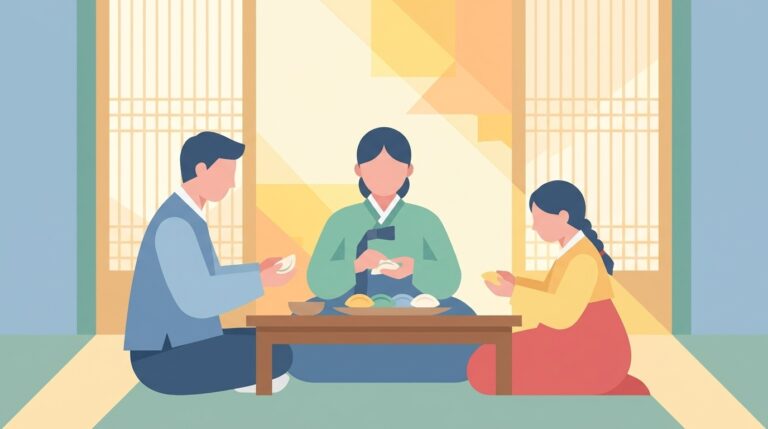
Picture this: You are seated cross-legged on an immaculate hardwood floor in your Korean friend’s family home in Andong. It is 8:00 AM on Chuseok morning. Before you rests an immense stainless-steel basin brimming with steaming, freshly kneaded rice dough, a bowl of toasted sesame seeds coated in dark honey, and fragrant pine needles plucked fresh from the morning hills. Halmeoni (grandmother) hands you a lump of dough, smiles warmly, and says, “자, 어디 한번 예쁘게 빚어봐라.” You panic. You’ve spent years mastering grammar patterns like -더니 and -을뿐더러, yet your hands tremble as your crescent dumpling ends up looking more like a collapsed football than an elegant half-moon. Everyone laughs gently, but you feel that sting of being the cultural outsider.
Two hours later, you are hiking up a steep, dew-drenched mountain trail wearing cotton work gloves, carrying wooden trays, dried pollack, and a bottle of Cheongju for 성묘 (seongmyo — ancestral grave visit). You are terrified of bowing at the wrong time, using casual phrasing with elder relatives, or committing an ancestral faux pas that echoes through centuries of Confucian propriety. As someone who has coached hundreds of advanced learners navigating their first holiday reunions in Korea, I hear this exact struggle every autumn: “I know C1-level academic Korean, but in front of family elders during traditional holidays, my tongue ties into knots.”
This guide is crafted directly from field notes, ethnographic cultural observation, and real expatriate feedback. By the end of this read, you won’t just survive the holiday; you will wield the linguistic precision, razor-sharp nunchi, and social warmth of a cherished family insider.
Phase 2: Three Essential Expressions Deep Dive
1. 예쁘게 빚어야 예쁜 딸 낳는다면서요? (한글)
- Pronunciation: [Ye-ppeu-ge bi-jeo-ya ye-ppeun ttal nan-neun-da-myeon-seo-yo?] (Think of “bijeo” like “bee-juh”, crisp and smooth)
- Meaning: Literal: “They say you have to shape it prettily to give birth to a pretty daughter, right?” | Nuanced: A witty, self-effacing cultural quip used to diffuse tension when your songpyeon dough looks slightly imperfect, showcasing instant insider cultural knowledge.
- K-Culture Moment: In weekend family K-dramas (like My Golden Life), whenever a new son-in-law or daughter-in-law clumsily shapes rice cakes, the elders tease them, and the younger person drops this classic folklore proverb to spark laughter.
- Editor’s Insight: Do not utter this mechanically. Use a playful, slightly self-deprecating pitch tilt at the end (
-면서요?rising tone). It instantly disarms critical aunties and transforms a culinary disaster into an endearing bonding moment. - Situation Spectrum: Casual (✅) | Semi-formal (✅) | Formal (⚠️ – avoid in rigid corporate contexts, but golden for family gatherings)
- 🤔 Think About It: Why does Korean culture tie the aesthetic craftsmanship of ritual food to future genealogical fortune? How does this compare to superstitions surrounding holiday food preparation in your home country?
2. 제가 술 한 잔 올리겠습니다 (한글)
- Pronunciation: [Je-ga sul han jan ol-li-get-seum-ni-da] (Pronounce “ol-li” like “all-lee”, reverent and steady)
- Meaning: Literal: “I will offer a cup of liquor.” | Nuanced: An elevated honorific declaration made before ancestral graves or elders, signaling respect, mindfulness, and active participation in sacred memorial rituals.
- K-Culture Moment: Seen in period dramas and solemn cinema scenes where the protagonist visits their family burial plot (sanso) on a mist-covered hill, pouring ritual alcohol across the memorial stone.
- Editor’s Insight: At C1, swapping the textbook verb
따르다(to pour) with the honorific ritual verb올리다(to elevate / offer upwards) marks the boundary between someone who studies Korean and someone who understands the ancestral psyche. - Situation Spectrum: Casual (🚫) | Semi-formal (⚠️) | Formal (✅ – essential for rites and formal toasts to elders)
- 🤔 Think About It: Notice the verticality in Korean honorifics: physical downward gestures (bowing) matched with upward linguistic verbs (
올리다). What does this reveal about Confucian hierarchical metaphysics?
3. 벌초하느라 고생 많으셨어요 (한글)
- Pronunciation: [Beol-cho-ha-neu-ra go-saeng ma-neu-syeot-seo-yo] (Soft rolling “beol” like “bell”, crisp “cho”)
- Meaning: Literal: “You suffered a lot because of weeding the ancestral grave.” | Nuanced: A profound acknowledgment of collective physical sacrifice. Weeding mountain graves under the humid late-summer sun is exhausting, and validating that labor cements deep communal solidarity.
- K-Culture Moment: Depicted in modern films portraying homecoming journeys, where sweaty uncles returning from the hills with weedwhackers are greeted by the matriarch with iced barley tea and this heartfelt greeting.
- Editor’s Insight: Never substitute this with a generic
수고하셨어요.벌초(beolcho) is a sacred seasonal burden; naming the specific labor proves your nuanced empathy toward the family’s shared seasonal devotion. - Situation Spectrum: Casual (⚠️ – use with intimate peers) | Semi-formal (✅) | Formal (✅)
- 🤔 Think About It: In western cultures, maintaining resting places is often outsourced to public groundskeepers. How does the communal Korean act of manual beolcho reshape family ties?
Phase 3: Textbook Korean vs. Real Native Korean
Situation 1: Offering your hands to help prepare holiday food
- 📖 교과서 한국어 (Textbook): 송편 빚는 것을 도와드릴까요? (Songpyeon binneun geoseul dowadeurilkkayo?) — “Shall I help you make songpyeon?”
- 🗣️ 진짜 한국어 (Native C1): 어머님, 제가 손이 좀 야무진 편인데 옆에서 좀 거들어 드릴까요? (Eomeonim, jega soni jom yamujin pyeoninde yeop-eseo jom geodeureo deurilkkayo?) — “Mother, I’m actually quite dexterous with my hands—may I lend you a supportive hand alongside?”
- 💡 왜 다를까?: The textbook version sounds detached, like an outsourced volunteer at a community center. Native speakers use idiomatic self-assessments (
손이 야무지다– to be deft/skilled with one’s hands) and collective support verbs (거들다rather than돕다) to signal relational intimacy without sounding patronizing.
Situation 2: Catching your breath after ascending the mountain for rites
- 📖 교과서 한국어 (Textbook): 산소에 도착해서 기쁩니다. (Sansoe dochakhaeseo gippeumnida.) — “I am happy because we arrived at the grave.”
- 🗣️ 진짜 한국어 (Native C1): 조상님 뵈러 오는 길이 제법 험한데, 그래도 다 같이 모여서 올라오니 마음이 참 뿌듯하네요. (Josangnim boereo oneun giri jebeop heomhande, geuraedo da gachi moyeoseo ollaoni maeumi cham ppudeuthaneyo.) — “The trail to pay our respects to the ancestors is quite rugged, but ascending together as a family brings such a deep sense of fulfillment.”
- 💡 왜 다를까?: Native Korean adults rarely express raw emotional states with kindergarten adjectives like
기쁘다. Instead, complex emotional compounds like뿌듯하다(proud, deeply fulfilled within) paired with humble honorific visits (뵈러 오다) convey mature composure.
Phase 4: K-Culture Deep Dive & Non-Verbal Manners
4-1. 눈치 (Nunchi) & Body Language
- The Songpyeon Hand Position: Never place your palm flat when receiving fresh dough from an elder. Cup both hands together beneath theirs. When molding, avoid licking your fingers or touching your smartphone screen; keep a clean damp linen cloth beside you. If an elder’s songpyeon finishes before yours, subtly slow down your pace—never present your completed creation before the matriarch has set the benchmark shape.
- Seongmyo Spatial Etiquette: When approaching the burial mound (봉분, bongbun), never step directly on the turf mound or stand right at the apex. Walk along the side margins. When bowing (절, jeol), observe the dual-bow rule: two full floor-length prostrations for the deceased, followed by a slight half-bow standing (반절, banjeol). Remember: living elders on New Year’s receive one full bow; deceased ancestors receive two.
4-2. Cultural Code Analysis: The Crescent Moon Paradox
Why do we shape songpyeon like a half-moon (반달) rather than a full moon (보름달), despite Chuseok being the celebration of the harvest full moon? This historical philosophy traces back to the Three Kingdoms era (Samguk Sagi). King Uija of Baekje unearthed a turtle shell bearing the prophecy: “Baekje is like the full moon, Silla is like the crescent moon.” The full moon has nowhere to go but to wane, whereas the crescent moon is destined to grow and prosper. Kneading songpyeon into crescents is an ancestral prayer for expansion, resilience, and untapped potential. Understanding this gives your ritual participation historical reverence.
Phase 5: Real-Life Roleplay Scenario
Setting: The misty pine hills of Gyeongju. You are accompanying your Korean host family to their ancestral burial mound. The autumn air smells of wild persimmon and pine resin. Minho’s grandfather, a stern retired calligraphy master, adjusts the wooden ritual table.
- 할아버지: 먼 길 오느라 고생했다. 산길이 가팔라서 숨이 찰 텐데 괜찮니?
(Meon gil oneura gosaenghaetda. Sangiri gapallaseo sumi chal tende gwaenchanni?)
“You went through a lot coming such a long way. The trail is steep—you must be out of breath, are you alright?”
🎭 Action: He sets down a brass kettle of Cheongju and inspects your composure with a piercing, assessing gaze. -
You: 아닙니다, 할아버지. 조상님께 인사드리러 오는 발걸음이라 힘든 줄도 몰랐습니다.
(Animnida, harabeoji. Josangnimkke insadeurireo oneun balgeoreum-ira himdeun juldo mollatseumnida.)
“Not at all, Grandfather. Because each step was taken to pay my respects to the ancestors, I didn’t feel the strain at all.”
🎭 Action: You bow your head slightly, hands clasped formally in front of your navel (공수 자세). -
할아버지: 허허, 마음 씀씀이가 참 대견하구나. 자, 상 위에 주전자 좀 이리 건네주렴.
(Heoheo, maeum sseumsseumiga cham daegyeonhaguna. Ja, sang wie jujeonja jom iri geonnejuryeom.)
“Haha, your depth of heart is truly commendable. Now, hand me that kettle on the table, will you?”
🎭 Action: Grandfather brushes grass clippings off the ritual stone slab with an appreciative nod. -
You: 네, 여기 있습니다. 할아버지, 제가 술 한 잔 올려도 되겠습니까?
(Ne, yeogi itseumnida. Harabeoji, jega sul han jan ollyeodo doegesseumnikka?)
“Yes, here it is. Grandfather, may I also pour and offer a cup of wine to the ancestors?”
🎭 Action: You hold the kettle with your right hand, gently supporting your right forearm with your left fingertips. -
할아버지: 오냐, 기특하구나. 잔에 따르고 향 위로 세 번 돌린 다음 올리거라.
(Onya, giteukhaguna. Jane ttareugo hyang wiro se beon dollin daeum olligeora.)
“Of course, admirable indeed. Pour it into the goblet, circle it clockwise three times over the incense smoke, and present it.”
🎭 Action: He clears space at the center of the offering table, watching your hand coordination closely. -
You: 삼가 예를 갖추어 올리겠습니다. 편안히 쉬십시오.
(Samga yereul gatchueo olligetseumnida. Pyeon-anhi swisipsio.)
“I offer this with utmost reverence. Please rest in eternal peace.”
🎭 Action: You circle the bronze cup three times over the incense stick, place it on the altar stone, and step backward two paces. -
할아버지: 그래, 정성이 닿았을 게다. 다 같이 두 번 절하자꾸나.
(Geurae, jeongseongi da-asseul geda. Da gachi du beon jeolhajakkuna.)
“Indeed, your earnest sincerity has reached them. Let us all bow twice together.”
🎭 Action: He lowers his palms slowly to the grass, guiding the solemn rhythm of the ritual. -
You: 네, 정성껏 모시겠습니다.
(Ne, jeongseongkkeot mosigetseumnida.)
“Yes, I shall serve and honor them with all my heart.”
🎭 Action: You drop to your knees smoothly in unison with the family, keeping your back straight and forehead lowered.
🔀 Interactive Decision Branch
Grandfather pours a small cup of ritual wine for everyone after the ceremony—this is 음복 (eumbok, consuming the blessed ancestral food). You don’t drink alcohol. What do you do?
- Option A: Wave your hand dismissively and say: “저는 술을 못 마셔서 그냥 안 받을게요.” (“I can’t drink, so I won’t receive it.”)
- Option B: Receive the cup with both hands, lightly touch your lips to the rim to show respectful acceptance, set it down, and explain gently: “조상님의 복은 마음으로 깊이 모시겠습니다. 체질상 마시지 못해 아쉽습니다.” (“I receive the ancestral blessing deep within my heart; regrettably, my constitution prevents me from consuming alcohol.”)
- Option C: Accept the cup, quietly turn your back, and secretly pour the alcohol onto the grass behind the mound when nobody is looking.
💡 Outcome Analysis
- Selection A (Bad 🚫): Immediate social freeze. Refusing to take the eumbok cup outright breaks the ritual continuum; it feels like rejecting the grandfather’s blessing and ancestral hospitality.
- Selection B (Best ⭐): Absolute perfection. Touching the rim honors the symbolic communion without violating your physical boundaries. Using
체질상(due to my biological constitution) is a sophisticated, indisputable way to abstain politely in Korean etiquette. - Selection C (Risk ⚠️): Highly dangerous. Pouring wine randomly on the ground is part of specific ritual cleansing steps (퇴주), but doing it deceptively behind an elder’s back can be viewed as desecrating the sacred mound if caught.
Phase 6: 10-Second Emotion Shadowing Drill
Train your musical intonation, pitch breaks (/), and genuine affective vocal tone:
- [😊 따뜻하고 유쾌하게 – Warm & Playful]
“어머님, / 제가 빚은 송편은 / 왜 다 보름달처럼 / 둥글어질까요?”
(Eomeonim, / jega bijeun songpyeoneun / wae da boreumdalcheoreom / dung-geureojilkkayo?)
Pause softly after어머님, raise pitch on보름달처럼, drop into self-teasing warmth on둥글어질까요? -
[🙏 깊이 숙연하고 정중하게 – Solemn & Reverent]
“조상님의 은덕 덕분에 / 저희 가족 모두 / 무탈하게 한 해를 보냈습니다.”
(Josangnimui eundeok deokbune / jeohui gajok modu / mutal-hage han haereul bonaetseumnida.)
Elongate the vowel in은덕, keep the tempo deliberate and anchored down into the diaphragm on무탈하게. -
[🤝 든든하고 다정하게 – Reliable & Caring]
“삼촌, / 예초기 소리가 너무 요란한데 / 귀마개 챙겨서 하세요.”
(Samchon, / yechogi soriga neomu yoranhande / gwimagae chaenggyeoseo haseyo.)
Quick breath after삼촌, tender empathetic tilt over요란한데to demonstrate vigilant familial care.
Phase 7: K-Culture Mini Dictionary
- 벌초 (Beolcho – [Buhl-cho]) | Ancestral Grave Weeding
- Context: Cutting overgrown weeds around burial sites before Chuseok. In modern Korean corporate life, asking a colleague: “이번 주말에 벌초 다녀오세요?” demonstrates high-level relational awareness during September.
- 음복 (Eumbok – [Eum-bok]) | Ritual Partaking of Sacrificial Food/Drink
- Context: Consuming ancestral food after rites to ingest blessings. In culture-savvy social settings, referencing eumbok shows you understand that food at memorial rites is spiritual communication, not just a casual meal.
- 차례상 (Charyesang – [Cha-rye-sang]) | Ancestral Holiday Memorial Table
- Context: The strict spatial arrangement of food (e.g., red fruits east, white fruits west: 홍동백서). When helping in the kitchen, asking “어느 자리에 올릴까요?” (Where on the table shall I place this?) saves massive family confusion.
- 솔잎 (Sol-ip – [Sol-lip]) | Pine Needles for Steaming
- Context: Clean pine needles laid beneath songpyeon to prevent sticking and impart phytoncides. Symbolizes cleanliness, evergreen loyalty, and autumn aroma.
Phase 8: Survival Kit for Travelers
Top 3 On-Site Expressions
- 1. 어디부터 손을 보태면 될까요? (Eodi-buteo soneul botaemyeon doelkkayo?)
- Pro Tip: Use this the exact second you enter the kitchen. It means “Where should I add my hands to help?” and marks you as an active contributor, not a passive guest.
- 2. 향불 꺼지지 않게 잘 살피겠습니다. (Hyangbul kkeojiji anke jal salpigetseumnida.)
- Pro Tip: Said during seongmyo. Offering to watch the incense stick shows astonishing spatial awareness of fire safety and ritual persistence on breezy mountain slopes.
- 3. 송편 속재료가 꽉 차서 정말 고소해요. (Songpyeon sokjaeryoga kkwak chaso jeongmal gosohaeyo.)
- Pro Tip: The highest compliment to the cook. It highlights both the generosity of the filling (속재료) and the nutty sesame aroma (고소하다).
Editor’s Travel Note: Conquering Holiday Gridlock
- Essential Navigation: Chuseok creates nationwide highway gridlock (민족대이동). Regular GPS estimates collapse. Before traveling into provincial regions for seongmyo, ensure your phone has the latest Naver Map real-time navigation system installed, as it accurately calculates highway bypasses and bus-only lane permissions.
- Mountain Prep: Graveyards harbor autumn hornets (말벌) and scrub typhus mites (쯔쯔가무시). Pack long white socks to pull over pants, avoid wearing sweet perfume, and carry wet wipes. If you need public transit, intercity trains (KTX) sell out two months ahead; always monitor the Korail mobile ticket cancellation board for last-minute return seats.
Phase 9: A Step Deeper (한 발 더 깊이)
To modern Western eyes, spending an entire national holiday cleaning grass mounds and shaping hundreds of rice dumplings can seem an onerous, regressive ritual. Yet in the Korean collective unconscious, 효 (Hyo — filial piety) is not merely moral obedience; it is temporal continuity. It is the belief that living descendants and resting ancestors share one living, breathing communal fabric. By ascending the same mountain where generations have weathered war, famine, and modernization, Koreans anchor their identity in something permanent amidst the country’s hyper-accelerated digital reality.
💬 Your Turn: How does your heritage celebrate the harvest, honor deceased family members, or manage ancestral continuity? Drop your thoughts below—let’s discuss the deeper human parallels!
Phase 10: FAQ & Avoiding Misunderstandings
Q: Can I wear black mourning clothes or casual sportswear to Seongmyo?
A: Avoid both extremes! Black suits are for recent funerals (장례식), not festive memorial holidays. Bright neon hiking athletic wear can look disrespectful to traditional grandfathers. The golden standard is neat, muted earth-tone casual clothing: khaki or beige hiking trousers, long-sleeve collared shirts, and clean trail shoes.
Q: What if I drop or burn a Songpyeon while steaming them?
A: Don’t hide it or make a dramatic apology! Lightly tease yourself using: “제 송편이 너무 뜨거워서 깜짝 놀랐나 봐요!” (“My songpyeon must have been shocked by how hot it was!”). Self-effacing humor shows confidence and maturity in domestic social crises.
Q: Do Christians or non-ancestor-worshiping families still do Seongmyo?
A: Yes! For millions of Korean Christian or Catholic families, seongmyo has evolved into 추모 예배 (memorial prayer service) at the gravesite or columbarium. They substitute alcohol offerings with fresh flowers and silent prayer, while retaining the weeding (벌초) and communal songpyeon eating.
🚨 COMMON MISTAKES WARNING BOARD
-------------------------------------------------------------------------
❌ MISTAKE 1: Bowing only ONCE during ancestral rites.
👉 CORRECT ACTION: Deceased rites require TWO full bows (절 두 번) + one half bow. Single bows are exclusively for living elders.

❌ MISTAKE 2: Stepping onto the center of the grave mound (봉분) to weed.
👉 CORRECT ACTION: Stand around the perimeter base. Placing your shoes on top of the mound is considered walking on the ancestor's resting chest.

❌ MISTAKE 3: Leaving food wrappers or cigarette butts on the mountain.
👉 CORRECT ACTION: Traditional propriety treats the surrounding mountain nature as ancestral space. Pack all trash out in designated bags.
-------------------------------------------------------------------------
Phase 11: Action Missions
- 🥉 Bronze Mission (Solo Practice): Stand before your mirror and practice the phrase: “제가 술 한 잔 올리겠습니다” while holding an imaginary cup with two hands, maintaining eye contact with the floor, exactly 5 times.
- 🥈 Silver Mission (Community Sharing): Make a short audio recording of yourself executing the “Playful Songpyeon Shadowing Drill” and share it with your language exchange partner or in the comments section for intonation feedback.
- 🥇 Gold Mission (Real-World Execution): During your next dinner with Korean elders or friends, instead of saying “잘 먹겠습니다”, deploy “정성껏 차려주셔서 감사합니다. 손이 많이 가셨을 텐데요” (“Thank you for preparing this with such dedication; it must have taken so much effort”).
- 🎮 K-Culture Mission: Watch Episode 1 of a traditional family drama (like Reply 1988 or My Father is Strange) around the holiday season. Spot at least two scenes where someone uses the phrase “손을 보태다” or holds the ritual cup with two hands.
Phase 12: Interactive Quiz Challenge
Test your cultural reflexes before you pack your bags for the holiday!
Question 1: Situational Judgment
You are sitting around the living room table with three generations of relatives shaping songpyeon. Your crescent shapes look messy, and Auntie says: “우리 OO이는 손재주가 특이하네~” (Our friend OO has quite unique hand skills~). What is the most culturally adept C1 response?
- A) “아니에요, 제 손재주는 아주 정상적인데요?”
- B) “예쁘게 빚어야 예쁜 딸 낳는다는데, 아무래도 다음 판에 온 정성을 다 쏟아야겠습니다!”
- C) “원래 외국에서는 이렇게 빚는 게 유행입니다.”
👉 Click to Reveal Answer & Analysis
Correct Answer: B
Analysis: Option A is defensive and literal (breaking social harmony). Option C is culturally dismissive. Option B leverages traditional proverbs with self-deprecating wit and vows dedication to the collective activity, which will make the entire room burst into appreciative laughter.
Question 2: Fill-in-the-Blank
Complete the ritual sentence spoken before an ancestral offering:
* “삼가 예를 갖추어 잔을 ______ , 편안히 쉬십시오.”
- A) 부어드릴 테니
- B) 올릴 테니
- C) 올리겠습니다
👉 Click to Reveal Answer & Analysis
Correct Answer: C (올리겠습니다)
Analysis: -ㄹ 테니 implies conditional intention or presumption, which is inappropriate for solemn ancestral address. 올리겠습니다 (I shall offer up) maintains absolute formal deference (하십시오체).
Question 3: True or False (Culture Check)
True or False: Songpyeon is intentionally molded into the shape of a half-moon (반달) because traditional Korean philosophy equates the crescent moon with future prosperity and growth.
👉 Click to Reveal Answer & Analysis
Correct Answer: TRUE
Analysis: Based on historical lore dating back to King Uija of Baekje, the full moon symbolizes completion and subsequent decline, while the crescent moon symbolizes future blooming, growth, and infinite potential.







