

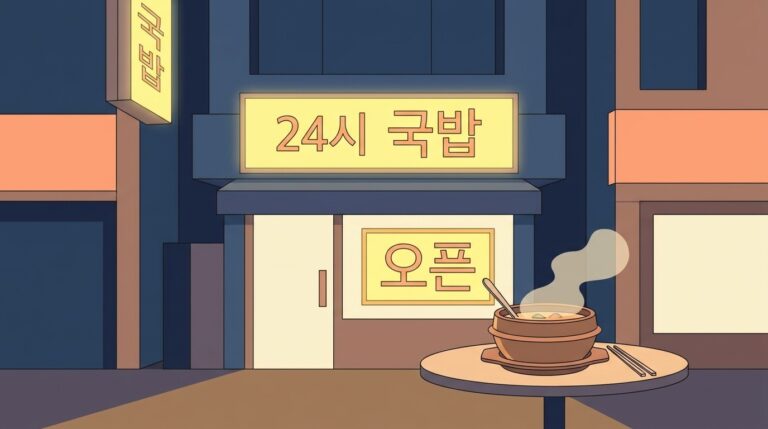
Conquering Korea’s 24-Hour Eateries: The Midnight Gourmet Guide
Phase 1: Empathy (Midnight in Seoul)
안녕하세요! 매일한글 에디터입니다. Picture this: It is 3:20 AM in Euljiro. The icy night air stings your cheeks after a long evening of laughter, karaoke, and perhaps one too many glasses of somaek. Your stomach grumbles with a sudden, relentless craving. You turn the corner, and through the misty winter fog, you see it—a warm, radiant glow beneath a weathered sign: 24시 원조 해장국 (24-Hour Original Hangover Stew).
Inside, the atmosphere is intoxicatingly vibrant. Silver-haired cab drivers are savoring steaming pots of soup; exhausted office workers in loosened ties are chuckling over plates of soondae; and university students are nursing their fatigue before tomorrow’s first lecture. You push aside the heavy vinyl curtain and step inside. The savory scent of boiling beef bones and roasted sesame oil wraps around you like a warm hug.
Suddenly, self-doubt strikes. How do you address the bustling server without sounding rude or painfully formal? Is it okay to ask for more broth, or will you offend the chef? Why isn’t anyone handing you a menu? In my ten years guiding Korean learners, I have watched brilliant C1 students freeze at this exact hurdle. Mastering 24-hour restaurant culture (야식 문화) isn’t merely about memorizing vocabulary; it is about grasping the delicate communal dance of nocturnal Korean society. This guide is crafted directly from real learner trials and local wisdom, giving you the pragmatic mastery to dine like a seasoned Seoulite at any hour of the night.
Phase 2: Core Expressions Deep Dive
1. 속 좀 풀 겸 들렀는데, 아직 식사 되나요? (한글)
- Pronunciation: [Sok jom pul gyeom deul-leon-neunde, a-jik sik-sa doe-na-yo?] (Think: Soke jom pool gyum deul-lun-neun-day, ah-jeek seek-sa dway-nah-yo?)
- Meaning: Literal: “I stopped by to soothe my stomach, is dining still possible?” | Actual Nuance: “Hey there, I dropped in to settle my stomach with some hot soup; are you folks still taking dinner/supper orders?”
- K-Culture Moment: In slice-of-life K-dramas like My Mister or Hospital Playlist, tired protagonists stumble into a quiet diner late at night, uttering this phrase to transition smoothly from the chaos of the night to a comforting warm meal.
- Editor’s Insight: At a C1 level, using 속을 풀다 (to relieve one’s hangover or soothe an unsettled stomach) showcases an organic grasp of Korean culinary philosophy. The construction -ㄹ 겸 elegantly softens your arrival, acknowledging the late hour without awkward hesitation.
- Situation Spectrum: Casual ⚠️ | Semi-formal ✅ | Formal 🚫
- 🤔 Think About It: In English, we simply ask, “Are you still open?” Why do you think Korean late-night inquiries often mention one’s physiological state (속을 풀다) to build instant empathy with the restaurant owner?
2. 이모님, 뚝배기 국물 좀 한 번만 더 데워주실 수 있을까요? (한글)
- Pronunciation: [I-mo-nim, ttuk-bae-gi guk-mul jom han beon-man deo de-wo-ju-sil su iss-eul-kka-yo?] (Think: Ee-mo-neem, took-bay-gee gook-mool jom hahn bun-mahn duh day-woh-joo-sheel soo ee-seul-kkah-yo?)
- Meaning: Literal: “Auntie, could you heat up this earthenware soup once more?” | Actual Nuance: “Excuse me, auntie, would you mind popping this earthenware bowl back on the flame to get the broth hot again?”
- K-Culture Moment: A staple scene in Reply 1988 and Itaewon Class, where lingering drinks turn the soup cold, and a seasoned patron effortlessly asks for a reheat (데우기) rather than letting good food go to waste.
- Editor’s Insight: Calling the server 이모님 (maternal aunt) establishes respectful warmth, while 뚝배기 (the traditional heat-retaining ceramic bowl) anchors your cultural context. The double-softener 좀 (a little) and 한 번만 (just once) prevents the request from sounding demanding during the graveyard shift.
- Situation Spectrum: Casual ✅ | Semi-formal ✅ | Formal 🚫
- 🤔 Think About It: In Western dining, asking a restaurant to reheat soup already on your table can feel slightly taboo. Why does Korean dining culture celebrate this ritual as a token of unhurried appreciation?
3. 사장님, 여기 깍두기 국물 좀 자작하게 더 주시고 밥 한 공기 추가해 주세요. (한글)
- Pronunciation: [Sa-jang-nim, yeo-gi kkak-du-gi guk-mul jom ja-jak-ha-ge deo ju-si-go bap han gong-gi chu-ga-hae ju-se-yo.] (Think: Sah-jahng-neem, yuh-gee kkahk-doo-gee gook-mool jom jah-jahk-hah-gay duh joo-she-go bahp hahn gohng-gee choo-gah-hay joo-say-yoh.)
- Meaning: Literal: “Boss, please give more radish kimchi juice abundantly and add one bowl of rice.” | Actual Nuance: “Boss, could we get a generous splash of kkakdugi brine over here, plus another bowl of steamed rice, please?”
- K-Culture Moment: Watch any episode of Let’s Eat (식샤를 합시다). The master eater pours tangy radish brine directly into their seolleongtang or gukbap, transforming the milky broth into a spicy, savory nectar.
- Editor’s Insight: 자작하게 is a rich sensory mimetic word (의태어) depicting liquid sitting just at the surface level. Pairing it with 깍두기 국물 signals to the diner staff that you understand the true gastronomy of 24-hour comfort food.
- Situation Spectrum: Casual ✅ | Semi-formal ✅ | Formal ⚠️
- 🤔 Think About It: Why do Korean diners embrace customized side-dish brine mixing at the table, while high-end gastronomy elsewhere discourages altering the chef’s original seasoning?
Phase 3: Textbook Korean vs. Real Korean
Scenario 1: Checking if 24-hour service is currently operational
- 📖 교과서 한국어: 지금 영업 중입니까? 식사를 주문할 수 있습니까? (Jigeum yeong-eop jung-im-nikka? Sik-sa-reul ju-mun-hal su iss-eum-nikka?)
- 🗣️ 진짜 한국어: 이모님, 지금 식사 되나요? 몇 시까지 하세요? (I-mo-nim, jigeum sik-sa doe-na-yo? Myeot si-kka-ji ha-se-yo?)
- 💡 왜 다를까? While 24-hour places advertise continuous operation, late nights often have unexpected prep times (브레이크 타임) or ingredient cutoffs. Asking 지금 식사 되나요? feels collaborative and natural, while 영업 중입니까 sounds like an official commercial audit.
Scenario 2: Asking for extra condiments or side refills
- 📖 교과서 한국어: 반찬을 더 주십시오. 김치를 더 원합니다. (Ban-chan-eul deo ju-sip-si-o. Gim-chi-reul deo won-ham-ni-da.)
- 🗣️ 진짜 한국어: 이모, 여기 겉절이랑 청양고추 좀 넉넉히 챙겨주세요! (I-mo, yeo-gi geot-jeol-i-rang cheong-yang-go-chu jom neong-neok-hi chaeng-gyeo-ju-se-yo!)
- 💡 왜 다를까? 원합니다 is almost never spoken aloud in modern Korean restaurants. Using the adverb 넉넉히 (generously/bountifully) triggers the concept of Jeong (정), prompting the server to fill your side dish to the brim with genuine hospitality.
Phase 4: K-Culture Deep Dive & Non-Verbal Manners
4-1. 눈치 (Nunchi) & The Art of Midnight Table Manners
When entering a 24-hour diner between 1:00 AM and 5:00 AM, situational intuition (눈치, Nunchi) is your greatest ally:
1. Locate the Hidden Utensils: Never demand chopsticks from the server. Check the side slide-drawer under the table. You will find paper-sleeved chopsticks, spoons, and napkins. Place a napkin down first, then lay your companion’s utensils across it—a classic hallmark of thoughtful dining etiquette.
2. The Self-Service Radar: Look for signs saying 물은 셀프입니다 (Water is self-service) or 추가 반찬 셀프 (Side-dish refills are self-service). Getting up to fetch your own icy stainless-steel water bottle and cups earns immediate silent respect from overworked nocturnal staff.
3. The Call Button vs. Eye Contact: If there is a wireless bell attached to the edge of your table or the napkin dispenser, press it gently once. If there isn’t, do not shout across the room. Catch the server’s eye, raise your hand slightly to chin level, and softly voice your 저기요~ (Excuse me).
4-2. Cultural Code: The Sacred Ritual of Haejang (해장)
In Western urban culture, post-midnight dining often revolves around greasy fast food eaten in haste. In Korea, 24-hour establishments—predominantly serving Gukbap (rice soup), Gamjatang (pork backbone stew), and Kalguksu (knife-cut noodles)—serve a holistic restorative purpose known as 해장 (Haejang; relieving the stomach of toxicity).
This tradition stems from royal Joseon remedies (hyojongguk) and has evolved into a democratic urban sanctum. At 4:00 AM, social hierarchies dissolve. A corporate CEO in bespoke tailoring sits adjacent to a logistics worker in high-visibility gear. Everyone is united by the communal comfort of bubbling broth, raw garlic, and pungent fermented radish. To participate is to embrace Korean egalitarian camaraderie at its purest.
Phase 5: Real Role-play Scenario
Setting: 3:45 AM at 종로 24시 가마솥 순대국 (Jongno 24-Hour Cauldron Soondae Soup). The steam forms condensation on the cold street-facing windows. Big cast-iron cauldrons simmer by the door. You and your Korean friend, Min-woo, enter.
- 이모님 (Server): (Wiping down an empty stainless-steel table, glancing up warmly) 어서 와요. 편한 데 앉아요. (Eo-seo wa-yo. Pyeon-han de an-ja-yo. / Welcome. Sit anywhere comfortable.)
🎭 Gestures toward a quiet booth near the bubbling broth vat - You: 이모님, 혹시 지금 식사 주문 되나요? (I-mo-nim, hok-si ji-geum sik-sa ju-mun doe-na-yo? / Imo-nim, by any chance, are you still taking meal orders right now?)
🎭 Bowing head slightly with polite smile - 이모님 (Server): 그럼요, 24시간인데! 뜨끈한 거 바로 말아줄게요. 뭐로 줄까? (Geu-reom-yo, i-sip-sa-si-gan-in-de! Tteu-kkeun-han geo ba-ro mar-a-jul-ge-yo. Mwo-ro jul-kka? / Of course, we’re 24 hours! I’ll dish up something steaming right away. What can I get you?)
🎭 Setting down two icy metal cups - Min-woo: 저는 순대국밥 보통 하나요. (Jeo-neun sun-dae-guk-bap bo-tong ha-na-yo. / I’ll take a regular Soondae soup.)
🎭 Looking at you expectantly - You: 저도 순대국밥 하나 주시고요, 다대기는 따로 챙겨주실 수 있나요? (Jeo-do sun-dae-guk-bap ha-na ju-si-go-yo, da-dae-gi-neun tta-ro chaeng-gyeo-ju-sil su innayo? / I’ll have the Soondae soup too, and could you please serve the chili seasoning paste on the side?)
🎭 Gesturing politely with open palm - 이모님 (Server): (Nodding approvingly at your customized request) 오케이, 다대기 따로! 청양고추도 좀 썰어 줄까? (O-kei, da-dae-gi tta-ro! Cheong-yang-go-chu-do jom sseol-eo jul-kka? / Got it, paste on the side! Shall I slice up some spicy Cheongyang peppers for you too?)
🎭 Smiling at your savvy preference - You: 네, 넉넉히 주시면 정말 감사하겠습니다! (Ne, neong-neok-hi ju-si-myeon jeong-mal gam-sa-ha-gess-seum-ni-da! / Yes, I’d really appreciate it if you could give us a generous portion!)
🎭 Clasping hands together in warm gratitude - 이모님 (Server): 알겠어요, 속 확 풀리게 맛있게 해줄게! (Al-gess-eo-yo, sok hwak pul-li-ge ma-sit-ge hae-jul-ge! / You got it, I’ll make it delicious so it clears your stomach completely!)
🎭 Hustling back to the steaming kitchen counter
🔀 Interactive Branching Choice
After eating half your bowl, the broth has cooled down, but you still have plenty of rice left. What do you do?
- Option A: Call out loudly across the room: 어이, 여기 국물 다시 끓여 와! (Eoi, yeogi gukmul dasi kkeulhyeo wa!)
- Option B: Gently raise your hand, catch Imo-nim’s gaze, and say: 이모님, 죄송하지만 국물 좀 한 번만 더 데워주실 수 있을까요? (Imo-nim, joesong-hajiman gukmul jom han beon-man deo de-wo-ju-sil su iss-eul-kka-yo?)
- Option C: Say nothing, leave the cold food behind, and order a fresh full portion to avoid being a burden.
Feedback:
* Option A (Bad): Disastrous. 어이 is an offensive, degrading summons, and using imperative 끓여 와 will immediately alienate the staff and spoil the room’s energy.
* Option B (Best!): Flawless pragmatic execution. 죄송하지만 acts as a respectful cushion, and asking for a reheat (데워주실 수 있을까요) displays effortless local fluency.
* Option C (Risk): Culturally well-intentioned but wasteful and costly. In Korean diner culture, asking for a broth warm-up or top-up (국물 리필) is completely standard and welcomed.
Phase 6: 10-Second Emotional Shadowing Drill
Practice reading these lines aloud. Focus on the pause markers (/) and adopt the indicated emotional mindset!
[😊 Warm and polite inquiry]
이모님! / 지금 식사 되나요? / 뜨끈한 국물이 / 너무 당겨서요.
(I-mo-nim! / Ji-geum sik-sa doe-na-yo? / Tteu-kkeun-han guk-mul-i / neo-mu dang-gyeo-seo-yo.)
“Auntie! / Are you taking food orders now? / I was just craving / some piping hot soup so much.”-
[🥺 Courteous, humble request]
죄송한데요, / 뚝배기가 좀 식어서 그런데 / 한 번만 / 데워주실 수 있을까요?
(Joe-song-han-de-yo, / ttuk-bae-gi-ga jom sik-eo-seo geu-reon-de / han beon-man / de-wo-ju-sil su iss-eul-kka-yo?)
“Excuse me, / the bowl cooled down a bit, / could you possibly / heat it up just once more?” -
[😋 Delighted satisfaction]
크으, / 국물이 제대로네요! / 밥 한 공기만 / 더 추가할게요!
(Keu-eu, / guk-mul-i je-dae-ro-ne-yo! / Bap han gong-gi-man / deo chu-ga-hal-ge-yo!)
“Aahh, / this broth is truly the real deal! / We’ll add / just one more bowl of rice, please!”
Phase 7: K-Culture Mini Dictionary
-
해장 (Hae-jang) | Hangover recovery / stomach soothing
Originally derived from 해정 (dispelling toxins), this refers to consuming warm soups, teas, or hydration after drinking alcohol to harmonize the digestive tract. In late-night parlance, any comforting meal after midnight can be categorized affectionately as 해장. -
야식 (Ya-sik) | Late-night supper / midnight snacks
A cornerstone of urban Korean lifestyle. Encompasses dining out at 24-hour establishments, roadside carts (포장마차), or rapid delivery of fried chicken, jokbal, and tteokbokki between 10:00 PM and 4:00 AM. -
이모님 (I-mo-nim) | Beloved female diner server (lit. Revered maternal aunt)
A socially endearing honorific title reserved for middle-aged and mature female restaurant staff. Unlike cold transactional labels, it projects familial warmth and mutual goodwill. -
셀프 코너 (Sel-peu Ko-neo) | Self-service side dish station
The buffet-style counter within casual diners where patrons freely replenish kimchi, kkakdugi, fermented bean paste (쌈장), and fresh green chilies without repeatedly bothering servers.
Phase 8: Survival Kit for Travelers
Survival Expressions TOP 3
-
화장실 비밀번호 어디에 적혀 있어요?
(Hwa-jang-sil bi-mil-beon-ho eo-di-e jeok-hyeo iss-eo-yo?)
Pro Tip: In dense urban nightlife zones, restrooms are secured with keypad locks. The passcode is almost always printed at the bottom of your payment receipt or written in tape on the water dispenser. -
남은 음식 포장해 주실 수 있나요?
(Nam-eun eum-sik po-jang-hae ju-sil su innayo?)
Pro Tip: 24-hour diners are accustomed to wrapping up leftover stews (포장). You will often receive it in sealed plastic leak-proof containers alongside disposable spoons. -
계산 따로따로 해도 괜찮을까요?
(Gye-san tta-ro-tta-ro hae-do gwaen-chan-heul-kka-yo?)
Pro Tip: Splitting bills (더치페이) is widely accepted, but during frantic midnight rushes, paying as a single party via one card and transferring money via mobile banking shows ultimate courtesy.
Editor’s Travel Note
- Navigation: Never rely on Google Maps in Korea for real-time 24-hour diner schedules; operational hours shift frequently. Use the Naver Map app download to check the verified 24시간 영업 tag and real-time customer photo reviews.
- Night Transit: Subways stop around midnight to 1:00 AM. If you plan an all-night diner session, pre-install the Kakao T app download to hail verified late-night taxis effortlessly without standing out in the cold.
Phase 9: “One Step Deeper” (Sociolinguistic Essay)
In many global metropolises, venturing out at 3:30 AM demands guarded vigilance and defensive personal space. In Korea, however, stepping into a 24-hour soup house reveals an astonishing extension of domestic intimacy into the public sphere. By invoking fictive kinship terms such as 이모님 (maternal aunt) or 삼촌 (uncle), diners and hosts temporarily dissolve the transactional barrier of capitalism, transforming a cold night into a shared familial shelter. The steaming communal kettle, the unlocked side-dish bar, and the collective sighs of satisfaction illustrate a society that leans into relational warmth (정, Jeong) even in its most solitary nocturnal hours.
💬 Your Turn: Have you ever experienced a late-night diner in Korea, or does your home culture have a nocturnal gathering space that matches this level of communal safety? Share your stories in the comments below!
Phase 10: FAQ & Avoiding Misunderstandings
Q: Can I sit and eat alone at a 24-hour restaurant late at night?
A: Absolutely! 혼밥 (eating alone) is deeply rooted in 24-hour diner culture. Many taxi drivers and night-shift workers dine solo. However, if the diner specializes in shared barbecue or large hot-pots (전골/감자탕), you may be required to order a minimum 2-person portion (2인분 이상).
Q: Is it rude to address the server as “아줌마” (Ajumma)?
A: Yes, it is best avoided. While 아줌마 literally means middle-aged woman, it carries a blunt, dismissive, and dated connotation in modern service interactions. Opt instead for the affectionate 이모님 (Imo-nim) or the universally polite 사장님 (Sajang-nim, meaning ‘boss/owner’).
Q: Is tipping customary if the server is exceptionally kind at 4 AM?
A: No, never tip. Tipping does not exist in Korean restaurant culture and can cause confusion or awkward embarrassment. If you want to demonstrate deep gratitude, thank them enthusiastically with 잘 먹었습니다, 이모님! (I ate wonderfully, auntie!) and hand your payment card to them using both hands.
🚨 Common Mistakes Warning Box
- Mistake 1: Leaving wet chopsticks directly on the bare wooden table.
Correct Action: Always lay down a fresh paper napkin or use the ceramic utensil rest provided in the drawer. - Mistake 2: Standing at the cash register waiting for a server during a midnight kitchen rush.
Correct Action: Bring the bill slip (주문서) left on your table up to the front counter counter-stand yourself. - Mistake 3: Shouting “여기요!” (Over here!) repeatedly while servers are carrying boiling cauldrons.
Correct Action: Wait for safety. Make eye contact or tap the wireless table bell once, ensuring staff carrying boiling soup have a clear path.
Phase 11: Action Mission & Engagement
- 🥉 Bronze Level (Solo Practice): Stand in front of your bathroom mirror and practice saying: “이모님, 청양고추 좀 넉넉히 챙겨주실 수 있나요?” with natural inflection and a warm, appreciative smile three times.
- 🥈 Silver Level (Social Sharing): Capture a screenshot of your favorite late-night K-drama food scene, identify what soup the characters are eating, and write the appropriate ordering sentence in your Instagram or Twitter story tagging
@DailyHangul! - 🥇 Gold Level (Real-World Execution): Next time you step into a 24-hour diner in Korea (or a traditional Korean town abroad), fetch your own water from the self-corner and politely ask the server for a broth warm-up (데워주세요) in Korean!
- 🎮 K-Culture Mission: Watch Episode 1 of Let’s Eat or Itaewon Class. Spot when the characters invoke kinship terms (형, 이모, 사장님) at restaurants and note how the staff’s body language immediately softens.
Phase 12: Interactive Quiz Challenge
Test your mastery of Korean late-night dining etiquette and nuanced expressions!
1. Situational Judgment
You are sitting in a 24-hour Gamjatang restaurant at 3:00 AM. The broth has boiled down and become overly salty, and your friend wants more soup. What is the most culturally savvy and natural C1 expression?
* A) 국물이 너무 짜니까 새 걸로 바꿔 오세요. (Gukmuri neomu jjanikka sae geollo bakkwo oseyo.)
* B) 사장님, 여기 육수 좀 더 부어주실 수 있나요? (Sajang-nim, yeogi yuksu jom deo bueo-jusil su innayo?)
* C) 물을 부어서 제가 직접 다시 끓일게요. (Mureul bueoseo jega jikjeop dasi kkeulhilgeyo.)
🔍 Click here to reveal the answer and explanation
Correct Answer: B
Explanation: In Korean stews, adding fresh, unsalted base stock (육수) is standard practice when soup reduces. Option A is excessively aggressive and rude, while Option C waters down the carefully crafted flavor profile. Asking for a stock refill with 육수 좀 더 부어주실 수 있나요? shows true dining sophistication!
2. Fill-in-the-Blank Challenge
Fill in the missing adverbs and particles to make this midnight request natural and polite:
“이모님, 김치 반찬이 너무 맛있어서 그런데요, 깍두기 좀 ( ) 챙겨주실 수 있어요?”
🔍 Click here to reveal the answer and explanation
Correct Answer: 넉넉히 (neong-neok-hi)
Explanation: The adverb 넉넉히 conveys “generously/plentifully without stinginess.” Using it flatters the restaurant’s generosity and hospitality far better than simply saying 많이 (a lot).
3. True / False Cultural Check
Statement: In 24-hour Korean restaurants, it is considered rude to leave table space messy, so you should wash your own dishes in the back kitchen before paying.
* [ ] True
* [ ] False
🔍 Click here to reveal the answer and explanation
Correct Answer: False
Explanation: You should never enter the kitchen area—that is a health and safety hazard! Simply grouping your empty dishes neatly in the center of the table and placing used napkins on a plate is considered exemplary etiquette that will earn heartfelt smiles from the night crew.






