

Phase 1: Empathy (Story-Immersive Opening)
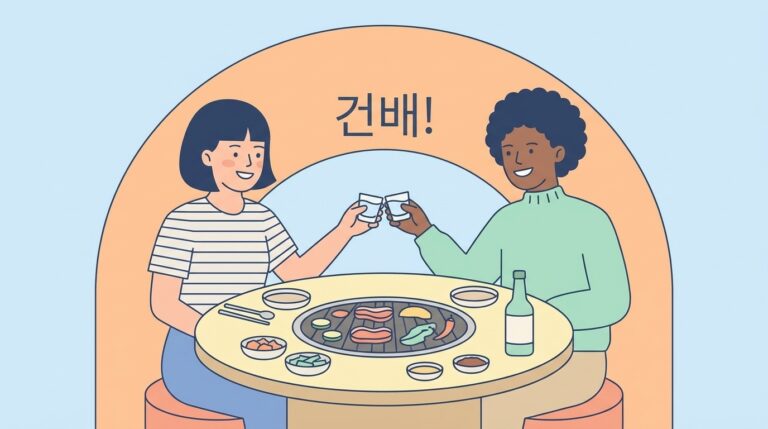
안녕하세요! 매일한글 에디터입니다. Picture this: you are sitting at a bustling Korean barbecue restaurant in Seoul. The grill sizzles with savory pork belly, cheerful laughter fills the warm evening air, and suddenly green bottles appear on your table. Your Korean companions raise their glasses, looking at you with bright, welcoming smiles. Panic strikes! Do you say “Geonbae”? Is “Jjan” too casual? Why is everyone tilting their glasses? Many beginner learners tell us that drinking gatherings in Korea feel like an intimidating cultural puzzle. But here is the secret: mastering just two magical toast expressions and simple body language transforms you instantly into everyone’s favorite dining buddy. Let’s make you toast like a true Seoul insider!
Phase 2: Core Expressions Deep-Dive
1. 짠! (Jjan!)
- Pronunciation: Jjan (Sounds like the crisp ringing “zzahn!” of glasses bumping)
- Meaning: Literal: Clinking sound (onomatopoeia) | Real Nuance: “Cheers!” (Informal, playful, friendly)
- K-Culture Moment: Seen in K-dramas like Hospital Playlist whenever best friends unwind at a casual late-night food cart (pojangmacha).
- Editor’s Insight: This is the most authentic, everyday toast word among friends and peers. It mimics the delightful musical ring of two glass cups touching.
- Situation Spectrum: Casual ✅ | Semi-formal ⚠️ | Formal 🚫
- 🤔 Think About It: Why does Korean use a sound effect rather than a word meaning “wishing you health” when drinking with close friends?
2. 건배! (Geonbae!)
- Pronunciation: Geon-bae (Sounds like “gun-beh”, similar to Japanese kanpai)
- Meaning: Literal: “Dry the cup” (Bottoms up) | Real Nuance: “Cheers! / A toast to us!” (Standard, respectful)
- K-Culture Moment: Office dinner scenes in K-dramas like Misaeng or Business Proposal where a manager proposes a group toast.
- Editor’s Insight: Geonbae originates from Sino-Korean characters. It sounds more organized and formal than Jjan, making it safe for mixed age groups or company banquets.
- Situation Spectrum: Casual ✅ | Semi-formal ✅ | Formal ✅
- 🤔 Think About It: In many East Asian languages, “cheers” literally means emptying the cup. How does this reflect group unity?
3. 원샷! (Won-syat!)
- Pronunciation: Won-syat (Koreanized English for “One shot”)
- Meaning: Literal: One shot | Real Nuance: “Bottoms up! Finish it in one gulp!”
- K-Culture Moment: University festivals or spirited celebrations in youth dramas like Twenty-Five Twenty-One.
- Editor’s Insight: It carries exciting, high-octane party energy. However, modern Koreans value moderation, so use it as playful hype rather than peer pressure.
- Situation Spectrum: Casual ✅ | Semi-formal ⚠️ | Formal 🚫
- 🤔 Think About It: How has modern drinking culture evolved from forced drinking to respectful enjoyment in your home country?
Phase 3: Textbook Korean vs. Real Korean
Situation 1: Clinking glasses with close friends
- 📖 교과서 한국어: 건배합시다! (Geonbaehapsida! / Let us toast!)
- 🗣️ 진짜 한국어: 자, 짠하자! (Ja, jjan-haja! / Alright, let’s clink!)
- 💡 왜 다를까? “건배합시다” sounds like a rehearsed speech at an international conference. Real friends use the warm, cozy sound “짠” (jjan) to spark the fun.
Situation 2: Encouraging someone during a drink
- 📖 교과서 한국어: 다 마시십시오. (Da masisipsio. / Drink all of it.)
- 🗣️ 진짜 한국어: 편하게 마셔요! (Pyeon-hage masyeoyo! / Drink at your own pace!)
- 💡 왜 다를까? Strict command forms can sound pushy. Today’s Korean dining etiquette prioritizes comfort and mutual care over compulsory drinking.
Phase 4: K-Culture Deep Dive & Non-Verbal Manners
4-1. 눈치 (Nunchi) & Mindful Gestures
- The Glass Height Rule: When toasting someone older or senior in status, make sure the rim of your glass touches slightly below theirs. This simple movement shows instant cultural respect.
- The Two-Handed Hold: Never hold or receive a glass with just one hand when drinking with elders. Place your left hand gently under your right wrist or against your chest.
- The Head Turn: When taking a sip in front of elders, politely turn your head and torso slightly away, shielding your mouth with your spare hand.
4-2. Culture Code: The Magic of 소맥 (Somaek) and 안주 (Anju)
In Korea, alcohol is almost never consumed alone; it is always paired with 안주 (anju, savory food pairings) like crispy Korean fried chicken or bubbling kimchi jjigae. Furthermore, creating 소맥 (somaek)—a golden ratio blend of soju and draft beer—is a national bonding art form that breaks social barriers instantly.
Phase 5: Real-Life Roleplay Scenario
- Setting: A lively neighborhood indoor pub (Pocha) in Hongdae with neon lights and sizzling aromas.
- Character: Minho (민호), your welcoming Korean colleague who loves good food.
- Minho: 알렉스 씨, 소주 한 잔 받을래요? (Alex ssi, soju han jan badeullaeyo? / Alex, would you like a glass of soju?) 🎭 Pours carefully with both hands holding the green bottle.
- Alex: 네, 좋아요! 감사합니다. (Ne, joayo! Gamsahamnida. / Yes, please! Thank you.) 🎭 Holds the small glass with both hands.
- Minho: 오늘 프로젝트 무사히 끝나서 진짜 기뻐요. (Oneul peurojekteu musahi kkeutnaseo jinjja gippeoyo. / I’m so happy our project finished safely today.) 🎭 Lifts his soju glass with an inviting smile.
- Alex: 민호 씨 덕분이에요. 고생 많으셨어요! (Minho ssi deokbun-ieyo. Gosaeng maneusyeosseoyo! / It is thanks to you, Minho. You worked so hard!) 🎭 Lifts glass to match the moment.
- Minho: 자, 우리 다 같이 털어 넣을까요? (Ja, uri da gachi teoreo neoeulkkayo? / Alright, shall we drink up together?) 🎭 Brings his glass forward enthusiastically.
- Alex: 좋아요, 짠! (Joayo, jjan! / Sounds great, clink!) 🎭 Gently clinks the rim slightly below Minho’s glass.
- Minho: 와, 센스 대박! 짠! (Wa, senseu daebak! Jjan! / Wow, incredible etiquette! Clink!) 🎭 Laughs joyfully as the glasses ring out.
- Alex: 시원하고 정말 달아요! (Siwonhago jeongmal darayo! / It’s refreshing and truly sweet!) 🎭 Turns head slightly to the side to take a smooth sip.
🔀 Interactive Choice Point
Minho finishes his drink and sets his empty glass down on the table. What is your next move?
* Option A: Pour yourself another drink and ignore Minho’s empty glass.
* Option B: Pick up the soju bottle with both hands and offer: “한 잔 더 드릴까요?” (Han jan deo deurilkkayo? / May I pour you another glass?).
* Option C: Shrug and say “원샷!” loudly while pointing at his plate.
- Feedback:
- Option A (Bad): In Korea, pouring your own drink (자작, jajak) is considered lonely and poor table manners. Always look out for your neighbor’s glass!
- Option B (Best): Perfect cultural awareness! Refilling each other’s cups builds mutual affection (정, jeong).
- Option C (Risk): Shouting “원샷” when glasses are empty creates awkward confusion.
Phase 6: 10-Second Emotion Shadowing Drill
Practice reading these out loud, pausing at each / mark with full emotional expression!
[😊 Cheerful & Bright]
자, / 우리 / 다 같이 / 짠하자! (Ja, / uri / da gachi / jjan-haja! / Alright, let’s all clink together!)[🤝 Polite & Heartfelt]
오늘 고생 많으셨습니다, / 건배! (Oneul gosaeng maneusyeosseumnida, / geonbae! / Thank you for your hard work today, cheers!)[🔥 Playful & High Energy]
분위기 좋은데, / 이번엔 / 원샷! (Bunwigi jo-eunde, / ibeonen / won-syat! / The vibe is great, this time bottoms up!)
Phase 7: K-Culture Mini Dictionary
- 짠 (Jjan): The quintessential casual Korean toast; an onomatopoeia describing the musical sound of glasses clinking.
- 건배 (Geonbae): The standard, slightly formal toast suitable for family gatherings, professional dinners, and official celebrations.
- 소맥 (Somaek): A popular cocktail combining Soju (소주) and beer (맥주, Maekju), loved for its smooth carbonation.
- 안주 (Anju): Any food or snack intentionally ordered to accompany and balance alcoholic beverages.
Phase 8: Survival Kit for Travelers
Top 3 Survival Phrases
- 물 좀 주세요. (Mul jom juseyo.)
- Meaning: Please give me some water.
- Pro Tip: Stay hydrated between soju shots! Water carafes are usually free in all Korean pubs.
- 짠! (Jjan!)
- Meaning: Cheers!
- Pro Tip: Use this anytime your friends raise their glasses, even with soft drinks or water.
- 화장실 어디예요? (Hwajangsil eodiyeyo?)
- Meaning: Where is the restroom?
- Pro Tip: Restrooms in smaller pubs may require a digital door passcode or a key hung near the front counter.
Editor’s Travel Note
- Late-Night Transit: Seoul subway trains stop around midnight. Make sure you complete the Kakao T app download before going out so you can call a licensed taxi seamlessly.
- Finding Hidden Spots: Skip generic tourist traps and find authentic local gastropubs using the Naver Map app download, which offers precise English walking navigation.
Phase 9: “A Step Deeper” (Cultural Reflection)
In Korean society, a drinking gathering (술자리, suljari) is rarely about drinking alone to get intoxicated. Instead, it is an intimate social dance of mutual consideration where people actively watch over each other’s cups. By lowering your glass rim and refilling your friend’s cup before your own, you communicate humility, attentiveness, and warmth without saying a paragraph. The short word “짠” is a bridge that collapses formal barriers and welcomes you into the collective heart.
💬 Your Turn: In your home culture, what small gesture or phrase shows respect when sharing a meal or drink? Leave a comment below and let’s compare notes!
Phase 10: FAQ & Avoiding Misunderstandings
Q: Can I use “짠” (Jjan) with my Korean boss or professors?
A: It is better to use 건배 (Geonbae) or simply wait for them to initiate the toast. “짠” is an informal, playful expression best saved for friends, peers, or people of similar age.
Q: What should I do if I cannot drink alcohol?
A: No worries at all! Tell your companions, “술 못 마셔요” (Sul mot masyeoyo / I cannot drink alcohol). Koreans will happily pour you soda, juice, or water so you can still join the energetic “짠!”.
Q: Do I need to turn my head every single time I drink?
A: Only when drinking in front of people noticeably older or superior to you in rank. When you are hanging out with peers or friends, you can look straight ahead and drink normally.
🚨 Common Mistakes Warning Board
- Pouring Your Own Glass (자작, Jajak): Pouring your own alcohol is thought to bring bad luck in folklore, but more importantly, it denies your friends the joy of serving you. Let others pour for you!
- Clinking Glasses Higher Than Elders: Clinking higher than someone senior can come across as arrogant. Aim your glass rim slightly lower.
- One-Handed Reception: Grabbing a poured drink with one casual hand signals indifference. Always support your cup with both hands to show gratitude.
Phase 11: Action Mission & Engagement
- 🥉 Bronze Mission (Solo Practice): Pick up a glass of water, look in the mirror, and practice saying “자, 짠!” with a bright smile 3 times.
- 🥈 Silver Mission (Social Share): Snap a photo of your evening beverage and share it on Instagram or Threads with the caption: “오늘도 시원하게 짠! #DailyHangul”.
- 🥇 Gold Mission (Real-World Test): Visit a Korean restaurant or hang out with a Korean speaker this week and successfully initiate a toast using 짠! or 건배!.
- 🎮 K-Culture Mission: Watch any episode of a K-drama featuring an evening dinner scene, count how many times the characters say “짠!”, and notice how they hold their cups!
Phase 12: Interactive Quiz Challenge
Question 1 (Situational Etiquette)
You are sharing dinner with your Korean friend’s parents. When raising your cup for a toast, what should you do?
* A) Clink your glass higher than the parents to show confidence.
* B) Tap your glass rim slightly lower than the parents’ glasses and turn slightly aside to take a sip.
* C) Shout “원샷!” and finish the entire bottle immediately.
Question 2 (Fill-in-the-Blank)
Fill in the missing word used for casual toasts among close friends:
“다들 만나서 반가워! 우리 다 같이 [ ? ]하자!”
Question 3 (True or False)
True or False: If you do not drink alcohol, you must sit quietly and cannot touch glasses during a Korean toast.
👉 Click to reveal answers & explanations!
- Question 1 Answer: B
- Explanation: Lowering your glass rim shows modest respect, and turning your head slightly away is proper dining etiquette in front of elders.
- Question 2 Answer: 짠 (Jjan)
- Explanation: “짠하자!” means “Let’s clink glasses!” in casual, everyday Korean.
- Question 3 Answer: False
- Explanation: You can fill your cup with water, cider, or cola! The joy of Korean toasts lies in togetherness, not the type of liquid in your cup.
- Explanation: You can fill your cup with water, cider, or cola! The joy of Korean toasts lies in togetherness, not the type of liquid in your cup.






