

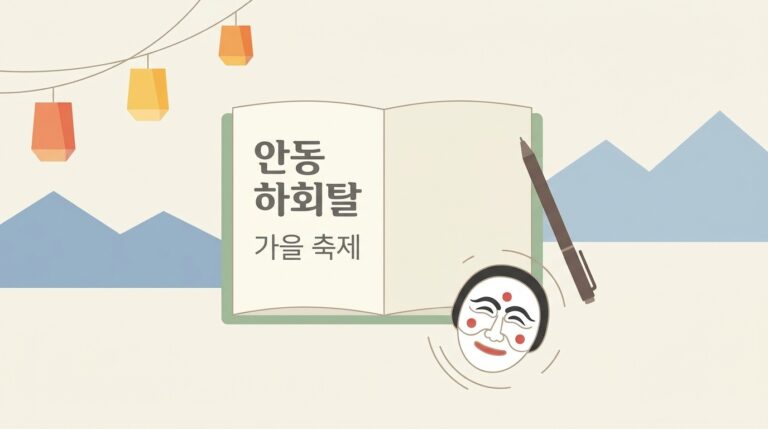
Phase 1: Empathy (Story Opening)
안녕하세요! 매일한글 에디터입니다.
Imagine this: The crisp autumn air of late September carries the savory, sweet aroma of simmered Andong Jjimdak and spiced roasted chestnuts along the banks of the Nakdong River. Suddenly, the thunderous beat of a buk (barrel drum) and the metallic resonance of a kkwaenggwari strike right into your chest. Before you know it, a dancer wearing an ancient wooden Hahoe mask—the sly Yangban (nobleman) with his open-mouthed, mocking laugh—leaps right across the dirt stage. He extends a long, billowing white sleeve directly toward you, gesturing for you to leap into the circle.
Your heart races. You’ve studied Korean for months, passed grammar tests, and mastered daily routines. Yet in that split second, standard textbook lines like “축제에 오신 것을 환영합니다” (Welcome to the festival) feel completely useless. How do you shout back encouragement? How do you join the banter with local elders sharing traditional Andong soju without sounding like an audio listening track from a university test?
Every autumn, our intermediate learners share this exact frustration: feeling trapped between classroom politeness and the raw, electric spirit of Korean folk culture. This guide is built directly from real field experiences and curated learner challenges. Master these nuances, and you will transform from a passive spectator on the bleachers into the heartbeat of the festival ground.
Phase 2: Deep Dive into 3 Core Expressions
1. 어깨가 절로 들썩이네요! (Eokkaega jeollo deulsseogineyyo!)
- Pronunciation: [Uh-kkae-ga jul-lo deul-sseo-gi-ne-yo] (Think of the quick hop in “up-beat” followed by a bouncy “dul-suhk”).
- Meaning: Literal: “My shoulders are bobbing up and down spontaneously!” | Real Nuance: “This rhythm is so infectious my body can’t help but dance!”
- K-Culture Moment: Used constantly during traditional Pungmul (folk percussion) performances or when an infectious trot/folk beat drops in variety shows like 2 Days & 1 Night.
- Editor’s Insight: Koreans often express groove through the shoulders rather than the hips. Deulsseok-eotta captures that involuntary micro-bounce of pure joy.
- Situation Spectrum: Casual: ✅ | Semi-formal: ✅ | Formal: ⚠️
- 🤔 Think About It: In your culture, which body part naturally expresses involuntary musical excitement? Why do Korean folk arts focus on the shoulders?
2. 흥을 돋우다 (Heungeul doduda)
- Pronunciation: [Heung-eul do-du-da] (Pronounce heung with a guttural breath from the chest, like humming “uhng”).
- Meaning: Literal: “To stoke/elevate the innate joyful energy.” | Real Nuance: “To fire up the crowd / to bring out the collective groove.”
- K-Culture Moment: Often cited when an MC or performer hype-up the crowd, comparable to how RM and J-Hope reference Heung in BTS festival tracks.
- Editor’s Insight: Heung (흥) is uniquely Korean—an untranslatable collective surge of ecstasy and resilience. Doduda literally means to raise a flame or mound.
- Situation Spectrum: Casual: ✅ | Semi-formal: ✅ | Formal: ✅
- 🤔 Think About It: Is “energy” or “hype” really an exact match for heung, or does heung carry a historical catharsis that Western party culture lacks?
3. 한판 흐드러지게 놀아봅시다! (Hanpan heudeureojige norabopsida!)
- Pronunciation: [Han-pan heu-deu-ruh-ji-ge no-ra-bop-si-da]
- Meaning: Literal: “Let’s play one round abundantly/luxuriously!” | Real Nuance: “Let’s throw down and dance our hearts out with zero regrets!”
- K-Culture Moment: The climactic call by the lead mask dancer right before the entire audience swarms the festival arena for the finale.
- Editor’s Insight: Heudeureojida originally describes flowers blossoming in lavish profusion. When applied to play (nolda), it signals abandoning all social inhibitions.
- Situation Spectrum: Casual: ✅ | Semi-formal: ✅ | Formal: 🚫
- 🤔 Think About It: Why does Korean use the counter pan (round/stage) for play, treating social dancing like a grand, shared communal showdown?
Phase 3: Textbook Korean vs. Real Native Korean
Situation 1: Praising the festival atmosphere to someone next to you
- 📖 교과서 한국어: 축제 분위기가 정말 재미있고 흥미롭습니다. (Chukje bunwigiga jeongmal jaemiitgo heungmiropseumnida.)
- 🗣️ 진짜 한국어: 분위기 완전 제대로 탔네요! 벌써 신나요! (Bunwigi wanjeon jedaero tannyeo! Beolsseo sinnayo!)
- 💡 왜 다를까?: Textbooks favor descriptive adjectives (jaemiitta), but native speakers use dynamic metaphors like tada (riding the wave/vibe) to express atmospheric momentum.
Situation 2: Asking dancers if you can step into the circle
- 📖 교과서 한국어: 제가 이 춤 대열에 참여해도 괜찮습니까? (Jega i chum daeyeore cham-yeohaedo gwaenchansseumnika?)
- 🗣️ 진짜 한국어: 저도 슬쩍 껴도 돼요? 같이 즐겨요! (Jeodo seuljjeok kyeodo dwaeyo? Gachi jeulgyeoyo!)
- 💡 왜 다를까?: Formal terms like cham-yeohada create distance in folk festivals. Using seuljjeok kkida (slip right in) softens social friction instantly.
Phase 4: K-Culture Deep Dive & Non-Verbal Manners
4-1. Nunchi & Gestures: The Art of Festival Etiquette
- The Chuimsae Timing: Never stay silent while watching Talchum! Shout out encouraging exclamations like “얼씨구!” (Eolssigu!) or “좋다!” (Jota!) right when the percussion picks up. It signals you understand the performer-audience contract.
- The Subtle Heel Step: In Talchum, don’t jump with your toes like at an EDM rave. Drop your weight through your heels with bent knees (oegum motion) while letting your arms rise smoothly.
4-2. Cultural Code: Haehak (Satire) and Catharsis
Andong’s Hahoe Byeolsingut Talnori wasn’t merely entertainment; it was a societal safety valve. During the Joseon Dynasty, commoners wore masks to viciously ridicule hypocritical Yangban aristocrats and corrupt monks without fear of execution. Knowing this transforms your trip: when you cheer in Andong, you aren’t just watching folk history—you are participating in Korea’s 800-year-old tradition of joyful rebellion.
Phase 5: Real-World Roleplay Scenario
Setting: At the outdoor Talchum Stage inside Andong Maskdance Park. Artisan Park, a seasoned wooden mask carver in his late 60s, is polishing an authentic Yangban mask at his interactive booth.
- Artisan Park: “젊은이, 가면이 마음에 드는가 보네? 한번 써보지 그래?” (Jeolmeuni, gamyeoni maeume deuneun-ga bone? Hanbeon sseoboji geurae?)
🎭 [Smiles broadly, extending the polished alder-wood mask toward you]
“Young traveler, looks like this mask caught your eye! Why not try it on?” -
You: “와, 눈매가 진짜 살아있네요! 써봐도 괜찮아요?” (Wa, nunmaega jinjja sarainnoyo! Sseobwado gwaenchannayo?)
🎭 [Takes the mask gently using both hands, showing respect]
“Wow, the eyes look completely alive! Is it really okay if I try it on?” -
Artisan Park: “그럼! 턱을 들면 웃고, 숙이면 성난 표정이 되는 게 하회탈의 묘미지.” (Geureom! Teogeul deulmyeon utgo, sugimyeon seongnan pyojeongi doeneun ge hahoetarui myomiji.)
🎭 [Adjusts the cord around your head, gesturing toward a bronze mirror]
“Of course! Lift your chin and it laughs; bow your head and it looks enraged. That is the genius of the Hahoe mask.” -
You: “직접 써보니까 어깨가 절로 들썩이네요!” (Jikjeop sseobonikka eokkaega jeollo deulsseogineyyo!)
🎭 [Bobs shoulders rhythmically in front of the mirror]
“Now that I’m wearing it, my shoulders are bouncing all on their own!” -
Artisan Park: “허허, 자네 흥을 제대로 아네! 오늘 밤 대동난장 무대에도 설 텐가?” (Heoheo, jane heungeul jedaero ane! Oneul bam daedongnanjang mudae-edo seol ten-ga?)
🎭 [Chortles warmly and gives an approving nod]
“Haha, you truly understand heung! Will you join the grand communal circle dance tonight?” -
You: “당연하죠! 한판 흐드러지게 놀아보려고요.” (Dang-yeonhajyo! Hanpan heudeureojige noraboryeogoyo.)
🎭 [Flashes an enthusiastic thumbs-up, smiling through the mask]
“Without a doubt! I plan to dance my heart out tonight.” -
Artisan Park: “좋지! 저쪽 부스에 가면 막걸리도 한 사발 주니까 목 축이고 가게.” (Jotji! Jeojjok buseue gamyeon makgeollido han sabal junikka mok chugigo gage.)
🎭 [Points toward the riverside food stalls with a wink]
“Splendid! If you head over to that booth, they will pour you a bowl of rice wine to wet your whistle.” -
You: “감사합니다, 어르신! 흥 제대로 돋우고 올게요!” (Gamsahamnida, eoreusin! Heung jedaero dodugo olgeyo!)
🎭 [Offers a courteous 30-degree bow before stepping onto the pathway]
“Thank you, elder! I will go fire up the festival spirit!”
🔀 Interactive Choice Point
The artisan hands you an unpainted wooden mask and invites you to critique his apprentice’s carving technique.
* Option A: “형식이 너무 현대적이라 전통미가 약간 아쉽네요.” (Critique the traditional authenticity directly)
* Option B: “선이 참 섬세하네요! 초보자가 보기에도 손맛이 느껴집니다.” (Praise the craftsman’s tactile touch warmly)
* Option C: “이거 얼마에 파시는 거예요? 깎아주세요!” (Ask for the price immediately and bargain)
- Option A Feedback [Risk]: While honesty is appreciated in some cultures, challenging an artisan’s lineage can introduce heavy awkwardness (gapbunsa).
- Option B Feedback [BEST]: Praising sonmat (the artisanal touch) shows deep respect and unlocks instant hospitality and insider stories.
- Option C Feedback [Bad]: Treating cultural preservation artifacts as cheap souvenir commodities instantly destroys the connection.
Phase 6: 10-Second Emotional Shadowing Drill
- [😆 흥분되고 신나게 – Excited & Upbeat]
와! / 꽹과리 소리 들리니까 / 어깨가 절로 들썩이네요!
(Wa! / Kkwaenggwari sori deullinikka / eokkaega jeollo deulsseogineyyo!) -
[🔥 결의에 차서 – Resolute & Passionate]
오늘 축제에서 / 체면 다 버리고 / 한판 흐드러지게 놀아봅시다!
(Oneul chukjee-seo / chemyeon da beorigo / hanpan heudeureojige norabopsida!) -
[🤩 감탄하며 – Awestruck & Respectful]
탈 하나로 / 사람 마음을 들었다 놨다 하는 게 / 진짜 예술이네요!
(Tal hanaro / saram maeumeul deureotda nwatda haneun ge / jinjja yesurineyo!)
Phase 7: K-Culture Mini Dictionary
- 흥 (Heung | Innate communal exuberance): An emotional wave of joy that overrides exhaustion and social barriers.
- 추임새 (Chuimsae | Exclamatory encouragement): Verbal prompts (“얼씨구”, “좋다”) shouted by spectators to energize performers.
- 풍자 (Pungja | Satirical critique): Masked performance traditions utilizing humor to poke fun at social inequality.
- 뒷풀이 (Dwitpuri | Post-event wrap party): Communal gathering after performances to share food, drinks, and reflections.
Phase 8: Survival Kit for Festival Travelers
TOP 3 Survival Phrases
- 탈 대여소는 어디에 있나요? (Tal daeyeosoneun eodie innayo?)
* Pro Tip: Don’t miss renting or purchasing a mask; visitors wearing masks often receive perks and free gifts across festival zones.
2. 셔틀버스 배차 간격이 어떻게 돼요? (Syeoteulbeoseu baecha ganggyeogi eotteoke dwaeyo?)
* Pro Tip: Essential when shuttling between Andong Downtown Maskdance Park and the historic Hahoe Folk Village.
3. 덜 맵게 해달라고 하면 가능한가요? (Deol maepge haedallago hamyeon ganeunghangayo?)
* Pro Tip: Genuine Andong Jjimdak contains fiery dried red peppers (cheongyang-gochu); ask for milder spice if needed.
Editor’s Travel Note
- Transit: Take the KTX-Eum high-speed train from Seoul’s Cheongnyangni Station directly to Andong Station (takes roughly 2 hours). Check train times and book via the Korail Talk reservation portal.
- Navigation: Foreign credit cards and domestic apps can sometimes mismatch; navigate local routes via the Naver Map application rather than international search maps for up-to-date festival detours.
Phase 9: Step Deeper (Reflection Question)
In aristocratic Joseon society, etiquette strictly dictated every physical posture, step, and tone of voice. Yet, inside the mask dance circle, an impoverished servant could mock his master as long as his delivery carried wit and rhythm. Talchum illustrates how communal Korean culture reconciles social hierarchies through art. By laughing together, conflict dissolves into shared vulnerability.
💬 Your Turn: Does your native culture feature carnival traditions where normal social rules are flipped upside down? Drop your thoughts in the comments below!
Phase 10: FAQ & Common Mistakes
Q: Can non-Koreans actively dance in the Talchum arena without knowing the steps?
A: Absolutely! Unlike classical ballet or court dance, the core principle of folk Talchum is spontaneity. As long as you follow the basic knee-bobbing groove (gulgsin), performers will cheer you on.
Q: Is Andong soju too strong to drink casually at festival food stalls?
A: Traditional Andong soju ranges between 35% and 45% ABV—far stronger than green bottle commercial soju. Sip it slowly like whiskey, and pair it with Gobi or savory Baechu-jeon (cabbage pancake).
Q: What is the most famous mask to know before visiting?
A: The Yangban-tal (the smiling nobleman) and the Choraengi-tal (the nimble, gossiping servant). Notice how the Yangban mask has an unattached jaw that swings when you tilt your head!
🚨 Common Mistakes Warning Board
- Mistake 1: Sitting silently like an academic observer. -> Correct Action: Shout out rhythmic Chuimsae (“얼씨구!”) whenever the tempo builds.
- Mistake 2: Calling masks “gamyun” interchangeably without context. -> Correct Action: While both mean mask, folk heritage items are specifically called Tal (탈), while masquerade/costume props are called Gamyeon (가면).
- Mistake 3: Bowing stiffly at 90-degrees when elders pull you into dance circles. -> Correct Action: Relax your neck, loosen your shoulders, and offer a warm Chuimsae smile instead.
Phase 11: Action Missions
- 🥉 Bronze Mission: Stand in front of your mirror, say “어깨가 절로 들썩이네요!” and bounce your shoulders to the rhythm three times.
- 🥈 Silver Mission: Record a short audio note shouting authentic Chuimsae exclamations (“얼씨구!”, “지화자!”) and upload it to your study log.
- 🥇 Gold Mission: Use “분위기 제대로 탔네요!” naturally when commenting on an exciting Korean festival or concert clip online.
- 🎮 K-Culture Mission: Watch a scene from Mr. Sunshine or traditional travel documentaries set in Andong, and spot whether dancers bend their knees on the downbeat or upbeat.
Phase 12: Interactive Quiz Challenge
- Situational Judgment: You want to tell a performer that their drumming energized the entire festival crowd. What is the most natural B2-level phrase?
* (A) 드럼 소리가 무척 흥미로웠습니다.
* (B) 신명 나는 장단으로 흥을 제대로 돋워주셨어요!
* (C) 북 치는 행동이 매우 빨랐습니다.
- Fill-in-the-Blank:
“음악이 너무 신나서 저도 모르게 (_____) 절로 들썩였어요!” -
True / False: Traditional Hahoe masks were carved with moveable jaws to allow performers to articulate speech and show shifting emotions through head movements.
👉 Click to reveal answers & explanations!
- Answer: (B)
* Explanation: While (A) and (C) are grammatically understandable, jangdan (traditional rhythm) and heungeul doduda reflect authentic, culturally sophisticated intermediate proficiency.
- Answer: 어깨가 (Eokkaega)
* Explanation: The idiomatic expression for rhythmic excitement centers on involuntary shoulder movement: eokkaega jeollo deulsseogida.
- Answer: True
* Explanation: The Yangban and Seonbi masks feature separate chin pieces connected with hemp strings, tilting to create laughing or stern facial expressions.







