

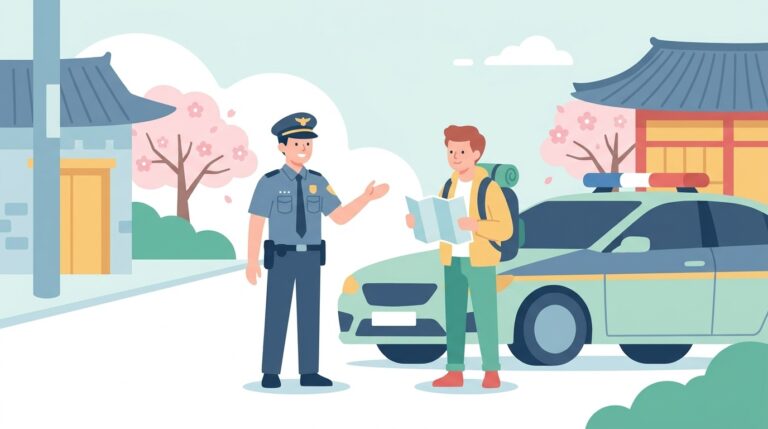
Phase 1: Empathy (Story Immersion Opening)
안녕하세요! 매일한글 에디터입니다. (Hello! I’m your Daily Hangul editor.)
Picture this: You are walking down a quiet alleyway in Hongdae after a fantastic night out enjoying Korean BBQ. The streetlights flicker gently, but suddenly you realize your bag is missing with your passport and wallet inside. Or worse, you spot someone acting aggressively, following you down the block. Your heart pounds. You grab your phone and know you should dial 112, but your mind freezes: What do I say when they pick up? Do they speak English? Will I panic?
If you have watched K-Dramas like Voice or Signal, you know how tense emergency calls can feel! In real life, emergencies are scary enough without a language barrier. This beginner-friendly guide is built from real stories shared by our international learners. By mastering just three simple sentence patterns, you will feel protected, confident, and ready for anything while navigating South Korea.
Phase 2: Core Expressions (Top 3)
1. 도와주세요! (Dowajuseyo!)
- Pronunciation: [Do-wa-ju-se-yo] (Sounds like “Dough-wah-joo-say-yo”)
- Meaning: Literal: “Please give help” / Real Nuance: “Please help me!” (Universal distress call)
- K-Culture Moment: The signature cry heard in almost every suspense drama when a character is cornered or witnesses an accident.
- Editor’s Insight: This is the single most vital word you can learn. Even if you forget everything else, shouting “도와주세요!” instantly alerts everyone nearby that you are in urgent trouble.
- Situation Spectrum: Casual: ⚠️ | Semi-formal: ✅ | Formal: ✅
- 🤔 Think About It: In English, we often shout “Help!” In Korean, the polite ending -yo (요) is almost always retained even in life-or-death situations. What does this tell you about Korean social respect?
2. 경찰 불러주세요! (Gyeongchal bulleojuseyo!)
- Pronunciation: [Gyeong-chal bul-leo-ju-se-yo] (Sounds like “Gyung-chahl bool-luh-joo-say-yo”)
- Meaning: Literal: “Please call the police!” / Real Nuance: “Call the cops right now!”
- K-Culture Moment: Used by shop owners and bystanders in shows like Taxi Driver when confronting troublemakers.
- Editor’s Insight: Gyeongchal means “police”, and bulleojuseyo comes from bureuda (to call). If you cannot dial the phone yourself, scream this toward passersby or convenience store clerks.
- Situation Spectrum: Casual: ⚠️ | Semi-formal: ✅ | Formal: ✅
- 🤔 Think About It: When asking strangers for immediate action in your home country, do you demand it directly or soften your words? Notice how Korean balances urgency with imperative politeness.
3. 여기 [장소]예요. (Yeogi [jangso]yeyo.)
- Pronunciation: [Yeo-gi … ye-yo] (Sounds like “Yuh-ghee … yay-yo”)
- Meaning: Literal: “Here is [place]” / Real Nuance: “I am currently at [location].”
- K-Culture Moment: When callers in Voice whisper their hidden location to the 112 dispatch center.
- Editor’s Insight: The police cannot help if they cannot find you. Replace [장소] with landmark names like 홍대입구역 (Hongdae Station) or GS25 편의점 앞 (in front of GS25 convenience store).
- Situation Spectrum: Casual: 🚫 | Semi-formal: ✅ | Formal: ✅
- 🤔 Think About It: Koreans prioritize spatial reference from broad to specific (Country → City → Street). How does this differ from how you give directions at home?
Phase 3: Textbook Korean vs. Real Korean
Situation 1: Calling for emergency assistance on the street
- 📖 교과서 한국어 (Textbook): 저를 도와주시겠습니까? (Jeoreul dowajusigesseumnikka? / Would you please assist me?)
- 🗣️ 진짜 한국어 (Real-life): 도와주세요! (Dowajuseyo! / Help me!)
- 💡 왜 다를까? (Why is it different?): Textbook grammar teaches hyper-formal questions, but in an emergency, lengthy grammar creates hesitation. Native speakers strip away unnecessary honorific modifiers for swift comprehension.
Situation 2: Asking someone nearby to phone the police
- 📖 교과서 한국어 (Textbook): 경찰서에 전화를 걸어 주십시오. (Gyeongchalseoe jeonhwareul georeo jusipsio. / Please place a call to the police station.)
- 🗣️ 진짜 한국어 (Real-life): 경찰 좀 불러주세요! (Gyeongchal jom bulleojuseyo! / Please call the police!)
- 💡 왜 다를까? (Why is it different?): Adding the soft adverb 좀 (jom – please/a bit) makes urgent requests naturally roll off the tongue while keeping an imperative punch.
Phase 4: K-Culture Deep Dive & Non-verbal Manners
4-1. 눈치 (Nunchi) & Emergency Gestures
When dialing 112 or reporting in person, panicking and waving your arms frantically can cause confusion. Practice high Nunchi (situational awareness): immediately look around for a blue street name sign (도로명주소) on buildings or a pole number. When speaking to an officer or bystander, hold your hands forward or point clearly toward the danger zone with an open palm rather than an aggressive single finger.
4-2. Cultural Code: The Korean Safety Net
South Korea boasts one of the world’s most advanced emergency response ecosystems. 112 (경찰) connects directly to an instantaneous three-way foreign language interpretation service (English, Chinese, Japanese, etc.). Furthermore, 24-hour convenience stores (CU, GS25, 7-Eleven) double as official safe havens for women and children (여성안심지킴이집). If you feel pursued, walk straight into the nearest illuminated convenience store; clerks have direct silent panic buttons installed under the counter!
Phase 5: Real-world Roleplay Scenario
- Background: It is 11:30 PM near Hongdae Exit 9. You noticed an intoxicated person shouting threats and approaching you. You quickly step into a brightly lit spot and dial 112.
- Characters: You (Traveler) & Dispatcher Officer Kim (112 경찰관)
- 경찰관 (Officer Kim): 네, 112 경찰입니다. 무슨 일이세요? (Ne, il-il-i gyeongchal-imnida. Museun il-iseyo?)
“Yes, 112 Police. What is your emergency?”
🎭 침착하고 빠른 목소리로 응대하며 (Speaking in a calm, brisk tone) -
You: 경찰 불러주세요! 도와주세요! (Gyeongchal bulleojuseyo! Dowajuseyo!)
“Please send police! Help me!”
🎭 숨을 헐떡이며 떨리는 목소리로 (Panting with a trembling voice) -
경찰관 (Officer Kim): 진정하세요. 다치셨나요? 어디 계세요? (Jinjeonghaseyo. Dachisyeonnayo? Eodi gyeseyo?)
“Please calm down. Are you hurt? Where are you?”
🎭 수첩에 받아적을 준비를 하며 (Preparing to jot down notes) -
You: 다치지 않았어요. 여기 홍대입구역 9번 출구예요. (Dachiji anasseoyo. Yeogi Hongdae-ip-gu-yeok gubeon chul-gu-yeyo.)
“I am not hurt. I am here at Hongdae Station Exit 9.”
🎭 주변 표지판을 확인하며 (Checking surrounding station signs) -
경찰관 (Officer Kim): 무슨 상황인가요? (Museun sanghwang-in-gayo?)
“What is happening right now?”
🎭 모니터의 CCTV 위치를 조회하며 (Looking up the CCTV coordinates on screen) -
You: 이상한 사람이 따라와요. 무서워요. (Isanghan sarami ttarawayo. Museowoyo.)
“A strange person is following me. I am scared.”
🎭 뒤를 살짝 돌아보며 안전거리 유지 (Looking back slightly, keeping distance) -
경찰관 (Officer Kim): 알겠습니다. 순찰차 바로 출발합니다. 편의점으로 들어가세요! (Al-gesseumnida. Sunchalcha baro chulbalhamnida. Pyeon-uijeom-euro deureogaseyo!)
“Understood. A patrol car is dispatched immediately. Please step inside a convenience store!”
🎭 신속하게 무전 지령을 내리며 (Issuing a rapid dispatch over the radio) -
You: 네, 감사합니다. 빨리 와주세요. (Ne, gamsahamnida. Ppalli wajuseyo.)
“Yes, thank you. Please come quickly.”
🎭 편의점 문을 열고 들어가며 (Opening the door into the convenience store)
🔀 Interactive Decision Point
The operator asks you: “English translator connection needed? (통역 연결해 드릴까요?)” What do you do?
- Option A: Say “Yes, English please! (네, 영어 통역 부탁해요!)” and stay on the line.
👉 Feedback [Best]: Excellent! The 112 center links a 3-way professional translator within 10-20 seconds. You can now state full details without linguistic confusion. - Option B: Hang up in panic to text a friend on KakaoTalk.
👉 Feedback [Bad]: Never hang up on emergency operators! If disconnected, police will try tracking your signal, but precious minutes will be wasted. - Option C: Shout long, complex English paragraphs at high speed without pause.
👉 Feedback [Risk]: High risk of misunderstanding. Officers have basic English training, but fast slang over a crackling line under stress causes delays. Keep it to single keywords until translation connects.
Phase 6: 10-Second Emotion Shadowing Drill
Practice these short survival lines using rhythm pauses (/) and dynamic emotion tags:
[🚨 긴급하고 절박하게 - Urgent & Pleading]
도와주세요! / 경찰 좀 / 불러주세요!
(Do-wa-ju-se-yo! / Gyeong-chal jom / bul-leo-ju-se-yo!)-
[📍 또박또박 침착하게 - Clear & Measured]
여기 / 홍대입구역 / 편의점 앞이에요.
(Yeo-gi / Hong-dae-ip-gu-yeok / pyeon-ui-jeom ap-i-e-yo.) -
[🥺 떨리지만 단호하게 - Shaky but Firm]
위험해요. / 빨리 / 와주세요!
(Wi-heom-hae-yo. / Ppal-li / wa-ju-se-yo!)
Phase 7: K-Culture Mini Dictionary
- 112 (일일이 – Il-il-i) | The National Police Emergency Hotline
Just remember: 112 is for Crime & Police; 119 is for Fire & Medical Ambulance. Available 24/7 toll-free from any SIM or payphone. - 파출소 (Pachulso) | Neighborhood Police Substation
Unlike large district police headquarters (경찰서), a pachulso is nestled inside neighborhood alleys. You can walk straight in anytime for help. - 편의점 (Pyeon-uijeom) | Convenience Store (Emergency Refuge)
More than a place to buy ramyeon! Designated stores participate in neighborhood safety watch initiatives equipped with CCTV and emergency links. - 비상벨 (Bisangbel) | Public Emergency Bell
Red panic buttons found in public park restrooms, hiking trails, and along women-safe walking paths (여성안심귀갓길). Pressing it triggers sirens and two-way voice call to control centers.
Phase 8: Traveler’s Survival Kit
Survival Expressions TOP 3
- 영어로 말씀해 주세요. (Yeong-eoro malsseumhae juseyo.)
“Please speak in English.”
Pro Tip: Say this immediately upon dialing 112 if your Korean freezes. - 살려주세요! (Sallyeojuseyo!)
“Save my life!”
Pro Tip: Use this only in extreme life-threatening danger; it commands immediate physical intervention from anyone within earshot. - 도둑이야! (Dodug-iya!)
“Thief! / Pickpocket!”
Pro Tip: South Korea has remarkably low theft rates, but if someone grabs your bike or phone at a crowded market, yell this loud.
Editor’s Travel Note
- Digital Navigation: Download the Naver Map app (네이버 지도 앱 다운로드) before your trip. Tap your current location pin to see the exact Korean road name address (도로명 주소) to read aloud to 112.
- Offline Phone Numbers: Even if your local SIM card has no voice minutes left, calling 112 and 119 is completely free and works on all Korean networks without credit.
Phase 9: “One Step Deeper” (Cultural Reflection)
In South Korea, public safety (치안 – Chian) is considered a collective community asset. People leave laptops on cafe tables for hours because society operates on high mutual accountability. However, this communal safety also means that when someone shouts “도와주세요!”, citizens and shopkeepers genuinely step in to assist or call the authorities together. Understanding this community-oriented responsibility helps you realize that calling for help in Korea is never seen as a burden—it is welcomed.
💬 Your Turn: Have you ever experienced an emergency while traveling abroad? How do emergency phone calls work in your home country compared to Korea? Share your story in the comments below!
Phase 10: FAQ & Common Mistakes
Q: Can I text 112 if I cannot speak out loud?
A: Yes! You can send an SMS text message to 112 directly from your phone in Korea. You can even attach a photo or short video clip showing the perpetrator, license plate, or street sign. English text is accepted.
Q: Does 112 charge any fee for translation services?
A: No, it is 100% free. The Korean National Police Agency partners with interpretation hotlines (like the 1330 Korea Travel Hotline and BBB Korea) to provide real-time translation.
Q: What is the difference between 112 and 119?
A: 112 is strictly for police, crime, stalking, traffic accidents, and disturbances. 119 handles fire, medical ambulances, paramedics, and natural disaster rescue.
🚨 Common Mistakes Warning Board
- Mistake: Dialing 911 on a non-roaming local phone.
Correction: 911 will reroute on some overseas phones, but always dial 112 directly to prevent connection drops. - Mistake: Explaining long background backstories first.
Correction: State your Location first, then your Current Condition. If the call cuts out, police can still dispatch to that location. - Mistake: Forgetting the polite suffix -yo and shouting informal banmal like “도와줘 (Dowajwo)” to officers.
Correction: Always use 도와주세요 (Dowajuseyo) to keep interactions cooperative and respectful.
Phase 11: Action Missions
- 🥉 Bronze Mission (Solo): Stand in front of your mirror and practice shouting “도와주세요! 경찰 불러주세요!” 5 times with clear pronunciation and confident projection.
- 🥈 Silver Mission (Social/Writing): Open your notes app and write down the Korean name of your hotel and the nearest station in the pattern: “여기 [Hotel Name]예요.”
- 🥇 Gold Mission (Real-world Preparedness): Next time you walk through a Korean city, locate one blue street name sign and one 24h convenience store. Rehearse in your mind how you would direct a police car there.
- 🎮 K-Culture Mission: Watch an episode of a Korean crime drama (such as Voice or Signal) and listen carefully for when a character screams “살려주세요!” or “경찰 불러!”
Phase 12: Interactive Quiz Challenge
1. Situation Judgment: You see someone snatch an elder’s bag and run away. What is the most immediate, natural Korean sentence to alert bystanders?
(A) 저기서 밥 먹었어요.
(B) 도둑이야! 경찰 불러주세요!
(C) 반갑습니다.
2. Fill in the Blank: When telling the operator your location near Seoul Station:
“여기 서울역 _______.” (I am here at Seoul Station.)
(A) 예요 (yeyo)
(B) 아니에요 (anieyo)
(C) 주세요 (juseyo)
3. True or False: In Korea, you must pay an extra service fee on your phone bill if you request an English translator while calling 112.
(True / False)
👉 Click to view Answer & Explanation
- Answer: (B) 도둑이야! 경찰 불러주세요! alerts everyone that a thief is on the run and urges them to contact the police.
- Answer: (A) 예요 (yeyo) is the polite “to be” ending used after vowel-ending nouns like 서울역 앞이에요 or noun tags.
- Answer: False. Emergency translation services through 112 are completely free of charge.







