

Deconstructing the Token: Master C1 Korean for ICOs and Whitepaper Analysis
Phase 1: Empathy (Storytelling Opening)
안녕하세요! 매일한글 에디터입니다. (Hello! This is your Daily Hangul editor.)
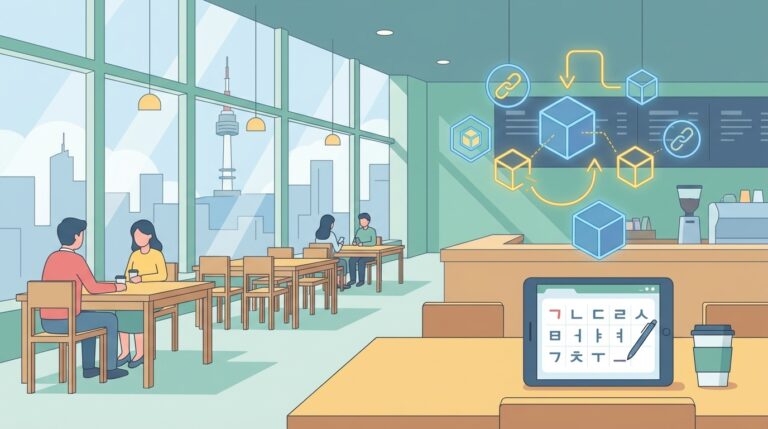
Picture this: You are sitting at an artisanal roastery along Teheran-ro—the beating heart of Seoul’s “Teheran Valley” in Gangnam. Across your table sits a seasoned Korean Web3 venture partner. The laptop screens are glowing, coffee is brewing, and between you lies a freshly printed 45-page whitepaper for an ambitious new Layer-1 protocol launch. You want to ask pointed questions about token allocation, unlock schedules, and technical feasibility. But suddenly, your mind freezes. You know the textbook words for “investigate” and “document,” yet you know that throwing rigid dictionary phrases across the table will instantly mark you as an outsider.
In Korea’s fiercely dynamic cryptocurrency sphere, navigating an ICO (Initial Coin Offering) or dissecting a whitepaper demands far more than basic business formalities. It requires the sharp, colloquial intuition of insider tech jargon paired with sophisticated evaluative rhetoric. Over the years, many of our C1-level students have shared this exact frustration: they possess advanced grammar, yet they stumble when trying to articulate subtle skepticism during technical due diligence. This guide is built directly from real investor debriefs, developer meetups, and investor pitch deck reviews in Seoul. By the end of this article, you will confidently deconstruct any whitepaper with the precision, nuance, and composure of a seasoned Korean crypto analyst.
Phase 2: Core Expressions Deep Dive (핵심 표현 3선)
1. 백서를 뜯어보다 (Baekseoreul tteudeoboda)
- Pronunciation: [Baek-seo-reul tteu-deo-bo-da] (Sounds like “beck-suh-reul tteu-duh-bo-da”—accentuate the tense double ‘tt’ sound like the click of a firm keystroke)
- Meaning: Literally “to rip open and examine a whitepaper”; figuratively means to scrutinize, dissect, or conduct an exhaustive line-by-line audit of a whitepaper.
- K-Culture Moment: Seen frequently in tech thrillers or YouTube crypto analysis channels when an analyst puts on reading glasses and says, “Let’s pull this project apart to check if it’s legitimate.”
- Editor’s Insight: The verb 뜯어보다 (tteudeoboda) combines 뜯다 (to tear apart) and 보다 (to see). In professional Korean Web3 circles, using this verb instead of the clinical 검토하다 (geomtohada, to review) demonstrates that you don’t merely skim documents—you aggressively inspect them for hidden flaws.
- Situation Spectrum: Casual ✅ | Semi-formal ✅ | Formal ⚠️
- 🤔 Think About It: In English, we say “dissect a document.” In Korean, the physical metaphor of “ripping apart” highlights an active, hands-on hunt for truth. How does your native language visualize deep analytical reading?
2. 실현 가능성을 따져보다 (Silhyeon ganeungseongeul ttajyeoboda)
- Pronunciation: [Sil-hyeon ga-neung-seong-eul tta-jyeo-bo-da] (Phonetically: “sil-hyun gah-neung-sung-ul tlah-jyeo-bo-dah”)
- Meaning: Literally “to calculate and verify feasibility”; figuratively means to critically evaluate whether a roadmap can realistically be executed.
- K-Culture Moment: Reminiscent of a tense board meeting scene in Start-Up where an investor cuts through high-concept buzzwords to demand concrete development timelines.
- Editor’s Insight: While 따지다 (ttajida) often means “to nitpick” or “to dispute” in domestic arguments, in venture capital and technical due diligence, it transforms into an indispensable virtue: rigorous scrutiny of claims against hard engineering realities.
- Situation Spectrum: Casual ✅ | Semi-formal ✅ | Formal ✅
- 🤔 Think About It: Notice how 따지다 emphasizes accountability. Why do you think Korean business culture places such heavy linguistic weight on cross-checking claims?
3. 스캠 의혹이 짙다 (Seukaem uihogi jittda)
- Pronunciation: [Seu-kaem ui-ho-gi jit-da] (Phonetically: “soo-cam oo-ee-ho-gi jeet-dah”)
- Meaning: Literally “the suspicion of a scam is thick/dark”; figuratively means there are glaring red flags suggesting a fraudulent project or rug pull.
- K-Culture Moment: Used by crypto investigative journalists and community moderators in KakaoTalk alpha groups when an anonymous dev team suddenly deletes their GitHub repositories.
- Editor’s Insight: The adjective 짙다 (jittda, dense/deep/thick) pairs beautifully with suspicion (의혹). Rather than directly accusing someone of fraud—which can be legally sensitive under Korean defamation statutes—seasoned analysts say the suspicion is “dense,” signaling clear danger while maintaining analytical distance.
- Situation Spectrum: Casual ✅ | Semi-formal ✅ | Formal ✅
- 🤔 Think About It: Why does Korean professional culture prefer descriptive atmospheric metaphors (like “dense suspicion”) over direct accusations during financial assessments?
Phase 3: Textbook Korean vs. Real Korean (교과서 한국어 vs 진짜 한국어)
Situation 1: Pointing out an unbalanced tokenomics structure
- 📖 교과서 한국어: 토큰 분배 구조가 적절하지 않습니다. (Token bunbae gujoga jeokjeolhaji anseumnida. / “The token distribution structure is not appropriate.”)
- 🗣️ 진짜 한국어: 초기 물량이 재단 쪽에 너무 쏠려 있어서 덤핑 위험이 커요. (Chogi mullyang-i jaedan jjoge neomu ssollyeo isseoseo deomp-ing wiheomi keoyo. / “Initial supply is way too heavily concentrated with the foundation, so the dumping risk is massive.”)
- 💡 왜 다를까? (Why the difference?): Textbook Korean relies on broad academic qualifiers like “inappropriate.” Native crypto analysts immediately identify the mechanical vulnerability—token concentration (물량 쏠림) and the impending risk of secondary market dumping (덤핑).
Situation 2: Warning colleagues about unrealistic roadmap milestones
- 📖 교과서 한국어: 개발 일정의 실현이 어려울 것으로 예상됩니다. (Gaebal iljeong-ui silhyeoni eoryeoul geoseuro yesangdoemnida. / “It is anticipated that real-world execution of the development schedule will be difficult.”)
- 🗣️ 진짜 한국어: 이 로드맵은 솔직히 장밋빛 청사진에 불과해서 개발 진척도를 재검증해야 해요. (I rodeumaep-eun soljikhi jangmitbit cheongsajine bulgwahaeseo gaebal jincheokdoreul jaegeomjeunghaeya haeyo. / “Honestly, this roadmap is nothing more than a rosy pipe dream; we must re-verify actual development progress.”)
- 💡 왜 다를까? (Why the difference?): In real tech evaluation, idioms like 장밋빛 청사진 (rosy blueprint) convey high-level professional skepticism without sounding like a robotic machine translation.
Phase 4: K-Culture Deep Dive & Non-Verbal Manners
4-1. 눈치 (Nunchi) & Gestures in Korean Crypto Meetings
In the Korean Web3 landscape, meetings are high-stakes intellectual sparring matches wrapped in impeccable corporate etiquette. When an executive or a founder presents an ICO pitch:
* The Skeptical Head Tilt & Chin Stroke: When discovering ambiguous tokenomics or lack of open-source repositories in a whitepaper, never bluntly shout “This is fake!” Instead, slightly tilt your head by 15 degrees, rest a finger under your chin, and let out a soft “흠… (Hmm…)”. This displays deep contemplation rather than aggressive hostility, giving the presenter face while signaling that you see through the fluff.
* Two-Handed Device Referencing: If pointing out a clause on a tablet or laptop screen, point with an open hand or touch the screen while keeping your other hand supporting your wrist or elbow. This subtle body language maintains respect even when delivering severe analytical criticism.
4-2. Cultural Code: The Post-Terra Landscape and “Kimchi Premium”
Korean retail and institutional investors have experienced intense market volatility, from the legendary “Kimchi Premium” (김치 프리미엄, where crypto traded at a significant premium on Korean exchanges like Upbit and Bithumb) to the catastrophic fallout of major domestic crypto collapses. Because of this shared history, the Korean Web3 ecosystem maintains rigorous community due diligence. Analyzing an ICO whitepaper is not seen merely as a speculative exercise; it is viewed through the cultural lens of financial safeguarding and ethical responsibility.
Phase 5: Real-World Roleplay Scenario
Setting: A private breakout room at a co-working space in Pangyo Techno Valley.
Characters:
* 민우 (Min-woo): Senior Investment Partner at a prominent Seoul crypto VC, analytical and sharp.
* You (Learner): Visiting Blockchain Due Diligence Specialist evaluating a newly unveiled decentralized finance protocol.
민우: 어서 오세요. 이번에 새로 올라온 이 디파이 프로젝트 백서, 혹시 미리 읽어보셨습니까?
(Eoseo oseyo. Ibeone saero ollaon i dipai peurojekteu baekseo, hoksi miri ilgeobosyeosseumnikka?)
“Welcome. Did you happen to read the whitepaper for this new DeFi project that was released recently?”
🎭 Adjusts his glasses, tapping the opened whitepaper on his tablet screen.
You: 네, 어젯밤에 백서를 꼼꼼하게 뜯어봤는데, 몇 가지 의문점이 남더라고요.
(Ne, eojetbame baekseoreul kkomkkomhage tteudeobwanneunde, myeot gaji uimunjeomi namdeoragoyo.)
“Yes, I tore through the whitepaper thoroughly last night, but a few questionable points remained.”
🎭 Opens notebook and points toward the token allocation chart.
민우: 어떤 부분이 가장 마음에 걸리셨나요? 기술 아키텍처 쪽인가요?
(Eotteon bubuni gajang maeume geollisyeonnayo? Gisul akitekcheo jjokingayo?)
“What part bothered you the most? Was it the technical architecture?”
You: 기술력보다는 토크노믹스와 락업 일정의 실현 가능성을 따져봐야 할 것 같아요.
(Gisullyeokbodaneun tokeunomikseuwa rakeu-eop iljeong-ui silhyeon ganeungseongeul ttajyeobwaya hal geot gat-ayo.)
“Rather than the technical prowess, I think we must scrutinize the feasibility of the tokenomics and lock-up schedule.”
🎭 Maintains steady eye contact with a calm, analytical expression.
민우: 아, 역시 정확히 보셨네요. 팀 배정 물량이 지나치게 많죠?
(A, yeoksi jeonghwakhi bosyeonneyo. Tim baejeong mullyang-i jinachige manjyo?)
“Ah, as expected, you caught it precisely. The team allocation volume is excessively large, right?”
You: 네, 팀 물량이 40%인데 락업 해제 기간이 겨우 6개월이라 스캠 의혹이 짙어 보여요.
(Ne, tim mullyang-i sasip-peosenteu-inde rakeu-eop haeje gigani gyeou yukgaeworira seukaem uihogi jitteo boyeoyo.)
“Yes, the team volume is 40%, yet the vesting cliff is merely six months, which raises thick suspicions of a scam.”
민우: 맞습니다. 게다가 깃허브(GitHub) 커밋 기록도 지난달 이후로 완전히 멈춰 있더군요.
(Matseumnida. Gedaga giteoheobeu keomit girokdo jinandall ihuro wanjeonhi meomchwo itdeogunyo.)
“Spot on. On top of that, their GitHub commit activity has been completely stalled since last month.”
You: 그렇다면 이번 프라이빗 라운드 참가는 전면 재검토하는 게 안전하겠네요.
(Geureotamyeon ibeon peuraibit raundeu chamganeun jeonmyeon jaegeomtohaneun ge anjeonhagetneyo.)
“In that case, it would be safest for us to conduct a total re-evaluation of participating in this private round.”
🎭 Nods resolutely while closing the tablet folio.
🔀 Interactive Branching Moment
Min-woo leans forward and asks: “If the project founders offer an extra 20% bonus token grant for our quick commitment today, how should we respond in Korean?”
- Choice A: “당장 계약서 씁시다! 이런 기회는 놓치면 아깝죠.” (Let’s sign immediately! It would be a waste to miss this chance.)
- Feedback: ❌ Bad. Demonstrates reckless FOMO (Fear Of Missing Out) and destroys your credibility as a professional analyst.
- Choice B: “당장의 인센티브보다는 로드맵 이행 여부와 온체인 데이터를 먼저 검증해야 합니다.” (Rather than immediate incentives, we must first verify roadmap execution and on-chain metrics.)
- Feedback: 🌟 Best. Perfectly demonstrates C1-level analytical maturity, prioritizing empirical evidence over hype.
- Choice C: “그 팀 사기꾼들이니까 경찰에 신고합시다.” (Those team members are crooks, so let’s call the police.)
- Feedback: ⚠️ Risk. Premature legal escalation without completed on-chain audit or conclusive forensic proof.
Phase 6: 10-Second Emotion Shadowing Drill
Read these high-frequency evaluation lines aloud. Follow the / pause markers to match native rhythm and absorb the emotional mindset.
[🧐 Sharp & Skeptical]
백서에 적힌 화려한 파트너십보다 / 실제 온체인 활성 지표를 / 뜯어봐야 합니다.
(Baekseoe jeokhin hwaryeohan pateuneosipboda / silje onchein hwalseong jipyoreul / tteudeobwaya hamnida.)
“Rather than the glamorous partnerships written in the whitepaper / we must dissect / the actual on-chain activity metrics.”-
[🚨 Resolute & Warning]
초기 유통량이 불투명하고 / 락업 해제 시점이 모호해서 / 스캠 의혹이 매우 짙습니다.
(Chogi yutongnyang-i bultumyeonghago / rakeu-eop haeje sijeomi mohohaeseo / seukaem uihogi maeu jitseumnida.)
“The initial circulating supply is opaque / and the unlock schedule is ambiguous / so the suspicion of a scam is exceptionally thick.” -
[💼 Professional & Decisive]
이 프로젝트의 기술적 로드맵은 / 현실적으로 실현 가능성을 / 다시 따져봐야 할 문제입니다.
(I peurojekteu-ui gisuljeok rodeumaebeun / hyeonsiljeogeuro silhyeon ganeungseongeul / dasi ttajyeobwaya hal munjeimnida.)
“This project’s technical roadmap / is an issue where we must practically / re-evaluate feasibility.”
Phase 7: K-Culture Mini Dictionary
| # | Term (한글 + Romanization) | Translation | Real-World Usage Insight |
|---|---|---|---|
| 1 | 락업 (Rakeu-eop) | Lock-up / Vesting Period | Refers to the mandatory holding period during which early investors and founders cannot sell their tokens. Vital for analyzing dump risks. |
| 2 | 로드맵 (Rodeumaep) | Development Roadmap | The milestone schedule. In Korean VC discussions, calling a roadmap a “장밋빛 청사진” (rosy blueprint) implies it lacks realistic engineering execution. |
| 3 | 먹튀 (Meoktwi) | Exit Scam / Rug Pull | Compound of 먹고 튀다 (eat and run). Used casually and professionally across Korean Web3 to describe teams that dump tokens and vanish. |
| 4 | 가스비 (Gaseubi) | Gas Fees / Network Fees | Transaction fees on networks like Ethereum. Essential when debating Layer-2 scalability solutions in technical whitepapers. |
Phase 8: Survival Kit for Tech Travelers & Business Professionals
Top 3 On-Site Survival Expressions
- 토큰 배분 비율과 베스팅 일정을 명시해 주실 수 있나요?
(Token baebun bi-yulgwa beseuting iljeong-eul myeongsihae jusil su innayo?)
Pro Tip: Use this formal query during an investor Q&A to ask founders to explicitly clarify token allocation and vesting schedules. - 스마트 컨트랙트 감사 보고서가 이미 발행되었습니까?
(Seumateu keonteuraektu gamsa bogoseoga imi balhaengdoe-eosseumnikka?)
Pro Tip: Essential due-diligence check: “Has the smart contract security audit report already been issued?” - 깃허브 저장소는 퍼블릭으로 언제 전환되나요?
(Giteoheobeu jeojangssoneun peobeulligeuro eonje jeonhwandoenayo?)
Pro Tip: Asking when private code repositories will become public tests a team’s transparency.
Editor’s Travel Note
Heading to Seoul for a blockchain conference like Korea Blockchain Week (KBW)? Download the Naver Map application to navigate the labyrinth of co-working spaces and underground cafes in Yeoksam and Samseong. Furthermore, set up KakaoTalk before landing; nearly all Korean tech networking and project alpha discussions take place in Kakao Open Chat rooms rather than Western-centric Telegram or Discord.
Phase 9: A Step Deeper (한 발 더 깊이)
The linguistic rigor used when critiquing Korean crypto projects is inextricably linked to Korea’s hyper-compressed modern economic development. Having witnessed rapid macroeconomic shifts, Korean society maintains a deep dual relationship with high-risk financial innovations—balancing intense pioneering enthusiasm with fierce collective skepticism. When industry professionals use idioms like 뜯어보다 (to tear apart and examine) rather than passive corporate jargon, they are channeling a cultural imperative: in an ultra-fast market, survival depends on proactive vigilance, where polite silence can lead to shared catastrophic loss.
💬 Your Turn: Have you ever read an investment document or whitepaper where something felt completely off? How do you express constructive doubt in your own language without sounding openly combative? Share your thoughts below!
Phase 10: FAQ & Avoiding Misunderstandings
Q: Can I use the term “먹튀 (Meoktwi)” in a formal pitch meeting?
A: While “먹튀” is universally understood, using it during a formal investor committee meeting sounds slightly unpolished. Instead, opt for the C1-level formal equivalent: “투자금 회수 위험 및 프로젝트 중단 가능성” (Risk of unreturned investment and project abandonment) or “러그풀(Rug pull) 위험”.
Q: Is it disrespectful to publicly question a founder’s roadmap during a presentation?
A: Not if framed through proper Korean indirect honorific strategies. Instead of stating “당신 로드맵은 비현실적입니다” (Your roadmap is unrealistic), frame it with inquiry particles: “로드맵상의 분기별 목표 달성에 필요한 인력 구성이 충분한지 궁금합니다” (I wonder whether the personnel structure is sufficient to reach the quarterly roadmap milestones).
Q: What is the difference between 백서 (Baekseo) and 사업계획서 (Saeop gyehoekseo)?
A: 백서 (Whitepaper) specifically references technical architecture, cryptographic mechanisms, and decentralized governance models. 사업계획서 (Business Plan) refers to standard commercial corporate enterprise documents focusing on conventional revenue and operational P&L models.
🚨 Common Mistakes Warning Board
- Mistake: Translating “scam” literally as 범죄 (crime) during technical meetings.
Correct Action: Use 스캠 의혹 (suspicion of scam) or 프로젝트 지속 가능성 부재 (lack of project sustainability). - Mistake: Using flat banmal with younger startup founders.
Correct Action: Even if founders appear very young, Korean venture etiquette mandates the highest polite speech style (하십시오체 / 해요체) until mutual intimacy is explicitly agreed upon. - Mistake: Saying “I checked the whitepaper” using superficial verbs like “확인했어요”.
Correct Action: Demonstrate thoroughness using C1 compounds like “면밀히 검토했습니다” (closely examined) or “꼼꼼하게 뜯어봤습니다” (thoroughly dissected).
Phase 11: Action Mission & Community Challenge
- 🥉 Bronze Mission (Solo Practice): Practice the Phase 6 Shadowing Drill 5 times in front of a mirror, timing your pauses with the slash markers.
- 🥈 Silver Mission (Social Sharing): Write a 2-sentence critique in Korean of any Web3 project on your Twitter or LinkedIn, utilizing the expression 실현 가능성을 따져보다.
- 🥇 Gold Mission (Real-world Execution): Attend an online Korean crypto webinar, AMA, or meetup, and ask one question using the polite business formula: “토큰 베스팅 일정의 실현 가능성에 대해 여쭤보고 싶습니다.”
🎮 K-Culture Bonus Mission: Find a Korean Web3 YouTube video by searching “백서 분석” (Whitepaper Analysis). Listen carefully and count how many times the presenter uses the verb 따져보다 or the noun 의혹!
Phase 12: Interactive Quiz Challenge
Test your mastery of Korean crypto due diligence concepts with this interactive check!
Question 1 (Contextual Judgment)
You are reviewing an ICO whitepaper where the anonymous team holds 60% of all issued tokens with no vesting lock-up. Which Korean sentence conveys the sharpest professional due diligence judgment?
* A) 이 백서는 한국어로 번역하기 아주 쉽습니다.
* B) 팀 물량 쏠림과 락업 부재로 인해 스캠 의혹이 매우 짙습니다.
* C) 토큰 가격이 내일 아침에 무조건 급등할 것입니다.
Question 2 (Fill-in-the-Blank)
완성도 높은 투자를 위해서는 백서에 적힌 화려한 수식어 대신 기술적 실현 ________을/를 냉정하게 따져봐야 합니다.
(Hint: The noun meaning ‘feasibility’)
Question 3 (True / False Cultural Check)
In Korean venture capital discussions, asking detailed questions about token unlock schedules and auditing reports is considered culturally impolite because it reveals a lack of trust in the founder.
* [ True / False ]
👉 Click here to reveal Answers & Explanations!
- Answer 1: B) “팀 물량 쏠림과 락업 부재로 인해 스캠 의혹이 매우 짙습니다.” (Due to token concentration and lack of lock-up, scam suspicions are very thick.) Choice A is irrelevant, and Choice C is irresponsible speculation.
- Answer 2: 가능성 (Full phrase: 실현 가능성 – Realization feasibility).
- Answer 3: False! In the post-Terra Korean Web3 environment, rigorous due diligence and demanding audit proofs are expected hallmarks of an educated, professional investor.







