

Beyond the Forecast: Decoding the Impact of El Niño and La Niña on Korean Society
Phase 1: 공감 (Story-Immersive Opening)
안녕하세요! 매일한글 에디터입니다.
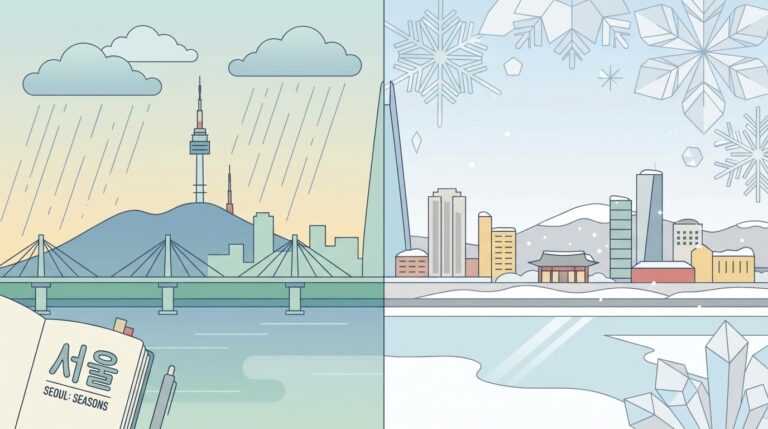
Picture this: You are sitting in an open-brick cafe in Seongsu-dong in late November. The ambient lo-fi music is softly humming, yet everyone’s eyes are glued to the cafe’s muted television screen mounted on the wall. A crimson emergency banner flashes across the bottom of the news screen: “엘니뇨 여파로 인한 기습 폭우 및 겨울철 이상고온 현상 지속” (Unprecedented sudden downpours and persistent winter heat anomalies due to El Niño). You glance around. The office workers beside you aren’t just sighing about wet shoes; they are debating the impending surge in Napa cabbage prices (배춧값 폭등) and analyzing how the breakdown of the traditional Samhansanon (삼한사온: three cold days, four warm days) will ravage winter retail supply chains.
You want to chime in. You have achieved advanced Korean proficiency, your grammar is pristine, yet you suddenly feel paralyzingly tongue-tied. You know words like 비 (rain) and 춥다 (cold), but in sophisticated Korean professional and intellectual circles, weather is not a banal icebreaker—it is an intricate socio-economic discourse. When oceanic temperature anomalies in the equatorial Pacific disrupt the East Asian jet stream, Koreans feel it directly in their dining tables, heating bills, and municipal infrastructure. This guide is crafted directly from field feedback from diplomats, analysts, and long-term residents who felt their conversational fluency collapse when climate complexity entered the room. By mastering this unit, you will step beyond basic fluency and claim your seat at the C2 executive table, effortlessly weaving atmospheric phenomena into nuanced socio-cultural analysis.
Phase 2: 핵심 표현 3선 심층 분석 (Top 3 Core Expressions)
1. 이상기후로 인한 기상이변 (Isang-gihu-ro inhan gisang-ibyeon)
- Pronunciation: [Ee-sang-gi-hu-ro in-han gi-sang-ee-byeon] (Sounds like reciting a formal documentary voice-over: ee-sang like ‘east-song’ without the t, gi-sang crisp and resolute).
- Meaning: Literal: “Meteorological anomalies caused by abnormal climate.” / Real Nuance: The definitive, high-register term used in academic, journalistic, and policy discourse to describe severe, unprecedented weather events shaking the status quo.
- K-Culture Moment: Frequently heard on JTBC Newsroom or KBS 9 O’Clock News investigative reports when discussing unseasonal torrential downpours in downtown Gangnam.
- Editor’s Insight: While beginners use 날씨가 이상해요 (The weather is strange), C2 speakers distinguish between 기후 (climate as a macro-system) and 기상 (day-to-day atmospheric phenomena). Using 기상이변 signals systemic awareness rather than subjective discomfort.
- Situation Spectrum: Casual ⚠️ | Semi-formal ✅ | Formal ✅
- 🤔 Think About It: In English, we often say “freak weather.” Does the Korean term 기상이변 (literally an “abnormal mutation/shift of meteorological signs”) imply a rupture in natural cosmic balance?
2. 엘니뇨 여파로 국지성 호우가 쏟아지다 (Eulninyo yeopa-ro gukjiseong hou-ga ssod-ajida)
- Pronunciation: [El-ni-nyo yeo-pa-ro guk-ji-seong ho-u-ga sso-da-ji-da] (Flow the yeo-pa softly like an aftershock wave, then snap the plosive ssod-a-ji-da like a dam bursting).
- Meaning: Literal: “In the aftermath/fallout of El Niño, localized torrential rain pours down.” / Real Nuance: Highlighting the unpredictable, violent concentration of rainfall over a hyper-specific district—a trademark pattern of El Niño summers in the Korean peninsula.
- K-Culture Moment: Disaster-thriller films or live disaster broadcasts when mountain flash floods hit Gangwon-do while neighboring Seoul remains dry.
- Editor’s Insight: 여파 (餘波) literally means “lingering waves after a storm.” It is the ultimate word to describe ripple effects or unintended downstream consequences in formal discourse.
- Situation Spectrum: Casual ⚠️ | Semi-formal ✅ | Formal ✅
- 🤔 Think About It: Notice the visceral verb 쏟아지다 (to spill/pour out) paired with the technical noun 국지성 호우. How does this blend technical precision with dramatic physical impact?
3. 라니냐의 영향으로 매서운 한파가 몰아치다 (Raninya-ui yeonghyang-euro maeseoun hanpa-ga mora-chida)
- Pronunciation: [La-ni-nya-eui yeong-hyang-eu-ro mae-seo-un han-pa-ga mo-ra-chi-da] (Feel the sharp, biting chill on mae-seo-un, mimicking howling Siberian wind cutting through layers of down coats).
- Meaning: Literal: “Under the influence of La Niña, a fierce/biting cold wave sweeps through.” / Real Nuance: Describing the notorious peninsular deep-freeze where dry, sub-zero continental polar air masses aggressively plunge south due to high-latitude pressure blocks.
- K-Culture Moment: Used in national winter energy crisis advisories and daily morning talk shows warning elders against hypothermia and burst pipes (동파 사고).
- Editor’s Insight: 매섭다 is an evocative adjective expressing cold that bites like a predatory hawk (매). Pairing it with 몰아치다 elevates your description from “it’s very cold” to cinematic narrative mastery.
- Situation Spectrum: Casual ✅ | Semi-formal ✅ | Formal ✅
- 🤔 Think About It: Why does Korean culture attribute violent, active agency (몰아치다 – to drive furiously) to cold air rather than treating it as an ambient state?
Phase 3: 교과서 한국어 vs 진짜 한국어 (Textbook vs. Native Reality)
Situation 1: Describing a sudden, devastating downpour in Seoul
- 📖 교과서 한국어 (Textbook Style):
비가 갑자기 너무 많이 와서 도로가 침수되었습니다. (Biga gapjagi neomu mani waseo doroga chimsudeo-eotsseumnida.)
Translation: The rain fell so suddenly and heavily that the road was flooded. - 🗣️ 진짜 한국어 (Authentic Native Style):
엘니뇨 때문에 대기가 워낙 불안정해서, 하늘에 구멍이라도 뚫린 것처럼 게릴라성 폭우가 퍼붓고 있어요. (Eulninyo ttaemune daegiga wonak buranjeonghaeseo, haneure gumeong-irado ttullinc heoreom gerillaseong poguga peobutgo isseoyo.)
Translation: The atmospheric instability from El Niño is so extreme that guerrilla-style torrential rain is dumping down as if someone poked a hole in the heavens. - 💡 왜 다를까? (Why the Difference?):
Advanced native speakers avoid plain descriptions like 비가 많이 오다. Instead, they employ vivid meteorological metaphors (게릴라성 폭우, 하늘에 구멍이 뚫리다) to articulate the violent unpredictability of climate anomalies.
Situation 2: Discussing winter cold waves and agricultural shock
- 📖 교과서 한국어 (Textbook Style):
날씨가 매우 추워져서 채소 가격이 많이 올랐습니다. (Nalssiga maeu chuwojyeoseo chaeso gagyeogi mani ollatseumnida.)
Translation: Because the weather became very cold, vegetable prices rose significantly. - 🗣️ 진짜 한국어 (Authentic Native Style):
올겨울 라니냐발 북극 한파가 직격탄을 날리면서, 농가 피해는 물론이고 장바구니 물가에 제대로 비상이 걸렸습니다. (Olgyeoul raninyabal bukgeuk hanpaga jikgyeoktaneul nallimyeonseo, nongga pihaeneun mullon-igo jangbaguni mulgae jedaero bisang-i geollyeotsseumnida.)
Translation: With this winter’s La Niña-driven Arctic cold snap dealing a direct blow, it has not only ravaged farms but sent household grocery inflation into full-blown crisis mode. - 💡 왜 다를까? (Why the Difference?):
In contemporary Korean society, weather is directly tied to socio-economic indicators. The compound affix -발 (originating from/sparked by) combined with vivid idioms like 직격탄을 날리다 (deliver a direct hit) and 비상이 걸리다 (go on emergency alert) reflects genuine executive-level dialogue.
Phase 4: K-Culture 딥다이브 & 비언어적 매너 (Deep Dive & Non-Verbal Nuance)
4-1. 눈치 (Nunchi) & Somatic Communication
When discussing the severe impacts of El Niño or La Niña in Korea, posture and tone must mirror empathy. Korea has a densely interconnected agricultural, logistics, and retail ecosystem.
* The Somatic Sigh (탄식): When an interlocutor mentions agricultural crop damage (작황 부진) or soaring Napa cabbage prices, avoid treating it as trivial trivia. Offer a subtle, downward head tilt combined with a light, suppressed tongue-click (쯧) or a quiet exhalation: “아이고, 농가 분들 시름이 깊으시겠어요…” (Oh dear, the farmers must be carrying such heavy hearts…).
* Gaze & Attentiveness: In formal or semi-formal business settings, when a colleague mentions that their commute was delayed due to flash flooding (침수), direct steady eye contact paired with hands clasped in front demonstrates respectful solidarity. Never smirk or dismiss torrential flooding as mere “bad luck.”
4-2. Cultural Code: The Collapse of Samhansanon and the Kimjang Economy
For centuries, the Korean peninsula’s winter rhythm was dictated by the folk wisdom of 삼한사온 (Samhansanon)—three consecutive Siberian cold days followed by four milder days brought by warming southern airflow. This predictability governed seasonal living, heating conservation, and the sacred ritual of 김장 (Kimjang), the communal late-autumn preparation of year-round kimchi.
However, ENSO (El Niño-Southern Oscillation) dynamics have shattered this rhythm.
* Under La Niña, the polar vortex breaks through weakened jet streams, subjecting Korea to prolonged, unyielding 시베리아 한파 (Siberian cold blasts) without the four-day reprieve. The ground freezes solid prematurely, rotting radish and cabbage roots.
* Under El Niño, late autumns experience anomalous subtropical moisture plumes, producing humid, damp warm spells where fermented kimchi rots before curing.
To discuss El Niño and La Niña in Korea is therefore to touch the nerve center of Korean culinary survival, energy infrastructure, and collective memory.
Phase 5: 실전 롤플레이 시나리오 (Real-World Roleplay Scenario)
- Setting: The high-floor executive briefing lounge of an urban resilience consultancy in Yeouido, overlooking a storm-swept Han River.
- Characters:
- 이준호 부장 (Director Lee Jun-ho): A seasoned, sharp municipal policy expert in his late 40s, nursing a black coffee while watching radar displays.
- 알렉스 (Alex): A C2-certified foreign senior infrastructure analyst navigating high-stakes strategic adaptation.
Turn 1
* 이준호: 알렉스 님, 방금 기상청 레이더 화면 확인하셨습니까? 서해안에서 발달한 비구름대가 심상치 않네요. (Alex nim, bang-geum gisangcheong reideo hwamyeon hwaginhayeosseumnikka? Seohae-aneseo baldalhan bigureumdaega simsangchi anneyo.)
* Alex, did you just check the Korea Meteorological Administration radar feed? The rain cloud band developing over the West Coast looks deeply ominous.
* 🎭 행동 지문: 창밖의 거센 비바람을 응시하며 미간을 찌푸린다. (Frowns while staring intently out the window at the fierce rain and wind.)
Turn 2
* 알렉스: 네, 부장님. 전형적인 슈퍼 엘니뇨 여파로 북태평양 고기압 가장자리를 따라 막대한 수증기가 유입된 탓입니다. (Ne, bujangnim. Jeonhyeongjeogin syupeo eulninyo yeoparo buktaepyeong-yang gogi-ap gajangjarireul ttara makdaehan sujeung-giga yu-ipdoen tasimnida.)
* Yes, Director. It is a textbook El Niño ripple effect; massive atmospheric moisture has been funneled along the western periphery of the North Pacific High.
* 🎭 행동 지문: 태블릿의 강수량 예측 모델을 테이블 중앙으로 밀어 보여준다. (Slides the precipitation forecast model on the tablet toward the center of the table.)
Turn 3
* 이준호: 맞아요. 이런 식이면 퇴근 시간대에 강남역 일대에 또다시 국지성 폭우가 쏟아질 텐데, 배수 펌프장 가동 현황은 어떻습니까? (Majayo. Ireon sik-imyeon toegeun sigandae-e Gangnam-yeok ildae-e ttodasi gukjiseong poguga ssodajil tende, baesu peompeujang gadong hyeonhwang-eun eotteosumnikka?)
* Precisely. At this rate, localized cloudbursts will hammer the Gangnam Station basin right at the evening rush hour. What is the status of the drainage pump stations?
* 🎭 행동 지문: 시계를 확인한 뒤 우려 섞인 목소리로 책상을 톡톡 두드린다. (Checks his watch and taps the desk with an anxious rhythm.)
Turn 4
* 알렉스: 저지대 집수 시설은 선제적으로 수위를 낮춰 뒀지만, 시간당 80밀리미터 이상 퍼부으면 침수 피해를 완전히 막긴 역부족입니다. (Jeojidae jipsu siseoreun seonjejeog-euro suwireul natchwo dwoetjiman, sigandang palsip-millimiteo isang peobu-eumyeon chimsu pihaereul wanjeonhi makgin yeokbujogimnida.)
* We preemptively lowered the retention levels in the low-lying catchment basins, but if it dumps over 80 millimeters per hour, it will simply be beyond capacity to prevent flooding entirely.
* 🎭 행동 지문: 굳은 표정으로 고개를 가볍게 가로젓는다. (Shakes head lightly with a resolute, solemn expression.)
Turn 5
* 이준호: 여름에는 엘니뇨로 게릴라성 폭우, 겨울에는 라니냐로 기록적인 북극 한파… 한반도 사계절의 근간이 흔들리는 기분이에요. (Yeoreum-eneun eulninyoro gerillaseong pogu, gyeoul-eneun raninyaro girokjeogin bukgeuk hanpa… Hanbando sagyejeorui geun-gani heundeullineun gibun-ieyo.)
* Summer brings guerrilla flash floods from El Niño, and winter brings record-breaking Arctic freezes from La Niña… It feels as though the very foundation of the peninsula’s four seasons is unraveling.
* 🎭 행동 지문: 씁쓸한 미소를 지으며 커피잔을 내려놓는다. (Sets down his coffee cup with a wry, bittersweet smile.)
Turn 6
* 알렉스: 동감입니다. 전통적인 삼한사온은 사실상 붕괴되었고, 농축산물 작황 악화로 장바구니 물가 안정이 최우선 정책 과제가 되었으니까요. (Dong-gam-imnida. Jeontongjeogin samhansanoneun sasilsang bung-goedoeeotgo, nongchaksanmul jakhwang akhwaro jangbaguni mulga anjeong-i choe-useon jeongchaek gwajega doeeosseunikkayo.)
* I couldn’t agree more. The traditional cycle of three cold and four warm days has practically collapsed, making the stabilization of grocery inflation the foremost policy emergency due to ruined crop yields.
* 🎭 행동 지문: 분석 리포트의 농산물 지표 도표를 가리킨다. (Points to the agricultural index chart in the analytical report.)
Turn 7
* 이준호: 알렉스 님 덕분에 우리 팀 기후 리스크 대응 보고서의 논리가 아주 탄탄해졌습니다. 이번 재난대책회의에서 발언하실 때 방점을 어디에 두실 계획인가요? (Alex nim deokbune uri tim gihu riseukeu daeeung bogoseoui nonriga aju tantanhaejyeotsseumnida. Ibeon jaenandaechaekhoe-ui-eseo bareonhasil ttae bangjeomeul eodi-e dusil gyehoek-ingayo?)
* Thanks to you, Alex, the rationale in our team’s climate risk response report has become rock-solid. Where do you plan to place the core emphasis when you speak at the upcoming Disaster Management Committee?
* 🎭 행동 지문: 안경을 고쳐 쓰며 기대 어린 눈빛으로 알렉스를 바라본다. (Adjusts his glasses and looks at Alex with an expectant gaze.)
Turn 8
* 알렉스: [Your Decision Point Below]
🔀 인터랙티브 분기점 (Interactive Branching Point)
Choose Alex’s response for Turn 8:
- Option A: “기상이변은 어쩔 수 없는 자연재해니까, 침수 발생 시 피해 보상 예산을 대폭 늘리자고 건의하겠습니다.” (Since meteorological anomalies are unavoidable natural disasters, I will propose drastically increasing compensation budgets after floods occur.)
- Evaluation: 🚫 Bad. Demonstrates a passive, reactionary mindset. In Korean corporate and municipal leadership, disaster strategy demands proactive prevention (선제적 대응) and systemic resilience, not mere post-disaster payout.
- Option B: “단순한 제방 증고보다는, 엘니뇨와 라니냐의 변동성을 상수로 둔 도시 인프라의 전면적 패러다임 전환과 물가 충격 완화망 구축에 방점을 찍겠습니다.” (Rather than simple levee reinforcement, I will emphasize a total paradigm shift in urban infrastructure that treats ENSO volatility as a baseline constant, alongside building economic safety nets against food inflation shocks.)
- Evaluation: ✅ Best. Pure C2 executive mastery. Perfectly synthesizes structural urban engineering with macro-economic empathy, framed in high-level policy lexicon (상수로 두다, 패러다임 전환, 완화망 구축).
- Option C: “비가 너무 많이 오면 재택근무를 전면 의무화해서 직원들의 출퇴근 불만을 해소하자고 제안하겠습니다.” (I will suggest mandating work-from-home whenever it rains heavily to resolve employee commute complaints.)
- Evaluation: ⚠️ Risk. While empathetic to individual workers, it fundamentally misreads the scale of the meeting. In an executive disaster summit dealing with multi-billion-won public infrastructure and climate volatility, focusing solely on office telework sounds detached and trivial.
Phase 6: 10초 감정 섀도잉 드릴 (Emotional Shadowing Drill)
Master the subtle cadence, breathless weight, and authoritative rhythm of modern Korean meteorology. Practice pausing at each / mark.
- [😰 다급하고 단호하게 – Urgent and Decisive]
“서해안에서 유입된 수증기 탓에 / 수도권 일대에 시간당 80밀리미터가 넘는 / 기록적인 폭우가 쏟아지고 있습니다!”
(Seohae-aneseo yu-ipdoen sujeung-gi tase / sudogwon ildaee sigandang palsip-millimiteoga neomneun / girokjeogin poguga ssodajigo isseumnida!) -
[😔 탄식하며 혀를 차듯이 – Deeply Sighing with Empathetic Lament]
“라니냐로 인한 역대급 한파 때문에 / 채소 작황이 망가져서 / 장바구니 물가에 제대로 비상이 걸렸어요…”
(Raninyaro inhan yeokdaegeup hanpa ttaemune / chaeso jakhwang-i mang-gajyeoseo / jangbaguni mulgae jedaero bisang-i geollyeosseoyo…) -
[🧐 냉철하고 분석적으로 – Cool-headed, Analytical Executive Pitch]
“엘니뇨와 라니냐의 주기적 교차를 / 단순한 기상이변이 아닌 / 상시적 기후 위기 변수로 / 재정의해야 합니다.”
(Eulninyowa raninya-ui jugijeok gyocha-reul / dansunhan gisang-ibyeon-i anin / sangsijeok gihu wigi byeonsu-ro / jaejeong-uihaeya hamnida.)
Phase 7: K-Culture 미니 사전 (Mini Dictionary)
- 게릴라성 집중호우 (Gerillaseong Jipjunghou)
- English: Guerrilla-style localized cloudburst / flash flood.
- Context: Originating from military terminology, this describes unpredictable, violent cloudbursts that strike tiny districts for 30–60 minutes and vanish. Used constantly by navigation apps, news alerts, and office workers coordinating lunch.
- 장바구니 물가 (Jangbaguni Mulga)
- English: Grocery cart consumer inflation (literally “market-basket prices”).
- Context: Unlike abstract CPI figures, this specifically refers to everyday dietary staples (cabbage, spring onions, eggs, tofu). When El Niño or La Niña damages rural poly-tunnels, headlines scream about 장바구니 물가 비상.
- 삼한사온의 붕괴 (Samhansanon-ui Bung-goe)
- English: The breakdown of the traditional cycle of three cold days and four warm days.
- Context: An intellectual, melancholic lament often raised in editorials and seasonal essays reflecting how anthropogenic warming and Pacific teleconnections have destroyed Korea’s historical seasonal balance.
- 기상특보 (Gisangteukbo)
- English: Official Meteorological Emergency Warning / Severe Weather Advisory.
- Context: Divided into 주의보 (Advisory) and 경보 (Warning). When the emergency siren barks on mobile phones across Seoul, the text header always reads [기상특보 발령].
Phase 8: 여행자를 위한 생존 키트 (Survival Kit for Navigators)
서바이벌 표현 TOP 3 (Survival Phrases)
- “지하철역 출구가 침수 위험으로 통제되었나요?”
(Ji-hacheol-yeok chul-guga chimsu wiheom-euro tongjedeo-eonnayo?)
Translation: Has the subway station exit been closed due to flood risk?- Pro Tip: During Seoul flash floods, low-lying underground stations (Gangnam, Isu, Daechi) close specific stairs. Use this phrase with subway station attendants (역무원).
- “라니냐 한파 경보가 떴는데 오늘 도로 결빙 심한가요?”
(Raninya hanpa gyeongboga tteonneunde oneul doro gyeolbing simhangayo?)
Translation: A La Niña cold wave warning was issued; is road black ice severe today?- Pro Tip: Crucial when booking early morning taxis or airport buses after a freezing night.
- “농산물 가격 폭등 때문에 식자재 수급에 차질이 있나요?”
(Nongsanmul gagyeok pokdeung ttaemune sikjajae sugeube chajiri innayo?)
Translation: Is there any disruption in ingredient supply due to skyrocketing produce prices?- Pro Tip: An ultra-polite, elite phrase when dining at traditional Korean multi-course restaurants (한정식) experiencing menu substitutions during severe seasonal crop failures.
Editor’s Travel Note
- Digital Lifelines: Do not rely on foreign weather apps; they severely lag behind peninsular micro-climate models. Make sure you complete the 기상청 날씨알리미 앱 다운로드 for localized radar tracking and cell-broadcast alerts. For civil defense warnings, install the 안전디딤돌 국민재난안전포털 앱 다운로드.
- Transit Etiquette: On days with severe localized downpours (호우경보), public buses will strictly ban passengers holding soaking wet, non-sheathed umbrellas without vinyl wrap or absorbent covers. Look for the umbrella wrapper stand (우산 비닐 회수기) at building lobbies.
Phase 9: “한 발 더 깊이” (Philosophical Insight)
Koreans have historically viewed the changing of the seasons not merely as an atmospheric cycle, but as a moral dialogue between human industry and the natural cosmos (천지인, 天地人). The twenty-four solar terms (24절기) governed the collective life of agrarian communities, where shared hardship fostered 정 (Jeong) and mutual cooperation (품앗이). When modern oceanic oscillations like El Niño and La Niña shatter these timeless temporal markers, the shock in Korean society is both economic and existential. Discussing climate in Seoul is never detached data analysis—it is a deeply socialized recognition of our collective vulnerability, woven right into the cost of tonight’s communal dinner.
💬 Your Turn: How does your home country’s language articulate the connection between distant oceanic phenomena like El Niño and your daily dining table? Share your favorite meteorological or culinary idiom in the comments below!
Phase 10: FAQ & 오해 방지 (FAQ Schema)
Q: Does El Niño only affect summer in South Korea?
A: No. While an El Niño summer in Korea is famous for heavy moisture influxes, persistent cloud cover, and localized downpours (국지성 호우), an El Niño winter typically leads to anomalous high-pressure anomalies south of Japan, drawing warm, humid southwesterly winds that result in unseasonal winter warmth, heavy wet snow, and dense coastal fogs.
Q: Why do Koreans talk about cabbage and radish (배추, 무) whenever La Niña is mentioned?
A: Because La Niña brings sudden, brutal cold waves (기습 한파) from the Arctic straight into the Korean agricultural heartland during late October and November. This is precisely when farmers harvest cabbage for the nationwide winter Kimjang ritual. Frostbitten cabbage rots, triggering acute domestic supply shortages.
Q: What is the difference between 국지성 호우 and 장마?
A: 장마 (Jangma) refers to the traditional, predictable East Asian monsoon front that stalls over the peninsula in late June to mid-July. In contrast, 국지성 호우 (localized torrential rain) is a rapid-onset, highly unpredictable convective storm cell—heavily intensified by global warming and El Niño—that dumps catastrophic rainfall over a tiny sector without warning.
🚨 흔한 실수 (Common Mistakes)
| Mistake (오류) | Why It Sounds Unnatural | Correct Action (올바른 표현) |
|---|---|---|
| “오늘 날씨가 엘니뇨예요.” | El Niño is a macro oceanic/atmospheric state, not a daily adjective. | “엘니뇨의 여파로 오늘 날씨가 유난히 습하고 덥네요.” |
| Using “추워 죽겠어요” in a policy meeting | Overly juvenile slang (죽겠다) in high-stakes professional analysis. | “라니냐로 인한 기록적인 한파로 전력 수급에 차질이 예상됩니다.” |
| Confusing 이상기온 with 이상기후 | 기온 refers only to temperature; 기후 refers to systemic macro climate. | Use 이상기후 when discussing the broad socio-ecological crisis. |
Phase 11: 액션 미션 & 참여 유도 (Action Missions)
- 🥉 Bronze Mission (Solo Practice): Read the three Phase 6 shadowing sentences aloud 5 times, focusing on pausing sharply at the slash (
/) marks to nail the news-anchor cadence. - 🥈 Silver Mission (Social Engagement): Check the current weather report on Naver or Daum. Write a 2-sentence post using the words 여파로 and 장바구니 물가, tag
@DailyHangul, and let us review your nuance! - 🥇 Gold Mission (Real-World Deployment): In your next Korean conversation, whether with a co-worker, language partner, or taxi driver, pivot from standard weather talk by asking: “요즘 엘니뇨 때문에 날씨가 예전 같지 않죠?” (The weather hasn’t been what it used to be due to El Niño, right?). Observe how quickly their demeanor shifts to deep engagement!
- 🎮 K-Culture Mission: Watch the opening 5 minutes of tonight’s KBS or SBS 8 O’Clock News. Transcribe the weather graphic terms and count how many times the words 특보 (advisory), 침수 (inundation), or 한파 (cold wave) appear.
Phase 12: 인터랙티브 퀴즈 챌린지 (Interactive Quiz Challenge)
1. 상황 판단 (Situational Judgment)
You are presenting an urban planning brief to the Seoul Metropolitan Government regarding winter readiness under strong La Niña conditions. Which phrase is most appropriate?
* A) 라니냐가 오니까 다들 두꺼운 패딩을 사 입어야 합니다. (Everyone should buy thick padded jackets because La Niña is coming.)
* B) 라니냐 여파로 인한 기습 한파에 대비해 수도 계량기 동파 방지 대책을 선제적으로 강화해야 합니다. (We must preemptively strengthen preventative measures against water meter freezing in preparation for sudden cold snaps caused by La Niña.)
* C) 날씨가 추워지면 사람들이 기분이 나빠지므로 휴가를 줘야 합니다. (People feel bad when it gets cold, so we must give them holidays.)
2. 빈칸 채우기 (Fill in the Blank)
여름철 엘니뇨의 영향으로 대기가 극도로 불안정해지면서 특정 구역에만 비가 쏟아지는 (____________)가 자주 발생하고 있다.
(Due to atmospheric instability influenced by summer El Niño, [____________] where rain pours over hyper-specific zones is occurring frequently.)
3. O/X 문화 퀴즈 (True/False)
전통적인 삼한사온(三寒四溫) 현상은 최근 엘니뇨와 라니냐 등 기상이변의 심화와 관계없이 여전히 완벽하게 규칙적으로 유지되고 있다. (O / X)
👉 퀴즈 정답 및 해설 확인하기 (Click to reveal answers & explanations)
- 정답: B
- 해설: Option B displays masterful C2 administrative vocabulary (선제적으로 강화하다, 동파 방지 대책, 라니냐 여파로 인한 기습 한파). Option A is too casual and colloquial, while Option C is completely irrelevant to urban infrastructure planning.
- 정답: 국지성 호우 (또는 게릴라성 집중호우)
- 해설: 국지성 호우 (localized torrential rain) or 게릴라성 집중호우 specifically fills the blank describing concentrated downpours in narrow geographical zones.
- 정답: X
- 해설: Due to climate change, Arctic warming, and ENSO teleconnections, the historical peninsular cycle of three cold days and four warm days (삼한사온) has largely unraveled, often being replaced by prolonged deep freezes or unseasonal heat anomalies.
- 해설: Due to climate change, Arctic warming, and ENSO teleconnections, the historical peninsular cycle of three cold days and four warm days (삼한사온) has largely unraveled, often being replaced by prolonged deep freezes or unseasonal heat anomalies.







