

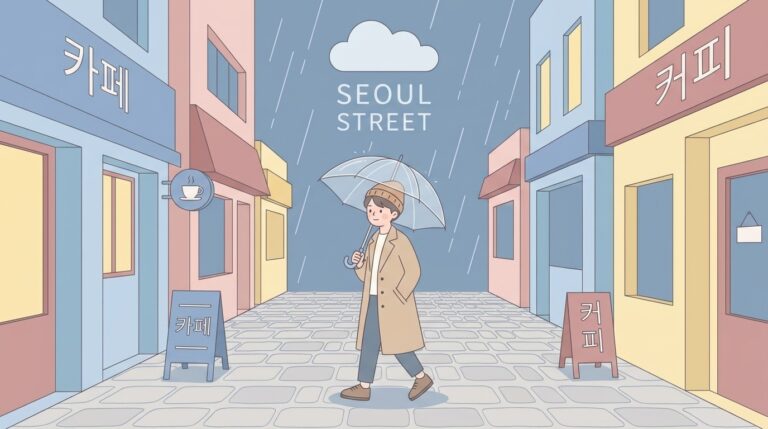
When the Forecast Lies: How to Complain About Korean Weather Like a True Local
Phase 1: 공감 (Story Immersion Opening)
안녕하세요! 매일한글 에디터입니다.
Picture this: You spent twenty minutes putting together the ultimate Seongsu-dong cafe outfit—pristine white sneakers, an airy linen button-down, and your favorite canvas tote. Before stepping out of your Airbnb, you diligently opened your weather app. Precipitation probability: 0%. Maximum temperature: a comfortable 22°C. You stepped out feeling like the main character in an upbeat K-drama montage.
Two hours later, you are standing outside a bakery near Seoul Forest. The sky turns a brooding charcoal gray in under three minutes, and suddenly, fat raindrops begin drumming violently against your iced Americano. Within seconds, a sudden summer cloudburst drenches the sidewalk. You look around, stunned, only to see locals calmly sighing, pulling folding umbrellas out of nowhere, or sprinting toward the nearest GS25.
You want to turn to your Korean friend and vent your disbelief, but your mind draws a blank. Sure, you know beginner phrases like “비가 와요” (It is raining) or “날씨가 달라요” (The weather is different). But those sound like robot lines from a Chapter 1 dialogue book! Where is the expressive bite? How do you say, “Wait, they promised clear skies today! The weather bureau missed it completely!” with that natural, intermediate flair?
If you have ever felt betrayed by Korean weather forecasts, you are not alone. Our intermediate B2 learners constantly ask how to express contrast, frustration, and unexpected weather shifts without sounding stiff. Today, we are bridging that exact gap. Let’s master the colloquial, colorful, and culturally savvy ways to talk about weather forecasts versus reality.
Phase 2: 핵심 표현 3선 심층 분석 (Core Expressions Deep Dive)
1. 오늘 비 온다더니 해만 쨍쨍하네요. (Oneul bi ondadeoni haeman jjaengjjaenghaneyo.)
- Pronunciation: [Oh-neul bi on-da-duh-nee hae-man jjaeng-jjaeng-ha-nae-yo]. Think of “da-deoni” as sounding like a rhythmic “da-dawn-ee”.
- Meaning: Literal: “They said it would rain today, but only the sun is blazing.” / Real Nuance: “So much for the rain forecast—the sun is out in full force!”
- K-Culture Moment: Seen in romantic comedies like Hometown Cha-Cha-Cha when characters pack heavy rain boots and umbrellas for an outdoor festival, only to end up sweating under the blazing seaside sun.
- Editor’s Insight: The grammar pattern -다더니 combines an indirect quotation (-다고 하다) with contrast/reflection (-더니). It is the quintessential intermediate structure used to compare what was heard or reported with what is actually unfolding in front of your eyes.
- Situation Spectrum: Casual (✅) | Semi-formal (✅) | Formal (⚠️ – adjust to “쨍쨍합니다” in official broadcasts)
- 🤔 Think About It: In English, we often say, “It was supposed to rain, but…” Korean uses
-다더니to subtly place the responsibility on whoever made the claim (the forecast), highlighting the observational mismatch.2. 일기 예보가 또 빗나갔어요. (Ilgi yeboga tto binnagasseoyo.)
- Pronunciation: [Il-gi ye-bo-ga tto bin-na-ga-ssuh-yo]. The word 빗나갔어요 sounds like “bean-na-ga-ssuh-yo” due to nasalization rules where ㅅ assimilates to ㄴ before ㄴ.
- Meaning: Literal: “The weather forecast missed the target again.” / Real Nuance: “The weather forecast got it wrong once again!”
- K-Culture Moment: Every Korean variety show host (Running Man, 2 Days & 1 Night) says this whenever an outdoor shoot gets wrecked by sudden showers or intense heat waves.
- Editor’s Insight: The verb 빗나가다 comes from archery or shooting—it literally means an arrow deviating from its target. Using it for weather forecasts conveys that the meteorologists were “off-target,” adding a humorous, slightly dramatic punch.
- Situation Spectrum: Casual (✅ – drop 요) | Semi-formal (✅) | Formal (✅)
- 🤔 Think About It: Why does Korean describe incorrect predictions as “deviating off mark” rather than simply “being wrong” (틀리다)? It frames the forecast as a target-hitting endeavor!
3. 맑을 줄 알고 얇게 입었는데 쌀쌀하네요. (Malgeul jul algo yalpkke ibeonneunde ssalssalhaneyo.)
- Pronunciation: [Mal-geul jool al-go yal-kke eeb-uhn-neun-de ssal-ssal-ha-nae-yo]. Ensure the double consonant ㅆ in 쌀쌀 has a tense, crisp hiss.
- Meaning: Literal: “I thought it would be sunny so I wore thin clothes, but it is chilly.” / Real Nuance: “I dressed light expecting sunny skies, but there is quite a nip in the air!”
- K-Culture Moment: A staple line in campus dramas where a university student wears a breezy spring skirt on the first day of April, shivering outside the library.
- Editor’s Insight: -(으)ㄹ 줄 알고 expresses an assumption that proved incorrect or led to a specific action. Pair it with sensory words like 쌀쌀하다 (chilly with a breeze) or 후덥지근하다 (muggy/humid) to speak with sensory precision.
- Situation Spectrum: Casual (✅) | Semi-formal (✅) | Formal (⚠️)
- 🤔 Think About It: Notice how Korean packs your expectation, your resultant action, and the contrasting real-time sensory result all into one smooth sentence.
Phase 3: 교과서 한국어 vs 진짜 한국어 (Textbook vs. Real Korean)
Situation 1: Calling out a completely inaccurate weather report
- 📖 교과서 한국어: 일기 예보와 실제 날씨가 일치하지 않습니다. (Ilgi yebowa silje nalssiga ilchihaji anseumnida.) — “The weather forecast and actual weather do not coincide.”
- 🗣️ 진짜 한국어: 예보랑 날씨가 완전 딴판이에요! (Yeborang nalssiga wanjeon dtanpanieyo!) — “The weather is the total opposite of the forecast!”
- 💡 왜 다를까? 일치하지 않습니다 sounds like a technical whitepaper drafted by the Korea Meteorological Administration. Real humans use 딴판 (completely different world / opposite board) to capture that vivid shock when sunny becomes stormy.
Situation 2: Reacting to unexpected sudden downpours
- 📖 교과서 한국어: 예보에 없던 비가 갑자기 내립니다. (Yeboe eopdeon biga gapjagi naerimnida.) — “Rain that was not in the forecast is suddenly falling.”
- 🗣️ 진짜 한국어: 갑자기 비가 쏟아지네요. 기상청 또 틀렸네. (Gapjagi biga ssodajineyo. Gisangcheong tto teullyeonne.) — “It’s suddenly bucketing down. The weather bureau blew it again!”
- 💡 왜 다를까? Native speakers immediately mention the 기상청 (Korea Meteorological Administration). Teasing the weather bureau is practically a national pastime in South Korea whenever an unscheduled shower appears.
Phase 4: K-Culture 딥다이브 & 비언어적 매너 (Culture & Manners)
4-1. Nunchi & Weather Gestures
When rain suddenly betrays the forecast on a Korean street, observe the collective body language:
* The Sky-Palm Check: Stick your hand out palm-up at chest height, squint up at the clouds, and let out a quick, quiet “헐…” (Heol…) or “아, 진짜?” (Ah, seriously?).
* Shared Resignation: Don’t throw an angry tantrum at your companion or server. In Korea, unpredictable weather is treated as a shared communal trial. A wry smile and a light chuckle (“우산 안 챙겼는데 큰일 났네요”) build instant camaraderie.
* Subway Shake-Off: If you do manage to buy a wet umbrella, always slide it into the plastic sleeve stands (우산 비닐 커버) or shake it vigorously off to the side before boarding public transit. Stepping into a crowded Line 2 train with a dripping wet umbrella without care will invite sharp 눈치 (nunchi) stares!
4-2. The “KMA Sports Day” Cultural Code
Koreans have a running cultural joke about the 기상청 체육대회 (The Weather Administration’s Annual Sports Day). Whenever heavy rain ruins a national holiday or weekend that was forecasted to be sunny, netizen comment sections flood with jokes like: “Did the Meteorological Administration schedule their company picnic today? That must be why it is pouring!”
Another unwritten cultural rule is the 편의점 비닐우산 릴레이 (Convenience Store Vinyl Umbrella Relay). Sudden localized rain showers (게릴라성 호우) mean nearly everyone in Seoul buys an identical 5,000-KRW transparent plastic umbrella from CU, GS25, or 7-Eleven. By the end of summer, every Korean household secretly has an umbrella bucket overflowing with at least seven identical clear umbrellas.
Phase 5: 실전 롤플레이 시나리오 (Real-World Roleplay)
Setting: The sun-drenched rooftop terrace of a trendy bakery cafe in Seongsu.
Character: Min-ji (민지), your trendy Korean friend who wore brand-new suede boots today.
- 민지: 오늘 날씨 진짜 좋다! 미세먼지도 없고 하늘 완전 파랗네.
(Oneul nalssi jinjja jota! Misemeonjido eopgo haneul wanjeon paranne.)
“The weather is incredible today! No fine dust, and the sky is totally blue.”
🎭 Takes a selfie while holding up her iced latte against the skyline. -
나 (You): 그러게요! 어제 일기 예보에서는 오늘 비 온다더니 해만 쨍쨍하네요.
(Geureogeyo! Eoje ilgi yeboeseoneun oneul bi ondadeoni haeman jjaengjjaenghaneyo.)
“I know, right! Yesterday the forecast said it would rain, but the sun is blazing!”
🎭 Shades eyes from the sun with a happy grin. -
민지: 맞아요. 어제 예보 보고 약속 취소할 뻔했잖아요. 안 나왔으면 억울할 뻔했어.
(Majayo. Eoje yebo bogo yaksok chwisohal ppeonhaetjanhayo. An nawasseumyeon eogulhal ppeonhaesseo.)
“Exactly. I almost cancelled our meetup after seeing the forecast. I would have regretted it so much!”
🎭 Gently brushes dust off her new suede boots. -
나 (You): 근데 저기 서쪽 하늘 좀 봐요. 먹구름이 몰려오는데요?
(Geunde jeogi seojjok haneul jom bwayo. Meokgureumi mollyeoonundeyo?)
“Wait, look at the western sky over there. Aren’t dark storm clouds gathering?”
🎭 Points toward an ominous dark wall of clouds moving rapidly. -
민지: 어? 설마… 아까 강수확률 0%라고 떴는데?
(Eo? Seolma… Akka gangsuhwangryul 0%-rago tteonneunde?)
“Huh? No way… It said 0% chance of precipitation earlier?”
🎭 Quickly taps open her smartphone weather app, eyes widening. -
나 (You): 앗, 빗방울 떨어져요! 일기 예보가 또 빗나갔네요.
(At, bitbang-ul tteoreojyeoyo! Ilgi yeboga tto binnaganneyo.)
“Ack, raindrops are falling! The forecast missed the mark again!”
🎭 Holds out a hand as heavy raindrops patter on the table surface. -
민지: 아, 진짜 기상청 왜 이래! 내 스웨이드 부츠 어떡해! 빨리 안으로 들어가요!
(Ah, jinjja gisangcheong wae irae! Nae seuweideu bucheu eotteokhae! Ppalli aneuro deureogayo!)
“Ugh, what is wrong with the weather bureau! What about my suede boots! Let’s hurry inside!”
🎭 Grabs her drinks tray in a frantic rush. -
나 (You): 얼른 짐 챙겨요. 제가 1층 편의점 가서 비닐우산 사 올게요!
(Eolleun jim chaenggyeoyo. Jega ilcheung pyeon-uijeom gaseo binil-usan sa olgeyo!)
“Grab your things quickly. I will run to the first-floor convenience store and grab clear umbrellas!”
🎭 Quickly scoops up napkins and bags to rush into the indoor seating area.
🔀 인터랙티브 분기점 (Interactive Choice)
When the rain suddenly pours down on the terrace, what do you say to Min-ji?
- Choice A: “기상청 정말 한심하네요. 당장 민원 넣어야겠어요.”
(The Meteorological Administration is truly pathetic. I should file a civil complaint immediately.) - Choice B: “예보랑 날씨가 완전 딴판이네요! 민지 씨 신발 젖기 전에 얼른 실내로 들어가요.”
(The weather is the exact opposite of the forecast! Let’s get inside before your shoes get soaked, Min-ji.) - Choice C: “왜 우산 안 챙겨왔어요? 날씨는 항상 의심해야죠.”
(Why didn’t you bring an umbrella? You should always doubt the weather.)
Feedback:
* Option A [Risk]: Overly aggressive and bureaucratic. Native speakers complain about the weather bureau, but filing an actual government complaint (민원) sounds uncomfortably intense for a casual outing.
* Option B [Best!]: Empathetic, culturally natural, and shows quick nunchi. You validate the forecast mismatch using intermediate slang (완전 딴판), while caring for her precious suede boots.
* Option C [Bad]: Blaming your friend when the forecast literally said 0% rain will ruin the mood completely!
Phase 6: 10초 감정 섀도잉 드릴 (10-Second Shadowing Drill)
Practice these natural cadences out loud. Pause at the slashes (/), and mimic the exact emotional cue!
[😮 황당하고 어이없게 / Bewildered & In Disbelief]
“오늘 비 온다더니 / 해만 쨍쨍하네요. / 우산 왜 들고 나왔지?”
(Oneul bi ondadeoni / haeman jjaengjjaenghaneyo. / Usan wae deulgo nawatji?
— “They said it’d rain today / but the sun is blazing. / Why did I even bring this umbrella?”)-
[🥶 오들오들 떨면서 / Shivering in Unexpected Cold]
“따뜻할 줄 알고 / 얇게 입었는데 / 바람 불어서 너무 쌀쌀해요.”
(Ttatteushal jul algo / yalpkke ibeonneunde / baram bureoseo neomu ssalssalhaeyo.
— “I thought it’d be warm / so I dressed light / but the wind makes it so chilly!”) -
[😂 체념하듯 웃으며 / Resigned Chuckle]
“강수확률 0%라더니 / 폭우가 쏟아지네요. / 기상청이 또…”
(Gangsuhwangryul yeong-peosenteuradeoni / poguga ssodajineyo. / Gisangcheongi tto…
— “They said 0% precipitation / but it’s pouring cats and dogs. / The weather bureau did it again…”)
Phase 7: K-Culture 미니 사전 (Mini Dictionary)
-
게릴라성 호우 (Gerillaseong hou)
Meaning: Sudden localized guerrilla rainstorms.
Usage: Refers to intense, unpredictable downpours that hit one specific neighborhood for 30 minutes while the neighboring district stays bone-dry. Essential for Korean summer conversations. -
딴판 (Dtanpan)
Meaning: A complete opposite; night and day.
Usage: Colloquially combined with 완전 (totally): “어제 예보랑 완전 딴판이에요!” (It’s a world apart from yesterday’s forecast!). -
빗나가다 (Binnagada)
Meaning: To miss the mark / to miss the target.
Usage: Commonly paired with 예측 (prediction), 기대 (expectation), or 일기 예보 (weather forecast). -
체감온도 (Chegam-ondo)
Meaning: Perceived “feels-like” temperature.
Usage: In Korean summers and winters, actual mercury numbers mean little because of humidity and Siberian wind. Koreans always ask: “기온은 25도인데 체감온도는 몇 도예요?” (The temp is 25°C, but what does it feel like?).
Phase 8: 여행자를 위한 생존 키트 (Traveler’s Survival Kit)
서바이벌 표현 TOP 3
- 혹시 우산 있어요? (Hoksi usan isseoyo?)
“Do you happen to have an umbrella?”
Pro Tip: Use this at hotel front desks or subway customer service centers if you get stranded. - 비가 언제쯤 그칠까요? (Biga eonjejjeum geuchilkkayo?)
“Around when will the rain stop?”
Pro Tip: Perfect to ask cafe baristas when you are debating whether to wait out a localized shower. - 일교차가 심하니까 겉옷 챙기세요. (Ilgyochaga simhanikka geot-ot chaenggiseyo.)
“The daily temperature swing is huge, so pack an outer layer.”
Pro Tip: Ideal when making plans with Korean friends during spring or autumn.
Editor’s Travel Note
- Never rely purely on global default weather widgets while traveling in South Korea. Download local tools with live Doppler updates by tapping 기상청 날씨알리미 앱 다운로드 for immediate hyper-local alerts.
- You can also monitor live storm cloud movements directly on your phone through 네이버 지도 날씨 레이더 기능 확인하기. When sudden showers hit, look for the nearest convenience store to buy a 5,000 KRW transparent umbrella (비닐우산) rather than expensive department store umbrellas.
Phase 9: “한 발 더 깊이” (Reflective Cultural Essay)
In South Korea, venting about an inaccurate weather forecast is rarely about genuine anger toward meteorologists. Rather, it functions as a social glue—a shared communal icebreaker known as 정(Jeong) through shared experience. In a fast-paced society where strangers rarely make small talk in elevators or at bus stops, sudden unpredicted rain lowers interpersonal walls. You will see strangers squeezing under cafe awnings together, shopkeepers leaving spare umbrellas out for neighborhood school children, and colleagues bonding over a hearty bowl of 파전 (scallion pancake) and 막걸리 (rice wine). Complaining about the weather is an invitation: “We are both experiencing this absurdity together, aren’t we?”
💬 Your Turn: Have you ever dressed up for an outing in Seoul, Busan, or your hometown, only for the weather forecast to get it completely backwards? What happened? Drop your story in the comments below in Korean using -다더니 or -(으)ㄹ 줄 알고!
Phase 10: FAQ & 흔한 실수 (FAQ & Common Mistakes)
Q: What is the difference between -다더니 and -다고 했는데?
A: While both report what someone else said, -다고 했는데 is a neutral statement of fact (“They said it would rain, but…”). In contrast, -다더니 carries an emotional nuance of personal observation and commentary (“They made such a big deal saying it would rain, and look—it’s blazing hot!”). Use -다더니 when you want to sound expressive and colorful!
Q: Can I use 빗나갔어요 when someone guesses my age wrong?
A: No! 빗나가다 is used for predictions, shots, plans, or forecasts missing the intended mark. If someone guesses your age or the answer to a trivia quiz wrong, use the standard verb 틀렸어요 (teullyeosseoyo).
Q: What does 쨍쨍 mean versus 찌는 듯한?
A: Both describe intense sunshine, but with different sensory focuses. 쨍쨍하다 emphasizes bright, radiant, blinding sunlight. 찌는 듯하다 (literally “steaming”) focuses on suffocating, sauna-like heat and humidity.
🚨 흔한 실수 (Common Mistakes) TOP 3
- ❌ “일기 예보가 거짓말했어요!” (The forecast told a lie!)
👉 Correct Action: Inanimate reports cannot intentionally lie. Say: 일기 예보가 빗나갔어요 (The forecast missed the mark) or 예보가 안 맞아요 (The forecast doesn’t match). - ❌ “비가 올 것을 생각해서 우산을 샀어요.” (Literal translation of “thinking it would rain…”)
👉 Correct Action: Use natural intermediate grammar: 비 올 줄 알고 우산 샀어요. - ❌ Confusing 쌀쌀하다 (pleasantly chilly/crisp) with 싸늘하다 (cold atmosphere / chilly attitude).
👉 Correct Action: For breezy autumn weather, always use 쌀쌀하다!
Phase 11: 액션 미션 & K-Culture 챌린지
- 🥉 Bronze Mission (Solo Practice): Look out your window right now. Compare your weather app’s prediction with reality and record a 10-second voice memo saying: “[맑다/비 오다]더니 실제로는 [쌀쌀하네요 / 해만 쨍쨍하네요]!”
- 🥈 Silver Mission (Community Share): Take a photo of the sky in your city today. Post it on Instagram Stories or Threads with the caption: “오늘 날씨 예보랑 완전 딴판!” and tag our community handle.
- 🥇 Gold Mission (Real Interaction): The next time you chat with a Korean language exchange partner or tutor, start your conversation by referencing the weather: “한국은 오늘 비 온다더니 날씨 어때요?”
- 🎮 K-Culture Mission: Watch any outdoor episode of I Live Alone (나 혼자 산다) or Run BTS. Listen closely for the word 기상청 or 우중 (in the rain). Spotting how celebrities react to sudden weather changes will lock these expressions into your long-term memory!
Phase 12: 인터랙티브 퀴즈 챌린지 (Quiz Challenge)
1. 상황 판단 (Situation Choice)
You prepared thick down jackets because the weather app warned of freezing cold, but the afternoon feels like warm spring. What is the most natural intermediate phrase to express this to a friend?
* (A) 날씨가 거짓말쟁이예요.
* (B) 춥다더니 생각보다 날씨가 완전 포근하네요!
* (C) 날씨와 예보의 관계가 일치하지 못했습니다.
🔍 정답 및 해설 확인하기 (Click for Answer)
정답: (B)
해설: (B) uses the natural quotation-contrast structure -다더니 alongside the expressive sensory word 포근하다 (pleasantly warm and cozy). (A) personifies the weather unnaturally, and (C) sounds like a broken statistical report!
2. 빈칸 채우기 (Fill in the Blank)
- “비가 올 줄 알고 큰 우산을 들고 나왔는데, 예보가 완전히 (________) 해만 쨍쨍해요.”
- Hint: The verb meaning “to miss the target/deviate” in past tense.
🔍 정답 및 해설 확인하기 (Click for Answer)
정답: 빗나가서 (or 빗나갔는데 / 빗나가서)
해설: The base form is 빗나가다. Combined with the cause-and-effect connective -아서/어서, it forms 빗나가서 (“Because the forecast missed the mark, the sun is blazing”).
3. 문화 퀴즈 (True / False)
- Q: In Korea, if a weather forecast is completely wrong and it starts raining out of nowhere, you can pop into almost any 24-hour convenience store to buy an inexpensive transparent umbrella called a 비닐우산.
🔍 정답 및 해설 확인하기 (Click for Answer)
정답: TRUE (O)
해설: Yes! Every Korean convenience store (CU, GS25, 7-Eleven, Emart24) places transparent vinyl umbrellas (비닐우산) right by the entrance the moment rain starts falling. It is a genuine staple of urban Korean survival!







