

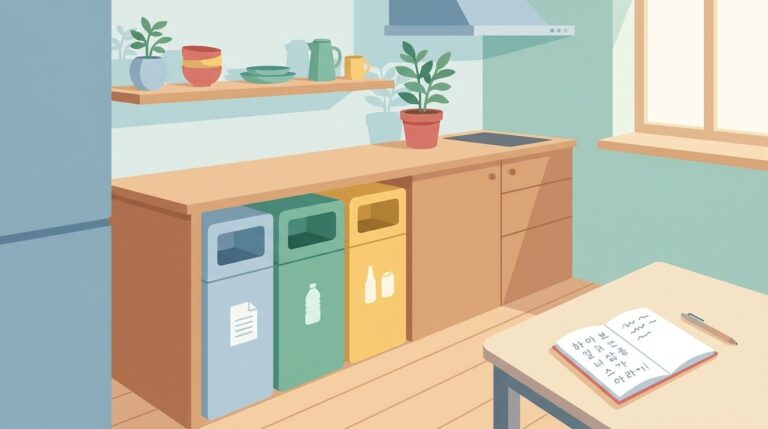
Phase 1: 공감 (Story Immersion Opening)
안녕하세요! 매일한글 에디터입니다.
Picture this: You have just moved into a charming studio apartment (원룸) in Seoul, or perhaps you are sharing a lovely Airbnb with friends in Hongdae. The sun sets, dinner wraps up, and you look over at the kitchen bin. It is bursting at the seams. You gently nudge the lid, hoping gravity will magically solve the problem, but your Korean roommate or host lets out a tiny, noticeable sigh while staring at the overflowing plastic wrap and takeout boxes. Suddenly, panic sets in: How do I politely suggest taking out the trash? Which bag do I use? What if I separate the plastics wrong and get a stern warning from the apartment security officer (경비 아저씨)?
If you have watched K-Dramas like Hospital Playlist or Reply 1994, you already know that household chores—especially trash duty—are a battlefield of affection, petty squabbles, and domestic diplomacy. Based on real feedback from dozens of intermediate Korean learners living in Seoul, chore communication is one of the highest-friction moments in daily life. But do not worry! Mastering just a few essential expressions and cultural instincts around emptying the trash will instantly turn you from an awkward guest into an ultra-reliable, thoughtful housemate.
Phase 2: 핵심 표현 3선 심층 분석 (Top 3 Core Expressions)
1. 쓰레기통 좀 비워 줄래? (Sseuregitong jom biwo jullae?)
- Pronunciation: Sseu-re-gi-tong jom bi-wo jul-lae? (Think of it as: see-regi-tong [bin] + chom [please/a bit] + bee-woh [empty] + jool-leh [will you?])
- Meaning: Literal: “Can you empty the trash bin a little?” / Real Nuance: A warm, casual, and friendly way to ask your partner, flatmate, or close sibling to clear out the bin without sounding bossy.
- K-Culture Moment: Commonly heard in slice-of-life K-dramas when one roommate is glued to the sofa watching television while the kitchen trash is visibly towering.
- Editor’s Insight: The tiny magic word 좀 (jom) softens the request completely. Leaving out ‘좀’ can make you sound like an exasperated parent commanding a child.
- Situation Spectrum: Casual ✅ | Semi-formal ⚠️ (switch to 비워 주실래요?) | Formal 🚫
- 🤔 Think About It: In English, we often ask “Could you take out the trash?” focused on the movement outside. Why do Koreans focus on emptying the container (비우다) instead?
2. 쓰레기 버리는 김에 분리수거도 해 줘 (Sseuregi beorineun gime bunrisugeodo hae jwo)
- Pronunciation: Sseu-re-gi beo-ri-neun gi-me bun-ri-su-geo-do hae jwo (Analogy: beori-neun rhymes with “burry-noon”, gime like “gee-meh”)
- Meaning: Literal: “While you are discarding trash, do the separate recycling too.” / Real Nuance: “Since you are already heading down to the dumpster, kill two birds with one stone!”
- K-Culture Moment: You will hear this in variety shows like I Live Alone (나 혼자 산다) whenever someone grabs their shoes and keys to step outside.
- Editor’s Insight: The grammar pattern -(으)는 김에 (-neun gime) is the golden key to natural Korean chore requests. It shows you recognize their effort and are piggybacking on their movement rather than creating a whole new task.
- Situation Spectrum: Casual ✅ | Semi-formal ⚠️ (해 주세요) | Formal 🚫
- 🤔 Think About It: Notice how Korean households bundle trash disposal with errands. How does this reflect the Korean lifestyle of maximizing efficiency in tight apartment living?
3. 종량제 봉투 거의 다 찼어 (Jongnyangje bongtu geoui da chasseo)
- Pronunciation: Jong-nyang-je bong-tu geo-ui da chas-seo (Rhythm: Jong-nyang-je [volume-based bag] + bong-tu [bag] + geo-ui [almost] + da chas-seo [all filled])
- Meaning: Literal: “The volume-rate garbage bag is almost all full.” / Real Nuance: The universal household announcement signaling: “Time to compress it down, tie the handles, and get it out before it smells!”
- K-Culture Moment: Family sitcoms love this moment—someone steps on the bag to squish the contents down to make room for one last piece of trash.
- Editor’s Insight: Instead of saying “The trash stinks” or “Throw it out now,” Koreans often state the objective status (다 찼어) as an indirect polite cue for someone to volunteer.
- Situation Spectrum: Casual ✅ | Semi-formal ✅ (다 찼어요) | Formal ⚠️ (다 찼습니다)
- 🤔 Think About It: Why does Korean culture prefer indirect observations over direct orders when managing domestic peace?
Phase 3: 교과서 한국어 vs 진짜 한국어 (Textbook vs. Real Korean)
Situation 1: Asking someone to toss the overflowing rubbish
- 📖 교과서 한국어 (Textbook): “쓰레기를 휴지통에서 꺼내어 버려 주십시오.” (Sseuregireul hyujitong-eseo kkeonaeeo beoryeo jusipsio. — “Please take the garbage out of the wastebasket and discard it.”)
- 🗣️ 진짜 한국어 (Real-world): “쓰레기통 다 찼는데, 나가는 길에 버려 줄래?” (Sseuregitong da chatneunde, naganeun gire beoryeo jullae? — “The bin is full; could you toss it on your way out?”)
- 💡 왜 다를까?: Real Koreans rarely use formal textbook imperatives for household chores. Instead, they pair a situational observation (다 찼는데) with an effortless transition (나가는 길에).
Situation 2: Announcing you completed the recycling
- 📖 교과서 한국어 (Textbook): “저는 분리수거 작업을 완료하였습니다.” (Jeoneun bunrisugeo jageob-eul wallyohayeotseumnida. — “I have completed the separate waste collection work.”)
- 🗣️ 진짜 한국어 (Real-world): “분리수거 싹 비우고 왔어!” (Bunrisugeo ssak biugo wasseo! — “I emptied out all the recycling clean!”)
- 💡 왜 다를까?: Conversational Korean relies on vibrant adverbs like 싹 (ssak – completely, cleanly) to convey genuine accomplishment and refreshing tidiness.
Phase 4: K-Culture 딥다이브 & 비언어적 매너 (Culture & Etiquette)
4-1. 눈치 (Nunchi) & Gestures: The Art of Domestic Harmony
- The Flatten & Press (발로 꾹꾹 밟기): Standard volume-rate bags (종량제 봉투) cost money. Before tying it, Koreans will use their foot or palm to compress the air out to maximize space. If you tie a half-empty bag, your Korean roommate might quietly cringe at the wasted volume!
- The Golden Tie (손잡이 묶기): Always tie the bag using the two butterfly flaps securely so nothing spills in the hallway. Leaving a trash bag open is considered a major breach of neighborly etiquette.
- The Reciprocity Eye Contact (눈치 채기): If someone cooked a delicious home meal for you, your automatic reflex should be picking up the trash bag. Say: “요리 맛있게 잘 먹었어! 쓰레기는 내가 버릴게!” (Thanks for the delicious meal! I’ll take out the trash!)
4-2. Cultural Code: The Sacred Ritual of 분리수거 (Bunrisugeo)
In Korea, waste separation is practically an Olympic sport. As depicted in countless scenes from My Liberation Notes or YouTube apartment vlogs, you do not just toss everything into one bin. You must rinse beverage containers with water, strip plastic delivery containers of greasy residue, and remove sticky parcel tape from cardboard boxes. Demonstrating that you know how to sort plastics (플라스틱), food waste (음식물 쓰레기), and paper (종이류) earns you instant respect from any landlord or housemate.
Phase 5: 실전 롤플레이 시나리오 (Real-Life Roleplay)
Setting: Sunday night, 9:30 PM. Your shared apartment in Mapo-gu, Seoul. You and your detail-oriented Korean flatmate, Minho (민호), are winding down after weekend takeout.
- 민호: “벌써 일요일 밤이네. 이번 주말도 순식간에 지나갔다.”
(Beolsseo iryoil bamine. Ibeon jumaldo sunsikgan-e jinagatda.)
“It’s already Sunday night. This weekend flew by in a flash.”
🎭 [Yawning while stretching his arms on the sofa] -
나 (You): “그러게 말이야. 그런데 주방 쓰레기통이 꽉 찼어.”
(Geureoge mariya. Geureonde jubang sseuregitongi kkwak chasseo.)
“Tell me about it. By the way, the kitchen trash can is completely packed.”
🎭 [Pointing toward the overflowing pedal bin in the kitchen corner] -
민호: “아, 진짜? 종량제 봉투 20리터짜리 다 찬 거야?”
(A, jinjja? Jongnyangje bongtu isip-liteojjari da chan geoya?)
“Oh, really? Is the 20-liter standard trash bag totally full?”
🎭 [Sitting upright with a surprised expression] -
나 (You): “응, 거의 넘칠 것 같아. 내가 꾹꾹 눌러서 묶어 둘게.”
(Eung, geoui neomchil geot gata. Naega kkuk-kkuk nulleoseo mukkeo dulge.)
“Yeah, it’s almost overflowing. I’ll press it down firmly and tie it up.”
🎭 [Mimicking a pressing motion with both hands] -
민호: “고마워! 혹시 베란다에 있는 플라스틱 분리수거도 같이 해 줄 수 있어?”
(Gomawo! Hoksi berandaye inneun peullaseutik bunrisugeodo gachi hae jul su isseo?)
“Thanks! Could you by any chance do the plastic recycling on the balcony too?”
🎭 [Looking apologetic while handing you the building access card] -
나 (You): “물론이지! 나 편의점 가는 김에 한꺼번에 버리고 올게.”
(Mulloniji! Na pyeon-uijeom ganeun gime hankkeobeone beorigo olge.)
“Of course! While I head out to the convenience store, I’ll toss it all out at once.”
🎭 [Grabbing the tied trash bag and recycling basket smoothly] -
민호: “완전 나이스! 박스 테이프 떼는 거 깜빡하지 말고!”
(Wanjeon naiseu! Bakseu teipeu ttenun geo kkamppakhaji malgo!)
“Totally awesome! Don’t forget to peel off the cardboard box tape!”
🎭 [Giving an appreciative thumbs-up with a big grin] -
나 (You): “걱정 마. 라벨이랑 테이프 다 뗐어. 금방 다녀올게!”
(Geokjeong ma. Rabeorirang teipeu da ttesseo. Geumbang danyeoolge!)
“No worries. Peeled off all the labels and tape already. Back in a jiffy!”
🎭 [Slipping into slides and heading toward the front door]
🔀 인터랙티브 분기점 (Interactive Choice)
What would you say if the bin was full right as your roommate was heading out the door?
* Choice A: “나가는 김에 쓰레기통 좀 비워 줄래?” (Since you’re going out, could you empty the trash bin?)
👉 Feedback [Best!]: 100% natural, courteous, and utilizes the -는 김에 connector flawlessly.
* Choice B: “쓰레기통 지금 당장 비워.” (Empty the trash bin right this instant.)
👉 Feedback [Bad]: Excessively blunt and commanding. Sounds like you are scolding a subordinate.
* Choice C: “쓰레기가 많은데 내일 버리자.” (There is lots of trash, let’s just toss it tomorrow.)
👉 Feedback [Risk]: Tolerable in winter, but in Korean summers, food residues breed fruit flies (초파리) overnight. Your roommate will silently stress out.
Phase 6: 10초 감정 섀도잉 드릴 (Emotional Shadowing Drill)
Practice matching the cadence, pauses (/), and exact emotional tone:
[😅 약간 미안하지만 싹싹하게 / Slightly apologetic yet sweet & polite]
“쓰레기통이 / 벌써 다 찼네. / 편의점 나가는 김에 / 비워 줄 수 있어?”
(Sseuregitongi / beolsseo da chatne. / Pyeon-uijeom naganeun gime / biwo jul su isseo?)
Pause naturally after ‘다 찼네’ to let the reality sink in before asking your favor.-
[✨ 든든하고 자신감 넘치게 / Dependable, proactive & proud]
“분리수거 라벨 / 싹 다 뗐으니까 / 내가 나갈 때 / 버리고 올게!”
(Bunrisugeo rabel / ssak da ttesseunikka / naega nagal ttae / beorigo olge!)
Emphasize the crisp ‘싹 (ssak)’ to highlight how thoroughly you finished the prep work.
Phase 7: K-Culture 미니 사전 (Mini Dictionary)
- 종량제 봉투 (Jongnyangje bongtu) | Official volume-rate garbage bag.
Usage: The government-mandated disposal bags sold at convenience stores and marts. Each municipal district (구) has its own exclusive color and print. - 분리수거 (Bunrisugeo) | Waste segregation / separate collection.
Usage: The system of categorizing recyclables into paper, plastic, styrofoam, cans, and glass. - 음식물 쓰레기 (Eumsikmul sseuregi) | Organic food waste.
Usage: Food scraps that can be processed into animal feed or compost. Non-edible items (bones, peach pits) are strictly excluded! - 대형 폐기물 스티커 (Daehyeong pyegimul seutikeo / 딱지) | Bulky waste sticker.
Usage: When throwing away chairs, suitcases, or desks, you must purchase this sticker online or at a local community center (주민센터).
Phase 8: 여행자를 위한 생존 키트 (Traveler’s Survival Kit)
Top 3 Survival Phrases
- “이거 일반 쓰레기예요?” (Igeo ilban sseuregiyeyo?)
Translation: “Is this general trash?”
Pro Tip: Perfect for cafes or bakeries when you cannot figure out which receptacle takes your dirty napkin versus beverage lid. - “음식물 쓰레기는 어디에 버려요?” (Eumsikmul sseuregineun eodie beoryeoyo?)
Translation: “Where do I discard food waste?”
Pro Tip: Essential for guesthouses, Airbnbs, or outdoor camping spots (캠핑장). - “종량제 봉투 10리터 한 장만 주세요.” (Jongnyangje bongtu sip-liteo han jangman juseyo.)
Translation: “Please give me one 10-liter volume-rate trash bag.”
Pro Tip: Ask this right at the cash register in any convenience store (편의점).
Editor’s Travel Note
- Navigating Bag Districts: Remember that a garbage bag bought in Gangnam-gu cannot be thrown away in Mapo-gu! Bags must match the district you are currently residing in.
- Essential App Reference: Check out the official 내 손안의 분리배출 모바일 가이드 다운로드 for an interactive searchable database whenever you are unsure if an item is recyclable or general waste.
Phase 9: “한 발 더 깊이” (Cultural Essay & Reflection)
In many Western cultures, household chores are viewed strictly through the lens of individual duty, contractual division of labor, or personal hygiene. However, in Korea, emptying the trash can and managing bunrisugeo touches upon 공동체 의식 (gongdongche uisik – communal consciousness). When you compress your trash bag neatly, strip clear tape from parcels, and haul the bins down on designated collection nights, you are honoring an unwritten covenant with your neighbors and local sanitation workers. It is an everyday expression of 정 (Jeong) and shared respect for communal space.
💬 Your Turn: How does garbage separation work in your home country compared to Korea? Have you ever had an embarrassing or funny mishap with recycling abroad? Share your story in the comments below!
Phase 10: FAQ & 오해 방지 (FAQ Schema)
Q: Can I use regular grocery shopping bags to toss my apartment trash?
A: Absolutely not! You can only use official 종량제 봉투 (volume-rate bags). Tossing general trash in ordinary black plastic bags can result in hefty municipal fines of up to 300,000 KRW for illegal dumping (무단투기).
Q: Are chicken bones, eggshells, and onion skins considered food waste?
A: No! This is the most common mistake foreigners make. A golden rule of thumb in Korea is: “Could a farm animal safely eat this?” If not (hard pork/chicken bones, clam shells, fruit pits, eggshells, onion peels), it goes into 일반 쓰레기 (general waste).
Q: What should I do if my apartment building doesn’t have a designated trash collection room?
A: In traditional residential villas (빌라) or one-room buildings without security guards, residents leave tied bags neatly outside their building entrance strictly between designated evening hours (usually 7 PM to midnight, excluding Saturdays). Check the schedule posted near your front entrance!
🚨 흔한 실수 (Common Mistakes) 경고판
- Throwing unwashed instant ramen cups into plastics
Correction: Red grease stains cannot be recycled mechanically. Wash thoroughly with sunlight/soap, or discard into general trash (일반 쓰레기). - Leaving shipping labels on cardboard boxes
Correction: Always peel off paper address stickers and plastic packing tape before flattening boxes. - Putting plastic delivery lids with stickers into recycling
Correction: Remove every single paper sticker before discarding, otherwise the entire batch is rejected.
Phase 11: 액션 미션 & 참여 유도 (Action Missions)
- 🥉 Bronze Mission (Solo Practice): Look at your room’s wastebasket right now. Say aloud with natural feeling: “쓰레기통 거의 다 찼네. 비워야겠다!” (The trash can is almost full. I better empty it!)
- 🥈 Silver Mission (Social Sharing): Post a photo of your neatly tied Korean trash bag or sorted recycling on Instagram or Threads with the caption: “오늘 분리수거 끝! (Finished waste sorting today!)” and tag
@DailyHangul. - 🥇 Gold Mission (Real-Life Action): Walk into your local Korean convenience store and purchase a bag using only Korean: “사장님, 일반 종량제 봉투 10리터짜리 두 장만 주세요!”
- 🎮 K-Culture Mission: While watching your next K-Drama or variety show, spot the color of the trash bag in the character’s kitchen and identify their district code!
Phase 12: 인터랙티브 퀴즈 챌린지 (Interactive Quiz)
Q1. Situation Judgment: Your flatmate cooked a big dinner for you. The trash can is full. What is the most culturally thoughtful thing to say?
1. “음식 잘 먹었어, 설거지는 네가 해.”
2. “쓰레기통 다 찼네! 요리하느라 고생했으니까 내가 비우고 올게.”
3. “쓰레기 냄새 나니까 빨리 버려 줘.”
Q2. Fill in the Blank: Complete this natural chore sentence:
“편의점에 우유 사러 가는 (____), 쓰레기통도 비워 줄래?”
(Hint: ‘While doing X on the way’)
Q3. True or False: Clam shells (조개껍데기) and beef ribs (소갈비뼈) must be thrown into the yellow food waste (음식물 쓰레기) bin. (True / False)
👉 Click here to reveal the answers and explanations!
- Q1 Answer: 2번 (“쓰레기통 다 찼네! 요리하느라 고생했으니까 내가 비우고 올게.”)
Explanation: Acknowledging their effort (고생했으니까) and volunteering to handle the chore displays premier 눈치 (Nunchi) and etiquette. - Q2 Answer: 김에 (gime)
Explanation: Combined with 가는, the phrase 가는 김에 means “while you are on your way / on the occasion of going.” - Q3 Answer: False
Explanation: Hard bones, teeth, and shells cannot be ground down for livestock feed or fertilizer, so they belong strictly in 일반 쓰레기 (general waste)!







