

How to Pick the Best Cinema Seats in Korea Without Panic
Phase 1: 공감 (Story-Driven Opening)
안녕하세요! 매일한글 에디터입니다.
Picture this: You are standing inside a buzzing CGV cinema in the heart of Hongdae on a vibrant Friday evening. The air is warm and filled with the irresistible aroma of sweet caramel and savory butter popcorn. You are excited to catch the latest blockbuster or your favorite idol’s brand-new documentary. You approach the ticket desk, ready to test your Korean skills. But the moment the friendly cinema clerk smiles and turns a glowing mini monitor toward you, your mind goes completely blank.
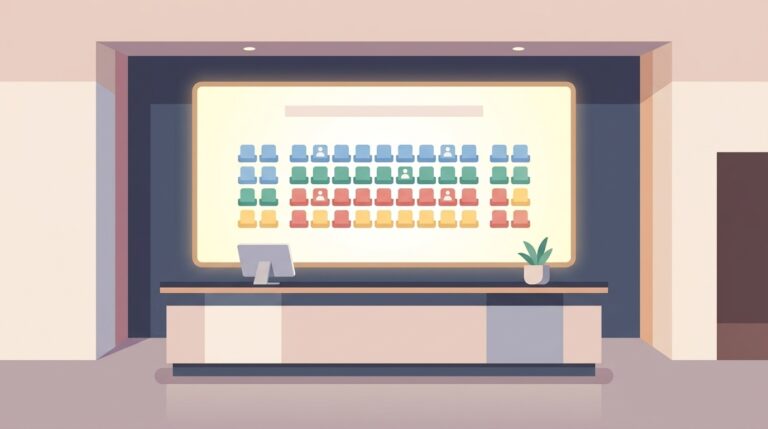
The screen is a dizzying matrix of red, green, and gray boxes. A stylish line of local moviegoers is stacking up right behind you. Your heart begins to race: What if I accidentally book the front-row corner and spend two hours with severe neck strain? How do I ask for two seats together in the sweet spot? You panic, tap a random square, and end up sitting all the way to the side. Over 80% of our beginner students confess that quick-fire decision moments at counters—especially ticket booths—trigger instant freeze-ups.
Good news: you do not need complex grammar to conquer the cinema counter! Today, we are unlocking 3 magic expressions that will transform you from a flustered traveler into a savvy local moviegoer who snags the best seats in the house with calm confidence.
Phase 2: 핵심 표현 3선 심층 분석 (3 Core Expressions Deep Dive)
1. 가운데 자리 있어요? (Gaunde jari isseoyo?)
- Pronunciation: [Gaunde jari isseoyo?] (Sound analogy: Think “cow” without the ‘c’ -> “gow-oon-deh”, cookie “jar-ee”, and “ee-ssuh-yo?”)
- Meaning:
- Literal: “Middle seat exists?”
- Actual Nuance: “Do you have any seats available in the center area?”
- K-Culture Moment: In modern romantic K-Dramas like Business Proposal, the dashing lead always ensures the couple sits dead center for the optimal sound and view before passing over the jumbo popcorn.
- Editor’s Insight: Koreans value the visual and acoustic “sweet spot” (known as 명당, myeongdang) above all else. Asking this single question immediately tells the clerk you know what makes a good movie experience.
- Situation Spectrum: Casual: ⚠️ | Semi-formal: ✅ | Formal: ✅
- 🤔 Think About It: In English, we often ask “What seats do you have left?” Korean speakers, however, immediately state the spatial preference (gaunde, middle) first. Why do you think Korean communication prefers establishing the specific location upfront?
2. 뒤쪽으로 주세요 (Dwijjogeuro juseyo)
- Pronunciation: [Dwijjogeuro juseyo] (Sound analogy: “Dwee-jjoh-geu-ro joo-seh-yo” – rhymes with sweet, joke, row, and juice-eh-yo)
- Meaning:
- Literal: “Please give toward the back side.”
- Actual Nuance: “Could you place us in the back rows, please?”
- K-Culture Moment: In high school web dramas, best friends whisper this phrase at the box office window to secure the top rows where they can chat quietly during the opening trailers.
- Editor’s Insight: Notice the particle ~으로 (-euro)! It means “toward” or “in the direction of.” By saying “back-direction please,” you give the staff the flexibility to pick the cleanest open seat in the upper tier without needing to name a specific row.
- Situation Spectrum: Casual: ⚠️ | Semi-formal: ✅ | Formal: ✅
- 🤔 Think About It: Polite requests in Korea almost always conclude with 주세요 (juseyo), meaning “please give.” How does this direct giving-concept compare to how you make requests in your own language?
3. 두 자리 붙은 걸로 주세요 (Du jari bueun geollo juseyo)
- Pronunciation: [Du jari bueun geollo juseyo] (Sound analogy: “Doo jah-ree boo-teun geol-lo joo-seh-yo” – boo-teun sounds like “button” with a soft ‘t’)
- Meaning:
- Literal: “Please give the ones with two seats attached.”
- Actual Nuance: “Could we have two seats together, please?”
- K-Culture Moment: Seen frequently on variety shows like Running Man, where team members frantically request adjacent seating so they won’t get separated during surprise undercover theater missions.
- Editor’s Insight: On busy weekend nights, Korean multiplexes fill up in seconds, leaving single orphan seats dotted across the theater. The word 붙은 (bueun) comes from the verb 붙다 (butda, to stick together). Using this guarantees you and your companion won’t be split across different aisles!
- Situation Spectrum: Casual: ⚠️ | Semi-formal: ✅ | Formal: ✅
- 🤔 Think About It: Korean uses physical imagery like “sticking together” (붙다) to describe adjacent seats. What physical metaphors does your native language use for companionship?
Phase 3: 교과서 한국어 vs 진짜 한국어 (Textbook vs. Real-Life Korean)
Situation 1: Asking if there are seats left
- 📖 교과서 한국어: 빈 좌석이 남아 있습니까? (Bin jwaseogi nama itseumnikka? – “Are there empty seats remaining?”)
- 🗣️ 진짜 한국어: 자리 있어요? (Jari isseoyo? – “Are there seats?”)
- 💡 왜 다를까? Traditional textbooks use heavy Sino-Korean vocabulary like 좌석 (jwaseok, seat) and rigid formal endings (-sumnikka). Real people in cinemas use pure Korean 자리 (jari, spot/seat) with everyday polite ending -a/eoyo.
Situation 2: Asking for aisle seats
- 📖 교과서 한국어: 통로에 인접한 좌석으로 결정하겠습니다. (Tongnoe injeophan jwaseogeuro gyeoljeonghagetseumnida. – “I shall decide upon the seating adjacent to the aisle.”)
- 🗣️ 진짜 한국어: 통로 쪽으로 주세요. (Tongno jjogeuro juseyo. – “Aisle side, please.”)
- 💡 왜 다를까? Spoken Korean values quick clarity. Adding 쪽 (jjok, side/direction) creates an effortless, natural flow that ticket agents grasp in a split second.
Phase 4: K-Culture 딥다이브 & 비언어적 매너 (K-Culture Deep Dive & Manners)
4-1. 눈치 (Nunchi) & Cinema Body Language
- Screen Interaction: When the clerk points their monitor toward you, lean in slightly to show engagement. Point with two fingers or your index finger close to the glass, but avoid tapping hard on their display.
- Two-Hand Rule (두 손): When handing over your credit card or receiving the printed paper ticket, always hold it with both hands or support your right forearm with your left hand. This classic Korean etiquette instantly signals warmth and respect.
- Kiosk Speed: If you are using a digital kiosk and a line forms behind you, take a deep breath. Have your credit card or mobile pay app ready in your palm beforehand to keep the queue moving seamlessly.
4-2. The Korean Multiplex Experience
Korean cinemas (CGV, Megabox, Lotte Cinema) are not just movie houses; they are full lifestyle centers!
* Gourmet Concessions: Don’t stop at plain popcorn. Korean cinemas offer flavored varieties like Garlic Butter and Double Caramel, along with grilled butter squid (버터구이 오징어) and cheesy hot dogs.
* 포토티켓 (Photo Tickets): Through theater smartphone apps, Korean moviegoers love printing custom plastic Photo Tickets featuring personal selfies or movie posters on the front and booking details on the back—a cherished Korean memory keepsake!
Phase 5: 실전 롤플레이 시나리오 (Real-World Roleplay Scenario)
- Scene: Friday, 7:40 PM at CGV Gangnam. Neon posters illuminate the lobby, and the smell of popcorn is everywhere. You walk up to the ticketing counter.
- NPC: Min-woo (민우), an attentive and energetic cinema clerk wearing a sleek black CGV apron and headset.
- Min-woo: 안녕하세요! 어떤 영화 보시겠어요? (Annyeonghaseyo! Eotteon yeonghwa bosigesseoyo?)
“Hello! Which movie would you like to watch?”
🎭 Min-woo bows pleasantly and taps his monitor schedule. -
Learner: 안녕하세요! 8시 영화 두 장 주세요. (Annyeonghaseyo! Yeodeol-si yeonghwa du jang juseyo.)
“Hello! Two tickets for the 8 o’clock movie, please.”
🎭 You return a warm smile and hold up two fingers gently. -
Min-woo: 네, 8시 상영입니다. 좌석은 어디로 하시겠어요? (Ne, yeodeol-si sang-yeong-imnida. Jwaseogeun eodiro hasigesseoyo?)
“Yes, the 8 o’clock screening. Where would you like your seats?”
🎭 He pivots the interactive seat map towards you. -
Learner: 가운데 자리 있어요? (Gaunde jari isseoyo?)
“Do you have middle seats available?”
🎭 You lean forward slightly, inspecting the grid. -
Min-woo: G열과 H열 가운데 남아 있습니다. (Ji-yeol-gwa Eichi-yeol gaunde nama itseumnida.)
“Rows G and H have middle seats open.”
🎭 Min-woo taps Row G on his screen. -
Learner: 두 자리 붙은 걸로 주세요. G열로 할게요. (Du jari bueun geollo juseyo. Ji-yeollo halgeyo.)
“Please give us two seats together. We will take row G.”
🎭 You point gently toward the green middle boxes in Row G. -
Min-woo: 네, G열 9번, 10번으로 도와드릴게요. 결제는 카드로 하시나요? (Ne, Ji-yeol gu-beon, sip-beoneuro dowadeurilgeyo. Gyeoljeneun kadeuro hasinayo?)
“Sure, I will set you up with Row G, seats 9 and 10. Paying by card?”
🎭 Min-woo confirms your selection and points to the card reader. -
Learner: 네, 카드로 할게요. 감사합니다! (Ne, kadeuro halgeyo. Gamsahamnida!)
“Yes, by card. Thank you!”
🎭 You insert your payment card using both hands.
🔀 Interactive Branching Point
What if Row G and H middle seats were completely booked? How do you reply?
* Option A: 그럼 뒤쪽으로 두 자리 붙은 걸로 주세요. (Geureom dwijjogeuro du jari bueun geollo juseyo.)
* Feedback [BEST]: Excellent! You smoothly pivot: “Then please give us two seats together in the back.” You secure great viewing height without breaking a sweat.
* Option B: 앞자리 아무 데나 줘. (Ap-jari amu dena jwo.)
* Feedback [BAD]: Dangerous! This drops into rude casual talk (반말) and says “Give me whatever front seat.” You risk getting front-row neck aches and sounding disrespectful.
* Option C: 그냥 취소할게요! (Geunyang chwisohalgeyo!)
* Feedback [RISK]: “I will just cancel!” A bit dramatic! Unless the theater is completely sold out, side or back rows are still great in modern Korean cinemas.
Phase 6: 10초 감정 섀도잉 드릴 (10-Second Emotion Shadowing Drill)
Practice these lines out loud with the rhythm breaks (/) and matching facial expressions!
[😊 Friendly & Inquiring]가운데 자리 / 있어요? (Gaunde jari / isseoyo?)[🎯 Decisive & Polite]뒤쪽으로 / 주세요. (Dwijjogeuro / juseyo.)[🤝 Hopeful & Warm]두 자리 / 붙은 걸로 / 주세요! (Du jari / bueun geollo / juseyo!)[✨ Cheerful & Grateful]통로 쪽으로 / 부탁드려요~ (Tongno jjogeuro / butakdeuryeoyo~)
Phase 7: K-Culture 미니 사전 (Mini Dictionary)
- 예매 (Yemae) | Advance Booking | The golden word for reserving cinema tickets, K-Pop concerts, or express trains ahead of time on apps.
- 좌석표 (Jwaseokpyo) | Seating Chart | The floor map displayed on screens. Gray usually means booked/unavailable; colored blocks (green/blue) are open!
- 통로 쪽 (Tongno jjok) | Aisle Side | Ideal if you need to slip out for restroom breaks during long running times without excusing yourself past six pairs of knees.
- 매진 (Maejin) | Sold Out | The red warning word on schedule boards. If you spot this, it is time to check the next screening slot!
Phase 8: 여행자를 위한 생존 키트 (Traveler’s Survival Kit)
Top 3 Survival Phrases
- 자막 있어요? (Jamuk isseoyo?) – Does this have subtitles?
Pro Tip: Foreign Hollywood movies in Korea are subtitled in Korean. If you want to watch a Korean film with English subtitles, look for special “English Subtitle Screenings” in districts like Myeongdong or Yongsan. - 학생 할인 돼요? (Haksaeng harin dwaeyo?) – Do you offer student discounts?
Pro Tip: Showing an International Student Identity Card (ISIC) can net you weeknight cinema discounts at major multiplexes. - 주차 등록해 주세요. (Jucha deungnokhae juseyo.) – Please register my parking validation.
Pro Tip: Showing your movie ticket at the counter provides 2 to 3 hours of free or cheap parking in complex mall garages.
Editor’s Travel Note
- Install the Naver Map navigation app to quickly locate nearby branches of CGV, Megabox, and Lotte Cinema.
- While mobile ticketing through the CGV Korean cinema booking app is popular, kiosks inside theaters feature an “English” button in the top corner. If using an international card, staffed counters are often smoother than digital kiosks!
Phase 9: “한 발 더 깊이” (One Step Deeper – Cultural Insight)
In Korean cinema culture, seat selection is an unspoken act of public consideration (배려, baeryeo). Whether choosing an aisle seat so you don’t disrupt your neighbors during an emergency exit or grouping seats neatly so pairs aren’t split apart, Korean theatergoers take subconscious care not to disturb the communal viewing harmony. Even inside a dark, crowded theater filled with strangers, mutual courtesy keeps everyone comfortable.
💬 Your Turn: What is your ultimate movie seat strategy—dead center, high back row, or quick-escape aisle? Let us know in the comments below!
Phase 10: FAQ & 오해 방지 (FAQ & Common Mistakes)
Q: Can I switch seats after the movie starts if the theater is half-empty?
A: It is best to stay in your assigned seat. Korean theaters track reservations digitally up to the minute, and late arrivals frequently walk in 10 to 15 minutes after trailers start. Moving can lead to awkward moments in the dark!
Q: What should I do if the digital kiosk has no English option?
A: Look at the top right of the touchscreen. Virtually all modern CGV, Megabox, and Lotte Cinema kiosks have an “English” button or globe icon. If you don’t see one, simply step up to the staffed service desk (티켓 매표소).
Q: Are Korean movies in local theaters subtitled in English?
A: As a rule, domestic Korean films do not have English subtitles in standard cinemas. However, select theaters in international hubs like CGV Yongsan I’Park Mall hold dedicated foreigner screenings with English subs.
🚨 Common Mistakes Warning Board
- Saying “Center” directly in English: Clerks might misunderstand. Use 가운데 자리 (gaunde jari) for crisp, instant recognition.
- Forgetting to specify adjacent seats: Saying just “두 장 (two tickets)” on a crowded evening might get you split up. Always add 붙은 걸로 (bueun geollo – attached together).
- Waiting in line without preparing your payment method: Keep your transit/credit card ready in hand to maintain the smooth flow of the line.
Phase 11: 액션 미션 & 참여 유도 (Action Missions)
- 🥉 Bronze Mission: Practice saying 가운데 자리 있어요? out loud 3 times in front of your mirror with your friendliest smile.
- 🥈 Silver Mission: Write down your favorite theater snack in Korean (e.g., 팝콘, 오징어) and share your combo in our comment section!
- 🥇 Gold Mission: Next time you visit a Korean cinema or practice ordering online, complete the entire seat selection in Korean without switching to English!
- 🎮 K-Culture Mission: Watch any K-Drama theater date scene (like in Weightlifting Fairy Kim Bok-joo) and spot how they choose their seats and snacks at the counter!
Phase 12: 인터랙티브 퀴즈 챌린지 (Interactive Quiz Challenge)
Q1. Situational Judgment: You arrive at the cinema on a busy Saturday night with your travel buddy. You want to make sure you sit side-by-side. What do you say?
* A) 통로 쪽으로 혼자 갈게요.
* B) 두 자리 붙은 걸로 주세요.
* C) 앞자리 아무 데나 주세요.
Q2. Fill in the Blank: If you want to sit far from the screen toward the back rows, fill in the missing word:
“_________으로 주세요.” (Hint: Back side)
Q3. True or False: The word “매진 (Maejin)” on the screen means there are plenty of center seats left to choose from. (True / False)
👉 Click here to reveal answers and explanations!
- Q1 Answer: B) 두 자리 붙은 걸로 주세요.
(Explanation: “붙은 걸로” ensures you get two seats side by side so you won’t be separated!) - Q2 Answer: 뒤쪽 (Dwijjok)
(Full sentence: 뒤쪽으로 주세요 – Please give me seats toward the back.) - Q3 Answer: False
(Explanation: 매진 means “Sold Out.” If you see this, you will need to choose a different movie or a later timeslot!)







