

Phase 1: 공감 (Story-Immersive Opening)
안녕하세요! 매일한글 에디터입니다.
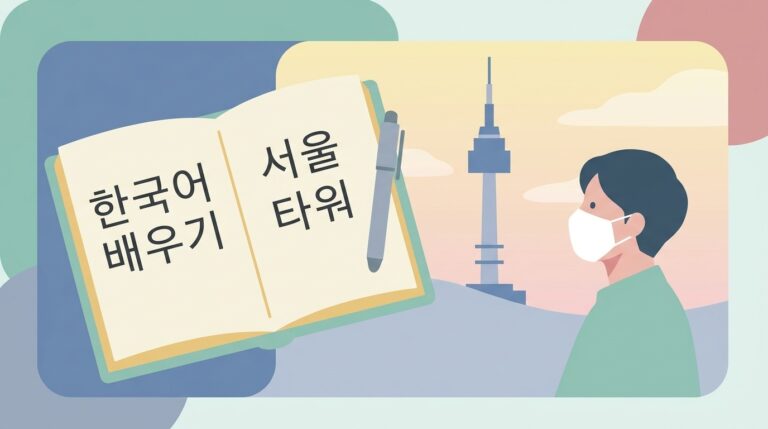
Picture this: You wake up in your cozy Seoul Airbnb on a bright April morning. You eagerly fling open the curtains, expecting the postcard-perfect vista of Namsan Tower from your favorite K-Drama. Instead, the entire cityscape looks like a faded vintage photo washed out by a hazy, yellowish-grey fog. Within five minutes of stepping outside for your morning iced Americano, your throat begins to scratch and your eyes feel dry. You glance at the locals briskly marching down the street, and nearly every single person is wearing a snug, pristine white mask.
You open your weather app and spot a grumpy warning icon: ‘미세먼지’ (Misemeonji). Many beginner Korean learners know basic weather lines like “비가 와요” (It is raining) or “날씨가 좋아요” (The weather is nice), but when seasonal air pollution strikes, they suddenly find themselves speechless at the convenience store counter. Over the past decade of coaching expat newcomers, I have seen this exact scenario trip up so many travelers. Learning to talk about fine dust is not just a language exercise—it is your everyday health armor and an instant ticket to bonding with locals over the shared struggle of spring weather in Korea!
Phase 2: 핵심 표현 3선 심층 분석
1. 오늘 미세먼지 심해요 (Oneul misemeonji simhaeyo)
- Pronunciation: [Oh-neul mee-seh-meon-jee sheem-hae-yo] (Sound tip: ‘simhaeyo’ rhymes with ‘seem heavy’, said with a gentle sigh)
- Meaning: Literal: “Today fine dust is severe.” | Actual Nuance: “The air quality is pretty awful today; let’s stay inside or be careful.”
- K-Culture Moment: Seen in almost every Seoul lifestyle vlog when creators check their morning window before canceling outdoor picnic plans at the Han River.
- Editor’s Insight: ‘심하다’ (simhada) is a versatile A1-friendly word that means “extreme,” “severe,” or “too much.” You can use it for headaches, traffic, or bad weather.
- Situation Spectrum: Casual: ⚠️ (Use ‘심해’ instead) | Semi-formal (Polite -yo): ✅ (Best for coworkers, baristas, friends) | Formal (-seumnida): ✅
- 🤔 Think About It: In many Western countries, people ask “Is it sunny?” In Korea, the very first question is often “Is the air clean?” How does your hometown prioritize air conditions?
2. 마스크 써야 돼요 (Maseukeu sseoya dwaeyo)
- Pronunciation: [Mah-seu-keu sseo-yah dway-yo] (Sound tip: ‘sseo’ sounds like the start of ‘sir’, popping with a double ‘ss’)
- Meaning: Literal: “Must wear a mask.” | Actual Nuance: “You really should put on a mask before stepping out.”
- K-Culture Moment: A classic K-drama line where a caring mother or attentive partner slips a KF94 mask into the protagonist’s pocket before work.
- Editor’s Insight: The grammar ending ‘-아/어야 돼요’ (-a/eoya dwaeyo) means “must” or “need to.” It expresses friendly, protective advice rather than a harsh military command.
- Situation Spectrum: Casual: ⚠️ (Use ‘써야 돼’) | Semi-formal: ✅ | Formal: ✅
- 🤔 Think About It: Notice how Korean masks are spoken of as something you “write/use/wear on head” (쓰다, sseuda) rather than “put on clothing” (입다, ipda). Body parts dictate verbs!
3. 목이 칼칼해요 (Mogi kalkalhaeyo)
- Pronunciation: [Moh-gee kahl-kahl-hae-yo] (Sound tip: ‘kalkal’ mimics the crisp scraping sound of a dry cough)
- Meaning: Literal: “Throat feels scratchy/spicy-gritty.” | Actual Nuance: “My throat feels rough and dry because of the dusty air.”
- K-Culture Moment: What variety show cast members complain about right before heading out to a K-BBQ restaurant to eat pork belly!
- Editor’s Insight: ‘칼칼하다’ (kalkalhada) is a sensory onomatopoeic word. It can describe spicy soup that catches in your throat or that dusty, irritated feeling after breathing bad air.
- Situation Spectrum: Casual: ⚠️ (Use ‘목이 칼칼해’) | Semi-formal: ✅ | Formal: ⚠️ (A bit too sensory for formal news, but completely fine in casual offices)
- 🤔 Think About It: Korean vocabulary is exceptionally rich in sound-symbolic words that capture physical body sensations. How would you describe a scratchy throat in your native language?
Phase 3: 교과서 한국어 vs 진짜 한국어
Situation 1: Talking about bad air outside
- 📖 교과서 한국어 (Textbook): 대기 질이 매우 나쁩니다. (Daegi jiri maeu nappeumnida. – “The atmospheric quality is exceedingly poor.”)
- 🗣️ 진짜 한국어 (Real-life): 오늘 공기 진짜 안 좋아요. (Oneul gonggi jinjja an joayo. – “The air is really not good today.”)
- 💡 왜 다를까? ‘대기 질’ (atmospheric quality) sounds like a formal meteorological broadcast. In everyday life, native speakers simply use ‘공기’ (gonggi, air) and ‘안 좋아요’ (an joayo, not good) for effortless natural communication.
Situation 2: Reminding your buddy to grab a mask
- 📖 교과서 한국어 (Textbook): 마스크를 착용하도록 하십시오. (Maseukeureul chagyonghadorok hasipsio. – “Please wear a mask.”)
- 🗣️ 진짜 한국어 (Real-life): 마스크 꼭 챙겨요! (Maseukeu kkok chaenggyeoyo! – “Make sure to bring a mask!”)
- 💡 왜 다를까? The textbook verb ‘착용하다’ (chagyonghada) is administrative. Friends naturally say ‘챙기다’ (chaenggida, to pack/bring along) with the magic adverb ‘꼭’ (kkok, definitely/make sure).
Phase 4: K-Culture 딥다이브 & 비언어적 매너
4-1. 눈치 (Nunchi) & Body Language
When fine dust spikes in Korea, social awareness is key:
1. The Mask Check Gesture: When stepping out of a subway station, locals immediately look upward squinting at tall buildings to judge visibility, then pat their coat pockets for a mask. Doing this shows you are attuned to the environment.
2. Coughing Etiquette: If the dust makes you cough, never cough into your open hands. Cough downward into the inner crook of your elbow or directly into your collar.
3. Indoor Politeness: Always remove your dust-covered outer mask when settling down inside a friend’s home or a quiet restaurant table to avoid looking like you are tracking contaminants into their space.
4-2. The Folk Tale & Cultural Code: Samgyeopsal (삼겹살)
Ask any Korean what to eat on a dusty day, and nine out of ten will say: “We need to eat Samgyeopsal (grilled pork belly)!” Historically, miners in Korea believed the slick pork oil washed down coal dust stuck in their throats. While modern science has debunked this myth, the cultural ritual remains wildly popular. Whenever the sky turns yellow, Korean BBQ spots fill up with colleagues laughing: “Let’s go grease our throats today!”
Phase 5: 실전 롤플레이 시나리오
- Setting: A bustling GS25 convenience store in Hongdae on a hazy morning.
- Characters: You (visiting exchange student) and Minji (friendly Korean classmate who meets you outside).
-
Turn 1 (Minji): 오늘 하늘 봤어요? 미세먼지 진짜 심해요. (Oneul haneul bwasseoyo? Misemeonji jinjja simhaeyo.) 🎭 Squinting at the yellowish sky and rubbing her throat.
- Turn 2 (You): 네, 맞아요. 목이 조금 칼칼해요. (Ne, majayo. Mogi jogeum kalkalhaeyo.) 🎭 Nodding in agreement while clearing your throat gently.
- Turn 3 (Minji): 어? 마스크 안 썼네요? 편의점 가서 마스크 사요. (Eo? Maseukeu an sseonneyo? Pyeon-uijeom gaseo maseukeu sayo.) 🎭 Pointing gently to her own white KF94 mask.
- Turn 4 (You): 네, 좋아요. 어떤 마스크 사야 돼요? (Ne, joayo. Eotteon maseukeu sayo dwaeyo?) 🎭 Looking at the convenience store display rack curiously.
- Turn 5 (Minji): KF94 마스크 사야 돼요. 미세먼지를 잘 막아줘요. (KF-gusa maseukeu sayo dwaeyo. Misemeonjireul jal magajwoyo.) 🎭 Picking up a black pack with “KF94” stamped clearly in bold.
- Turn 6 (You): 이거 원플러스원(1+1)이네요! 완전 좋아요. (Igeo won-peulleo-seu-won-ineyyo! Wanjeon joayo.) 🎭 Smiling while holding up two packs with price tags.
- Turn 7 (Minji): 나이스! 마스크 쓰고 얼른 실내 카페로 들어가요. (Naiseu! Maseukeu sseogo eolleun silnae kapero deureogayo.) 🎭 Tearing open a pack and adjusting the nose wire.
- Turn 8 (You): 네, 마스크 썼어요. 출발해요! (Ne, maseukeu sseosseoyo. Chulbalhaeyo!) 🎭 Snapping the elastic ear loops into place and grinning.
🔀 인터랙티브 분기점 (Interactive Branching Point)
Minji asks: “오늘 날씨 안 좋은데 한강 갈까요, 아니면 실내 갈까요?” (The weather is bad today, should we go to the Han River or stay indoors?)
- Choice A: “미세먼지 심해요. 백화점이나 카페 가요!” (Misemeonji simhaeyo. Baekhwajeomina kape gayo! – The dust is bad. Let’s go to a department store or cafe!)
- Outcome (Best): Minji sighs in relief! You demonstrated empathy, practical vocabulary, and protected both of your lungs.
- Choice B: “괜찮아요! 한강에서 자전거 타요!” (Gwaenchanayo! Hangang-eseo jajeon-geo tayo! – It’s fine! Let’s ride bicycles at the Han River!)
- Outcome (Risk): Minji looks hesitant and worried. Riding bikes during severe dust alert will leave you both coughing for days!
- Choice C: “대기 질이 심각하므로 집에 귀가하겠습니다.” (Daegi jiri simgakhameuro jibe gwigahagesseumnida. – Atmospheric conditions are severe, hence I will return to my domicile.)
- Outcome (Bad/Awkward): Too robotic! Minji might wonder if you copied your sentence from a formal news teleprompter.
Phase 6: 10초 감정 섀도잉 드릴 (10-Second Emotion Shadowing Drill)
Practice reading out loud, paying attention to the pauses marked by / and emotional directions!
[😷 답답하고 걱정스럽게 - Annoyed and concerned]- 오늘 / 미세먼지 / 진짜 심해요. (Oneul / misemeonji / jinjja simhaeyo.)
[💡 다정하게 챙겨주는 톤 - Caring and thoughtful best friend voice]- 밖에 나갈 때 / 마스크 / 꼭 챙겨요! (Bakke nagal ttae / maseukeu / kkok chaenggyeoyo!)
[🥺 목 만지며 칭얼거리듯 - Rubbing throat, slightly whining]- 아, 공기 때문에 / 목이 너무 칼칼해요. (A, gonggi ttaemune / mogi neomu kalkalhaeyo.)
Phase 7: K-Culture 미니 사전 (핵심 키워드 4개)
- 미세먼지 (Misemeonji): Fine Dust (PM10). The umbrella term Koreans use daily for atmospheric particulate matter.
- 초미세먼지 (Chomisemeonji): Ultrafine Dust (PM2.5). The tiny particles that penetrate deep into lungs; when this is high, alerts beep on phones.
- 황사 (Hwangsa): Yellow Dust. Natural seasonal desert sand originating from the Gobi Desert that blows into Korea during spring.
- KF94 (K-F-gu-sa): “Korea Filter 94”. Certified mask rating blocking 94% of particles down to 0.4 microns. The gold standard in Seoul.
Phase 8: 여행자를 위한 생존 키트 (Survival Kit for Travelers)
Survival Expressions TOP 3
- KF94 마스크 있어요? (KF-gusa maseukeu isseoyo?)
- Meaning: Do you have KF94 masks?
- Pro Tip: Convenience store staff will instantly point you to the wall rack without needing further English.
- 오늘 공기 안 좋아요? (Oneul gonggi an joayo?)
- Meaning: Is the air bad today?
- Pro Tip: Great conversation starter with hotel front desk clerks or guesthouse hosts.
- 따뜻한 물 좀 주세요. (Ttatteut-han mul jom juseyo.)
- Meaning: Please give me some warm water.
- Pro Tip: Drinking warm water flushes micro-particles out of your throat quickly.
Editor’s Travel Note
Before stepping outside your hotel, check the air index. Avoid generic global weather apps that refresh slowly. Instead, use the MiseMise Fine Dust Forecast App download or look at real-time air quality maps through the Naver Map navigation application. If the icon turns red (나쁨 – Bad) or black (최악 – Worst), pop into any CU, GS25, or 7-Eleven where masks are almost always on a buy-one-get-one-free (1+1) promotional deal!
Phase 9: “한 발 더 깊이” (생각 질문)
In many individualistic cultures, talking about the weather is merely casual small talk to avoid silence. In Korea, however, checking whether fine dust is severe is an act of communal care known as 정 (Jeong). When a Korean text message arrives saying: “오늘 미세먼지 심하니까 마스크 꼭 써!” (Fine dust is bad today, make sure to wear a mask!), they are not simply predicting weather—they are saying “I care about your wellbeing.”
💬 Your Turn: How does your culture express everyday care for others through weather or health reminders? Leave a comment below and share your thoughts with us!
Phase 10: FAQ & 오해 방지 (FAQ Schema)
Q: Can I just wear a regular cloth fashion mask or dental mask on dusty days in Korea?
A: Unfortunately, no. Regular dental or cotton masks cannot filter microscopic PM2.5 particles. Always look for the KF94 or KF80 mark certified by the Korean Ministry of Food and Drug Safety.
Q: What is the difference between 미세먼지 (Misemeonji) and 황사 (Hwangsa)?
A: 황사 (Yellow dust) refers specifically to windblown desert sands from inner Asia, usually hitting in spring. 미세먼지 (Fine dust) refers to general industrial and vehicular smog particles present throughout the year.
Q: Does eating Samgyeopsal (pork belly) really remove dust from your body?
A: It is a beloved culinary urban legend! While it does not physically detoxify your respiratory tract, it brings comfort, hydrates your mouth, and serves as a wonderful social excuse for dinner with friends.
🚨 흔한 실수 (Common Mistakes TOP 3)
- Mistake: Pronouncing ‘마스크’ as English “mask”.
- Correct Action: Break it down into 3 clear Korean syllables: 마-스-크 (Ma-seu-keu).
- Mistake: Saying “미세먼지 커요” (Fine dust is big).
- Correct Action: In Korean, air quality severity uses 심해요 (simhaeyo, severe) or 안 좋아요 (an joayo, bad), not 크다 (keuda, big).
- Mistake: Hesitating to wear a mask because you feel awkward.
- Correct Action: In Seoul, nobody looks twice at someone wearing a mask. Not wearing one on bad days stands out far more!
Phase 11: 액션 미션 & 참여 유도
- 🥉 Bronze Mission (Solo Practice): Stand in front of your mirror, imagine looking out a smoggy window, and say: “오늘 미세먼지 심해요!” out loud 3 times.
- 🥈 Silver Mission (Social Share): Snap a picture of today’s sky outside your window and post a story tagging our account with the caption: “오늘 공기 어때요?”
- 🥇 Gold Mission (Real Life): Next time you walk into a Korean convenience store or mart, locate the mask rack and verify the “KF94” label yourself!
- 🎮 K-Culture Mission: Watch an episode of a Korean reality show (like I Live Alone or Omniscient Interfering View) and notice how guests always mention the air index when checking morning forecasts.
Phase 12: 인터랙티브 퀴즈 챌린지
1. Situation Decision: You meet a Korean coworker in the elevator and the sky outside is thick with grey haze. What is the most natural comment?
* A) 비가 많이 와요. (Biga mani wayo.)
* B) 오늘 미세먼지 심해요. (Oneul misemeonji simhaeyo.)
* C) 날씨가 정말 완벽해요! (Nalssiga jeongmal wanbyeokhaeyo!)
2. Fill-in-the-blank: When reminding a friend to protect their throat before heading out, complete the sentence:
“공기 안 좋으니까 마스크 [______] 돼요!”
3. True or False: In Korea, saying “마스크 꼭 챙겨요!” is considered cold and bossy command speech.
* True
* False
👉 Click to reveal answers & explanations!
- Answer: B) 오늘 미세먼지 심해요. (It expresses sympathy and shares weather observation accurately!).
- Answer: 써야 (sseoya) (Full sentence: “마스크 써야 돼요!” meaning “You need to wear a mask!”).
- Answer: False. (It is actually a warm, caring expression of everyday friendship and concern!).







