

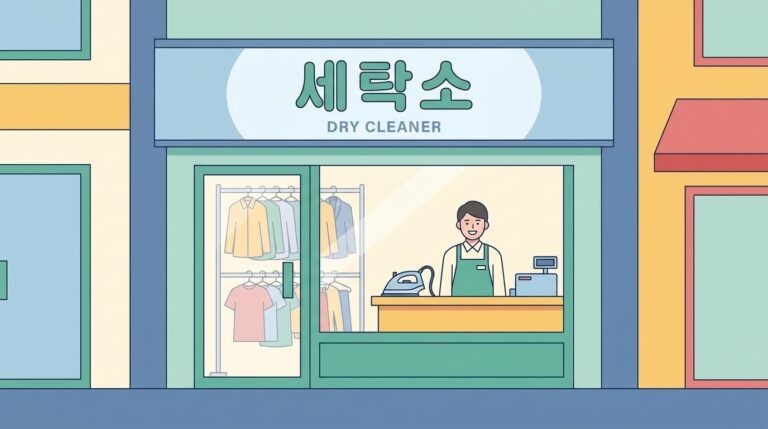
Phase 1: Empathy (Storytelling Opening)
안녕하세요! 매일한글 에디터입니다. (Hello! I’m your Daily Hangul editor.)
Picture this: You just had the most incredible night in Seoul. You treated yourself to sizzling Korean BBQ or savory tteokbokki, but halfway through the meal, a splash of red pepper oil lands right on your favorite beige coat. Instant panic! You know you need to visit a local neighborhood dry cleaner, or setakso (세탁소), first thing in the morning. But the moment you stand before the sliding glass door with vintage yellow lettering, your heart pounds. What if the ajumma or ajossi speaks rapid-fire Korean? How do you ask them to remove that tricky stain without ruining the fabric?
If you have ever frozen in front of a local shop with an armful of laundry, take a deep breath. You are definitely not alone! Hundreds of our beginner students have told us that dropping off clothes at a dry cleaner is one of their biggest “first-time adulting in Korea” hurdles. That’s why I created this foolproof A1-friendly survival guide. In just five minutes, you will learn the exact three magic phrases to drop off your clothes, check the pickup time, and walk out feeling like a total local.
Phase 2: Core 3 Expressions In-Depth
1. 이거 드라이해 주세요 (Igeo deulai-hae juseyo)
- Pronunciation: [I-geo deu-ra-i-hae ju-se-yo] (Sounds like: “Ee-guh dry-hair joo-say-yo” – yes, “dry” is just the English word adapted into Korean phonetics!)
- Meaning: Literal: “Please dry this.” / Actual Nuance: “Please dry clean this garment for me.”
- K-Culture Moment: You’ll see this in countless everyday K-dramas where a busy character rushes into the neighborhood shop before a big job interview or date, handing over a suit jacket.
- Editor’s Insight: You don’t need complicated grammar. In Korean, “dry cleaning” is simply shortened to deulai (드라이). Paired with the polite request ending ~hae juseyo (해 주세요), you instantly sound polite, natural, and clear.
- Situation Spectrum: Casual (⚠️ – only to very close friends as 드라이해 줘), Semi-formal (✅ – ideal for daily storefronts), Formal (✅ – 드라이해 주시겠습니까)
- 🤔 Think About It: In English, we say “I’d like to get this dry cleaned.” In Korean, simply combining the English loanword with juseyo (“give/do for me”) does all the heavy lifting. Isn’t it wonderfully direct yet respectful?
2. 언제 찾으러 와요? (Eonje chajeureo wayo?)
- Pronunciation: [Eon-je cha-jeu-reo wa-yo?] (Sounds like: “Uhn-jeh chah-jeu-ruh wah-yo?” – imagine saying “on jet” without the ‘t’, then rolling smoothly into “chajeureo”!)
- Meaning: Literal: “When do I come to find it?” / Actual Nuance: “When should I come pick it up?”
- K-Culture Moment: In slice-of-life dramas like Reply 1988, characters drop off laundry and instinctively ask this right before walking out the door to check their schedule.
- Editor’s Insight: Koreans use the verb chatda (찾다 – to find/seek) when picking up laundry, retrieving mail, or withdrawing money from an ATM. Saying “find” feels active and natural here.
- Situation Spectrum: Casual (⚠️), Semi-formal (✅ – standard friendly customer tone), Formal (✅ – 언제 찾으러 오면 될까요?)
- 🤔 Think About It: Notice how Korean frames picking up items as “finding/claiming” rather than “collecting” or “picking up.” It shifts the focus onto you reuniting with your belongings!
3. 여기 얼룩 지워져요? (Yeogi eolluk jiwojyeoyo?)
- Pronunciation: [Yeo-gi eol-luk ji-wo-jyeo-yo?] (Sounds like: “Yuh-ghee ul-look jee-woh-jyuh-yo?”)
- Meaning: Literal: “Does the stain here erase?” / Actual Nuance: “Can you get this stain out?”
- K-Culture Moment: When a character spills coffee over an important white blouse right before an office presentation, they desperately rush to the tailor pointing at the spot with this exact phrase.
- Editor’s Insight: Always point your index finger directly at the spot while asking this. The passive form jiwojyeoyo (“does it come off?”) is much softer and more polite than asking “Can you erase this?” (지울 수 있어요?).
- Situation Spectrum: Casual (🚫), Semi-formal (✅), Formal (✅)
- 🤔 Think About It: In Korean culture, softening direct demands by asking about the possibility of the outcome rather than the person’s ability is a cornerstone of polite communication.
Phase 3: Textbook Korean vs Real Korean
Situation 1: Dropping off your winter jacket
- 📖 교과서 한국어 (Textbook): 이것을 드라이클리닝 해 주시겠습니까? (Igeoseul deulaikeullining hae jusigesseumnikka?) – “Would you be so kind as to perform dry cleaning upon this?”
- 🗣️ 진짜 한국어 (Real-life): 사장님, 이거 드라이 맡길게요! (Sajangnim, igeo deulai matgilgeyo!) – “Boss, I’d like to leave this for dry cleaning!”
- 💡 왜 다를까? (Why the difference?): Textbook Korean often overuses lengthy honorific verbs. In real neighborhood shops, addressing the owner warmly as Sajangnim (사장님 – shop owner/boss) and using matgida (맡기다 – to leave in one’s care) builds an instant, warm neighborhood bond.
Situation 2: Asking for the completion date
- 📖 교과서 한국어 (Textbook): 세탁물이 언제 완성됩니까? (Setangmuri eonje wanseongdoemninkka?) – “When will the laundry be completed?”
- 🗣️ 진짜 한국어 (Real-life): 이거 언제 돼요? (Igeo eonje dwaeyo?) – “When will this be ready?”
- 💡 왜 다를까? (Why the difference?): Real spoken Korean is delightfully economical. The verb doeda (되다 – to become / to be done) replaces heavy formal nouns like “completion” (wanseong).
Phase 4: K-Culture Deep Dive & Non-verbal Manners
4-1. 눈치 (Nunchi) & Body Gestures at the Dry Cleaners
When you enter a traditional Korean setakso, the shopkeeper will usually be bent over a hissing steam iron or seated behind a sewing machine. Here is how to use your cultural awareness (Nunchi):
1. Two-handed handover: Always pass your clothing across the counter using both hands (or with your right hand supported by your left hand at the elbow or wrist). Tossing clothes casually on the counter looks disrespectful.
2. The gentle point: If there is a stain, do not just say “it is dirty.” Unfold the garment yourself and point to the problem area with an open hand or a soft finger point.
3. Receipt care: The owner will likely write a small handwritten paper slip called an insu-jeung (인수증) or phone slip. Accept it with two hands, fold it neatly, and keep it safe in your wallet. Do not crumple it!
4-2. Cultural Code: The Neighborhood Heartbeat (골목 세탁소)
Unlike massive industrial laundromats, the Korean neighborhood setakso is a cultural institution. You will recognize them by their distinctive smell of clean steam, starch, and warm fabric. The owners are often veteran artisans who have run the shop in the same alleyway for 20 to 40 years! They are also the neighborhood’s living CCTV cameras; they know who moved into apartment 302, who is preparing for wedding ceremonies, and which high school student got into college. When you step into their shop, treating them like a neighborhood elder rather than a transactional service worker will guarantee your clothes receive five-star artisan care.
Phase 5: Real-Life Roleplay Scenario
Setting: A crisp autumn morning at 행복세탁소 (Happy Cleaners) in a residential alley in Mapo-gu. Steam rises from a heavy commercial press. Behind the counter stands Mr. Park (60s), wearing an apron with measuring tape draped around his neck.
- Turn 1 (Alex): 안녕하세요, 사장님! (Annyeonghaseyo, sajangnim!) [🎭 Smiles warmly, bows lightly at 15 degrees, holding a wool coat with both hands]
- Turn 2 (Mr. Park): 네, 어서 와요! 날씨 춥죠? 무슨 옷이에요? (Ne, eoseo wayo! Nalssi chupjyo? Museun osieyo?) [🎭 Wipes hands on towel, smiles warmly]
- Turn 3 (Alex): 이거 코트 드라이해 주세요. (Igeo koteu deulai-hae juseyo.) [🎭 Gently places the coat on the counter facing the owner]
- Turn 4 (Mr. Park): 알겠어요. 어디 묻은 데나 뜯어진 데 있어요? (Algesseoyo. Eodi mudeun dena tteudeojin de isseoyo?) [🎭 Inspects the lapels and cuffs with skilled hands]
- Turn 5 (Alex): 네, 여기 커피 얼룩 좀 지워주세요. (Ne, yeogi keopi eolluk jom jiwojuseyo.) [🎭 Points closely to the small dark spot on the front pocket]
- Turn 6 (Mr. Park): 아, 이거? 문제없어요. 깨끗하게 빼줄게! (A, igeo? Munjeeopseoyo. Kkaekkeuthage bbaejulge!) [🎭 Nods reassuringly and circles the spot with tailor’s chalk]
- Turn 7 (Alex): 감사해요! 언제 찾으러 와요? (Gamsahaeyo! Eonje chajeureo wayo?) [🎭 Pulls out phone to note down the date]
- Turn 8 (Mr. Park): 목요일 오후 다섯 시 이후에 와요. 번호 뒷자리 적어줘요. (Mogyoil ohu daseot si ihue wayo. Beonho dwitjari jeogeojwoyo.) [🎭 Slides over a notepad and pen with a nod]
🔀 Interactive Choice Point
Mr. Park asks for your contact details. What do you do?
* Choice A: Say “네! 1234예요.” (Ne! Il-i-sam-sa-yeyo.) and write down the last 4 digits of your phone number on the notepad.
* Choice B: Hand over your credit card immediately without writing anything.
* Choice C: Say “싫어요, 영수증 주세요!” (Sireoyo, yeongsujeung juseyo! – “No, give me a receipt!”)
Feedback:
* Choice A (Best!): Perfect! In Korea, dry cleaners organize pick-ups by the last 4 digits of your mobile number. It takes 3 seconds and establishes smooth communication.
* Choice B (Risk): In many local Korean cleaners, you pay after the service is finished when you pick up your clothes. Paying immediately can confuse older shopkeepers.
* Choice C (Bad): Extremely rude! Demanding a receipt aggressively breaks the warm community rapport and will make the interaction uncomfortable.
Phase 6: 10-Second Emotion Shadowing Drill
Read these out loud! Follow the pause markers (/) and embody the emotion tags.
[😊 Friendly & Polite]
사장님, / 이거 / 드라이해 주세요!
(Sajangnim, / igeo / deulai-hae juseyo!)-
[🥺 Worried & Earnest]
여기 커피 얼룩, / 깨끗하게 / 지워져요?
(Yeogi keopi eolluk, / kkaekkeuthage / jiwojyeoyo?) -
[😄 Cheerful & Relieved]
네! / 목요일에 / 찾으러 올게요!
(Ne! / Mogyoile / chajeureo olgeyo!)
Phase 7: K-Culture Mini Dictionary
- 세탁소 (Setakso) | Dry Cleaners / Neighborhood Laundromat
- The traditional neighborhood laundry shop. Unlike self-service coin laundries (코인세탁), a setakso handles professional dry cleaning, stain removal, and fabric steaming.
- 얼룩 (Eolluk) | Stain / Smudge
- Used for any food spills, ink spots, or makeup marks on clothes. Combining it with juda (e.g., 얼룩 빼주세요 – “Please remove the stain”) is a lifesaver.
- 수선 (Suseon) | Clothing Alterations / Mending
- Most Korean dry cleaners double as alteration shops. If your pants are too long or a button falls off, you say: 바지 수선해 주세요 (Please alter these pants).
- 보관 (Bogwan) | Storage / Safekeeping
- Many Korean cleaners offer seasonal storage services. In spring, locals send heavy winter down parkas for cleaning and storage (보관) until next winter.
Phase 8: Survival Kit for Travelers
Top 3 Survival Phrases
- 카드 돼요? (Kadeu dwaeyo?)
- Pronunciation: Kah-deu dwae-yo?
- Pro Tip: “Do you take cards?” Most neighborhood shops accept credit cards, but small mom-and-pop shops appreciate local cash or bank transfer (계좌이체) for small amounts under 5,000 KRW.
- 내일까지 돼요? (Naeil-kkaji dwaeyo?)
- Pronunciation: Nae-il-kkah-jee dwae-yo?
- Pro Tip: “Can it be ready by tomorrow?” Crucial when you are traveling and checking out of your hotel soon!
- 영수증 주세요 (Yeongsujeung juseyo)
- Pronunciation: Yung-soo-jeung joo-say-yo
- Pro Tip: “Please give me a receipt/pickup slip.” Essential so you have proof of your drop-off when coming back.
Editor’s Travel Note
Need to find a reputable local cleaner right near your Airbnb? Skip global maps that lack local updates. Instead, use the Naver Map navigation app download and search for “세탁소”. Look for shops with high ratings for 친절 (kindness) and 수선 (alterations). Also, remember that most traditional cleaners close on Sunday afternoons!
Phase 9: One Step Deeper (Reflection Question)
In many Western countries, laundry drop-offs are strictly formal commercial transactions governed by printed barcodes and upfront payments. In Korea, you will often find that the shopkeeper doesn’t even ask you to pay when you leave your expensive designer coat; they simply write down your phone number on a scrap of paper and say, “Pay me when you pick it up!” This is rooted in Jeong (정)—an unspoken social bond of mutual trust and neighborhood kinship. It assumes that members of the community respect each other’s labor and honesty.
💬 Your Turn: How does customer service in your home neighborhood compare to this trust-based community system? Have you ever experienced an awkward laundry mix-up while traveling abroad? Share your story in the comments below!
Phase 10: FAQ & Avoiding Misunderstandings
Q: Do I pay when dropping clothes off or picking them up?
A: In standard Korean neighborhood cleaners (setakso), payment upon pick-up (후불 – hubul) is the most common custom. However, large chains like Cleantopia (크린토피아) require upfront payment (선불 – seonbul). If unsure, simply ask: 지금 계산해요? (Ji-geum gye-san-hae-yo? – “Do I pay now?”).
Q: What if I lose my paper pickup slip?
A: Don’t panic! Neighborhood cleaners index clothes by your phone number’s last 4 digits and your name. Just show your photo ID or show your phone number on your screen and say: 전화번호로 찾을게요 (I’ll claim it with my phone number).
Q: Can they hem pants or fix zippers too?
A: Yes! Almost all local dry cleaners have a sewing station. Simply fold the cuffs to your desired length and say: 이만큼 줄여주세요 (I-mankeum jul-yeo-ju-se-yo – “Please shorten it by this much”).
🚨 Common Mistakes Warning Board
- Mistake: Throwing down a ball of wrinkled clothes without explaining what needs dry cleaning.
- Correct Action: Hang or gently fold each item, hand them over piece by piece, and say: 이거 드라이해 주세요.
- Mistake: Expecting same-day service within 2 hours without asking.
- Correct Action: Standard dry cleaning takes 2 to 3 business days. If you are in a rush, always ask first: 오늘 돼요? (Can it be done today?).
- Mistake: Assuming all items cost the same.
- Correct Action: Long padding coats (롱패딩) and pure wool/cashmere coats cost significantly more than regular dress shirts. Check prices by asking: 얼마예요? (How much is it?).
Phase 11: Action Mission & Engagement
- 🥉 Bronze Level: Stand in front of your bedroom mirror with your favorite jacket. Practice saying “이거 드라이해 주세요!” smoothly 5 times with a bright smile.
- 🥈 Silver Level: Screenshot your favorite scene from a K-drama featuring a neighborhood dry cleaner or laundry room, and post it on your Instagram Story with the caption: 세탁소에서 드라이 맡기기! #DailyHangul.
- 🥇 Gold Level: During your next trip to Korea, visit a local neighborhood setakso to drop off at least one item using our 3 core phrases without using translation apps!
🎮 K-Culture Mission: Watch an episode of the healing K-drama When the Camellia Blooms or Crash Landing on You. Can you spot the neighborhood laundry shop or identify the familiar hum of the steam press in local village scenes?
Phase 12: Interactive Quiz Challenge
Test your knowledge before your laundry adventure!
Question 1: Situational Judgment
You dropped your winter coat off on Tuesday, and the owner said: “목요일에 와요.” When should you return to pick it up?
* A) Wednesday
* B) Thursday
* C) Friday
Question 2: Fill in the Blank
To ask if a stubborn stain can be removed, point to the spot and say:
“여기 얼룩 _______?”
* A) 가요 (gayo)
* B) 먹어요 (meogeoyo)
* C) 지워져요 (jiwojyeoyo)
Question 3: True or False
At traditional Korean neighborhood cleaners, you must always pay in advance before leaving your clothes.
* True or False?
👉 Click here to reveal the answers & explanations!
- Question 1 Answer: B) Thursday. (Mogyoil 목요일 means Thursday in Korean!).
- Question 2 Answer: C) 지워져요. (Jiwojyeoyo means “does it erase/come out?”).
- Question 3 Answer: False! Most local mom-and-pop cleaners prefer or allow payment upon pickup (후불) after you inspect the finished garment.







