

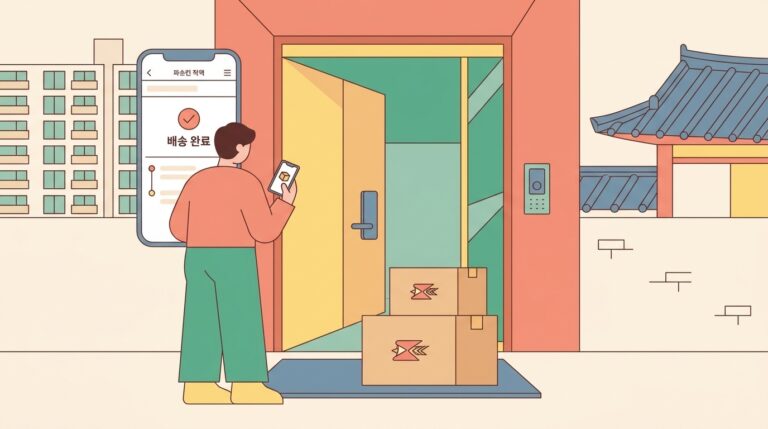
Why Koreans Refresh Delivery Tracking 50 Times a Day: Master Korean Pali-Pali Delivery Slang
Phase 1: Empathy (Storytelling Opening)
안녕하세요! 매일한글 에디터입니다. (Hello! This is your Daily Hangul editor.)
Picture this: You just ordered a stylish knit sweater or the newest K-pop album online at 11:45 PM. In most countries, you would comfortably settle in for a 3-to-5-day wait. But in South Korea? You wake up at 6:30 AM, instinctively reach for your smartphone, and refresh the courier app for the seventh time before your feet even touch the floor. “Has it departed the logistics terminal yet? Is it stuck in the dreaded Okcheon Hub? Why isn’t the tracking status updating?”
If you have ever caught yourself impatiently swiping down on your screen to refresh a tracking page, congratulations—you have officially been infected by Korea’s legendary 빨리빨리 (Pali-Pali / Hurry-Hurry) culture! While textbooks teach you sterile phrases like “택배가 언제 도착합니까?” (When will the parcel arrive?), real life in Korea runs on a completely different rhythm of express delivery slang, doorstep photo notifications, and mutual understanding of hyper-speed logistics.
This guide is crafted directly from intermediate (B2) learners’ real-world struggles. By the end of this lesson, you will not only understand why your Korean friends obsess over shipping updates, but you will also master the exact colloquial phrases and cultural nuances to sound like a bona fide local.
Phase 2: Core 3 Expressions Deep Dive
1. 배송 조회가 아직도 안 떠요 (Baesong johoega ajikdo an tteoyo)
- Pronunciation: [Bae-song jo-hoe-ga a-jik-do an tteo-yo] (Sounds like: “Beh-song jo-hweh-gah ah-jeek-doh ahn ttuh-yo” — the ‘tteo’ is a tense, popping double-T sound like ‘butter’ spoken quickly).
- Meaning: Literal: “The delivery inquiry is still not floating/appearing.” | Real Nuance: “The tracking status hasn’t updated at all yet (and it’s driving me crazy).”
- K-Culture Moment: Seen frequently in K-webtoons and vlogs where characters buy limited-edition concert merch and anxiously refresh the logistics portal every 10 minutes.
- Editor’s Insight: The verb 뜨다 (tteuda) literally means ‘to float’ or ‘to rise,’ but in modern digital Korean, it is universally used when data, notifications, or pop-ups appear on screen.
- Situation Spectrum: Casual ✅ | Semi-formal ✅ | Formal ⚠️ (In formal customer service inquiries, use ‘배송 내역이 아직 조회되지 않습니다’)
- 🤔 Think About It: In English, we say tracking “hasn’t updated.” Why do you think Korean uses a visual, spatial metaphor like “floating up” (뜨다) for real-time digital information?
2. 옥천HUB에 갇혔나 봐요 (Okcheon HUB-e gachyeonna bwayo)
- Pronunciation: [Ok-cheon heo-beu-e ga-chyeon-na bwa-yo] (Sounds like: “Oak-chun hub-eh gah-chyun-nah bwah-yo” — smooth liaison between ‘갇’ and ‘혔’ creating a soft ‘ch’ sound).
- Meaning: Literal: “It seems to be trapped in Okcheon HUB.” | Real Nuance: “My package is stuck in courier limbo / the Bermuda Triangle of shipping!”
- K-Culture Moment: A viral internet meme across Korean online communities whenever a package takes longer than 24 hours because it entered the massive central sorting hub in Okcheon.
- Editor’s Insight: Okcheon is a major logistics hub in central Korea through which enormous freight volumes pass. When delivery statuses stall there, netizens jokingly call it the ‘Ok-muda Triangle’ (옥천 + 버뮤다). Using this phrase will instantly make any Korean friend laugh at your insider cultural knowledge!
- Situation Spectrum: Casual ✅ | Semi-formal ⚠️ | Formal 🚫
- 🤔 Think About It: How do internet memes in your native language turn logistical realities into shared cultural humor?
3. 문 앞에 두고 가주세요 (Mun ape dugo gajuseyo)
- Pronunciation: [Mun a-pe du-go ga-ju-se-yo] (Sounds like: “Moon ah-peh doo-goh gah-joo-seh-yoh”).
- Meaning: Literal: “Please leave it in front of the door and go.” | Real Nuance: “Please leave it right by my doorstep (no need to ring or hand it to me).”
- K-Culture Moment: The gold standard note typed into shipping apps or said quickly to delivery drivers during a phone call across all modern K-dramas.
- Editor’s Insight: South Korea possesses an extraordinary level of civic safety where leaving packages outside apartment doors is 100% standard practice. This phrase is the ultimate polite instruction that respects the driver’s tight schedule.
- Situation Spectrum: Casual ✅ | Semi-formal ✅ | Formal ✅
- 🤔 Think About It: How does societal trust shape everyday language conventions around personal property and deliveries?
Phase 3: Textbook Korean vs. Real Korean
Situation A: Asking a flatmate why they are glued to their phone
- 📖 교과서 한국어 (Textbook):
- 무엇을 그렇게 집중해서 검색하고 있습니까?
- (Mueoseul geureohke jipjunghaeseo geomsaekhago itseumnikka? / What are you searching for with such concentration?)
- 🗣️ 진짜 한국어 (Real-World B2):
- 뭐 봐? 택배 아직 출발 안 했어? 새로고침 그만해!
- (Mwo bwa? Taekbae ajik chulbal an haesseo? Saerogochim geumanhae! / What are you watching? Did your package not dispatch yet? Stop hitting refresh!)
- 💡 왜 다를까? (Why the difference?): Native speakers use punchy, contextual verbs like 출발하다 (to depart/dispatch) and 새로고침 (refresh) instead of generic textbook verbs like ‘검색하다’ (to search).
Situation B: Expressing relief when a parcel arrives in record time
- 📖 교과서 한국어 (Textbook):
- 배송이 매우 신속하게 완료되어 만족스럽습니다.
- (Baesongi maeu sinsokhage wanryodoeo manjeokseureopseumnida. / The delivery was completed very swiftly, so I am satisfied.)
- 🗣️ 진짜 한국어 (Real-World B2):
- 와, 시킨 지 하루도 안 됐는데 벌써 왔네? 완전 총알배송이다!
- (Wa, sikin ji harudo an dwaenneunde beolsseo wanne? Wanjeon chong-al-baesong-ida! / Wow, it hasn’t even been a day since I ordered and it’s already here? Total bullet delivery!)
- 💡 왜 다를까? (Why the difference?): Natural spoken Korean relies on emotional interjections (
와), temporal relative clauses (시킨 지 ~도 안 됐는데), and vivid colloquial compound nouns (총알배송).
Phase 4: K-Culture Deep Dive & Non-verbal Manners
4-1. 눈치 (Nunchi) & Delivery Etiquette
In Korea, delivery drivers (기사님 – gisanim) operate on breathtakingly tight schedules, often handling hundreds of parcels daily. Having good Nunchi (social intuition) means:
1. Do not force face-to-face handoffs: Unless it is high-value jewelry or fresh medicine, requesting drivers to knock and wait for you to open the door is actually seen as slightly inconvenient for them. The default preference is doorstep drop-off.
2. Text over Calls: If you need to change instructions, reply directly to the automated SMS or KakaoTalk Alimtalk message rather than calling the driver during peak route hours (1 PM – 6 PM).
3. The Silent Acknowledgment: When you accidentally run into the courier in the hallway or elevator, a crisp 15-degree bow accompanied by “수고 많으십니다!” (Sugo maneusimnida – Thank you for your hard work!) is top-tier manners.
4-2. Cultural Code Analysis: The Magic of 새벽배송 (Dawn Delivery)
South Korea revolutionized e-commerce through services like Rocket Delivery (로켓배송) and Dawn Delivery (새벽배송). Order organic milk, fresh meat, or emergency charging cables before midnight, and they will be silently sitting on your door mat before 7:00 AM. This extreme speed is powered by automated mega-fulfillment centers and high-density apartment housing. This hyper-punctual environment has conditioned Koreans to expect real-time status updates at every stage: 상품준비중 (Preparing item) ➔ 집하 (Collected) ➔ 간선하차 (Hub transit) ➔ 배송출발 (Out for delivery) ➔ 배송완료 (Delivered).
Phase 5: Real Roleplay Scenario
Setting: Min-woo (민우) and foreign exchange student Alex (알렉스) are hanging out at their university shared studio. Alex has been looking at his phone with a distressed expression for the past 20 minutes.
- Min-woo: 알렉스, 아까부터 핸드폰만 보네. 무슨 일 있어? (Alex, akka-buteo haendeupon-man bone. Museun il isseo? / 🎭 Peeking curiously over Alex’s shoulder)
- Alex: 어제 주문한 패딩이 오늘 와야 하는데, 배송 조회가 아직도 안 떠. (Eoje jumunhan paedangi oneul waya haneunde, baesong johoega ajikdo an tteo. / 🎭 Sighing while rapidly tapping the screen)
- Min-woo: 어디서 샀는데? 송장번호는 나왔어? (Eodiseo satneunde? Songjangbeonhoneun nawasseo? / 🎭 Grabbing his own drink and leaning in)
- Alex: 응, 송장은 떴는데 계속 ‘집하처리’ 상태에서 멈춰 있어. 혹시 옥천HUB에 갇힌 건 아니겠지? (Eung, songjangeun tteotneunde gyesok ‘jiphacheori’ sangtae-eseo meomchwo isseo. Hoksi Okcheon HUB-e gachin geon anigetji? / 🎭 Showing the frozen progress bar)
- Min-woo: 아, 거기는 한번 들어가면 반나절은 기본이야. 그래도 오늘 밤엔 무조건 도착할걸? (Ah, geogineun hanbeon deureogamyeon bannajeoreun giboniya. Geuraedo oneul bamen mujokeon dochakhalkeol? / 🎭 Chuckling and waving his hand dismissively)
- Alex: 오늘 저녁에 입고 나가야 한단 말이야. 기사님한테 전화해 볼까? (Oneul jeonyeoge ipgo nagaya handan mariya. Gisanimhante jeonhwahae bolkka? / 🎭 Hovering thumb over the phone icon)
- Min-woo: 잠깐! 아직 ‘배송출발’도 안 떴는데 기사님께 전화하면 곤란해하셔. (Jamkkan! Ajik ‘baesongchulbal’do an tteotneunde gisanimkke jeonhwahamyeon gonranheahasyeo. / 🎭 Putting a hand on Alex’s wrist to stop him)
- Alex: 아, 그렇구나! 그냥 차분하게 새로고침 하면서 기다려야겠다. (Ah, geureokguna! Geunyang chabunhage saerogochim hamyeonseo gidaryeoyagetda. / 🎭 Chuckling sheepishly and setting the phone down)
🔀 Interactive Branching Decision:
What should Alex do next if the status suddenly changes to ‘배송출발 (Out for Delivery)’?
- Choice A: Call the driver immediately and ask them to deliver to his address first.
- Choice B: Check the estimated arrival time in the app and text a note: “문 앞에 두고 가주세요.”
- Choice C: Keep refreshing the screen every 30 seconds while standing right in front of the front door.
[Feedback Analysis]
- Choice A (Bad): Drivers follow strictly planned, GPS-optimized routes. Requesting priority delivery disrupts their workflow.
- Choice B (Best!): Highly practical, polite, and follows Korean delivery norms flawlessly.
- Choice C (Risk): You will exhaust your phone battery and your sanity! Delivery statuses update in batch chunks.
Phase 6: 10-Second Emotion Shadowing Drill
Practice these lines with rhythm, pausing naturally at each / mark:
[😤 답답하고 초조하게 - Frustrated & Impatient]- 왜 아직도 / 집하 처리 상태지? / 옥천HUB에 / 갇힌 게 분명해!
- (Wae ajikdo / jiphacheori sangtaeji? / Okcheon HUB-e / gachin ge bunmyeonghae!)
[🤩 설레고 기대하며 - Excited & Anticipating]- 드디어 / 배송출발 떴다! / 오늘 저녁 전에는 / 무조건 오겠네!
- (Deudio / baesongchulbal tteotda! / Oneul jeonyeok jeoneneun / mujokeon ogetne!)
[😌 안도하며 정중하게 - Relieved & Courteous]- 기사님, / 바쁘실 텐데 / 문 앞에 두고 / 사진 한 장만 보내주세요.
- (Gisanim, / bappeusil tende / mun ape dugo / sajin han jangman bonaejuseyo.)
Phase 7: K-Culture Mini Dictionary
- 총알배송 (Chong-al-baesong) | Bullet delivery / ultra-fast shipping
Used to describe items that arrive within a few hours or early the next morning. Common in e-commerce reviews: “어제 샀는데 오늘 아침 도착… 완전 총알배송이네요!” -
옥뮤다 삼각지대 (Ok-muda Samgakjidae) | The Okcheon Bermuda Triangle
Slang combining Okcheon Logistics Hub and the Bermuda Triangle. Used humorously when tracking statuses remain frozen at Okcheon Hub for over 24 hours. -
문앞 인증샷 (Mun-ap Injeung-syat) | Doorstep proof-of-delivery photo
The standard photo message couriers send via text/KakaoTalk showing your package safely positioned next to your door number. -
송장번호 (Songjang-beonho) | Waybill / Parcel Tracking Number
The crucial 10-to-12 digit tracking number required to look up shipping progress across carrier portals like CJ Logistics, Post Office, or Lotte.
Phase 8: Survival Kit for Travelers & Expats
Survival Expressions TOP 3:
- 배송 조회 어떻게 해요? (Baesong johoe eotteoke haeyo? / How do I check tracking for this?)
Pro Tip: Use this when buying goods at offline department stores or tax-free shops that offer hotel courier services. - 부재 시 경비실에 맡겨주세요. (Bujae si gyeongbisire matgyeojuseyo. / If absent, please leave it with the security office.)
Pro Tip: Essential if staying in an officetel (오피스텔) or apartment complex where parcel theft prevention or weather protection is managed by security. - 배송 완료 문자 받았어요. (Baesong wanryo munja badasseoyo. / I received the delivery completion text.)
Pro Tip: Great for verifying reception with your Airbnb host or hotel front desk.
Editor’s Travel Note:
When staying in Korea, download the Naver Map app on the iOS App Store or Google Play Store to track package drop-off locations at nearby convenience stores (CU, GS25). If ordering directly, you can track virtually any local parcel instantly by pasting the tracking number straight into the Naver search bar!
Phase 9: “One Step Deeper” (Cultural Insight)
Foreign visitors are frequently amazed to see valuable electronics, designer sneakers, and fresh groceries sitting unattended outside Korean front doors for hours. This unique coexistence of high-speed impatience (Pali-Pali) and deep public security stems from two pillars: pervasive CCTV/smart door lock infrastructure and a strong collective civic conscience (공동체 의식). The urgency in Korea is rarely about fear of package loss; rather, it is a cultural celebration of digital efficiency and uninterrupted momentum in daily life.
💬 Your Turn: In your home country, what happens to packages left outside your door? Would the Korean style of “문 앞에 두고 가주세요” work in your neighborhood? Share your experiences in the comments below!
Phase 10: FAQ & Common Mistakes
Q: Why does my package status say ‘간선상차’ for so many hours?
A: 간선상차 (Ganseonsangcha) means your parcel has been loaded onto a long-haul semi-truck traveling between major logistics hubs overnight. The status will not update until the truck arrives at your city’s local terminal and undergoes 간선하차 (Ganseonhacha – Unloading) in the early morning.
Q: Is it rude to text a Korean delivery driver late at night?
A: Yes. If your delivery arrived at night or in the morning, do not call or text the courier directly during off-hours. Automated apps allow you to register doorstep delivery notes without bothering individual drivers during their rest periods.
Q: What does ‘배송준비중’ mean if I want to cancel my order?
A: 배송준비중 (Preparing for delivery) means the seller has already printed the shipping label (송장 출력). In many Korean shopping malls, once this status appears, instant cancellation is blocked because the warehouse has already packed the carton.
🚨 Common Mistakes Warning Board:
- Mistake: Calling the driver when the app still says ‘간선하차’ (Truck Unloading).
Correct Action: Wait until the status changes to 배송출발 (Out for Delivery) and shows your assigned local driver’s direct contact. - Mistake: Using textbook formal language on delivery notes (e.g., “문전에 적재하여 주시기를 당부드립니다”).
Correct Action: Keep it short, polite, and standard: “문 앞에 두고 가주세요 (사진 부탁드립니다).” - Mistake: Forgetting to enter your apartment unit number (동/호수) on Korean checkout forms.
Correct Action: Always verify the building number (동) and door number (호) to ensure seamless doorstep drop-off.
Phase 11: Action Mission & Engagement
- 🥉 Bronze Tier (Solo Drill): Read Phase 6 Shadowing Drills aloud 3 times, focusing on switching your tone from frustrated to relieved.
- 🥈 Silver Tier (Community): Leave a comment below using the word 총알배송 or 옥천HUB in a full Korean sentence.
- 🥇 Gold Tier (Real-world Challenge): Next time you order something in Korea (or look up K-pop merch tracking), take a screenshot and identify three status terms: 집하, 배송출발, 배송완료 without using a translator!
🎮 K-Culture Mission: Watch an episode of a modern Korean variety show (like I Live Alone / 나 혼자 산다) and spot how many package boxes are stacked near the celebrity’s entrance door!
Phase 12: Interactive Quiz Challenge
1. Situational Judgment:
Your package tracking status has been stuck at Okcheon Hub since yesterday morning. How would you casually express this to your Korean friend?
* A) 택배가 아직 백화점에 있어요.
* B) 내 택배 옥천HUB에 갇혔나 봐.
* C) 택배 기사님이 주무시고 계십니다.
2. Fill-in-the-Blank:
Complete the standard delivery note instruction:
“부재 시 택배는 ________ 두고 가주세요.”
* (Hint: In front of the door)
3. True or False:
In Korea, leaving packages outside apartment doors without immediate collection is considered dangerous and socially unacceptable. (True / False)
👉 Click here to reveal the Answers & Explanations!
-
Answer: B (내 택배 옥천HUB에 갇혔나 봐.)
Explanation: This uses natural intermediate grammar (~나 봐– seems like) combined with the classic Korean logistics meme. -
Answer: 문 앞에 (Mun ape)
Explanation: “부재 시 택배는 문 앞에 두고 가주세요” (If absent, please leave the parcel in front of the door) is the standard phrasing. -
Answer: False
Explanation: Doorstep drop-off is the standard, trusted, and widely preferred method of delivery across South Korea thanks to high public safety and CCTV networks.







