

안녕하세요! 매일한글 에디터입니다.
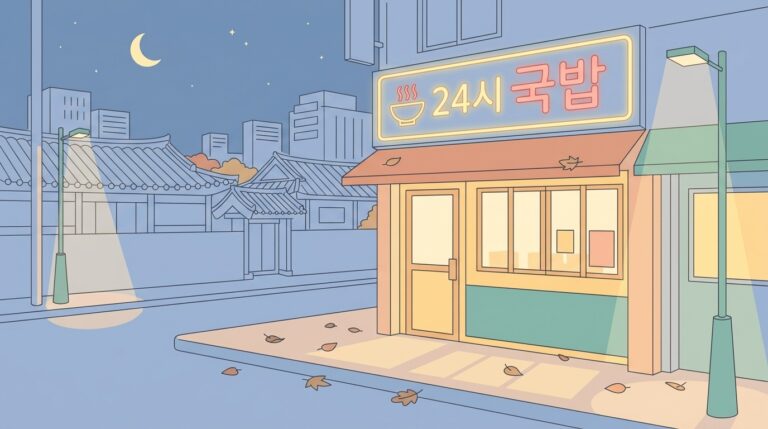
Picture this: It’s 2:45 AM on a chilly autumn night in Seoul. You’ve just wrapped up an exhilarating three-hour session at a coin noraebang (karaoke) with friends, or maybe severe jet lag has jolted you wide awake. Your stomach lets out a thunderous rumble. You crave steaming hot Gamjatang (pork backbone stew) or crispy late-night Kimbap.
You wander into an alley illuminated by glowing red and yellow neon signs, but a sudden wave of hesitation freezes you at the door. The lights are on, but the staff seem to be sweeping the floor. Are they still serving food, or are they wrapping up? If you step inside and blurt out an awkward textbook phrase like “Yeogi yeongeop hamnikka?”, will you sound like a robotic news anchor?
Navigating Korea’s iconic Yasik (night snack) scene is a quintessential rite of passage for any intermediate learner. In this masterclass guide—built upon real-world feedback from hundreds of Daily Hangul learners—you will master natural, intermediate-level (B2) phrases to locate 24-hour eateries, read the room (Nunchi), and order like a confident local.
Phase 2: Deep Dive into 3 Core Expressions
1. 지금 식사 돼요? (Jigeum siksa dwaeyo?)
- Pronunciation: Jee-geum seek-sah dway-yo? (Rhymes with “see” and “dough”)
- Meaning:
- Literal: Is a meal possible right now?
- Nuanced: “Are you guys still serving food / taking dine-in orders right now?”
- K-Culture Moment: In the hit K-drama Hospital Playlist, tired doctors stumble into an all-night diner at 3:00 AM, casually poking their heads through the sliding glass door and asking the owner this exact phrase before stepping inside.
- Editor’s Insight: At B2 level, avoid asking “Is the restaurant open?” (Muni yeollyeo isseoyo?). Asking if meals are possible (Siksa dwaeyo?) naturally clarifies whether the kitchen is still operating or if they are only fulfilling takeout/cleaning up.
- Situation Spectrum:
- Casual (반말): ⚠️ 지금 밥 돼? (Jigeum bap dwae? – only to close friends who run the diner)
- Semi-formal (Polite 해요체): ✅ 지금 식사 돼요? (Jigeum siksa dwaeyo? – universally perfect)
- Formal (하십시오체): ⚠️ 지금 식사 가능합니까? (Jigeum siksa ganeunghamnikka? – overly stiff for 3 AM)
- 🤔 Think About It: Why do Koreans inquire about the possibility of a meal rather than the state of the business hours? How does this reflect the dynamic flexibility of Korean restaurant kitchens?
2. 몇 시까지 영업하세요? (Myeot si-kkaji yeongeop-haseyo?)
- Pronunciation: Myut-shee-kkah-jee young-up-hah-seh-yo?
- Meaning:
- Literal: Until what time do you do business?
- Nuanced: “What time are you open until tonight?”
- K-Culture Moment: When protagonists in romance dramas finish a late working overtime shift and scope out an unfamiliar pocha (tented street bar), they use this polite phrase to plan whether they have time for a second bottle of soju.
- Editor’s Insight: The particle -kkaji (until) coupled with the honorific verb yeongeophasyeoyo strikes the gold standard balance of respect and practical inquiry. It sounds polished without being excessively corporate.
- Situation Spectrum:
- Casual: 🚫 몇 시까지 해? (Myeot si-kkaji hae? – too blunt with strangers)
- Semi-formal: ✅ 몇 시까지 영업하세요? (Myeot si-kkaji yeongeophaseyo? – recommended)
- Formal: ✅ 몇 시까지 영업하십니까? (Myeot si-kkaji yeongeophasimnikka?)
- 🤔 Think About It: In English, we often ask “When do you close?”, focusing on the end. Korean often asks “Until when do you do business?”, focusing on the ongoing service. What does this reveal about customer-host interactions?
3. 혹시 24시간 식당 맞나요? (Hoksi isip-sa-sigan sikdang mannayo?)
- Pronunciation: Hoke-shee ee-sheep-sah-she-gahn seek-dahng mahn-nah-yo?
- Meaning:
- Literal: By any chance, is this a 24-hour restaurant right?
- Nuanced: “Excuse me, is this place open 24/7 by chance?”
- K-Culture Moment: Late-night variety show cast members roaming the backstreets of Gangnam searching for Haejangguk (hangover soup) spot a sign saying “24시” and double-check with the staff using this gentle inquiry.
- Editor’s Insight: The magic word Hoksi (“by any chance”) softens the inquiry, preventing you from sounding demanding. It acknowledges that post-pandemic, many signs that say “24시” might actually close at midnight.
- Situation Spectrum:
- Casual: ⚠️ 여기 24시간 맞아? (Yeogi isipsasigan maja?)
- Semi-formal: ✅ 혹시 24시간 식당 맞나요? (Hoksi isipsasigan sikdang mannayo? – ideal)
- Formal: ✅ 혹시 24시간 운영되는 곳입니까? (Hoksi isipsasigan un-young-doe-neun gos-imnikka?)
- 🤔 Think About It: How does introducing a sentence with Hoksi change the entire conversational temperature in high-context cultures like Korea?
Phase 3: Textbook Korean vs. Real Korean
Scenario 1: Checking if the kitchen is still taking orders
- 📖 교과서 한국어 (Textbook): 지금 주문을 받아도 됩니까? (Jigeum jumuneul badado doemnikka? / May I place an order now?)
- 🗣️ 진짜 한국어 (Real-world): 지금 주문 들어가요? (Jigeum jumun deureogayo? / Are orders still going in right now?)
- 💡 왜 다를까?: Native speakers use the dynamic verb deureogada (to enter/go through) to refer to the kitchen ticket system. It sounds instantly natural and native compared to textbook passive forms.
Scenario 2: Asking when the final order can be placed
- 📖 교과서 한국어 (Textbook): 마지막 주문 가능 시간은 언제입니까? (Majimak jumun ganeung siganeun eonjeimnikka? / When is the final possible order time?)
- 🗣️ 진짜 한국어 (Real-world): 라스트 오더 언제까지예요? (Laseuteu odeo eonjekkajiyeyo? / When is the last order?)
- 💡 왜 다를까?: The loanword 라스트 오더 (Last Order) is ubiquitous in modern Korean food culture. Using long Sino-Korean compounds (마지막 주문 가능 시간) sounds like reading an official legal disclaimer.
Phase 4: K-Culture Deep Dive & Non-Verbal Manners
4-1. 눈치 (Nunchi) & Entryway Etiquette
When approaching an eatery at 3:00 AM in Korea, your eyes should do the talking before your mouth opens:
1. The Chair Scan: If dining chairs are stacked upside down on tables near the window, the restaurant is in Magam (closing mode). Do not just walk in and sit down.
2. The Threshold Step: Stop right at the doorway. Catch the eye of the Imo-nim (auntie/manager), slightly tilt your head by 15 degrees, hold up your fingers to indicate your party size (e.g., two fingers), and ask: “지금 식사 돼요?” (Jigeum siksa dwaeyo?).
3. The Table Bell Decorum: In 24-hour spots, staff are often multitasking (prepping soup broths for the morning rush). Look for the call bell (Hocheulbel) on the side of the table instead of loudly shouting across the room.
4-2. The Soul of Nighttime Gastronomy: 해장국 (Haejangguk) & 분식 (Bunsik)
Korea’s 24-hour dining culture is historically rooted in two institutions:
* The Soup Sanctuaries: 24시 뼈해장국 (Pork bone soup) and 콩나물국밥 (Bean sprout soup) houses. These are culinary safety nets where weary night-shift workers, taxi drivers, and partygoers sit side by side in mutual, steamy warmth.
* The All-Night Bunsik Corners: Places like Gimbap Cheonguk (Kimbap Heaven) where you can grab Ramen, Tteokbokki, and freshly rolled rolls at 4:30 AM before catching the first subway train.
Phase 5: Real-Life Roleplay Scenario
Setting: 3:15 AM. A misty night in an alley near Euljiro. You and your friend stand before “새벽집 뼈해장국” (Dawn House Gamjatang). Steam billows from the exhaust fan, and an energetic Imo-nim in a floral apron is wiping down the counter.
- Learner: 저기요, 안녕하세요! 지금 식사 돼요?
(Jeogiyo, annyeonghaseyo! Jigeum siksa dwaeyo?)
“Excuse me, hello! Are you still serving food right now?”
🎭 Standing politely at the entrance, making gentle eye contact. -
Imo-nim: 어서 와요! 두 명이에요? 안쪽 편한 자리에 앉아요.
(Eoseo wayo! Du myeong-ieyo? Anjjok pyeonhan jarie anjayo.)
“Welcome! Party of two? Take any comfortable seat inside.”
🎭 Gesturing warmly toward an inner booth. -
Learner: 혹시 몇 시까지 영업하세요? 저희가 조금 늦게 와서요.
(Hoksi myeot si-kkaji yeongeophaseyo? Jeohuiga jogeum neutge waseoyo.)
“By any chance, until what time are you open? We arrived a bit late.”
🎭 Sliding into the seat and neatly placing chopsticks on a napkin. -
Imo-nim: 우리 집 24시간이야! 새벽 내내 하니까 천천히 편하게 먹어요.
(Uri jip isipsiganiya! Saebyeok naenae hanikka cheoncheonhi pyeonhage meogeoyo.)
“Our place is 24 hours! We’re open all dawn long, so eat slowly and relax.”
🎭 Setting down a metal jug of ice-cold barley tea. -
Learner: 아, 다행이네요! 그럼 뼈해장국 두 개 지금 주문 들어가요?
(A, dahaeng-ineyyo! Geureom ppyeohaejangguk du gae jigeum jumun deureogayo?)
“Ah, what a relief! In that case, can we put in an order for two bone soups now?”
🎭 Pointing at the wall menu with both hands. -
Imo-nim: 응, 바로 나와요. 깍두기 더 필요하면 셀프바 이용하고!
(Eung, baro nawayo. Kkakdugi deo piryohamyeon selpeuba iyonghago!)
“Sure thing, coming right up. If you need more radish kimchi, use the self-bar!”
🎭 Tapping the kitchen bell and shouting the order to the cook. -
Learner: 네, 감사합니다! 이모님, 앞치마는 어디 있나요?
(Ne, gamsahamnida! Imo-nim, apchimaneun eodiscore unnayo?)
“Yes, thank you! Auntie, where might the aprons be?”
🎭 Looking around politely for the hanging apron rack. -
Imo-nim: 저기 정수기 옆에 걸려있어요, 가져다 써요~
(Jeogi jeongsugi yeope geollyeoisseoyo, gajyeoda sseoyo~)
“They’re hanging right next to the water purifier over there, feel free to grab one~”
🎭 Smiling as she brings sizzling stone bowls.
🔀 Interactive Branching Point
The clock hits 4:10 AM. You finished your stew and want to order an extra bowl of rice and a soda. What do you do?
- Option A: Wave both arms and shout loudly: “야! 밥 더 줘!” (Ya! Bap deo jwo!)
- Option B: Press the small bell on the corner of your table once, wait for eye contact, and say: “이모님, 공깃밥 하나랑 사이다 하나 추가해 주세요.” (Imo-nim, gonggitbap hanarang saida hana chugahae juseyo.)
- Option C: Walk straight into the private kitchen area to take a soda can from the fridge yourself.
🔍 Check Branching Feedback
- Option A [Bad 🚫]: “Ya!” is rude banmal used only with close peer friends. Using it with restaurant owners will instantly ruin the hospitable vibe.
- Option B [Best ✅]: Perfect! Pressing the bell shows respect for the staff’s workflow, and addressing the server as Imo-nim while using -hae juseyo is peak natural Korean etiquette.
- Option C [Risk ⚠️]: Never enter the cooking station. Even if side dishes are self-service (셀프), drinks must be tracked by staff for billing.
Phase 6: 10-Second Emotional Shadowing Drill
Practice these rhythmic pauses (/) and embody the native emotional state!
[🥺 Relieved & Polite]
저기요 / 혹시 지금 / 식사 돼요?
(Jeogiyo / hoksi jigeum / siksa dwaeyo?)
“Excuse me / by any chance / can we still eat?”-
[✨ Curious & Natural]
마감 언제예요? / 라스트 오더 / 끝났나요?
(Magam eonjeyeyo? / Laseuteu odeo / kkeutnannayo?)
“When is closing time? / Has last call / already passed?” -
[😊 Cheerful & Appreciative]
24시간이라니 / 정말 다행이에요! / 맛있게 먹겠습니다.
(Isipsigan-irani / jeongmal dahaeng-ieyo! / Mas-itge meokgetseumnida.)
“I’m so glad / you’re 24 hours! / We will enjoy the meal.”
Phase 7: K-Culture Mini Dictionary
- 야식 (Yasik): Late-night snack / midnight meal. In Korea, this is a distinct cultural meal category separate from dinner (Jeonyeok).
- 해장국 (Haejangguk): “Hangover-chasing soup.” Packed with hearty proteins, Napa cabbage, and deep savory broths, it is the undisputed king of 24-hour restaurant menus.
- 마감 (Magam): Closing time / Wrapping up business for the day. If a waiter says “저희 마감했어요” (Jeohui magamhaesseoyo), the kitchen has stopped cooking.
- 셀프바 (Selpeuba): “Self-service bar.” Stations in casual diners where you replenish your own kimchi, pickled radishes, water, and side dishes.
Phase 8: Survival Kit for Travelers
Top 3 Survival Phrases
- 포장도 되나요? (Pojangdo doenayo?)
Meaning: “Can I get this to go / as takeout?”
Pro Tip: If all tables are full or closing soon, grab your hot soup as takeout to enjoy in your hotel! - 계산 지금 해야 하나요? (Gyesan jigeum haeya hanayo?)
Meaning: “Do I need to pay right now (pre-pay)?”
Pro Tip: Some late-night diners switch to prepayment (선불 / Seonbul) after 2:00 AM. - 화장실 비밀번호 있어요? (Hwajangsil bimilbeonho isseoyo?)
Meaning: “Is there a restroom passcode?”
Pro Tip: Late at night, commercial building restrooms are locked. Look at the bottom of your receipt or ask the cashier!
Editor’s Travel Note
- Navigation Tip: Google Maps often shows inaccurate business hours in Korea. Make sure to download the Naver Map late-night navigation guide or use KakaoMap to toggle the “영업 중” (Open Now) live filter.
- Payment: Almost all 24-hour restaurants accept international credit cards (Visa/Mastercard) and Apple Pay (where supported), but keeping a 10,000 KRW cash note or a loaded T-money transit card in your pocket is a great backup.
Phase 9: 한 발 더 깊이 (Going Deeper)
Korea’s 24-hour dining landscape is a testament to the nation’s exceptional public safety and its communal, nocturnal vibrancy. Unlike many Western cities where streets empty out after midnight, Seoul transforms into a bustling second shift of culinary comfort. Eating hot soup at 4:00 AM is not seen as an act of desperation, but rather a warm, collective ritual that embraces night owls, shift workers, and friends creating lasting memories.
💬 Your Turn: What is your favorite midnight comfort food in your home country, and how does it compare to sitting before a boiling Korean stone pot (Ttukbaegi) at 3:00 AM? Let’s chat in the comments below!
Phase 10: FAQ & Common Mistakes
Q: What should I do if the sign outside says “24시” but the door is locked?
A: Many Korean diners operated 24/7 prior to 2020 and kept their physical outdoor neon signage intact even after adjusting their hours. Always check if the inside lights are vibrant and ask “지금 식사 돼요?” before assuming they are open.
Q: Can I order just one portion (1인분) at an all-night barbecue place?
A: Most Korean BBQ (K-BBQ) restaurants require a minimum order of 2 servings (2인분) even if you are dining solo. However, Gukbap and Bunsik spots readily serve single portions (1인분 가능).
Q: Is it rude to drink alcohol alone late at night in these restaurants?
A: Not at all! Solo dining and drinking (Honsul / Honbap) is widely accepted and respected in modern Korea, especially in 24-hour soup restaurants.
🚨 흔한 실수 (Common Mistakes) TOP 3
- Mistake: Shouting “Ajumma!” (아줌마) aggressively from across the room.
Correct Action: Call them politely with “이모님!” (Imo-nim) or “사장님!” (Sajang-nim), or simply press the table bell. - Mistake: Sitting down at a table that hasn’t been cleared yet because you assume it’s open seating.
Correct Action: Wait at the door until staff notice you and gesture toward a clean, prepared table. - Mistake: Asking for the check at the dining table.
Correct Action: In Korea, you take your printed bill (Gyesanseo) from your table clip and bring it up to the counter register by the exit to pay.
Phase 11: Action Missions
- 🥉 Bronze Mission: Practice saying “지금 식사 돼요?” 5 times aloud using the rhythmic shadowing audio tempo in Phase 6.
- 🥈 Silver Mission: Open your map application and locate two 24-hour restaurants in Hongdae or Myeongdong using the search term “24시 식당”.
- 🥇 Gold Mission: Next time you are in Korea or at a Korean diner in your local Koreatown, use “라스트 오더 언제까지예요?” directly with the host!
- 🎮 K-Culture Mission: Watch an episode of a slice-of-life K-drama (like Let’s Eat or Weightlifting Fairy Kim Bok-joo) and spot how characters address late-night restaurant owners.
Phase 12: Interactive Quiz Challenge
1. Situational Decision Quiz
You enter a soup restaurant at 2:30 AM. The staff is washing dishes and mopping the entryway. Which of the following is the most natural B2-level phrase to check if you can eat?
* (A) 문 열어 주세요! (Mun yeoreo juseyo!)
* (B) 저기요, 혹시 지금 식사 돼요? (Jeogiyo, hoksi jigeum siksa dwaeyo?)
* (C) 폐점 시간 언제입니까? (Pyejeom sigan eonjeimnikka?)
2. Fill-in-the-Blank
Complete the sentence to ask when the last call for orders is:
* “실례지만, _________ 언제까지예요?”
3. True / False Cultural Check
- Statement: In all Korean restaurants with a “24시” sign, you are guaranteed to get service 24 hours a day without exception. (True / False)
👉 Click here to reveal Quiz Answers & Explanations!
-
Answer: (B)
Explanation: Asking “혹시 지금 식사 돼요?” is polite, considerate, and gets straight to whether food can be prepared. (A) sounds demanding (“Open the door!”), and (C) is unnaturally formal and stiff. -
Answer: 라스트 오더 (Last Order)
Complete Sentence: 실례지만, 라스트 오더 언제까지예요? (Sillyejiman, laseuteu odeo eonjekkajiyeyo?) -
Answer: False
Explanation: Many restaurants keep their original vintage “24시” signage even though their real-world hours changed. Always verify with “지금 식사 돼요?” or check live map applications!







