

Phase 1: 공감 (Story Immersion Opening)
안녕하세요! 매일한글 에디터입니다.
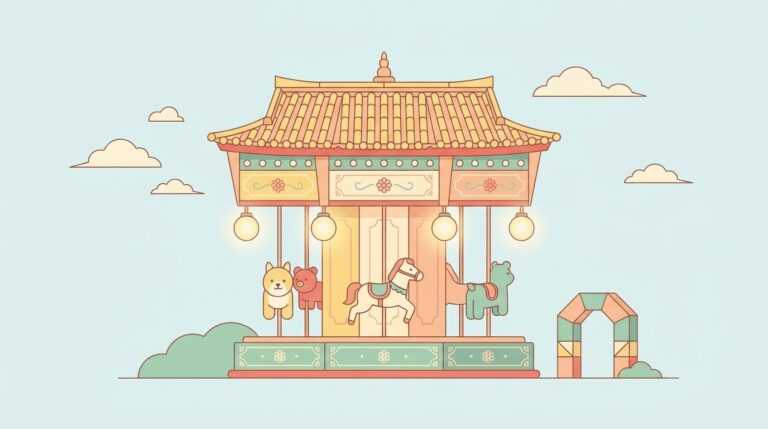
Picture this: You are standing under thousands of glowing fairy lights right in front of the legendary carousel at Lotte World in Seoul. You’ve got your cute character headband on, retro K-pop tunes are bouncing through the air, and everyone around you is capturing that dreamy, golden-hour photo—just like in your favorite K-dramas! But as you hold your phone, your heart starts racing. You want to ask the friendly couple nearby to take your photo, or you want to check if that majestic white horse with the gold saddle is free to ride. How do you say it naturally without freezing up or resorting to awkward hand gestures?
Don’t worry, my friend! Many of our beginner students tell us they feel intimidated to speak up in noisy, fast-paced theme parks. This guide is crafted specifically for A1 absolute beginners based on real-world learner feedback. In just five minutes, you will master the exact three magical phrases you need to ride with confidence and capture your dream photos in Korea!
Phase 2: 핵심 표현 3선 심층 분석 (Top 3 Essential Expressions)
1. 사진 찍어 주세요! (Sajin jjigeo juseyo!)
- Pronunciation: [sa-jin jji-geo ju-se-yo] (Sounds like: ‘Sa’ as in salad + ‘jean’ + sharp ‘jjee’ as in cheese + ‘geo’ like girl without the ‘rl’ + ‘juice-say-yo’)
- Meaning: Literal: “Please take a picture!” | Actual Nuance: “Could you kindly take a photo for me?”
- K-Culture Moment: Handing your smartphone to a friendly person standing in front of the illuminated carousel so they can snap your aesthetic Instagram shot.
- Editor’s Insight: The word 주세요 (juseyo) means “please give/do for me.” It is the single most useful polite request ending for beginner travelers in Korea.
- Situation Spectrum: Casual: ⚠️ (Only with close friends: 사진 찍어줘!) | Semi-formal: ✅ (사진 찍어 주세요!) | Formal: ✅ (사진 촬영 부탁드립니다)
- 🤔 Think About It: In English, we often ask “Can you take a photo?” (ability). In Korean, polite speech directly states the action followed by “give me the favor.” How does this change how you feel about asking strangers?
2. 같이 타요! (Gachi tayo!)
- Pronunciation: [ga-chi ta-yo] (Sounds like: ‘Ga’ + ‘chee’ as in cheese + ‘tah’ + ‘yo’)
- Meaning: Literal: “Ride together!” | Actual Nuance: “Let’s ride this together! / Come ride with me!”
- K-Culture Moment: Beckoning your travel buddy or date toward the twin horses on the carousel platform as the music starts.
- Editor’s Insight: Notice that 같이 is spelled with a ‘t’ sound (t-i), but pronounced like 가치 (gachi). It’s a natural phonetic softening in Korean!
- Situation Spectrum: Casual: ⚠️ (같이 타!) | Semi-formal: ✅ (같이 타요!) | Formal: ✅ (함께 탑승하시죠)
- 🤔 Think About It: Koreans love doing activities 함께/같이 (together). Notice how easily invitations are formed by just adding -요 (yo) to verbs.
3. 여기 앉아도 돼요? (Yeogi anjado dwaeyo?)
- Pronunciation: [yeo-gi an-ja-do dwae-yo] (Sounds like: ‘Yeo-gee’ + ‘an-jah-doh’ + ‘dway-yo’)
- Meaning: Literal: “Is sitting here okay?” | Actual Nuance: “May I take this seat / ride this horse?”
- K-Culture Moment: Asking the ride attendant or a nearby parent if a specific carousel horse or carriage is unoccupied.
- Editor’s Insight: ~도 돼요? (~do dwaeyo?) is the golden pattern for asking “Is it okay to…?” You can use it across Korea for seats, photos, and trying on clothes!
- Situation Spectrum: Casual: ⚠️ (여기 앉아도 돼?) | Semi-formal: ✅ (여기 앉아도 돼요?) | Formal: ✅ (여기 착석해도 되겠습니까?)
- 🤔 Think About It: In Korean culture, checking politely before occupying shared space shows high consideration (배려, baeryeo).
Phase 3: 교과서 한국어 vs 진짜 한국어 (Textbook vs. Real Korean)
Situation 1: Asking if a carousel seat is available
- 📖 교과서 한국어: 이 자리는 비어 있습니까? (I jarineun bieo isseumnikka? – Is this seat vacant?)
- 🗣️ 진짜 한국어: 여기 타도 돼요? (Yeogi tado dwaeyo? – Can I ride here?)
- 💡 왜 다를까? Textbook phrases sound like an official military inspection! Real Koreans use the friendly, natural verb 타다 (to ride) with permission ending -도 돼요?.
Situation 2: Asking someone for a photo
- 📖 교과서 한국어: 저의 사진을 촬영해 주시겠습니까? (Jeoui sajineul chwaryeonghae jusigesseumnikka? – Would you photograph me?)
- 🗣️ 진짜 한국어: 저, 사진 한 번만 찍어주세요! (Jeo, sajin han beonman jjigeojuseyo! – Excuse me, could you take just one photo?)
- 💡 왜 다를까? Adding 저 (jeo – excuse me/um) and 한 번만 (han beonman – just once) softens your request instantly, making you sound extremely sweet and polite.
Phase 4: K-Culture 딥다이브 & 비언어적 매너 (Culture Deep Dive & Manners)
4-1. 눈치 (Nunchi) & Gestures at the Carousel
- The Golden Trade Rule: If someone takes an amazing photo for you in front of the carousel, polite Korean etiquette (눈치, nunchi) calls for you to immediately offer back: **”찍어드릴까요?” (Jjigeo deurilkkayo? – Shall I take yours?)
- Two-Handed Phone Delivery: When handing over your phone or taking it back, hold it lightly with both hands or support your right wrist with your left hand. It shows respect and care.
- The K-Pose: Don’t just stand stiff! A quick finger heart (손가락 하트) or gentle wave while sitting on the carousel horse completes the look.
4-2. Cultural Code: The Lotte World Carousel Phenomenon
In Korean pop culture, the carousel (회전목마) isn’t just a ride for kids; it is the ultimate romantic landmark. Made iconic by classic K-dramas like Stairway to Heaven and countless modern idol reality shows, posing in rented school uniforms (교복 대여) in front of the illuminated ride is a celebrated rite of passage for friends and couples alike.
Phase 5: 실전 롤플레이 시나리오 (Real Role-Play Scenario)
Setting: Evening at the Lotte World indoor carousel. Warm golden lights sparkle, and upbeat park music plays. You meet Minji (민지), a friendly park visitor wearing bunny ears.
- Turn 1 (You): 🎭 Approaching politely with a gentle smile and holding your phone
저기요, 사진 한 번만 찍어 주세요! (Jeogiyo, sajin han beonman jjigeo juseyo!) – Excuse me, could you please take a photo for me? - Turn 2 (Minji): 🎭 Smiling warmly and nodding
네, 좋아요! 회전목마 앞에 서 보세요. (Ne, joayo! Hoejeonmokma ape seo boseyo.) – Sure, I’d love to! Stand in front of the carousel. - Turn 3 (You): 🎭 Posing cheerfully on the photo line
감사합니다! 예쁘게 부탁드려요. (Gamsahamnida! Yeppeuge butakdeuryeoyo.) – Thank you! Please take a pretty one. - Turn 4 (Minji): 🎭 Crouching down slightly for the best angle
하나, 둘, 셋! 김치~ 다 찍었어요! (Hana, dul, set! Gimchi~ Da jjigeosseoyo!) – One, two, three! Kimchi~ All done! - Turn 5 (You): 🎭 Receiving your phone with two hands
와, 정말 마음에 들어요! (Wa, jeongmal maeume deureoyo!) – Wow, I really love it! - Turn 6 (You): 🎭 Pointing gently at her camera
제가 찍어 드릴까요? (Jega jjigeo deurilkkayo?) – Shall I take a photo for you? - Turn 7 (Minji): 🎭 Delighted clap
정말요? 감사합니다! 같이 타요! (Jeongmalyo? Gamsahamnida! Gachi tayo!) – Really? Thank you! Let’s ride together after! - Turn 8 (You): 🎭 Giving a bright thumbs up
좋아요, 같이 타요! (Joayo, gachi tayo!) – Sounds great, let’s ride together!
🔀 인터랙티브 분기점 (Interactive Choice)
When Minji finishes taking your photo, what do you say next?
* Option A: “야! 고마워!” (Ya! Gomawo!)
* Feedback (Bad): Too casual! “Ya!” is like shouting “Hey!” to a childhood friend. Strangers might find it jarring.
* Option B: “감사합니다! 찍어드릴까요?” (Gamsahamnida! Jjigeodeurilkkayo?)
* Feedback (Best): Perfect 100/100! Polite appreciation plus the thoughtful Korean counter-offer.
* Option C: “돈 얼마예요?” (Don eolmayeyo?)
* Feedback (Risk): Asking “How much money is it?” Theme park photo help among visitors is always a free, friendly gesture!
Phase 6: 10초 감정 섀도잉 드릴 (10-Second Emotion Shadowing Drill)
- [✨ Polite & Sweet]
저기요, / 사진 한 번만 / 찍어 주세요!
(Jeogiyo, / sajin han beonman / jjigeo juseyo!) - [😊 Happy & Energetic]
회전목마 / 너무 예뻐요! / 같이 타요!
(Hoejeonmokma / neomu yeppeoyo! / Gachi tayo!) - [🤔 Inquiring & Gentle]
여기 / 자리 있어요? / 앉아도 돼요?
(Yeogi / jari isseoyo? / Anjado dwaeyo?)
Phase 7: K-Culture 미니 사전 (Mini Dictionary)
- 회전목마 (Hoejeonmokma) | Carousel / Merry-go-Round | Compound word of 회전 (rotation) + 목마 (wooden horse). Used at all Korean amusement parks.
- 인생샷 (Insaengsyat) | “Life Shot” / Perfect Photo | A slang term for that once-in-a-lifetime photo that looks flattering enough to be your permanent profile picture.
- 머리띠 (Meoritti) | Character Headband | Must-have fashion item sold at park gates. Wearing animal or food headbands inside the park is standard for all ages.
- 교복 대여 (Gyobok daeyeo) | School Uniform Rental | Popular tourist experience where visitors rent stylish Korean high school uniforms for theme park photos.
Phase 8: 여행자를 위한 생존 키트 (Traveler’s Survival Kit)
🌟 Top 3 Survival Phrases
- 줄이 어디예요? (Juri eodiyeyo?) – Where is the line?
- Pro Tip: Useful when carousel photo lines blend into boarding lines.
- 여기 타도 돼요? (Yeogi tado dwaeyo?) – May I ride here?
- Pro Tip: Quick confirmation before boarding a specific horse.
- 한 번 더 타요! (Han beon deo tayo!) – Let’s ride one more time!
- Pro Tip: Perfect cheer when exiting the ride with friends.
🗺️ Editor’s Travel Note
- Make sure to check the official Lotte World Adventure App or download your ride wait times before arriving.
- Theme park photo spots get crowded right after sunset. Head to the carousel 15 minutes before the night parade for the best lighting with fewer photobombers!
Phase 9: “한 발 더 깊이” (Reflective Question)
In Korean theme parks, you will notice that even complete strangers treat each other with warm camaraderie. When asking someone for a photo, saying “예쁘게 찍어드릴게요!” (I will take a pretty one for you!) reflects 정 (Jeong)—the warm bond of mutual affection in Korean society. Language isn’t just about grammar; it’s a bridge to shared joy.
💬 Your Turn: What is your favorite theme park memory, and who would you invite with “같이 타요!”? Leave a comment below!
Phase 10: FAQ & 흔한 실수 (FAQ & Common Mistakes)
Q: Can I use “사진 찍어줘 (Sajin jjigeojwo)” if the person looks younger than me?
A: Even if the person looks like a student or younger than you, always use the polite form 사진 찍어 주세요 (Sajin jjigeo juseyo) when speaking to strangers in Korea.
Q: How do I ask them to take a full-body photo specifically?
A: You can say: “전신 나오게 찍어 주세요!” (Jeonsin naoge jjigeo juseyo! – Please include my full body!).
Q: What should I say when handing back their phone after taking their photo?
A: Hand it back gently and say: “확인해 보세요!” (Hwaginhae boseyo! – Please check if you like it!).
🚨 흔한 실수 (Common Mistakes) Warning Board
- Calling strangers “당신 (Dangsin)”: Avoid “당신 사진 찍어주세요.” Just drop the subject or say 저기요 (Jeogiyo).
- Forgetting “주세요 (Juseyo)”: Just saying 사진 찍어 (Sajin jjigeo) sounds like a rude command to native speakers.
- Walking away silently: Always say 감사합니다 (Gamsahamnida) with a light head nod.
Phase 11: 액션 미션 & 참여 유도 (Action Mission)
- 🥉 Bronze Mission: Practice saying “사진 찍어 주세요!” 3 times in front of the mirror with a big smile.
- 🥈 Silver Mission: Write a comment below answering: 회전목마 좋아해요? (Do you like carousels?) using 네, 좋아해요! or 아니요!
- 🥇 Gold Mission: On your next trip to Korea or a K-event, ask someone to take your photo using 100% Korean!
- 🎮 K-Culture Mission: Watch an episode of a K-drama with a theme park scene and spot whether they say “같이 타요!” or “사진 찍자!”.
Phase 12: 인터랙티브 퀴즈 챌린지 (Interactive Quiz)
1. Situation Check: You want to hop onto a pretty horse on the carousel, but want to make sure no one is sitting there. What do you say?
* A) 여기 타도 돼요? (Yeogi tado dwaeyo?)
* B) 저기 가세요! (Jeogi gaseyo!)
* C) 이름이 뭐예요? (Ireumi mwoyeyo?)
2. Fill in the blank: 사진 한 번만 ________ 주세요! (Please take a photo for me!)
* [ 찍어 / 먹어 / 자 ]
3. True or False: In Korea, it is polite to offer to take the other person’s photo after they take yours.
* [ True / False ]
👉 Click to Reveal Answers & Explanations!
- Answer: A (여기 타도 돼요? means ‘Can I ride here?’. B means ‘Go away over there’, and C means ‘What is your name?’).
- Answer: 찍어 (찍다 is the verb for taking/snapping photos).
- Answer: True (Offering “찍어드릴까요?” is a beloved cultural courtesy in Korea!).







