

Signed Your Lease? Master Essential Korean to Explore Your New Dongne Like a Local
Phase 1: Empathy & Story Immersion
안녕하세요! 매일한글 에디터입니다. (Hello! It’s your Daily Hangul editor!)
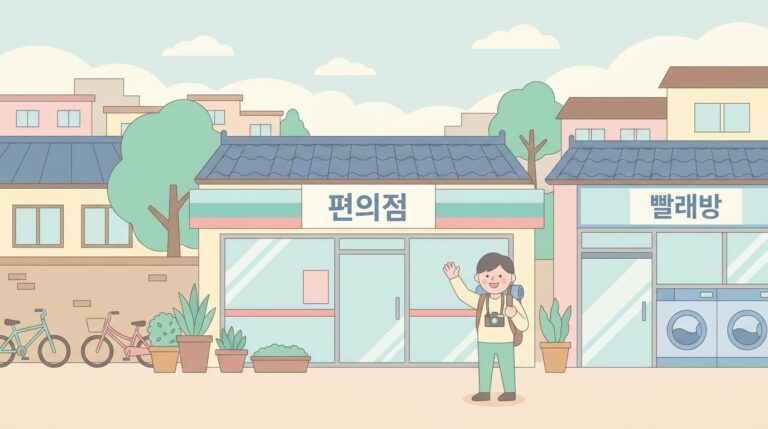
Imagine this: you’ve finally signed your housing contract in Korea. You’re holding the electronic door lock code in your hand, standing in your cozy new one-room (원룸). It feels like a triumph straight out of a slice-of-life K-drama like Because This Is My First Life or Welcome to Samdal-ri! But the moment your stomach rumbles or you realize you have mountains of moving boxes with zero official trash bags, reality hits. You step outside, and the bustling alleys of your new neighborhood look exciting yet intimidating.
Where is the nearest coin laundromat (koin-ppallaebang)? Which small grocery store sells the freshest fruit without mega-mart prices? And how on earth do you ask the friendly convenience store owner for the specific district trash bag?
Don’t worry! Exploring your new dongne (동네, neighborhood) is the fastest way to turn a strange city into your warm home. Today, we’ve designed an A2-level survival guide based on real feedback from international residents. By the end of this post, you’ll be able to navigate local shops, ask for recommendations, and experience genuine Korean neighborhood warmth (jeong, 정) with total confidence!
Phase 2: Top 3 Essential Expressions Deep Dive
1. 이 근처에 [장소] 있어요? (I geuncheoe [jangso] isseoyo?)
- Pronunciation: Ee geun-chuh-eh [place] ee-ssuh-yo? (Sounds like “E-gun-chuh-air … is-saw-yo?”)
- Meaning: Literal: “Is there a [place] near here?” | Nuance: “Could you tell me if there’s a [place] nearby?”
- K-Culture Moment: Think of classic K-drama scenes where the main character moves into a rooftop apartment (oktapbang) and asks the local grandma where the grocery shop is.
- Editor’s Insight: Just slot in words like
마트(mateu / supermarket),약국(yakguk / pharmacy), or세탁소(setakso / dry cleaner). It is the ultimate Swiss Army knife phrase for new movers. - Situation Spectrum: Casual: ⚠️ (Only with close friends: 이 근처에 마트 있어?) | Semi-formal: ✅ (이 근처에 마트 있어요?) | Formal: ✅ (이 근처에 마트가 있습니까?)
- 🤔 Think About It: In English, we often say “Where is the nearest…?” but Korean frequently uses “Does [place] exist near here?” (isseoyo?). Notice how Korean prioritizes confirming existence first!
2. 종량제 봉투 있어요? (Jongnyangje bongtu isseoyo?)
- Pronunciation: Jong-nyang-je bong-too ee-ssuh-yo? (Jong-nyang-jeh sounds like “jong-nyang-jay”)
- Meaning: Literal: “Do you have standard volume-rate garbage bags?” | Nuance: “Can I buy standard local trash bags here?”
- K-Culture Moment: Every foreigner living alone in Korea encounters this rite of passage! You cannot throw away household trash in regular shopping bags; you need local district-specific bags sold at convenience stores and marts.
- Editor’s Insight: If the clerk asks you
몇 리터요?(Myeot riteoyo? / “How many liters?”), a single-person household usually uses10리터(sip riteo / 10L) or20리터(isip riteo / 20L). - Situation Spectrum: Casual: 🚫 | Semi-formal: ✅ (종량제 봉투 있어요?) | Formal: ✅
- 🤔 Think About It: Korea has one of the strictest waste-sorting systems in the world. Buying jongnyangje bongtu is your official first step as an active Korean community member!
3. 여기 동네 맛집 추천해 주세요! (Yeogi dongne matjip chucheonhae juseyo!)
- Pronunciation: Yeo-gi dong-neh mat-jip choo-cheon-hae joo-seh-yo!
- Meaning: Literal: “Please recommend a delicious neighborhood restaurant here!” | Nuance: “What’s the best local spot to eat around here?”
- K-Culture Moment: In food shows like Street Food Fighter or variety shows where celebrities explore hidden alley eateries known only to neighborhood locals.
- Editor’s Insight: Koreans take food seriously. Asking your real estate agent or a local shop owner for a dongne matjip will instantly unlock insider culinary gems not found on standard tourist blogs.
- Situation Spectrum: Casual: ⚠️ | Semi-formal: ✅ | Formal: ✅
- 🤔 Think About It: Why is matjip (taste + house) such an everyday compound word in Korea? Food recommendations are considered a natural expression of hospitality.
Phase 3: Textbook Korean vs. Real Native Korean
Situation 1: Asking where the coin laundry is
- 📖 Textbook Korean:
코인 빨래방이 어디에 위치하고 있습니까?(Koin ppallaebangi eodie wichi-hago isseumnikka? / Where is the coin laundromat located?) - 🗣️ Real Native Korean:
혹시 근처에 코인 빨래방 있어요?(Hoksi geuncheoe koin ppallaebang isseoyo? / By any chance, is there a coin laundromat nearby?) - 💡 Why the difference? Real Koreans rarely use formal academic words like
위치하다(wichihada / to be located) in casual daily street interactions. Adding혹시(hoksi / by any chance) softens the question naturally.
Situation 2: Asking if takeout is available
- 📖 Textbook Korean:
음식을 가지고 갈 수 있도록 포장하는 것이 가능합니까?(Eumsigeul gajigo gal su itdorok pojanghaneun geosi ganeunghamnikka?) - 🗣️ Real Native Korean:
여기 포장 돼요?(Yeogi pojang dwaeyo? / Can I get this to go?) - 💡 Why the difference? Korean values fast and concise communication (ppalli-ppalli). Three syllables
포장 돼요?do the exact same job effortlessly.
Phase 4: K-Culture Deep Dive & Non-verbal Manners
4-1. Nunchi & Gestures: Local Shop Etiquette
When you step into a neighborhood dongne mart or bakery:
1. The Gentle Head Nod (Mokrye, 목례): When entering or asking a question, do a quick, polite 15-degree bow while saying 안녕하세요~ (Annyeonghaseyo).
2. Two-Handed Card Handover: Handing over your payment card or receiving your receipt with both hands (or supporting your right wrist with your left hand) signals instant respect and politeness.
3. Eye Contact & Voice Pitch: Don’t stare aggressively. Speak in a gentle, warm tone with a rising intonation at the end of questions.
4-2. Culture Code: The “Seulse-gwon” (슬세권) Lifestyle
In Korea, real estate lovers use the slang Seulse-gwon (슬세권)—a portmanteau of seullipeo (slippers) and yeoksegwon (station area). It means an area so convenient that you can access cafes, convenience stores, and marts wearing just your house slippers! Exploring your seulse-gwon after signing a lease helps you locate your daily comfort spots.
Phase 5: Real-Life Roleplay Scenario
Setting: You just moved in and walked down to the small neighborhood supermarket (Dongne Super) run by a friendly owner, Mrs. Kim (김 사장님).
- Mrs. Kim:
어서 오세요! 뭐 찾으시는 거 있어요?(Eoseo oseyo! Mwo chajeusineun geo isseoyo? / 🎭 Smashing a cardboard box down and smiling warmly / “Welcome! Looking for anything in particular?”) - You:
안녕하세요! 저 이번에 이사 왔는데요, 일반 쓰레기 봉투 있어요?(Annyeonghaseyo! Jeo ibeone isa wanneundeyo, ilban sseuregi bongtu isseoyo? / 🎭 Politely nodding / “Hello! I just moved here, do you have regular trash bags?”) - Mrs. Kim:
아이구, 새로 이사 왔구나! 몇 리터짜리 줄까요?(Aigu, saero isa watguna! Myeot riteojjari julkkayo? / 🎭 Reaching under the counter / “Oh, a new neighbor! How many liters would you like?”) - You:
10리터 열 장 주세요.(Sim-niteo yeol jang juseyo. / 🎭 Showing 10 with fingers / “Ten 10-liter bags, please.”) - Mrs. Kim:
여기 있어요. 또 필요한 건 없어요?(Yeogi isseoyo. Tto piryohan geon eopseoyo? / 🎭 Handing the bags over / “Here you go. Need anything else?”) - You:
혹시 이 근처에 코인 빨래방도 있어요?(Hoksi i geuncheoe koin ppallaebangdo isseoyo? / 🎭 Looking curious / “By any chance, is there also a coin laundromat nearby?”) - Mrs. Kim:
저기 골목 돌아서 약국 옆에 바로 있어!(Jeogi golmok doraseo yakguk yeope baro isseo! / 🎭 Pointing out the window with a pen / “Turn around that alley, right next to the pharmacy!”) - You:
감사합니다! 자주 올게요!(Gamsahamnida! Jaju olgeyo! / 🎭 Handing card with both hands / “Thank you! I’ll come often!”)
🔀 Interactive Branching Choice
Mrs. Kim smiles and gives you a free Yakult drink as a welcome bonus (service). What do you say?
- Option A:
우와, 감사해요! 잘 마실게요!(Uwa, gamsahaeyo! Jal masilgeyo!) - Option B:
이거 안 시켰는데요? 돈 내야 돼요?(Igeo an sikyeonneundeyo? Don naeya dwaeyo?) - Option C:
고마워.(Gomawo.)
🔍 Click to see the Feedback on your choice
- Option A (BEST!): Perfect! Expressing gratitude with 잘 마실게요 (“I will enjoy drinking this”) builds instant neighborhood jeong and makes you a beloved regular (dangol) right away!
- Option B (BAD): While understandable if you’re confused, questioning service items makes the atmosphere awkward.
- Option C (RISKY): Gomawo is informal banmal. Using it with an elder shop owner is culturally rude!
Phase 6: 10-Second Emotion Shadowing Drill
Practice matching these rhythm pauses (/) and emotions aloud:
[😊 밝고 싹싹하게 / Bright & Friendly]
저 이번에 / 새로 이사 왔어요! / 잘 부탁드립니다!
(Jeo ibeone / saero isa wasseoyo! / Jal butakdeurimnida!)-
[🤔 조심스럽고 공손하게 / Inquiring & Polite]
혹시 / 종량제 봉투 / 10리터짜리 있어요?
(Hoksi / jongnyangje bongtu / sim-niteojjari isseoyo?) -
[😋 신나고 기대하며 / Excited & Curious]
사장님! / 여기 동네 맛집 / 어디예요?
(Sajangnim! / Yeogi dongne matjip / eodiyeyo?)
Phase 7: K-Culture Mini Dictionary
- 동네 (Dongne): Neighborhood. Not just a geographical boundary, but a community with familiar faces, small alleys, and local shops.
- 종량제 봉투 (Jongnyangje bongtu): Government-regulated volume-rate garbage bag. Different colored bags represent different cities and districts.
- 단골 (Dangol): Regular customer. Becoming a dangol at a neighborhood diner often gets you extra side dishes (banchan) or free drinks!
- 슬세권 (Seulse-gwon): Slippers-zone. A trendy slang describing a super-convenient residential area where everything is reachable in casual lounge wear.
Phase 8: Neighborhood Survival Kit
Survival Expressions TOP 3
카드 결제 돼요?(Kadeu gyeolje dwaeyo? / Can I pay by card?)- Pro Tip: Almost everywhere in Korea takes card, but checking at tiny stalls shows consideration.
영수증은 버려주세요.(Yeongsujeungeun beoryeojuseyo. / Please throw away the receipt.)- Pro Tip: Perfect when you don’t need small paper receipts at convenience stores.
여기 제일 인기 있는 메뉴가 뭐예요?(Yeogi jeil ingi inneun menyuga mwoyeyo? / What is the most popular menu item here?)- Pro Tip: Use this when entering a neighborhood restaurant for the first time!
Editor’s Travel & Living Note
- Install the Naver Map app download for local exploration to search for laundromats (코인빨래방) and supermarkets (슈퍼/마트). Google Maps is often outdated for small Korean alleys!
- Download the Karrot Market (당근마켓) app to buy used furniture or household goods from neighbors within a 2-3km radius.
Phase 9: “One Step Deeper” (Reflective Thought)
In many Western cultures, a neighborhood is simply where your building stands. But in Korea, the concept of Dongne (동네) carries the nostalgic warmth of collective community life. When you introduce yourself to local vendors with a small greeting, you transition from being an anonymous foreigner into a recognized neighbor. Even in high-tech Seoul, daily human connection flourishes right in the local produce market.
💬 Your Turn: What is the very first shop you always look for when moving to a new neighborhood? Tell us in the comments below!
Phase 10: FAQ & Avoiding Misunderstandings
Q: Can I use trash bags from my previous neighborhood in my new apartment?
A: Generally, no! Jongnyangje bags are district-specific (e.g., Mapo-gu vs. Gangnam-gu). If you moved to a new Gu (district), you must buy that district’s designated bags, or get official transfer stickers at your local Community Center (Jumin Center).
Q: What is the polite title to call local shop owners?
A: Call male or female owners 사장님 (Sajangnim / boss/owner). Calling female owners 이모 (Imo / auntie) is only for very informal diners where you are already an established regular!
Q: Can I ask convenience stores for free plastic bags?
A: By Korean law, single-use plastic shopping bags are banned or cost an extra fee (around 50-100 KRW). Bring your own tote bag or buy a jongnyangje trash bag to carry your items!
🚨 Common Mistakes Warning Board
- ❌ Mistake 1: Throwing food waste into the regular trash bag.
- Correct Action: Food waste (eumsikmul) goes into separate yellow/orange food waste bags or smart RFID bins!
- ❌ Mistake 2: Saying
너(neo / you) when asking directions from locals.- Correct Action: Skip the pronoun entirely and start with
저기요, 혹시...(Jeogiyo, hoksi…).
- Correct Action: Skip the pronoun entirely and start with
- ❌ Mistake 3: Assuming small neighborhood stores are closed on Sundays.
- Correct Action: Large supermarket chains (E-Mart, Homeplus) close on the 2nd and 4th Sunday of the month, but local neighborhood dongne marts are almost always open!
Phase 11: Action Missions
- 🥉 Bronze Mission (Solo Practice): Stand in front of your mirror and practice saying:
이 근처에 편의점 있어요?5 times with a bright smile. - 🥈 Silver Mission (Observation): Look up your local area on Naver Map and bookmark 3 key places: a laundromat, a pharmacy, and a local bakery.
- 🥇 Gold Mission (Real Action): Visit a small local mart or convenience store today, buy one item, and politely ask for a jongnyangje bongtu in Korean!
- 🎮 K-Culture Mission: Watch an episode of a neighborhood K-drama (like Reply 1988 or Fight For My Way) and spot characters chatting with local shop keepers.
Phase 12: Interactive Quiz Challenge
1. Situation Decision Quiz
You just finished unpacking and have a mountain of general cardboard and wrappers. You go to the local mart. Which phrase should you say?
* A) 여기서 살게요.
* B) 10리터 종량제 봉투 주세요.
* C) 이거 얼마예요?
2. Fill-in-the-Blank Quiz
Complete the sentence to ask if there is a pharmacy nearby:
이 근처에 _____ 있어요? (I geuncheoe _____ isseoyo?)
3. True or False Cultural Quiz
- Question: You can throw away recyclables, food, and clothes together in one big black plastic bag in Korea. (True / False)
🎉 Click to reveal Quiz Answers & Explanations!
- Answer: B (
10리터 종량제 봉투 주세요.)- Explanation: Asking specifically for standard trash bags (jongnyangje bongtu) with the size is the correct way to dispose of moving debris.
- Answer: 약국 (Yakguk / Pharmacy)
- Full Sentence:
이 근처에 약국 있어요?(I geuncheoe yakguk isseoyo?)
- Full Sentence:
- Answer: False!
- Explanation: Korea enforces meticulous sorting: General Waste (일반쓰레기), Food Waste (음식물쓰레기), and Recyclables (재활용품). Mixing them results in municipal fines!
- Explanation: Korea enforces meticulous sorting: General Waste (일반쓰레기), Food Waste (음식물쓰레기), and Recyclables (재활용품). Mixing them results in municipal fines!







