

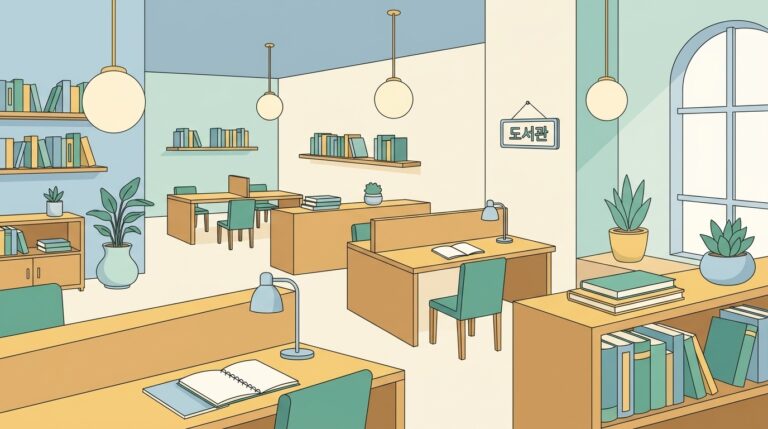
Phase 1: 공감 (Story-Immersive Opening)
안녕하세요! 매일한글 에디터입니다.
Imagine walking into the world-famous Starfield Library in Seoul, or stepping into a cozy neighborhood study café (스터디카페) nestled near a university campus in Sinchon. You have your favorite stationery ready, a chilled iced Americano on your desk, and you’re feeling motivated to study just like your favorite K-drama leads in Twenty-Five Twenty-One. But the moment you look around, a wave of hesitation hits you: Is this seat taken? Can I plug in my laptop charger here? How do I politely say ‘I’m studying’ without sounding stiff?
If you’ve ever felt shy or worried about breaking the quiet harmony of a Korean study space, you are definitely not alone. Many beginner learners freeze up when trying to speak in quiet public areas. The good news? With just a few simple, natural A1-level phrases, you can navigate any Korean library, bookstore, or study café with ease and warmth. Let’s explore how to study like a true local!
Phase 2: 핵심 표현 3선 심층 분석 (Top 3 Core Expressions)
1. 여기서 공부해도 돼요? (Yeogiseo gongbuhaedo dwaeyo?)
- Pronunciation: Yeo-gi-seo gong-bu-hae-do dwae-yo? (Sounds like: “Yaw-gee-saw gong-boo-heh-doh dweh-yo?” — smooth, flowing glide at the end)
- Meaning: Literal: “Is it okay if I study here?” | Actual Nuance: “May I study here? / Can I use this spot?”
- K-Culture Moment: You’ll hear this constantly in university K-dramas when two students ask to share a large, open library table during exam week.
- Editor’s Insight: The pattern -해도 돼요? (-haedo dwaeyo?) is your golden key for asking polite permission anywhere in Korea. Add it after any basic verb stem to instantly sound respectful.
- Situation Spectrum: Casual ⚠️ | Semi-formal ✅ | Formal ✅
- 🤔 Think About It: In Korean culture, proactively asking permission before taking a shared seat demonstrates consideration for the collective space.
2. 열공하세요! (Yeolgonghaseyo!)
- Pronunciation: Yeol-gong-ha-se-yo! (Sounds like: “Yawl-gong-hah-seh-yoh!” — energetic and crisp)
- Meaning: Literal: “Do passionate studying!” | Actual Nuance: “Happy studying! / Study hard! / You got this!”
- K-Culture Moment: Friends sending KakaoTalk stickers of cheering bears holding highlighters right before midterm exams.
- Editor’s Insight: This is a blend of 열심히 (passionately/diligently) and 공부 (studying). It’s warm, supportive, and universally loved among students and coworkers alike.
- Situation Spectrum: Casual ✅ | Semi-formal ✅ | Formal ⚠️
- 🤔 Think About It: Why does Korean culture place such high social value on cheering on each other’s hard work and personal growth?
3. 조용히 해주세요 (Joyonghi hae-juseyo)
- Pronunciation: Jo-yong-hi hae-ju-se-yo (Sounds like: “Cho-yong-hee heh-joo-seh-yoh” — soft and gentle whisper tone)
- Meaning: Literal: “Please do quietly” | Actual Nuance: “Please keep it down / Please be quiet”
- K-Culture Moment: A librarian or study buddy gently tapping the desk to remind people to lower their voices.
- Editor’s Insight: Always use a gentle, soft tone when saying this. The ending -해 주세요 (-hae juseyo) turns a direct command into a courteous request.
- Situation Spectrum: Casual 🚫 | Semi-formal ✅ | Formal ✅
- 🤔 Think About It: In Korea, addressing noise directly can feel tense, so softening your voice and facial expression keeps social harmony intact.
Phase 3: 교과서 한국어 vs 진짜 한국어 (Textbook vs. Real Korean)
Situation 1: Cheering on a study buddy
- 📖 교과서 한국어: “열심히 공부하십시오.” (Yeolsimhi gongbuhasipsio. – Please study diligently.)
- 🗣️ 진짜 한국어: “열공해요!” (Yeolgonghaeyo! – Let’s study hard! / Happy studying!)
- 💡 왜 다를까? Old textbooks often rely on stiff, military-style formal endings. Modern native speakers prefer warm, punchy contractions like 열공 to sound approachable and friendly.
Situation 2: Telling someone your current activity
- 📖 교과서 한국어: “저는 도서관에서 책을 읽습니다.” (Jeoneun doseogwan-eseo chaegeul ikseumnida. – I read a book in the library.)
- 🗣️ 진짜 한국어: “지금 공부 중이에요.” (Jigeum gongbu jung-ieyo. – I’m in the middle of studying right now.)
- 💡 왜 다를까? Real Koreans rarely state obvious textbook sentences; they use -중이에요 (-jung-ieyo, in the middle of) to describe their active status naturally.
Phase 4: K-Culture 딥다이브 & 비언어적 매너 (Deep Dive & Manners)
4-1. 눈치 (Nunchi) & Library Body Language
- Keyboard & Mouse Etiquette: In Korean quiet study rooms (독서실 or library 열람실), mechanical keyboard clicking is considered impolite. Koreans use silicone keyboard covers or silent mice (무소음 마우스).
- Vibration Caution: Never leave your phone on vibrate directly on wooden desks! The buzzing rattles the entire table. Keep it on total silence or place it over a notebook.
- The 15-Degree Nod: When sitting down next to someone at a shared desk, a brief, silent head nod acknowledges their space without speaking.
4-2. Culture Code: The Rise of the ‘Study Café’ (스카)
In Korea, studying isn’t just a chore—it’s a lifestyle culture. Modern 스터디카페 (Study Cafes), affectionately abbreviated as 스카 (Seuka), operate 24/7 with automated self-service kiosks, offering complimentary espresso machines, phone chargers, and ultra-quiet zone cubicles. It’s the ultimate backdrop for high-focus productivity.
Phase 5: 실전 롤플레이 시나리오 (Roleplay Scenario)
- Setting: A bright, sunny study area at a university library in Seoul.
- NPC Character: Minho (민호), a friendly college student wearing cozy oversized knitwear, studying with colored highlighters.
- Alex: 저기요, 여기 앉아도 돼요? (Jeogiyo, yeogi anjato dwaeyo? – Excuse me, may I sit here?)
🎭 Action: Whispering politely with a slight head bow. - Minho: 네, 앉으세요! (Ne, anjeuseyo! – Yes, please take a seat!)
🎭 Action: Smiles softly and pulls his pencil case inward to make room. - Alex: 감사합니다. 한국어 공부하고 있어요. (Gamsahamnida. Hangugeo gongbuhago isseoyo. – Thank you. I’m studying Korean.)
🎭 Action: Shows a beginner Korean workbook with a proud smile. - Minho: 오, 한국어 공부요? 대단해요! (O, hangugeo gongbuyo? Daedanhaeyo! – Oh, Korean study? That’s awesome!)
🎭 Action: Whispers back with an encouraging thumbs-up. - Alex: 조금 어렵지만 재미있어요. (Jogeum eoryeopjiman jaemiisseoyo. – It’s a bit hard, but fun.)
🎭 Action: Grins quietly while opening a notebook. - Minho: 모르는 거 있으면 편하게 물어보세요. (Moreuneun geo isseumyeon pyeonhage mureoboseyo. – If there’s anything you don’t know, feel free to ask.)
🎭 Action: Nods kindly and points to his own notepad. - Alex: 정말요? 고마워요. 열공하세요! (Jeongmalyo? Gomawoyo. Yeolgonghaseyo! – Really? Thank you. Happy studying!)
🎭 Action: Giving a friendly two-handed mini wave. - Minho: 네, 같이 열공해요! (Ne, gachi yeolgonghaeyo! – Yes, let’s study hard together!)
🎭 Action: Chuckles silently and returns to his laptop.
🔀 Interactive Decision Branch
What would you say next to wrap up the conversation before you start studying?
- Option A: “열공하세요!” (Yeolgonghaseyo! – Happy studying!)
- 👉 Feedback [BEST]: Perfect! It’s polite, friendly, and naturally ends the conversation so you both can focus.
- Option B: “조용히 하세요!” (Joyonghi haseyo! – Be quiet!)
- 👉 Feedback [BAD]: Avoid this! It sounds like you are ordering Minho to shut up.
- Option C: “공부 그만해요.” (Gongbu geumanhaeyo. – Stop studying.)
- 👉 Feedback [RISK]: This means “Stop studying now.” It will leave Minho totally confused!
Phase 6: 10초 감정 섀도잉 드릴 (Shadowing Drill)
Practice saying these phrases aloud while mimicking the intonation pauses (/) and emotional cues:
[😊 Polite & Seeking Permission]
저기요, / 여기서 / 공부해도 돼요? (Jeogiyo, / yeogiseo / gongbuhaedo dwaeyo?)[🔥 Motivated & Cheerful]
우리 / 오늘 / 같이 열공해요! (Uri / oneul / gachi yeolgonghaeyo!)[🤫 Soft & Courteous Whisper]
조금만 / 조용히 / 해주세요. (Jogeumman / joyonghi / hae-juseyo.)
Phase 7: K-Culture 미니 사전 (Mini Dictionary)
- 스터디카페 (Seu-teo-di-ka-pe) | Study Café | Modern, high-tech self-study spaces open 24/7 with private booths and free drinks.
- 열공 (Yeol-gong) | Passionate Study | Super common slang combining ‘열심히’ (hard) and ‘공부’ (study).
- 독서실 (Dok-seo-sil) | Traditional Study Room / Reading Room | Quiet partitioned cubicle study rooms popular among exam students.
- 자리 (Ja-ri) | Seat / Spot | Essential noun when asking if a desk or seat is occupied (자리 있어요?).
Phase 8: 여행자를 위한 생존 키트 (Traveler’s Survival Kit)
Survival Expressions TOP 3
- 자리 있어요? (Jari isseoyo? – Is this seat taken? / Is there a seat?)
- Pro Tip: Point to an empty chair and ask this with a questioning tone.
- 와이파이 비밀번호 뭐예요? (Wa-i-pa-i bimilbeonho mwoyeyo? – What is the Wi-Fi password?)
- Pro Tip: Look around the receipt or walls first; it’s often written as WIFI PW.
- 콘센트 있어요? (Konsenteu isseoyo? – Is there an electrical outlet?)
- Pro Tip: Look under desks or along the wall baseboards.
💡 Editor’s Travel Note
- App Guide: Before heading out, use the Naver Map app download to search for ‘스터디카페’ (Study Cafe) or ‘도서관’ (Library) nearby to check real-time user reviews and seat photos.
- Kiosk Payment: Most Korean study cafes use touchscreen kiosks at the entrance. They easily accept foreign credit cards and allow you to select your seat on a digital floor plan.
Phase 9: “한 발 더 깊이” (Deep Cultural Reflection)
In Korea, studying together in silence is an act of shared empathy. When you step into a crowded library where everyone from high schoolers to working professionals is quietly reading under desk lamps, you feel the heartbeat of Korea’s passion for self-improvement. It is not cold silence; it is a shared space of mutual support and focus.
💬 Your Turn: Where is your favorite place to study Korean—in a quiet room at home, a vibrant coffee shop, or a library? Tell us in the comments!
Phase 10: FAQ & 흔한 실수 (FAQ & Common Mistakes)
Q: Can I talk out loud in a Korean study café?
A: Most study cafes have two separate areas: a Lounge Zone where soft chatting and music are allowed, and a Study Zone where absolute quiet is observed.
Q: What is the difference between 도서관 (doseogwan) and 서점 (seojeom)?
A: 도서관 is a library where you borrow and read books for free; 서점 is a commercial bookstore (like Kyobo Bookstore) where you buy new books.
Q: How do I tell someone their headphones are leaking music?
A: Whisper gently: “소리가 조금 들려요” (Soriga jogeum deullyeoyo – “The sound is leaking a little bit”).
🚨 흔한 실수 (Common Mistakes) Warning Board
- Calling a stranger “너” (You): Never ask “너 공부해?”. Instead, omit the pronoun and say “공부하세요?”.
- Using informal commands: Saying “공부해!” to someone you just met sounds aggressive. Always use “열공하세요!”.
- Loud phone vibrations: Leaving your phone vibrating on a hollow desk will get you stern looks. Always switch to complete silence.
Phase 11: 액션 미션 & 참여 유도 (Action Missions)
- 🥉 Bronze Mission: Practice whispering “여기서 공부해도 돼요?” 3 times in front of a mirror.
- 🥈 Silver Mission: Take a photo of your Korean study notes and post it on social media with the hashtag #열공!
- 🥇 Gold Mission: Walk into a local library or café and ask for a seat using “자리 있어요?” in Korean.
- 🎮 K-Culture Mission: Watch an episode of a school/campus K-drama and spot how characters wish each other good luck before studying!
Phase 12: 인터랙티브 퀴즈 챌린지 (Interactive Quiz Challenge)
1. Situation Quiz: You want to ask the student sitting next to you if you can study at the empty desk. What should you say?
* A) 여기서 공부하세요! (Yeogiseo gongbuhaseyo!)
* B) 여기서 공부해도 돼요? (Yeogiseo gongbuhaedo dwaeyo?)
* C) 공부 그만하세요! (Gongbu geumanhaseyo!)
2. Fill-in-the-Blank: Complete the cheerful phrase: “우리 같이 ____하세요!” (Let’s study hard!)
* A) 열공 (Yeolgong)
* B) 조용 (Joyong)
* C) 도서관 (Doseogwan)
3. True / False Cultural Manners: In a Korean quiet study room, it is totally fine to use a loud mechanical clicking keyboard.
* (True / False)
👉 Click here to reveal the answers and explanations!
- 1. Answer: B) 여기서 공부해도 돼요? is the polite, standard way to ask permission to study in an open spot.
- 2. Answer: A) 열공 (Yeolgong) — 열공하세요 means “Happy studying! / Study hard!”.
- 3. Answer: False! Koreans use silicone keyboard covers or silent mice to keep study zones completely quiet.







