

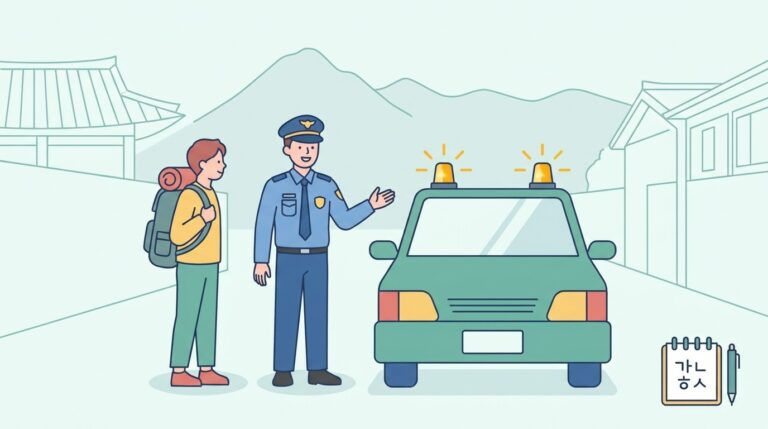
How to Report a Car Accident in Korea Without Panicking
Phase 1: Empathy (Story Immersion Opening)
안녕하세요! It’s your Daily Hangul editor here.
Imagine this: You are cruising along the coastal roads of Jeju Island in your rental car, listening to your favorite K-Pop playlist, or taking a late-night taxi back to your hotel in Hongdae. Suddenly—screeech, bump!—a minor fender-bender happens. Your heart races, adrenaline surges, and your mind completely freezes. You know you need to explain what happened, but in the heat of the moment, every Korean word you ever learned vanishes into thin air.
In K-Dramas, characters might dramatically step out clutching their necks in shock, but in real life, being unable to communicate during an emergency is terrifying. Many foreign travelers and expats share that their biggest fear in Korea isn’t ordering food or asking for directions—it’s dealing with an unexpected emergency like a traffic accident.
Don’t worry! You do not need complex legal or medical vocabulary to handle this situation safely. In this guide, built directly from real experiences and practical feedback from hundreds of international learners, we will break down the essential A2-level expressions you need to report a car accident, ask for help, and stay safe in Korea.
Phase 2: Core Expressions Deep Dive
1. 교통사고가 났어요. (Gyotongsagoga nasseoyo.)
- Pronunciation: [Gyo-tong-sa-go-ga na-sseo-yo] (Think of ‘Gyo-tong’ like ‘go-tongue’, ‘sa-go’ like ‘saw-go’, and ‘nasseoyo’ like ‘nah-so-yo’)
- Meaning: Literal: “A traffic accident has emerged.” vs. Real Nuance: “There has been a car accident / An accident happened.”
- K-Culture Moment: You hear this line constantly in thriller K-dramas whenever a character witnesses a crash and frantically calls dispatch on the phone.
- Editor’s Insight: The verb 나다 (nada) means ‘to occur’ or ‘to break out’. In Korean, accidents, fires, and problems are described as “emerging” or “happening” rather than something you “had”.
- Situation Spectrum: Casual: 🚫 | Semi-formal: ✅ | Formal: ✅
- 🤔 Think About It: In English, we often say “I had an accident,” placing the subject on the person. In Korean, the accident itself is the subject (교통사고가 났어요). How does this subtle shift reduce personal blame when reporting an incident?
2. 사람이 다쳤어요. (Sarami dachyeosseoyo.)
- Pronunciation: [Sa-ram-i da-chyeo-sseo-yo] (Sounds like ‘sah-rahm-ee dah-chuh-so-yo’)
- Meaning: Literal: “A person has been hurt.” vs. Real Nuance: “Someone is injured.”
- K-Culture Moment: Medical dramas like Hospital Playlist or Dr. Romantic often start emergency room scenes with paramedics reporting this exact sentence to the triage desk.
- Editor’s Insight: 사람 (saram) means ‘person/people’ and 다치다 (dachida) means ‘to get injured’. When reporting to 119 dispatchers, stating this immediately determines how quickly an ambulance is deployed.
- Situation Spectrum: Casual: 🚫 | Semi-formal: ✅ | Formal: ✅
- 🤔 Think About It: Why is it crucial to state human injury before discussing vehicle damage when dealing with Korean emergency operators?
3. 여기 119 좀 불러주세요. (Yeogi il-il-gu jom bulleojuseyo.)
- Pronunciation: [Yeo-gi il-il-gu jom bool-leo-joo-se-yo] (119 is read digit-by-digit as ‘il-il-gu’)
- Meaning: Literal: “Please call 119 here.” vs. Real Nuance: “Please call emergency services / an ambulance for me.”
- K-Culture Moment: Used by distressed pedestrians in action movies shouting to nearby crowds when a bystander collapses after a collision.
- Editor’s Insight: Adding 좀 (jom) softens the command into a polite and urgent plea. Remember: in South Korea, 119 handles fire and medical emergencies, while 112 connects to the police.
- Situation Spectrum: Casual: ⚠️ | Semi-formal: ✅ | Formal: ✅
- 🤔 Think About It: In many Western countries, one single number (like 911) handles all emergencies. In Korea, medical (119) and police (112) are separate. How does knowing this distinction change how you ask for help?
Phase 3: Textbook Korean vs. Real Korean
Situation 1: Explaining a minor fender-bender
- 📖 교과서 한국어 (Textbook): 차량 간 경미한 접촉 사고가 발생했습니다. (Charyang gan gyeongmihan jeopchok sagoga balsaenghaessseumnida. – A minor contact collision has occurred between vehicles.)
- 🗣️ 진짜 한국어 (Real Korean): 차가 살짝 부딪혔어요. (Chaga saljjak budichyeosseoyo. – The cars bumped lightly.)
- 💡 왜 다를까? (Why the difference?): Textbook Korean sounds like an official police deposition. Real Koreans use the descriptive adverb 살짝 (saljjak – lightly/slightly) to quickly communicate that nobody is severely hurt.
Situation 2: Asking the other driver if they are okay
- 📖 교과서 한국어 (Textbook): 귀하께서는 신체적 부상을 입으셨습니까? (Gwi-hakkeseoneun sinchejeok busang-eul ibeusyeosseumnikka? – Have you sustained physical bodily injuries?)
- 🗣️ 진짜 한국어 (Real Korean): 괜찮으세요? 다친 데 없으세요? (Gwaenchaneuseyo? Dachin de eopseuseyo? – Are you okay? Are you hurt anywhere?)
- 💡 왜 다를까? (Why the difference?): In sudden shock, complex honorific formulas cause confusion. Everyday conversational Korean uses warm, empathetic checks like “다친 데 없으세요?” to assess everyone’s condition immediately.
Phase 4: K-Culture Deep Dive & Non-verbal Manners
4-1. Nunchi & Emergency Body Language
When an accident occurs in Korea, emotional control and 눈치 (Nunchi – situational awareness) are vital:
1. Turn on Hazard Lights (비상등 켜기): The absolute first non-verbal step is pressing the hazard flashers. This alerts surrounding drivers in Korea’s busy traffic.
2. Polite, Calm Demeanor: Shouting, pointing fingers, or aggressive body language will quickly escalate the situation and alienate witnesses. Keep your hands slightly open, speak in polite 해요체 (-yo ending), and avoid sudden confrontational movements.
3. Safe Photo Documentation: Before moving vehicles, Koreans take photos from 10 meters away showing tire angles, road markings, and damage from multiple directions.
4-2. Cultural Code: The Dashcam (블랙박스) Culture
In Korea, over 95% of vehicles are equipped with a 블랙박스 (Black Box – dashcam). Because front and rear high-definition video recording is ubiquitous, drivers rarely engage in furious roadside arguments over who was at fault. Instead, both parties exchange insurance details, check if anyone is hurt, and let the 보험사 (insurance company) review dashcam footage later.
Phase 5: Real-world Roleplay Scenario
Setting: You are taking a taxi near a busy intersection in Mapo-gu, Seoul. A sudden car stops abruptly ahead, causing a light fender-bender. The taxi driver, Mr. Park, puts on the hazard lights.
- Turn 1 (Mr. Park – 🚕): 아이고! 차가 살짝 부딪혔네. 손님, 괜찮으세요? (Aigo! Chaga saljjak budichyeonne. Sonnim, gwaenchaneuseyo?)
🎭 Holding steering wheel, looking back with concern(Oh dear! The cars bumped lightly. Passenger, are you okay?) - Turn 2 (You – 🙋): 네, 저는 괜찮아요. 기사님은 다친 데 없으세요? (Ne, jeoneun gwaenchanayo. Gisanimeun dachin de eopseuseyo?)
🎭 Checking arms, speaking calmly(Yes, I’m okay. Are you hurt anywhere, driver?) - Turn 3 (Mr. Park – 🚕): 네, 저도 안 다쳤어요. 비상등 켜고 잠깐 내릴게요. (Ne, jeodo an dachyeosseoyo. Bisangdeung kyeogo jamkkan naerilgeyo.)
🎭 Pressing hazard button and unbuckling seatbelt(Yes, I’m not hurt either. I will turn on the hazard lights and step out for a moment.) - Turn 4 (Other Driver – 🚙): 저기요, 뒤에서 차를 박으시면 어떡해요! (Jeogiyo, dwieseo chareul bageusimyeon eotteokhaeyo!)
🎭 Stepping out and examining the rear bumper(Excuse me, what should we do if you hit us from behind!) - Turn 5 (Mr. Park – 🚕): 죄송합니다. 다치신 분은 없으시죠? 보험사 바로 부를게요. (Joesonghamnida. Dachisin buneun eopseusijyo? Boheomsa baro bureulgeyo.)
🎭 Bowing slightly and holding up phone(I apologize. No one is injured, right? I will call the insurance company immediately.) - Turn 6 (You – 🙋): 기사님, 제가 112에 신고할까요? (Gisanim, jega il-il-ie singohalkkayo?)
🎭 Showing smartphone screen ready to dial(Driver, shall I report this to the police at 112?) - Turn 7 (Mr. Park – 🚕): 아니에요, 다친 사람이 없어서 보험사 직원이 오면 해결돼요. (Anieyo, dachin sarami eopseoseo boheomsa jigwoni omyeon haegyeoldwaeyo.)
🎭 Waving hand gently to reassure you(No, no one is hurt, so it will be resolved once the insurance agent arrives.) - Turn 8 (You – 🙋): 네, 알겠습니다. 조심하세요. (Ne, algessseumnida. Josimhaseyo.)
🎭 Nodding politely and staying inside the safe taxi(Yes, understood. Please be careful.)
🔀 Interactive Choice Point
What would you do if the other driver was bleeding and holding their arm?
- Choice A: Shout angrily in English and demand money for your taxi fare.
- Choice B: Dial 119 and say: “여기 사람이 다쳤어요. 119 빨리 와주세요!” (Yeogi sarami dachyeosseoyo. Il-il-gu ppalli wajuseyo!)
- Choice C: Walk away silently into the subway station without checking.
Feedback:
* Choice A (Bad): Escalates chaos and risks legal liability.
* Choice B (Best): Perfect response! Clearly states injury (사람이 다쳤어요) and requests urgent medical assistance.
* Choice C (Risk): Leaving the scene of an accident where someone is injured can complicate insurance or legal procedures.
Phase 6: 10-Second Emotion Shadowing Drill
Practice saying these lines aloud by matching the emotional cues and natural breath breaks (/):
[🚨 다급하고 명확하게 - Urgent & Clear]
교통사고가 났어요! / 여기 119 좀 / 불러주세요!
(Gyotongsagoga nasseoyo! / Yeogi il-il-gu jom / bulleojuseyo!)-
[🙏 차분하고 정중하게 - Calm & Polite]
괜찮으세요? / 어디 다친 데 / 없으세요?
(Gwaenchaneuseyo? / Eodi dachin de / eopseuseyo?) -
[📞 정확하게 위치 전달 - Informative Dispatch]
사람이 다쳤어요. / 위치는 / 시청 앞 사거리예요.
(Sarami dachyeosseoyo. / Wichineun / Sicheong ap sageori-yeyo.)
Phase 7: K-Culture Mini Dictionary
- 블랙박스 (Beullaekbakseu) | Dashcam / Black Box | The essential in-car recording device used by insurance companies to settle traffic disputes.
- 보험사 (Boheomsa) | Insurance Company | In Korea, calling the insurance dispatch agent is standard procedure before arguing over road liability.
- 비상등 (Bisangdeung) | Hazard Lights | Flashing lights turned on immediately during accidents, sudden stops, or as a polite road “thank you” gesture.
- 112 / 119 (Il-il-i / Il-il-gu) | Police / Ambulance & Fire | 112 connects to the National Police Agency; 119 connects to the Fire & Medical Emergency Response.
Phase 8: Traveler’s Survival Kit
Top 3 Survival Phrases
- 도와주세요! (Dowajuseyo!) – “Please help me!”
- Pro Tip: Use this loudly if you cannot remember full sentences; nearby Koreans will immediately assist.
- 영어로 말씀해 주시겠어요? (Yeong-eoro malsseumhae jusigesseoyo?) – “Could you speak in English, please?”
- Pro Tip: Useful when speaking to 112/119 dispatchers, who have real-time English translation services.
- 여기가 어디예요? (Yeogiga eodiyeyo?) – “Where is this place?”
- Pro Tip: Ask a passerby so you can read the exact location back to the emergency operator.
Editor’s Travel Note
- If you are traveling or driving in Korea, always download the 네이버 지도 앱 다운로드 (Naver Map) or 카카오 T 앱 다운로드 (Kakao T) beforehand. Both apps display your exact Korean road address with a single tap.
- If you face a severe language barrier during any emergency, dial the Korea Travel Helpline at 1330 (available 24/7 in English, Japanese, and Chinese) for immediate three-way interpretation.
Phase 9: One Step Deeper (Reflection)
In Korean society, the concept of 공동체 의식 (gongdongche uisik – community mindset) plays a remarkable role in emergencies. While the fast-paced 빨리빨리 (ppalli-ppalli) culture rules daily road traffic, Koreans quickly unite to help when accidents occur. Bystanders often step in to direct traffic, call 119 on your behalf, or translate for foreigners in distress. Knowing just a few polite Korean phrases shows respect and encourages this warm community support.
💬 Your Turn: Have you ever experienced an unexpected travel emergency abroad? How did you overcome the language barrier? Share your story in the comments below!
Phase 10: FAQ & Common Mistakes
Q: What is the exact difference between calling 112 and 119 in Korea?
A: 112 is exclusively for the police (reporting crimes, minor traffic disputes, and legal documentation). 119 is for the fire department and ambulances (medical treatment and rescue). If someone is hurt in an accident, call 119 first.
Q: Can Korean 119 and 112 operators speak English?
A: Yes! Both 112 and 119 dispatch centers in South Korea have access to on-demand interpretation services (BBB Korea / 1330). When connected, simply say “English, please” or “영어 통역 부탁합니다 (Yeong-eo tong-yeok butakhamnida)”.
Q: What should I do first if I get into an accident with a rental car in Jeju?
A: First, ensure everyone is safe and turn on your hazard lights. Take photos of the scene and contact your rental car company’s emergency hotline immediately. They will dispatch their partner insurance agent directly to your location.
🚨 Common Mistakes Warning Board
- Mistake: Fleeing or moving the vehicle without photos.
- Correct Action: Keep hazard lights on, snap clear photos of road lines and damages, and wait for safe clearance.
- Mistake: Shouting “911” repeatedly to bystanders.
- Correct Action: Shout “119 (일일구 – Il-il-gu)!” so local bystanders immediately understand.
- Mistake: Forgetting to mention physical injuries.
- Correct Action: Always prioritize human safety by stating “사람이 다쳤어요” (Sarami dachyeosseoyo) before discussing car damages.
Phase 11: Action Mission & Engagement
- 🥉 Bronze Mission: Practice saying “교통사고가 났어요” and “사람이 다쳤어요” 3 times in front of the mirror with a clear, calm voice.
- 🥈 Silver Mission: Save emergency numbers (112, 119, and 1330) and your hotel’s Korean address into your phone’s quick-access notes.
- 🥇 Gold Mission: Write a mock emergency SMS to a Korean friend explaining a pretend road incident using today’s A2 phrases.
- 🎮 K-Culture Mission: Next time you watch an action or medical K-Drama, listen closely for the words 교통사고 (gyotongsago) and 다쳤어요 (dachyeosseoyo)!
Phase 12: Interactive Quiz Challenge
1. Situation Decision: You are on a bus that had a minor bump. You want to ask the elderly person next to you if they are unhurt. Which phrase is most natural?
– A) 귀하의 상태를 보고하십시오. (Report your status.)
– B) 괜찮으세요? 다친 데 없으세요? (Are you okay? Anywhere hurt?)
– C) 왜 다쳤어요? (Why are you hurt?)
2. Fill-in-the-Blank: Complete the emergency sentence for calling an ambulance:
“여기 _________ 좀 불러주세요!”
– A) 114
– B) 119
– C) 007
3. True or False: In Korea, 112 handles both fire rescue and medical ambulances.
– [ ] True
– [ ] False
👉 Click here to reveal the Answers & Explanations!
- Answer: B | 괜찮으세요? 다친 데 없으세요? is the warmest, most polite A2 expression to check someone’s condition.
- Answer: B (119 – il-il-gu) | 119 is South Korea’s dedicated medical and emergency hotline.
- Answer: False | 112 is for the police. 119 is for fire and medical emergencies!







