

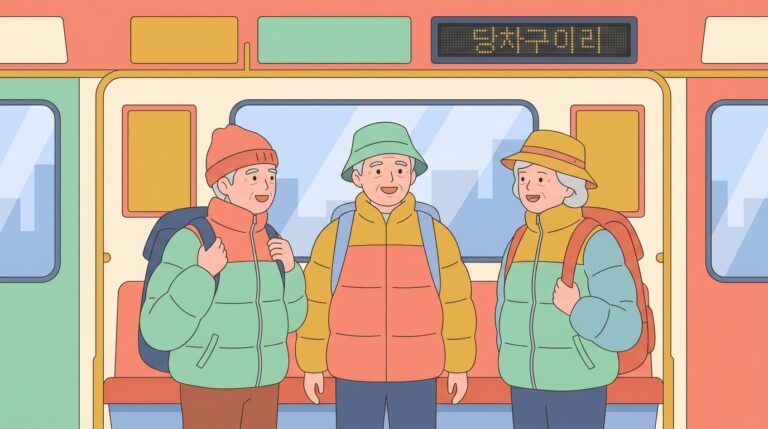
Why Seoul Subways Turn Neon on Weekends: Korean Hiking Culture & Essential Expressions
Phase 1: Empathy (Welcome to the Neon Hiking Squad!)
안녕하세요! 매일한글 에디터입니다. (Hello! This is your Daily Hangul editor.)
Picture this: It’s 7:30 AM on a crisp Saturday in Seoul. You step onto Subway Line 3 heading north, half-asleep, expecting a quiet commute. Instead, the subway car is an explosion of neon lime, hot pink, and vibrant cobalt blue. Everywhere you look, groups of energetic Korean uncles (ahjussis) and aunties (ahjummas) are fully geared up in high-tech Gore-Tex jackets, clutching carbon-fiber trekking poles, and cheerfully discussing their summit plans. Welcome to the legendary 등산복 부대 (Deungsanbok Budae – The Hiking Gear Squad)!
For many international residents and travelers, this morning phenomenon is an unforgettable cultural shock. You might wonder: Are they climbing Mount Everest right now? Why is everyone wearing high-end outdoor brands to climb a 600-meter mountain? How can I strike up a warm conversation without feeling awkward?
If you have ever felt hesitant or curious watching these lively weekend warriors, this guide is crafted specifically for you. Based on real classroom insights and field feedback from intermediate Korean learners, mastering a few authentic hiking expressions will transform you from a confused bystander into a beloved hiking companion. Let’s unlock the warm, communal magic of Korean mountain culture!
Phase 2: Core 3 Expressions In-Depth
1. 어디 산으로 가세요? (Eodi saneuro gaseyo?)
- Pronunciation: [Eodi saneuro gaseyo?] (Sounds like: “uh-dee sahn-eu-ro gah-seh-yo?”)
- Meaning: Literal: “To which mountain are you going?” | Actual Nuance: “Which peak are you hiking today?”
- K-Culture Moment: You will hear this friendly conversation starter constantly around transfer hubs like Dobongsan or Gupabal stations when hikers meet fellow outdoor enthusiasts.
- Editor’s Insight: The particle -(으)로 (-(eu)ro) indicates direction. Asking this shows genuine interest in their weekend adventure and immediately breaks the ice.
- Situation Spectrum: Casual: ⚠️ (too polite for close peers) | Semi-formal: ✅ (Perfect for strangers on the trail/subway) | Formal: ✅
- 🤔 Think About It: In many Western cultures, asking a stranger on public transit where they are going might feel intrusive. Why is asking about hiking destinations in Korea considered an act of warm friendliness (Jeong)?
2. 안산 즐산 하세요! (Ansan jeulsan haseyo!)
- Pronunciation: [Ansan jeulsan haseyo!] (Sounds like: “ahn-sahn jeul-sahn hah-seh-yo!”)
- Meaning: Literal: “Do safe mountain and fun mountain!” | Actual Nuance: “Have a safe and enjoyable hike!”
- K-Culture Moment: A popular phrase swapped between hikers crossing paths on narrow rocky ridges or inside hiking group chatrooms.
- Editor’s Insight: This is a classic Korean portmanteau (abbreviation): 안산 (안전한 등산 – Safe Hiking) + 즐산 (즐거운 등산 – Fun Hiking). Dropping this phrase instantly proves you understand authentic hiker lingo!
- Situation Spectrum: Casual: ✅ | Semi-formal: ✅ | Formal: ⚠️ (Use full sentence in formal broadcasts)
- 🤔 Think About It: Koreans love creating abbreviations for warm well-wishes (like 열공, 즐추). What compound abbreviations exist in your own language for outdoor safety?
3. 정상 찍고 막걸리 한잔해야죠! (Jeongsang jjikgo makgeolli hanjanhaeyajyo!)
- Pronunciation: [Jeongsang jjikgo makgeolli hanjanhaeyajyo!] (Sounds like: “jeong-sahng jjeek-goh mahk-geol-lee hahn-jahn-hae-yah-jyoh!”)
- Meaning: Literal: “We should stamp the summit and drink a cup of makgeolli!” | Actual Nuance: “The real reason we hike is to reach the peak and reward ourselves with cold rice wine afterward!”
- K-Culture Moment: Often exclaimed by K-Drama characters at the base of Bukhansan before even taking their first step uphill.
- Editor’s Insight: The verb 찍다 (jjikda – to stamp/take a picture) is colloquially used here to mean “reaching the summit marker stone (Jeongsangseok), snapping proof, and immediately moving on.”
- Situation Spectrum: Casual: ✅ | Semi-formal: ✅ (With hiking buddies/colleagues) | Formal: 🚫
- 🤔 Think About It: Notice how Korean hiking culture is deeply tied to the celebratory post-hike feast (hasanju). How does post-workout dining differ in your home culture?
Phase 3: Textbook Korean vs. Real Korean
Situation 1: Asking someone which mountain they plan to climb
- 📖 Textbook Korean: 오늘 어느 산을 등산하실 예정입니까? (Oneul eoneu saneul deungsanhasi-l yejeong-imnikka? – Which mountain do you plan to climb today?)
- 🗣️ Real Korean: 오늘 어디 타세요? (Oneul eodi taseyo? – Which trail/mountain are you hitting today?) or 어디 산 가세요? (Eodi san gaseyo?)
- 💡 Why is it different? The verb 타다 (tada) literally means “to ride,” but among seasoned Korean hikers, 산(을) 타다 (san-eul tada) is the most natural, idiomatic way to say “to hike a mountain.”
Situation 2: Wishing someone a safe journey on the trail
- 📖 Textbook Korean: 안전하고 즐겁게 등산하시기 바랍니다. (Anjeonhago jeulgeopge deungsanhasigi baramnida. – I hope you have a safe and pleasant hike.)
- 🗣️ Real Korean: 안산하세요~! (Ansanhaseyo~! – Have a safe hike!)
- 💡 Why is it different? Shortened words sound energetic and affectionate on the move, matching the fast-paced, cheerful rhythm of Korean outdoor culture.
Phase 4: K-Culture Deep Dive & Non-verbal Manners
4-1. Subway Nunchi (눈치) & Hiking Etiquette
- Backpack Forward (Baenang Apeu-ro): On packed weekend morning trains, turn your bulky 30L hiking pack to the front or place it between your feet so you don’t accidentally bump sleepy commuters.
- Tuck the Trekking Pole Tips: Always keep rubber caps on sharp trekking pole tips and store them pointing downward towards the floor.
- The Trail Nod (Mokrye): When passing older hikers on narrow stairs or rocky paths, make brief eye contact, tilt your head down 15 degrees, and give a short “안녕하세요~” (Annyeonghaseyo).
4-2. Cultural Code: The Post-Hike Trinity (전, 막걸리, 도토리묵)
Korean hiking is 40% exercise and 60% gastronomy. At the foot of almost every major mountain (like Bukhansan, Gwanaksan, or Dobongsan), you will discover bustling restaurant alleys. The universal post-hike reward is 해물파전 (Haemul Pajeon – Seafood Scallion Pancake), 도토리묵무침 (Dotori-muk Muchim – Seasoned Acorn Jelly Salad), and chilled 막걸리 (Makgeolli – Korean sparkling rice wine) served in golden brass bowls.
Phase 5: Real Role-Play Scenario
Setting: 7:45 AM on Seoul Subway Line 3 toward Gupabal Station. You (Alex) are carrying a daypack and standing next to Mr. Park (62), who is sporting an eye-catching neon orange windbreaker and checking his trail map.
- Turn 1 (Mr. Park): 학생, 오늘 북한산 가나 봐? 배낭 보니까 백운대 코스네! (Haksaeng, oneul Bukhansan gana bwa? Baenang bonikka Baegundae koseune!) 🎭 Smiling warmly while pointing at Alex’s daypack
- “Young man/student, looks like you’re heading to Bukhansan today? Seeing your backpack, it must be the Baegundae peak course!”
- Turn 2 (Alex): 네, 맞아요! 날씨가 좋아서 백운대 정상 찍으러 가요. (Ne, majayo! Nalssiga joaseo Baegundae jeongsang jzigeureo gayo.) 🎭 Adjusting backpack straps with a bright smile
- “Yes, exactly! The weather is so nice, I’m heading out to stamp the Baegundae summit!”
- Turn 3 (Mr. Park): 오, 한국말 잘하네! 백운대 마지막 암벽 구간은 바위가 미끄러우니까 조심해야 해. (O, hangungmal jalhane! Baegundae majimak ambyeok guganeun bawiga mikkeureounikka josimhaeya hae.) 🎭 Giving a thumbs up and nodding proudly
- “Oh, your Korean is great! The final rocky section at Baegundae is slippery, so be extra careful on the boulders.”
- Turn 4 (Alex): 조언 감사합니다! 등산화 단단히 묶고 올라갈게요. (Joeon gamsahamnida! Deungsanhwa dandani mukgo ollagalgeyo.) 🎭 Bowing head slightly in appreciation
- “Thank you for the advice! I will tie my hiking boots tight before heading up.”
- Turn 5 (Mr. Park): 그래 그래, 오늘 사람 많을 테니까 안전하게 안산 즐산 해! (Geurae geurae, oneul saram maneul tenikka anjeonhage ansan jeulsan hae!) 🎭 Patting Alex gently on the shoulder
- “Right on, there will be lots of people today, so have a safe and fun hike!”
- Turn 6 (Alex): 어르신도 오늘 안산하세요! 혹시 하산하고 파전 드시러 가세요? (Eoreusindo oneul ansanhaseyo! Hoksi hasanhago pajeon deuseireo gaseyo?) 🎭 Asking with a cheeky, friendly grin
- “Have a safe hike too, sir! Are you heading for pajeon after coming down the mountain?”
- Turn 7 (Mr. Park): 껄껄! 역시 등산의 마무리는 막걸리에 파전이지! 뭘 좀 아네! (Kkeolkkeol! Yeoksi deungsanui mamurineun makgeollie pajeoniji! Mwol jom ane!) 🎭 Bursting into hearty laughter
- “Hahaha! Of course, the real finale of hiking is makgeolli and pajeon! You truly get it!”
- Turn 8 (Alex): 정상에서 뵙겠습니다. 조심히 다녀오세요! (Jeongsang-eseo boepgetseumnida. Josimhi danyeo-oseyo!) 🎭 Waving goodbye as the train arrives at the station
- “See you at the top. Have a wonderful hike!”
🔀 Interactive Branching Point
Mr. Park offers you a cold sliced cucumber (oi) from his insulated cooler bag on the summit trail: “이거 하나 먹어봐, 갈증 해소에 최고야!” (Try this, it is the best for thirst!) How do you respond?
- Option A: “우와, 시원하겠네요! 감사합니다, 잘 먹겠습니다!” (Uwa, siwonhagenneyo! Gamsahamnida, jal meokgetseumnida!)
- Feedback: [BEST] Highly natural and respectful! Accepting shared summit snacks with two hands is the fastest way to earn legendary mountain friendship.
- Option B: “저는 오이 싫어합니다. 안 먹어요.” (Jeoneun oi sileohamnida. An meogeoyo.)
- Feedback: [BAD] Grammatically correct but overly blunt and cold. Refusing bluntly without polite softening dampens the warm Jeong vibe.
- Option C: “얼마예요? 돈 드릴게요.” (Eolmayeyo? Don deurilgeyo.)
- Feedback: [RISK] Awkward misunderstanding! Offering money for food freely shared on a mountain trail will make the local hiker feel embarrassed.
Phase 6: 10-Second Emotion Shadowing Drill
Practice matching the cadence, pauses (/), and genuine Korean enthusiasm!
[🏔️ Cheerful & Friendly]
어디 산으로 가세요? / 저도 오늘 / 북한산 가요!
(Eodi saneuro gaseyo? / Jeodo oneul / Bukhansan gayo!)-
[😊 Warm & Supportive]
오늘 날씨 진짜 좋네요! / 안산 / 즐산 하세요~!
(Oneul nalssi jinjja jonneyo! / Ansan / jeulsan haseyo~!) -
[😋 Excited & Craving]
빨리 정상 찍고 / 하산해서 / 시원한 막걸리 한잔해요!
(Ppalli jeongsang jjikgo / hasanhaeseo / siwonhan makgeolli hanjanhaeyo!)
Phase 7: K-Culture Mini Dictionary
- 등산복 부대 (Deungsanbok Budae): Literally “Hiking Clothing Troops.” Refers affectionately to the ubiquitous crowds of Koreans clad in colorful outdoor gear occupying morning weekend trains.
- 하산주 (Hasanju): The celebratory “mountain descent alcoholic drink” enjoyed immediately after finishing a hike with hearty Korean dishes.
- 정상석 (Jeongsangseok): The engraved summit stone marking the mountain’s name and elevation in meters, where hikers line up politely to take their trophy photos.
- 안산 / 즐산 (Ansan / Jeulsan): Shortened slang for Anjeonhan Deungsan (Safe Hiking) and Jeulgeoun Deungsan (Fun Hiking).
Phase 8: Traveler’s Survival Kit
Top 3 Survival Phrases
- 정상까지 얼마나 더 가야 해요? (Jeongsangkkaji eolmana deo gaya haeyo?)
- Meaning: “How much farther to the summit?”
- Pro Tip: When passing hikers reply “Just 5 minutes!” (5분만 가면 돼요), prepare yourself—in Korean mountain time, that usually means 20 more minutes!
- 여기서 사진 한 장만 찍어주실 수 있나요? (Yeogiseo sajin han jangman jjigeojusil su innayo?)
- Meaning: “Could you take a picture of me here?”
- Pro Tip: Koreans take summit photos with incredible dedication, often taking 10 angles and directing your pose!
- 하산길이 어느 쪽이에요? (Hasangiri eoneu jjogieyo?)
- Meaning: “Which way is the trail down?”
Editor’s Travel Note
- Essential Navigation: Before heading out, install the Download the Naver Map app for hiking trails to view detailed topographic trail paths and public transit connections.
- Public Transport Tip: For Bukhansan, take Line 3 to Gupabal Station (Exit 1 or 2) and hop on Bus 704. For Cheonggyesan, take the Shinbundang Line directly to Cheonggyesan Station (Exit 2).
Phase 9: One Step Deeper (Reflection)
In modern Korean cities filled with glass skyscrapers and digital competition, mountains represent an egalitarian sanctuary. On the trail, corporate job titles, age hierarchies, and social statuses melt away under neon windbreakers. A CEO and a college student become equal hiking comrades who share cherry tomatoes, chilled cucumbers, and encouragement over rocky ridges.
💬 Your Turn: What outdoor traditions in your home country bring strangers together just like Korea’s weekend hiking squads? Have you ever greeted strangers while trekking? Let us know in the comments below!
Phase 10: FAQ & Common Mistakes
Q: Why do Koreans dress in head-to-toe high-tech gear for moderate day hikes?
A: Korean mountains are predominantly granite rocks (amneung), making trails steep and slippery. High-performance hiking boots and moisture-wicking gear ensure safety, while colorful styling expresses personal vitality and outdoor pride among older generations.
Q: Is it rude to start a casual conversation with elderly hikers on the subway?
A: Not at all! As long as you use polite language (Jondaetmal) and a warm smile, Korean hikers love sharing trail tips and often feel proud that foreigners appreciate their local mountains.
Q: Can I hike Korean mountains in ordinary running sneakers?
A: While possible for easy paved walking trails (like Namsan), rocky peaks like Bukhansan, Dobongsan, or Gwanaksan require shoes with solid rubber grip (ridgeline grip) to prevent slipping on smooth rock faces.
🚨 Common Mistakes TOP 3
- Mistaking ‘안산 (Ansan)’ for the city name: Saying 안산하세요 means “Have a safe hike,” not “Go to Ansan city in Gyeonggi province!”
- Correct Action: Recognize 안산 as a shortened compound of 안전한 등산.
- Leaving hiking poles pointed outward on trains: Swiveling around with outward-pointing pole tips can snag jackets or injure passengers.
- Correct Action: Keep pole tips collapsed, capped, and pointing toward your feet.
- Drinking alcohol during the steep ascent: Drinking on national park trails is illegal in Korea and carries hefty fines.
- Correct Action: Save your makgeolli for the official restaurants at the bottom of the mountain (hasanju)!
Phase 11: Action Mission & Engagement
- 🥉 Bronze Level (Solo Drill): Practice shadowing the phrase “안산 즐산 하세요!” 5 times with a bright, energetic tone.
- 🥈 Silver Level (Social Sharing): Share your favorite Korean hiking photo or mountain bucket list on Instagram/X and caption it: “이번 주말에 안산 즐산 할게요! #DailyHangul”
- 🥇 Gold Level (Real-World Mission): The next time you visit Bukhansan or Cheonggyesan on a weekend, greet at least one fellow hiker with “안녕하세요! 안산하세요!”
- 🎮 K-Culture Mission: Watch an episode of the Korean variety show I Live Alone (나 혼자 산다) or Workman featuring hiking, and spot how many times people mention Makgeolli and Pajeon!
Phase 12: Interactive Quiz Challenge
Test your knowledge from today’s guide!
Question 1: Situational Judgment
You are standing on a crowded morning train on Line 7 bound for Suraksan, surrounded by hikers. Which action is the most culturally polite?
* A) Rest your heavy 40L backpack on the person sitting in front of you.
* B) Wear your backpack on your front and keep trekking pole tips capped toward the floor.
* C) Open your metal thermos and start drinking makgeolli on the subway.
Question 2: Fill in the Blank
Complete the iconic Korean post-hike phrase:
“오늘 백운대 _______ 찍고 파전에 막걸리 한잔하자!”
* A) 지하철 (Ji-ha-cheol)
* B) 정상 (Jeong-sang)
* C) 편의점 (Pyeon-ui-jeom)
Question 3: True or False
Statement: In Korean hiking slang, “산(을) 타다” literally translates to “riding a mountain” and is a natural colloquial expression for hiking.
* ( ) True
* ( ) False
👉 Click to reveal answers & explanations!
Q1 Answer: B
Explanation: Holding your bag in front (Baenang Apeu-ro) and pointing pole tips downward avoids bumping into other passengers during peak morning hours.
Q2 Answer: B (정상 – Jeong-sang)
Explanation: “정상 찍고” (jeongsang jjikgo) means reaching the summit, taking your commemorative snapshot, and then heading down for good food!
Q3 Answer: True
Explanation: While textbooks teach 등산하다, native Korean speakers commonly say 산을 타다 in daily speech.







