

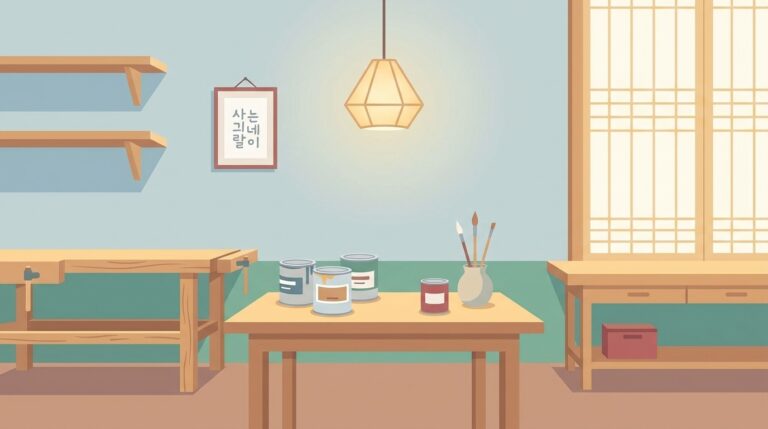
Master the Art of Korean Furniture DIY: The Secrets to Flawless Painting and Varnishing Like a Pro
Phase 1: Empathy & Story-Driven Opening
안녕하세요! Welcome back to another immersive deep-dive with your favorite Korean cultural navigator at Daily Hangul!
Picture this: You have just signed a lease on a charming, minimalist one-room (원룸) studio in Mangwon-dong or Yeonnam-dong. You want to embrace the iconic Korean aesthetic—what Koreans call self-interior (셀프 인테리어). You buy an untreated pinewood side table from an open-source craft market near Euljiro, grab a pair of work gloves, buy a can of water-based paint (수성 페인트), and head home full of creative enthusiasm. But 10 minutes into the job, disaster strikes: the wood grain absorbs the paint unevenly, drips form on the edges (눈물 자국), and the raw timber starts warping because you skipped applying a primer. You rush to the local neighborhood hardware store (철물점) or a woodworking atelier (목공방), only to find yourself tongue-tied trying to describe paint viscosity, wood grain alignment, and matte varnish finishes in Korean.
DIY furniture restoration and timber finishing aren’t just practical life skills in South Korea; they are a trending cultural statement of mindful living (소확행 and 느린 삶). Mastering native-level terminology for woodworking, staining, priming, and polyurethane coating (바니쉬 마감) will instantly transform you from a confused customer into a respected artisan. This guide is crafted from authentic feedback from our advanced international learners who wanted to bridge the gap between dictionary Korean and real studio lingo.
Phase 2: In-Depth Key Expressions
1. 얇게 여러 번 덧칠해야 결이 살아요
- Pronunciation: [Yalg-ge yeoreo beon deotchilhaeya gyeori sarayo] (Sound analogy: Think of saying ‘Yahl-kay’ like ‘yacht-key’, followed by ‘dutch-eel-hae-ya’.)
- Meaning: Literal: “You must coat thinly multiple times for the grain to live.” → Nuance: “You need to apply multiple thin coats to bring out the natural wood grain.”
- K-Culture Moment: Seen frequently in healing lifestyle vlogs (e.g., YouTube channels like Kihwa or interior makeover shows) where a carpenter teaches an idol how to finish an eco-friendly dining table.
- Editor’s Insight: The word 결 (grain/texture) is philosophical in Korean. It applies to wood grain (나뭇결), skin texture (피부결), and even a person’s inner disposition (마음결). Keeping the grain alive (결을 살리다) means respecting the natural essence of the material.
- Situation Spectrum: Casual: ✅ | Semi-formal: ✅ | Formal: ✅
- 🤔 Think About It: In Western DIY culture, the emphasis is often on complete coverage and durability. Why do you think Korean woodworking places such profound cultural emphasis on ‘letting the grain breathe’ (결을 살리다) rather than concealing it under thick paint?
2. 바니쉬 마감 전에 사포질로 단차를 잡아주세요
- Pronunciation: [Bani-swi magam jeone sapojillo dan-chareul jab-a-juseyo] (Sound analogy: ‘Barnish’ sounds just like varnish, ‘sah-poh-jeel’ rhymes with ‘car-go wheel’.)
- Meaning: Literal: “Before the varnish finish, catch the level difference with sanding.” → Nuance: “Make sure to sand down any uneven surfaces before applying the clear topcoat.”
- K-Culture Moment: Heard on reality shows like MBC’s I Live Alone (나 혼자 산다) when a celebrity builds customized cat towers or tea tables from scratch.
- Editor’s Insight: 단차 (level difference/uneven gap) is a professional architectural term that native DIY enthusiasts use constantly. Pairing it with the verb 잡다 (to catch/fix) shows a very high C1 mastery of idiomatic craft Korean.
- Situation Spectrum: Casual: ✅ | Semi-formal: ✅ | Formal: ✅
- 🤔 Think About It: How does the active verb 잡다 (to catch) function across various Korean professional fields (e.g., catching bugs in coding, catching drafts in carpentry, catching tones in singing)?
3. 젯소를 밑바탕에 발라야 발색이 쨍하게 올라와요
- Pronunciation: [Jesso-reul mit-batange balraya balsaegi jjaenghage ollawayo] (Sound analogy: ‘Jesso’ sounds like ‘espresso’ without the ‘es-‘, ‘jjaeng-ha-ge’ with a crisp, high-pitched double-j sound.)
- Meaning: Literal: “Only when you apply gesso to the foundation will the color expression rise vividly.” → Nuance: “You have to prime it with gesso first for the paint color to pop vibrantly without being absorbed.”
- K-Culture Moment: Popularized by Korean home-styling influencers on Instagram and Today’s House (오늘의 집) app tutorials when upcycling vintage furniture.
- Editor’s Insight: 쨍하다 is an expressive onomatopoeic/mimetic adjective describing intense, radiant sunlight or razor-sharp, vivid color saturation. Using 발색이 쨍하다 elevates your descriptive power immediately.
- Situation Spectrum: Casual: ✅ | Semi-formal: ✅ | Formal: ⚠️
- 🤔 Think About It: Korean has dozens of mimetic words for visual clarity (쨍하다, 선명하다, 화사하다). What does this richness reflect about sensory aesthetics in Korean design?
Phase 3: Textbook Korean vs. Real Korean
Scenario 1: Asking if the paint has dried between coats
- 📖 교과서 한국어: 페인트가 완전히 말랐는지 확인한 후에 다시 칠하십시오. (Peinteuga wanjeonhi marratneunji hwag-inhan hue dasi chilhasipsio.) — “Please check if the paint is completely dry before painting again.”
- 🗣️ 진짜 한국어: 손에 안 묻어날 때까지 바짝 말리고 재도장 들어가세요. (Sone an mudeonal ttaekkaji bajjak malligo jaedojang deureogaseyo.) — “Let it dry bone-dry until nothing comes off on your hand before jumping into the second coat.”
- 💡 왜 다를까?: Native makers use dynamic action words like 재도장 들어가다 (enter recoating) and vivid adverbs like 바짝 말리다 (dry completely/crisply) rather than passive, overly scholastic instructions.
Scenario 2: Choosing between gloss, semi-gloss, and matte finishes
- 📖 교과서 한국어: 광택이 없는 바니쉬를 주십시오. (Gwangtaegi eomtneun baniswireul jusipsio.) — “Please give me varnish that lacks gloss.”
- 🗣️ 진짜 한국어: 번들거리지 않게 무광이나 반광 계열로 추천해 주실래요? (Beondeul-georiji ankke mugwang-ina bangwang gyeyeollo chucheonhae jusillaeyo.) — “Could you recommend a matte or satin finish so it doesn’t look overly shiny/greasy?”
- 💡 왜 다를까?: In hardware shops, terms like 무광 (matte), 반광 (semi-gloss/eggshell), and 유광 (high-gloss) are standard industry taxonomy. Using 번들거리다 precisely describes unwanted oily shine.
Phase 4: K-Culture Deep Dive & Non-verbal Manners
4-1. Nunchi & Workshop Etiquette
When entering a Korean woodworking atelier (목공방) or Euljiro paint specialty shop, never touch raw, freshly planed lumber (대패질한 원목) with bare, sweaty palms. Natural oils can prevent stain absorption. Always look for a cotton work glove (목장갑) near the entrance before inspecting wood surfaces.
When an instructor or craftsperson looks over your shoulder while you are holding a paintbrush (붓) or roller (롤러), pause your movement slightly and tilt your head to maintain receptive eye contact. In Korean master-apprentice (스승과 제자) dynamics, continuing to vigorously paint while being advised can be perceived as impatient or dismissive.
4-2. Cultural Code: The ‘Today’s House’ (오늘의 집) Generation
In contemporary South Korea, where real estate prices make owning a standalone house challenging for young adults, customized DIY interior styling has become the supreme medium of personal identity. Rather than buying mass-produced luxury furniture, Gen Z and Millennials take immense pride in finding unvarnished modular shelves and applying their own unique eco-friendly milk paints (밀크 페인트) and water-based varnishes (수성 바니쉬). Upcycling old wooden furniture is seen as a sign of intellectual sophistication, environmental consciousness, and aesthetic sensibility.
Phase 5: Real-Life Roleplay Scenario
Setting: A cozy, aromatic woodworking studio in Seongsu-dong, Seoul.
Characters:
* Master Min-woo (민우 실장님): A seasoned furniture designer wearing an apron and dust mask.
* Sarah (사라): An advanced international learner revitalizing a vintage birch desk.
- 민우: 사라 씨, 사포질은 400방짜리로 마무리하셨어요? 결 반대 방향으로 밀면 흠집 나니까 조심하시고요.
(Sarah ssi, sapojireun 400-bangjjariro mamurihasyeosseoyo? Gyeol bandae banghyang-euro milmyeon heumjip nanikka josimhasigoyo.)
“Sarah, did you finish sanding with the 400-grit? Be careful not to sand against the grain, or it will scratch.”
🎭 [민우 checks the surface of the birch desk with the back of his fingers] -
사라: 네, 실장님! 나뭇결 따라서 곱게 밀어뒀어요. 이제 바로 페인트 올리면 될까요?
(Ne, siljangnim! Namutgyeol ttaraseo gopge mireodwoesseoyo. Ije baro peinteu ollimyeon doelkkayo?)
“Yes, Director! I sanded it smoothly along the wood grain. Should I apply the paint right away?”
🎭 [사라 wipes away the fine sawdust with a microfiber cloth] -
민우: 잠깐만요! 원목 수종이 자작나무라 페인트를 바로 바르면 얼룩덜룩해져요. 하도 작업으로 젯소부터 얇게 한 번 쳐야죠.
(Jamkkanmanyo! Wonmok sujongi jajangnamura peinteureul baro bareumyeon eollukdeollukhaejeoyo. Hado jageob-euro jessobuteo yalge han beon chyeoyajyo.)
“Hold on! Since the timber is birch, painting directly will cause blotches. You need to lay down a thin base coat of gesso first.”
🎭 [민우 points to the corner of the wood to show grain porosity] -
사라: 아, 흡수율이 달라서 그렇군요. 그럼 젯소 바르고 얼마나 건조시켜야 해요?
(A, heubsu-yuri dallaseo geureokunyo. Geureom jesso bareugo eolmana geonjosikyeoya haeyo?)
“Ah, because of the uneven absorption rate. Then how long should I let the gesso dry before painting?”
🎭 [사라 picks up the gesso can and stirs it carefully with a wooden stick] -
민우: 요즘 날씨가 건조하니까 1시간이면 충분해요. 붓자국 안 남게 힘 빼고 스치듯이 펴 발라주세요.
(Yojeum nalssiga geonjohanikka han-sigan-imyeon chungbunhaeyo. Butjaguk an namge him ppaego seuchideusi pyeo ballajuseyo.)
“The weather is dry these days, so one hour is plenty. Brush lightly as if gliding over the surface without pressing down, so you don’t leave brush streaks.”
🎭 [민우 mimics a smooth, gliding brush motion in the air] -
사라: 알겠습니다! 페인트 본 도장 끝난 뒤에는 무광 바니쉬로 2회 코팅하면 생활 방수도 잡히겠죠?
(Algetseumnida! Peinteu bon dojang kkeutnan dwie-neun mugwang baniswiro 2-hoe kotinghamyeon saenghwal bangsudo japhigetjyo?)
“Understood! After the main paint coating is done, if I apply two coats of matte varnish, that will make it water-resistant for daily use, right?”
🎭 [사라 checks the varnish label to confirm it’s water-based] -
민우: 그렇죠. 대신 1차 바니쉬 바르고 살짝 일어난 거스러미는 600방 사포로 가볍게 날려주셔야 표면이 도자기처럼 매끄러워져요.
(Geureochyo. Daesin 1-cha baniswi bareugo saljjak ireonan geoseureomineun 600-bang saporlo gabyeopge nallyeojusyeoya pyomyeoni dojagi-cheoreom maekkeureowojyeoyo.)
“Exactly. But remember to lightly buff away any raised wood whiskers after the first varnish coat with 600-grit sandpaper so the surface turns as smooth as porcelain.”
🎭 [민우 hands Sarah the ultra-fine finishing sandpaper with an encouraging nod] -
사라: 와, 디테일이 진짜 중요하네요. 꼼꼼하게 결 살려서 마감해 볼게요!
(Wa, diteiri jinjja jungyohaneyo. Kkomkkomhage gyeol sallyeoseo magamhae bolgeyo!)
“Wow, the devil is really in the details. I will carefully bring out the grain and finish it flawlessly!”
🎭 [사라 dips the brush tip one-third into the gesso with renewed focus]
🔀 Interactive Choice Point
You notice that your first coat of water-based paint started dripping on the edge and formed an uneven glob (눈물 자국). How do you respond to the master carpenter?
- Option A: “실장님, 칠이 뭉쳐서 눈물 자국이 생겼는데 마른 뒤에 사포로 갈아내면 될까요?” (Best)
- Option B: “선생님, 페인트를 너무 많이 발랐는데 물로 대충 씻어내도 되나요?” (Risk)
- Option C: “이거 그냥 위에 바니쉬 두껍게 덮어버리면 안 보이지 않을까요?” (Bad)
▶ Feedback Breakdown:
- Option A (Best): Perfectly professional! Proposing to sand down dried drip marks shows you understand paint curing processes and workshop terminology.
- Option B (Risk): Washing water-based paint off raw wood with water will swell the timber grain significantly and ruin the wood structure.
- Option C (Bad): Varnish is transparent! Putting thick varnish over an uneven paint drop magnifies the flaw like a lens.
Phase 6: 10-Second Emotion Shadowing Drill
- [🧐 학구적이고 세심하게 — Analytical & Attentive]
“붓자국 안 남게 / 힘 빼고 / 스치듯이 / 펴 바르는 게 / 핵심이에요.”
(Butjaguk an namge / him ppaego / seuchideusi / pyeo bareuneun ge / haeksim-ieyo.)
“The key is / to relax your wrist / and spread it lightly like gliding / without leaving brush streaks.” -
[💡 깨달음을 얻고 자신감 있게 — Enlightened & Confident]
“1차 도장 후에 / 거스러미를 털어내야 / 표면이 도자기처럼 / 매끈해지는군요!”
(1-cha dojang hue / geoseureomireul teoreonaeya / pyomyeoni dojagi-cheoreom / maekkeunhaejineungunyo!)
“So brushing off the raised wood whiskers / after the first coat / is what makes the surface / smooth like porcelain!” -
[😌 장인정신을 담아 정성스럽게 — Mindful & Dedicated]
“조급하게 칠하지 않고 / 결 따라서 / 천천히 / 여러 번 올릴게요.”
(Jogeubhage chilhaji ankko / gyeol ttaraseo / cheoncheonhi / yeoreo beon ollilgeyo.)
“Rather than rushing, / I will follow the natural wood grain / slowly / and apply multiple thin coats.”
Phase 7: K-Culture Mini Dictionary
-
하도 / 중도 / 상도 (Hado / Jungdo / Sangdo)
- Translation: Primer (Base coat) / Intermediate coat / Topcoat.
- Usage: Standard terminology in paint stores. 하도 (like gesso/sealer) bonds paint to wood, 중도 delivers color, and 상도 (varnish/polyurethane) seals and protects against moisture.
- 거스러미 (Geoseureomi)
- Translation: Wood whiskers / micro-burrs raised by moisture.
- Usage: When water-based paints hit raw wood, fine micro-fibers stand up rough. Carpenters say: “거스러미를 사포로 살짝 쳐내세요” (Lightly buff down the raised micro-fibers).
- 눈물 자국 (Nunmul jaguk)
- Translation: Paint runs / drip marks / sags.
- Usage: Caused by overloading the brush. Native expression: “페인트 양 조절 실패해서 눈물 자국 생겼어요” (I overloaded the brush and got drip marks).
- 오일 스테인 (Oil Stain)
- Translation: Penetrating wood oil stain.
- Usage: Unlike film-forming paint, oil stain penetrates deep into the wood to accentuate wood grains (나뭇결을 강조하다). Ideal for Scandinavian-style minimalist interiors.
Phase 8: Survival Kit for Makers & Travelers
Survival Expressions TOP 3
- “가구용 수성 페인트 저독성 친환경 제품으로 보여주세요.”
(Gaguyong suseong peinteu jeodokseong chinhwangyeong jepum-euro boyeojuseyo.)
Pro Tip: Hardware shops have industrial oil paints that smell intense. Always ask for 저독성 수성 (low-toxicity, water-based) for indoor furniture. -
“사포 몇 방으로 샌딩해야 바니쉬가 안 밀릴까요?”
(Sapo myeot bang-euro saendinghaeya baniswiga an millilkkayo?)
Pro Tip: ~방 (bang) is the Korean counter for grit count (e.g., 200방 = 200 grit, 600방 = 600 grit). -
“스펀지 롤러랑 붓 중에 자국이 덜 남는 게 뭐예요?”
(Seupeonji rolleorang but junge jagugi deol namneun ge mwoyeyo?)
Pro Tip: For broad flat table surfaces, high-density sponge rollers (스펀지 롤러) leave fewer streaks than traditional bristle brushes.
Editor’s Travel & Sourcing Note
If you are hunting for bespoke woodworking tools and premium paints in Seoul, bypass standard supermarket aisles. Head directly to the specialized tool alleys of Euljiro 3-ga Station (Lines 2 & 3) or the massive Ace Hardware Geumcheon/Yongsan branches. Before visiting, verify inventory using the Naver Map store locator app to search for 목공용 페인트 전문점 (woodworking specialty paint stores).
Phase 9: A Step Deeper (한 발 더 깊이)
In traditional Korean woodworking, finishing wood is referred to as providing 정성 (devoted care) and adding 손맛 (the artisan’s tactile touch). In an era dominated by instantaneous digital gratification and mass-manufactured plastic goods, woodworking and manual painting demand patience. You cannot rush drying time; you cannot skip sanding. The Korean aesthetic concept of 여백의 미 (the beauty of vacant space) and 자연미 (natural beauty) teaches us that we do not conquer the wood by smothering it with synthetic color—we honor the tree’s lifetime by helping its rings and grain shine through clear, protective coats.
💬 Your Turn: Have you ever restored an old piece of furniture or tried self-interior painting? What finish do you prefer: ultra-glossy (유광), satin (반광), or matte (무광)? Share your thoughts in the comments below!
Phase 10: FAQ & Common Mistakes
Q: 페인트 칠하기 전에 꼭 젯소를 발라야 하나요?
A: MDF나 필름지가 붙은 가구, 또는 진한 색상의 원목 위에 밝은 페인트를 올릴 때는 젯소가 필수입니다. 젯소는 표면의 접착력을 높이고 원목 특유의 타닌(유분)이나 원래 색상이 배어 나오는 것을 막아줍니다.
Q: 바니쉬와 니스(바니시)의 차이점은 무엇인가요?
A: 어원상 같은 계열이지만, 한국 일상 대화에서 니스는 전통적인 유성 락카/유성 바니쉬(누렇게 변색되는 황변 현상과 강한 냄새 동반)를 가리키는 경우가 많고, 바니쉬는 친환경 무황변 수성 코팅제를 의미하는 경우가 많습니다. 실내 가구 DIY에는 반드시 ‘수성 바니쉬’를 선택하세요.
Q: 페인트 도장 사이에 사포질을 하는 이유는 무엇인가요?
A: 1차 페인트가 마른 후 표면에 미세하게 일어난 나뭇결(거스러미)과 붓자국을 평탄화하여, 2차 도장 시 페인트가 훨씬 밀착력 있고 매끄럽게 안착되도록 만들기 위함입니다.
🚨 흔한 실수 (Common Mistakes)
- Mistake: Diluting water-based paint with too much tap water.
- Correct Action: If paint is too thick, add water within a strict 5–10% volume limit; otherwise, coverage (은폐력) drops drastically.
- Mistake: Sanding across the grain (결 반대 방향으로 사포질).
- Correct Action: Always sand strictly parallel to the grain lines (결 방향) to avoid permanent scratches.
- Mistake: Applying varnish before the base paint is fully cured deep inside.
- Correct Action: Even if the surface feels dry, wait at least 4 to 6 hours before clear-coating so trapped moisture won’t create cloudy, milky spots (백화 현상).
Phase 11: Action Missions
- 🥉 Bronze Mission (Self Practice): Say this sentence out loud 5 times in front of a mirror: “결을 살려서 얇게 덧칠할게요.” (Gyeoreul sallyeoseo yalge deotchilhalgeyo.)
- 🥈 Silver Mission (Social / Community): Snap a photo of a wooden table or shelf in your room and post an Instagram Story with the caption: “우리 집 가구 바니쉬 마감 완료! 결이 쨍하게 살아났어요 ✨”
- 🥇 Gold Mission (Real-world Challenge): Visit a local Korean DIY center or craft studio and ask the clerk: “원목 테이블 마감용 친환경 수성 무광 바니쉬 있나요?”
- 🎮 K-Culture Mission: Watch an episode of a Korean woodworking or home-makeover vlog on YouTube and write down every time the creator mentions 사포질 (sanding) or 덧칠 (re-coating)!
Phase 12: Interactive Quiz Challenge
1. Situational Judgment
Which statement demonstrates proper etiquette and professional technique in a Korean woodworking studio?
* A) 붓자국을 가리기 위해 페인트를 한 번에 아주 두껍게 붓는다.
* B) 나무 표면의 거스러미를 없애기 위해 나뭇결 방향으로 고운 사포질을 한다.
* C) 건조 시간을 줄이기 위해 젖은 페인트 위에 바로 바니쉬를 덧바른다.
🔍 Click to Reveal Answer & Explanation
Correct Answer: B
Explanation: Sanding along the grain with fine-grit sandpaper (나뭇결 방향으로 고운 사포질) removes burrs smoothly without damaging timber. Applying thick coats (A) causes running drips, and applying varnish over wet paint (C) ruins adhesion and causes whitening.
2. Fill-in-the-Blank
Fill in the missing native Korean term:
“원목 가구 표면의 나뭇______을 살리기 위해 오일 스테인을 얇게 펴 발랐어요.”
🔍 Click to Reveal Answer & Explanation
Correct Answer: 결 (Grain)
Full Sentence: 원목 가구 표면의 나뭇결을 살리기 위해 오일 스테인을 얇게 펴 발랐어요. (I spread a thin coat of oil stain to bring out the natural wood grain of the timber furniture.)
3. True / False Cultural Quiz
Statement: In Korean DIY culture, 유광 (high-gloss) is the only acceptable finish for wooden furniture restoration.
🔍 Click to Reveal Answer & Explanation
Correct Answer: False
Explanation: Modern Korean interior trends heavily favor 무광 (matte) or 반광/사틴 (satin/semi-gloss) finishes because they create a warm, calm, organic atmosphere (내추럴 무드) that blends harmoniously with minimalist home aesthetics.







