

Phase 1: 공감 (Story Opening)
안녕하세요! 매일한글 에디터입니다. (Hello! I’m your Daily Hangul editor.)
Picture this: You are spending a vibrant evening exploring an underground shopping mall in Gangnam or sitting in a cozy basement cafe in Hongdae with an iced Americano. Suddenly, a piercing alarm rings through the speakers, followed by a rapid-fire Korean announcement. If you’ve ever watched the thrilling Korean disaster-comedy blockbuster Exit (엑시트), your heart might skip a beat as people immediately start standing up and moving. In an unfamiliar country, sudden alarms and Korean announcements can make your mind go completely blank.
“Where do I go? What did that announcement say? How do I ask for the nearest safe place?” These are the exact pain points our A1 beginner students share whenever they experience their first loud emergency siren in Seoul.
Here is the reassuring truth: you do not need complex grammar to survive and stay safe during an emergency in Korea. With just three high-impact survival phrases and sharp situational awareness, you can navigate any evacuation calmly and safely. This guide is crafted directly from real student feedback and local safety protocols to give you practical, life-saving confidence. Let’s master emergency evacuation together!
Phase 2: 핵심 표현 3선 심층 분석 (Top 3 Evacuation Phrases)
1. 어디로 가야 돼요? (Eodiro gaya dwaeyo?)
- Pronunciation: [Uh-dee-ro gah-yah dway-yo?] (Think of saying “Uh-dee” + “row” + “gah-yah” + “dway-yo”)
- Meaning: Literal: “To where must I go?” | Real Nuance: “Where should I head to be safe?”
- K-Culture Moment: In disaster films like Train to Busan or Exit, frantic passengers and citizens ask station attendants where to head when escaping danger.
- Editor’s Insight: This is your absolute master key phrase. The polite ending “-돼요?” sounds humble yet urgently requests clear direction. Point in the direction you think is right, and locals will steer you immediately.
- Situation Spectrum: Casual ⚠️ | Semi-formal ✅ | Formal ✅
- 🤔 Think About It: While English speakers often ask for the noun (“Where is the exit?”), Korean naturally focuses on the necessary action (“Where must I go?”). How does focusing on action change your reaction speed in an emergency?
2. 이쪽으로 오세요! (Ijjogeuro oseyo!)
- Pronunciation: [Ee-jjoh-geu-ro oh-seh-yo!] (Sounds like “Each-choke-euro” + “oh-say-yo”)
- Meaning: Literal: “Please come towards this way!” | Real Nuance: “Follow me / Evacuate in this direction!”
- K-Culture Moment: In K-dramas, brave firefighters or building marshals wave their arms and flashlights, guiding crowds through safe emergency stairwells.
- Editor’s Insight: Hearing and understanding this phrase is just as critical as speaking it. When subway staff or police shout “이쪽으로 오세요!”, don’t hesitate—follow their voice and physical gestures.
- Situation Spectrum: Casual ⚠️ | Semi-formal ✅ | Formal ✅
- 🤔 Think About It: The particle “-으로” (-euro) denotes direction. Notice how Korean safety instructions prioritize guiding group flow rather than individual navigation.
3. 안전한 곳이 어디예요? (Anjeonhan gosi eodieyo?)
- Pronunciation: [Ahn-jeon-hahn go-shee uh-dee-yay-yo?] (“Ahn-john-hahn” + “go-she” + “uh-dee-yay-yo”)
- Meaning: Literal: “Where is the safe place?” | Real Nuance: “Where is the designated shelter or safe zone?”
- K-Culture Moment: Used during regional natural disaster drills or severe weather warnings when residents look for community shelters.
- Editor’s Insight: “안전” (Anjeon) is the magic word for “safety.” If you get overwhelmed and forget the full sentence, simply saying “안전?” (Anjeon?) with a questioning tone will help locals understand you need a safe spot.
- Situation Spectrum: Casual ⚠️ | Semi-formal ✅ | Formal ✅
- 🤔 Think About It: Korea has thousands of designated civil safety shelters (대피소). Asking directly for the “safe place” taps directly into this nationwide shelter network.
Phase 3: 교과서 한국어 vs 진짜 한국어 (Textbook vs. Real Korean)
Situation 1: Telling people to get out quickly
- 📖 교과서 한국어: “위험하니 신속하게 대피하십시오.” (Wiheomhany sin-sokhage daepihasipsio. – As it is dangerous, please evacuate swiftly.)
- 🗣️ 진짜 한국어: “위험해요, 빨리 나가요!” (Wiheomhaeyo, palli nagayo! – It’s dangerous, let’s get out quickly!)
- 💡 왜 다를까? Textbook Korean uses formal Sino-Korean administrative words like ‘신속’ (swift) and ‘대피’ (evacuation). In real-life urgency, native speakers switch to direct, punchy everyday verbs like ‘빨리 나가요’ to trigger instant action.
Situation 2: Following a guide to safety
- 📖 교과서 한국어: “안내원을 따라 이동해 주시기 바랍니다.” (Annaewoneul ttara idonghae jusigi baramnida. – Please move following the guide.)
- 🗣️ 진짜 한국어: “저 따라오세요!” (Jeo ttara-oseyo! – Follow me!)
- 💡 왜 다를까? In emergencies, complex honorific formulas are dropped for crisp, protective leadership commands that everyone can understand instantly.
Phase 4: K-Culture 딥다이브 & 비언어적 매너 (Culture & Body Language)
4-1. 눈치 (Nunchi) & Emergency Body Language
During an evacuation in Korea, Nunchi (the art of sensing the room) is your greatest ally. Koreans are known for Ppalli-Ppalli (hurry-hurry) efficiency, which turns into swift, organized collective movement during emergencies.
* Physical Gesture: If you need help, raise your hand high and wave with open palms. When following someone, maintain eye contact and give a firm nod to confirm you understand.
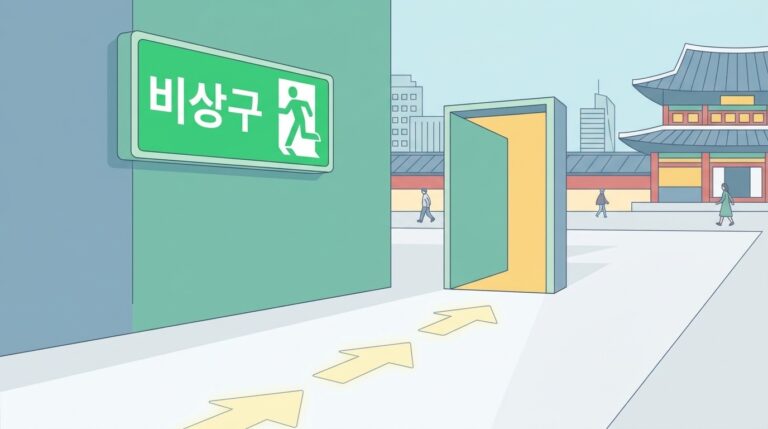
* Subway Etiquette: Never try to use escalators or elevators during fire alerts; immediately head for the stairs following the green running-man emergency exit signs (비상구).
4-2. Culture Code: Korea’s Emergency Alert System (긴급재난문자)
If you travel in Korea, your smartphone will periodically vibrate with an alarming loud siren sound. This is Korea’s 긴급재난문자 (Gingeup Jaenan Munja – Emergency Disaster Text). These alerts cover everything from air quality warnings and heavy rain forecasts to actual local emergencies. Do not panic when this alarm rings! Check whether people around you are evacuating or simply checking weather updates.
Phase 5: 실전 롤플레이 시나리오 (Interactive Roleplay)
Setting: A sudden smoke alarm rings at a busy underground subway station in Seoul. You see Min-woo, a subway safety marshal wearing an orange vest.
- Turn 1 (Alarm): [🚨 싸이렌 소리와 방송이 울린다 / Siren blares and announcement plays]
- Turn 2 (You): 🎭 Approaching the station marshal with an anxious look
“저기요, 무슨 일이에요?” (Jeogiyo, museun irieyo? / Excuse me, what is happening?) - Turn 3 (Min-woo): 🎭 Directing people with a flashlight
“연기가 나고 있어요. 침착하세요!” (Yeongiga nago isseoyo. Chimchakhaseyo! / Smoke is coming out. Stay calm!) - Turn 4 (You): 🎭 Looking around anxiously
“어디로 가야 돼요?” (Eodiro gaya dwaeyo? / Where should I go?) - Turn 5 (Min-woo): 🎭 Pointing firmly toward Exit 3 stairs
“이쪽으로 오세요! 3번 출구로 나가세요.” (Ijjogeuro oseyo! Sambeon chulguro nagaseyo. / Come this way! Go out through Exit 3.) - Turn 6 (You): 🎭 Checking the direction
“저쪽 계단으로 가면 돼요?” (Jeojjok gyedaneuro gamyeon dwaeyo? / Can I go up those stairs over there?) - Turn 7 (Min-woo): 🎭 Nodding encouragingly
“네! 엘리베이터 타지 말고 계단으로 가세요.” (Ne! Ellibeiteo taji malgo gyedaneuro gaseyo. / Yes! Don’t take the elevator, use the stairs.) - Turn 8 (You): 🎭 Bowing quickly and heading for the stairs
“감사합니다! 빨리 갈게요.” (Gamsahamnida! Palli galgeyo. / Thank you! I will go quickly.)
🔀 인터랙티브 분기점 (Interactive Choice Point)
As you reach the base of the stairs, you see thick smoke in one corridor, an open elevator, and a crowd moving up the right stairwell. What do you do?
- Option A: Hop into the elevator since it is faster.
- Feedback (Bad): 🚫 Critical Danger! Never take elevators during a fire or emergency evacuation due to power failure risks.
- Option B: Say “안전한 곳이 어디예요?” (Anjeonhan gosi eodieyo?) to the nearest marshal and follow the crowd up the stairs.
- Feedback (Best): ✅ Perfect Choice! You communicate clearly, avoid elevators, and follow designated evacuation channels.
- Option C: Freeze in place and try to translate the full written emergency poster using an image app.
- Feedback (Risk): ⚠️ Time Hazard. Every second counts in an evacuation. Rely on basic verbal cues and crowd flow rather than pausing to read complex text.
Phase 6: 10초 감정 섀도잉 드릴 (10-Second Shadowing Drill)
Practice saying these lines with the exact emotional intonation indicated:
[😨 긴장하고 다급하게 / Tense & Urgent]
“저기요! / 어디로 가야 돼요? / 빨리 알려주세요!”
(Jeogiyo! / Eodiro gaya dwaeyo? / Palli allyeojuseyo!)
Pause: 저기요! (0.5s) / 어디로 가야 돼요? (0.5s)-
[🚨 신속하고 또렷하게 / Fast & Clear]
“이쪽으로 오세요! / 계단으로 / 올라가세요!”
(Ijjogeuro oseyo! / Gyedaneuro / ollagaseyo!)
Pause: 이쪽으로 오세요! (0.5s) / 계단으로 (0.3s) -
[😮💨 안도하며 차분하게 / Relieved & Calm]
“여기가 / 안전한 곳이에요. / 다행이에요.”
(Yeogiga / anjeonhan gosieyo. / Dahaeng-ieyo.)
Pause: 여기가 (0.3s) / 안전한 곳이에요 (0.5s)
Phase 7: K-Culture 미니 사전 (Mini Dictionary)
- 대피소 (Daepiso) | Evacuation Shelter | Permanent emergency shelters found in subway stations, schools, and civic centers across Korea.
- 비상구 (Bisang-gu) | Emergency Exit | Marked by the internationally recognized glowing green running-man sign above doors.
- 소방관 (Sobanggwan) | Firefighter | First responders wearing orange/yellow uniforms who will direct you safely.
- 긴급재난문자 (Gingeup Jaenan Munja) | Disaster Alert Message | Public cell broadcasts sent to all phones in Korea during weather or safety events.
Phase 8: 여행자를 위한 생존 키트 (Traveler’s Survival Kit)
Survival TOP 3 Phrases
- 도와주세요! (Dowa-juseyo!) — Please help me!
- Pro Tip: Use this anytime you are trapped or need urgent human assistance.
- 비상구가 어디예요? (Bisang-guga eodieyo?) — Where is the emergency exit?
- Pro Tip: Keep this ready when inside underground malls or multi-story buildings.
- 불이야! (Buriya!) — Fire!
- Pro Tip: The universal 3-syllable alert to warn everyone around you immediately.
Editor’s Travel Note
- Emergency Hotlines in Korea:
- 119 (Fire & Medical Emergency – offers multi-language translation interpretation).
- 112 (Police Emergency).
- 1330 (Korea Travel Helpline – 24/7 emergency interpretation assistance).
- Essential App: We recommend checking the Official Emergency Ready App (안전디딤돌) Download Guide to receive official multi-lingual emergency push notifications while traveling in South Korea.
Phase 9: “한 발 더 깊이” (Cultural Insights & Essay)
Korea is renowned as one of the safest countries in the world, largely due to its strong communal solidarity and swift public infrastructure. In Korean society, the concept of Uri (우리 – “we/us”) means that in times of sudden crisis, ordinary citizens quickly step up to assist seniors, children, and foreign visitors. Knowing basic evacuation phrases allows you to seamlessly integrate into this protective community network when seconds matter most.
💬 Your Turn: Have you ever received a sudden emergency alert on your phone while traveling in Korea or watching a K-Drama? Share your experience in the comments below!
Phase 10: FAQ & 오해 방지 (FAQ & Common Mistakes)
Q: Will Korean emergency dispatchers speak English if I call 119?
A: Yes! When you dial 119 in Korea, you can say “English, please.” The 119 service immediately connects a real-time 3-way translation interpreter to assist you.
Q: What should I do when my phone makes a loud siren sound for a text message?
A: Check the text. Most alerts are weather or fine dust notifications. However, if people around you are standing up and moving toward exits, treat it as an active evacuation.
Q: Are subway stations considered safe evacuation shelters in Seoul?
A: Yes! Most underground subway stations in Korea are certified civil defense shelters (대피소), engineered to provide safety during severe crises.
🚨 흔한 실수 (Common Mistakes TOP 3)
- Mistake: Searching for complicated textbook sentences on translation apps while alarms are ringing.
- Correct Action: Keep it simple! Shout “도와주세요!” (Dowa-juseyo!) or ask “어디로 가요?” (Eodiro gayo?).
- Mistake: Attempting to take elevators during a fire evacuation.
- Correct Action: Always look for the green 비상구 (Bisang-gu) and use the stairs.
- Mistake: Ignoring evacuation drills believing they are only for local citizens.
- Correct Action: Follow the crowd (Nunchi) and participate respectfully for your own safety.
Phase 11: 액션 미션 (Action Missions)
- 🥉 Bronze Mission (Solo Practice): Stand in front of your mirror and practice saying “어디로 가야 돼요?” (Eodiro gaya dwaeyo?) 5 times with a clear, calm voice.
- 🥈 Silver Mission (Social Share): Write down the word 비상구 (Emergency Exit) on a sticky note and post it on your study board or share it on Instagram tagging
@DailyHangul. - 🥇 Gold Mission (Real-world Hunt): Next time you visit a Korean restaurant, mart, or travel in Korea, locate the emergency exit sign and whisper “저기가 비상구예요” (That place is the emergency exit).
- 🎮 K-Culture Mission: Watch the movie Exit (2019) and listen for how the main characters shout directions to guide people to the rooftop safe zone!
Phase 12: 인터랙티브 퀴즈 챌린지 (Interactive Quiz)
Question 1: Situation Check
You are in a crowded underground mall and hear an alarm. You want to ask a store clerk where to evacuate. Which phrase is best?
* A) 얼마예요? (Eolmayeyo?)
* B) 어디로 가야 돼요? (Eodiro gaya dwaeyo?)
* C) 맛있게 드세요! (Mas-itge deuseyo!)
👉 Click for Answer & Explanation
Correct Answer: B) 어디로 가야 돼요? (Eodiro gaya dwaeyo?)
* Explanation: Option A means “How much is it?”, and Option C means “Enjoy your meal!”. Option B correctly asks “Where should I go?”.
Question 2: Fill in the Blank
Complete the sentence for finding a safe place:
“______한 곳이 어디예요?”
* A) 안전 (Anjeon)
* B) 쇼핑 (Syoping)
* C) 사진 (Sajin)
👉 Click for Answer & Explanation
Correct Answer: A) 안전 (Anjeon)
* Explanation: “안전한 곳이 어디예요?” (Anjeonhan gosi eodieyo?) means “Where is the safe place?”.
Question 3: Cultural True or False
True or False: During a fire or building evacuation in Korea, taking the elevator is recommended because it is faster.
👉 Click for Answer & Explanation
Correct Answer: False (F)
* Explanation: You must NEVER take elevators during an emergency evacuation due to risk of electrical shutdown or smoke inhalation. Always take the stairs toward the 비상구 (Emergency Exit)!







