

안녕하세요! 매일한글 에디터입니다.
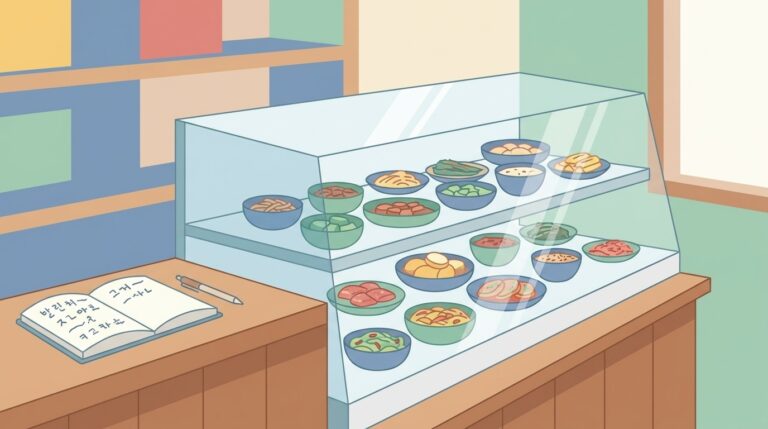
Imagine this: You’ve just finished a long day exploring the bustling streets of Seoul or settling into your temporary Airbnb in Busan. You want a wholesome, authentic Korean home-cooked meal without spending 30,000 KRW at a fancy restaurant or living off instant ramen from the convenience store. You walk down a charming residential alleyway and spot a brightly lit storefront with steaming pots and rows upon rows of colorful, perfectly portioned glass containers. Welcome to a banchan-gage (반찬가게 – side dish shop), Korea’s best-kept culinary secret for solo dwellers, busy families, and smart foodies.
However, the moment you slide open the door, panic sets in. There are fifty different types of seasoned herbs, glazed tofu, braised lotus roots, and marinating meats with handwritten labels. The friendly shop owner (사장님 / sajangnim) looks up and asks, “뭐 찾으시는 거 있으세요?” (Looking for anything in particular?). Suddenly, your mind blanks out. How do you ask for spice levels without sounding like a toddler? How do you ask how long each dish lasts in your tiny fridge? Based on feedback from hundreds of intermediate learners who freeze at local market stalls, this guide will elevate your conversational confidence to B2-level natural fluency so you can conquer any Korean side dish shop with charm and poise.
Phase 2: Core 3 Expressions Deep-Dive
1. 이거 덜 매운 걸로 추천해 주실 수 있나요?
- Pronunciation: Igeo deol maeun geollo chucheonhae jusil su innayo? (Sound analogy: Think of saying ee-guh dull meh-oon gull-lo choo-chun-heh joo-sheel soo een-nah-yo?)
- Meaning: Literal: “Could you recommend a less spicy version of this?” | Nuance: A polite, intermediate-level request asking the owner for milder variations or non-spicy alternatives without sounding demanding.
- K-Culture Moment: Commonly heard when characters who can’t tolerate spice (맵찔이 / maepjjiri) try to buy side dishes for a family dinner in dramas like Crash Course in Romance.
- Editor’s Insight: Using 덜 (less) combined with the indirect framing -ㄹ 수 있나요? softens the request significantly compared to the blunt beginner phrase “안 매운 거 주세요” (Give me non-spicy food).
- Situation Spectrum:
- Casual (Friends): 🚫
- Semi-formal (Shop owners, clerks): ✅
- Formal (High business): ⚠️
- 🤔 Think About It: In Korean food culture, spice (매운맛) isn’t just a flavor—it’s an emotional scale. Notice how asking for 덜 매운 것 acknowledges that the dish is traditionally flavorful while gently signaling your personal preference.
2. 보통 며칠 정도 두고 먹을 수 있어요?
- Pronunciation: Botong myeochil jeongdo dugo meogeul su isseoyo? (Sound analogy: boh-tong myuh-cheel jung-doh doo-goh muh-geul soo ee-ssuh-yo?)
- Meaning: Literal: “Usually, for about how many days can I keep and eat this?” | Nuance: “What is the refrigerator shelf-life of this dish?”
- K-Culture Moment: A staple question asked by practical university students and busy office workers stocking up their weekly mitbanchan (staple side dishes).
- Editor’s Insight: The phrase 두고 먹다 (to keep and eat over time) is a vital idiomatic compound verb. Beginners often ask “언제 상해요?” (When does it spoil?), which sounds negative and unnatural. 두고 먹다 sounds native and culinary-savvy.
- Situation Spectrum:
- Casual: ⚠️ (Use 두고 먹을 수 있어? with peers)
- Semi-formal (Everyday transactions): ✅
- Formal: ⚠️
- 🤔 Think About It: Why does Korean have a dedicated expression like 두고 먹다? Because Korean side-dish culture was historically built around fermentation and preservation through long, harsh winters.
3. 반찬 4팩에 만 원 행사 아직 하나요?
- Pronunciation: Banchan ne-paek-e man won haengsa ajik hanayo? (Sound analogy: bahn-chahn neh-pack-eh mahn won heng-sah ah-jeek hah-nah-yo?)
- Meaning: Literal: “Are you still doing the 4 packs of banchan for 10,000 KRW deal?” | Nuance: Checking if the popular bundle discount is currently valid.
- K-Culture Moment: You’ll see this handwritten in bright red markers outside nearly every neighborhood banchan shop between 4 PM and 7 PM.
- Editor’s Insight: Most independent banchan shops offer a bundle deal (e.g., 3 or 4 small packs for 10,000 KRW) for daily vegetable items (나물류). Asking about the 행사 (event/promotion) shows you know local shopping norms.
- Situation Spectrum:
- Casual: 🚫
- Semi-formal (Shopping, market encounters): ✅
- Formal: ⚠️
- 🤔 Think About It: In many Western grocery stores, discounts are rigidly scanned by barcode. In Korea, asking warmly about bundle promotions opens up a personal connection that often leads to free samples or 덤 (extra freebies)!
Phase 3: Textbook Korean vs. Real-World Korean
Scenario 1: Asking for the freshest/best item made today
- 📖 교과서 한국어 (Textbook): “오늘 만든 가장 신선한 반찬은 무엇입니까?” (Oneul mandeun gajang sinseonhan banchaneun mueosipnikka? – Which is the freshest banchan made today?)
- 🗣️ 진짜 한국어 (Real-World): “이모님, 오늘 어떤 반찬이 제일 잘 나왔어요?” (Imonim, oneul eotteon banchani jeil jal nawasseoyo? – Auntie, which side dishes turned out best today?)
- 💡 왜 다를까?: Native speakers rarely use clinical terms like 신선한 (fresh) when talking to neighborhood cooks. Instead, they use 잘 나오다 (turned out delicious/came out well) and address the shopkeeper warmly as 이모님 (auntie) or 사장님 (boss/owner).
Scenario 2: Asking if you can get a little extra or a small bonus
- 📖 교과서 한국어 (Textbook): “덤을 주십시오.” (Deomeul jusipsio. – Please give me extra bonus items.)
- 🗣️ 진짜 한국어 (Real-World): “사장님, 자주 올 테니까 서비스 하나만 살짝 챙겨주세요~” (Sajangnim, jaju ol tenikka seobiseu hanaman saljjak chaenggyeojuseyo~ – Boss, I’ll visit often, so please slip in a little bonus service~)
- 💡 왜 다를까?: Demanding 덤 directly sounds transactional and rude. Using a playful tone with the future promise 자주 올 테니까 (since I’ll come often) along with the soft phrasing 살짝 챙겨주세요 (please take care of me with a little bonus) taps right into Korean Jeong (정) culture.
Phase 4: K-Culture Deep-Dive & Non-Verbal Manners
4-1. 눈치 (Nunchi) & Physical Etiquette in Banchan Shops
- The Basket and Tong Protocol: When you enter, look near the entrance for a small plastic basket (바구니) or tray and tongs. Never touch open display containers with bare hands. If the items are pre-packaged in sealed containers, pick them up gently by the base, not by the fragile plastic cling-film lids.
- Eye Contact & Spatial Reading (눈치): Banchan shop owners are usually actively cooking large pots in the open kitchen behind the counter. Do not yell loudly across the room. Step up to the counter, make gentle eye contact, give a small 15-degree nod, and speak clearly.
- Two-Handed Transaction: When handing over your card or receiving your tightly knotted plastic bags, always hold the item with both hands or support your right wrist/forearm with your left hand. This non-verbal cue radiates intermediate cultural respect.
4-2. Cultural Code: The Rise of the Solo-Living Banchan Culture
In the hit K-Drama Crash Course in Romance (일타 스캔들), the female lead runs National Best Banchan (국가대표 반찬가게), demonstrating how central these shops are to Korean daily life. Historically, banchan was prepared exclusively at home in massive batches during events like Kimjang (김장). However, with the meteoric rise of single-person households (1인 가구) and double-income working couples in Korea, making ten different side dishes from scratch is both expensive and time-consuming. Buying 3-4 small containers of mitbanchan (staple side dishes like seasoned spinach, braised beef in soy sauce, and stir-fried dried squid) is now considered the smartest lifestyle choice in urban Korea.
Phase 5: Real-World Roleplay Scenario
Setting: A warm, aromatic banchan shop in a residential neighborhood near Mangwon Market, Seoul.
Characters:
* You (Intermediate Korean learner wanting fresh dishes for dinner)
* Sun-hee Imo (선희 이모): A 50-something shop owner with a sharp eye for food and an affectionate, fast-talking demeanor.
[Scene Start: You walk in as the bell chimes. The aroma of roasted sesame oil and bubbling kimchi stew fills the air.]
선희 이모: 어서 와요! 날씨 추운데 얼른 들어와요. 뭐 필요한 거 있어요?
(Eoseo wayo! Nalssi chuunde eolleun deureowayo. Mwo piryohan geo isseoyo?)
“Welcome! It’s cold outside, come on in. Looking for anything specific?”
🎭 [Smiling warmly while wiping down the stainless-steel counter with a clean cloth]
You: 안녕하세요, 이모님! 오늘 저녁에 집밥 해 먹으려고 들렀어요.
(Annyeonghaseyo, imonim! Oneul jeonyeoge jipbap hae meogeuryeogo deulleosseoyo.)
“Hello, auntie! I stopped by to make some home-cooked food for dinner tonight.”
🎭 [Holding a shopping basket with a polite bow]
선희 이모: 아이고, 집밥 먹으려고? 기특하네! 오늘 시금치나물이랑 제육볶음 기가 막히게 잘 나왔어.
(Aigo, jipbap meogeuryeogo? Giteukhane! Oneul sigeumchinamul-irang jeyuk-bokkeum giga makhige jal nawasseo.)
“Oh my, making home meals? How lovely! The seasoned spinach and spicy stir-fried pork turned out amazingly well today.”
You: 제육볶음 정말 맛있어 보이네요! 혹시 이거 덜 매운 걸로도 있나요? 제가 매운 걸 잘 못 먹어서요.
(Jeyuk-bokkeum jeongmal masisseo boineyyo! Hoksi igeo deol maeun geollodo innayo? Jega maeun geol jal mot meogeoseoyo.)
“The spicy pork looks amazing! By any chance, do you have a less spicy version? I can’t handle spicy food very well.”
🎭 [Pointing politely with an open palm toward the meat display]
선희 이모: 그럼 간장 불고기로 가져가! 저기 방금 볶아서 따끈한 거 있어.
(Geureom ganjang bulgogiro gajyeoga! Jeogi banggeum bokkaseo ttakkeunhan geo isseo.)
“Then take the soy-sauce bulgogi! I have some warm ones over there freshly stir-fried.”
You: 좋아요! 그럼 불고기 하나랑 시금치나물 담을게요. 그런데 나물은 보통 며칠 정도 두고 먹을 수 있어요?
(Joayo! Geureom bulgogi hanarang sigeumchinamul dameulgeyo. Geureonde namureun botong myeochil jeongdo dugo meogeul su isseoyo?)
“Great! I’ll take one bulgogi and the seasoned spinach. But how many days can I keep and eat the seasoned greens?”
선희 이모: 나물은 물 생기니까 2~3일 안에 얼른 먹는 게 좋아. 더 오래 두고 먹으려면 저기 연근조림이나 멸치볶음 가져가고!
(Namureun mul saengginikka i-sam-il ane eolleun meongneun ge joa. Deo orae dugo meogeuryeomyeon jeogi yeongeun-jorim-ina myeolchi-bokkeum gajyeogago!)
“Greens release water, so it’s best to eat them within 2-3 days. If you want something that lasts longer, grab the braised lotus root or stir-fried anchovies over there!”
You: 아, 그렇군요! 그럼 멸치볶음도 하나 주세요. 반찬 4팩에 만 원 행사 아직 하나요?
(A, geureokgunyo! Geureom myeolchi-bokkeumdo hana juseyo. Banchan ne-paek-e man won haengsa ajik hanayo?)
“Ah, I see! Then please give me the stir-fried anchovies too. Are you still doing the 4 packs for 10,000 KRW bundle deal?”
🎭 [Glancing enthusiastically at the small pre-packed side dish shelf]
선희 이모: 당연하지! 하나 더 골라봐, 학생(또는 손님). 내가 오늘 콩자반 맛있는 거 넣어줄게!
(Dangyeonhaji! Hana deo golla-bwa, haksaeng. Naega oneul kongjaban masinneun geo neoeojulge!)
“Of course! Pick one more. I’ll make sure you get our tastiest braised black beans today!”
🔀 Interactive Branching Moment
You have picked 3 items, and the owner tells you to pick one more for the 10,000 KRW deal. How do you respond?
- Choice A: “아무거나 대충 싼 걸로 하나 넣어주세요.” (Put in whatever cheap thing you have.)
- Choice B: “이모님 손맛 믿을 테니까, 제일 인기 많은 걸로 하나 골라주세요!” (I trust your cooking skills auntie, please pick the most popular one for me!)
- Choice C: “그냥 3개만 사고 7,500원어치만 계산해 주시면 안 돼요?” (Can’t I just buy 3 and pay 7,500 KRW instead?)
Feedback on Your Choice:
- Choice A (Bad): Calling her food 대충 싼 것 (whatever cheap thing) disrespects the artisan effort the owner put into each dish. It ruins the warm atmosphere instantly.
- Choice B (Best): Praising her 손맛 (culinary touch) and asking for her recommendation flatters the cook and builds instant rapport. She might even give you a bigger portion or extra sauce!
- Choice C (Risk): Set bundle deals (4팩 만 원) are fixed. Breaking the bundle down into fractions (7,500 KRW) creates awkward haggling over pennies and shows a lack of local shopping etiquette.
Phase 6: 10-Second Emotion Shadowing Drill
Practice reading these lines aloud with the specified emotion and intonation breaks (/ represents a micro-pause):
- [😊 Polite, Inquiring Tone]
- “이거 / 덜 매운 걸로 / 추천해 주실 수 있나요?”
- Igeo / deol maeun geollo / chucheonhae jusil su innayo?
- [🧐 Practical, Thoughtful Tone]
- “보통 / 며칠 정도 / 냉장고에 두고 먹을 수 있어요?”
- Botong / myeochil jeongdo / naengjanggo-e dugo meogeul su isseoyo?
- [😋 Enthusiastic & Flattering Tone]
- “이모님 손맛이 최고예요! / 오늘 제일 잘 나온 반찬 / 하나만 추천해 주세요~”
- Imonim sonmasi choegoyeyo! / Oneul jeil jal naon banchan / hanaman chucheonhae juseyo~
Phase 7: K-Culture Mini Dictionary
| # | Term (Hangul + Revised Romanization) | English Meaning | Practical Cultural Usage |
|---|---|---|---|
| 1 | 밑반찬 (Mitbanchan) | Foundational Side Dishes | Refers to preserved side dishes (pickled, braised, stir-fried dry goods) that can sit in the fridge for weeks as the backbone of everyday meals. |
| 2 | 장아찌 (Jang-ajji) | Soy-pickled vegetables | Vegetables (garlic scapes, onions, perilla leaves) pickled in a boiled soy sauce, vinegar, and sugar brine. Perfect non-perishable side dishes for travelers. |
| 3 | 덤 (Deom) | Bonus / Extra freebie | The traditional Korean concept of giving an extra scoop or small free item out of goodwill and affection (정). |
| 4 | 소분 (Sobun) | Portioning out into small batches | The modern practice of dividing large portions of food or banchan into single-meal airtight containers to prevent spoilage. |
Phase 8: Traveler’s Survival Kit
Top 3 Survival Phrases
- “국물이 새지 않게 랩으로 한 번만 더 싸주실 수 있나요?”
(Gungmuri saeji anke raebeuro han beonman deo ssajusil su innayo?)
Pro Tip: Essential if you are walking or taking the subway back to your hotel. It asks the owner to wrap watery side dishes (like Kimchi or Jorim) with an extra layer of plastic wrap to prevent spills. - “이거 전자레인지에 돌려 먹어야 하나요?”
(Igeo jeonjareinjie dollyeo meogeoya hanayo?)
Pro Tip: Asks whether the dish needs to be microwaved hot (e.g., meat, pancakes) or eaten cold directly from the fridge (e.g., namul, pickled vegetables). - “현금영수증 필요 없어요, 그냥 카드로 계산할게요.”
(Hyeongeum-yeongsujeung piryo eopseoyo, geunyang kadeuro gyesanhalgeyo.)
Pro Tip: Speeds up your checkout process smoothly when paying with international credit cards.
Editor’s Travel Note
- Navigation: Want to find real neighborhood gems instead of tourist traps? Download the Naver Map application on your smartphone and search for the keyword “반찬가게” or “반찬전문점” in your neighborhood. Look for stores with scores above 4.5 and real neighborhood reviews.
- Storage Warning for Airbnb Users: Fresh vegetable namul (나물) spoils quickly in warm weather. Store them in the coldest compartment of your refrigerator immediately and finish them within 48 hours.
Phase 9: “One Step Deeper” (Cultural Reflection)
In Western culinary traditions, a meal is centered around a solitary main protein with side garnishes on a single plate. In contrast, the Korean dinner table (Bapsang / 밥상) is an ecosystem of communal harmony. Banchan represents the ethos of maternal care (엄마 손맛)—the quiet labor of washing, blanching, seasoning, and fermenting multiple items so that every bite offers a harmonious balance of colors, textures, and nutritional elements. When you shop at a neighborhood banchan store, you aren’t just purchasing convenience food; you are buying into a shared culture of home-cooked comfort that has sustained Korean families through generations.
💬 Your Turn: What is your absolute favorite Korean side dish when you visit a Korean restaurant? Have you ever dared to buy it fresh from a local market? Share your stories and questions in the comments below!
Phase 10: FAQ & Misconception Prevention
Q: Can I ask to taste-test (맛보기) banchan before buying at small neighborhood stores?
A: At traditional open-air market stalls, owners will gladly give you a small toothpick sample if you ask politely: “혹시 맛 조금만 봐도 될까요?” (Could I taste a tiny bit?). However, at pre-packaged modern boutique banchan shops with sealed plastic lids, taste-testing is generally not allowed unless sample dishes are clearly set out.
Q: Do small banchan shops accept international credit cards or are they cash-only?
A: Over 98% of registered banchan stores in South Korea accept credit cards without hesitation. However, bringing cash (around 10,000 ~ 20,000 KRW) or using Korean bank transfer (계좌이체) is appreciated at traditional markets and often unlocks free 덤 (extra side dishes).
Q: How do I know which dishes need to be heated up and which should stay cold?
A: Rule of thumb: Namul (seasoned greens), Jang-ajji (pickles), and Kimchi are eaten cold or room temperature. Jorim (braised meats/tofu), Jeon (pan-fried pancakes), and Bokkeum (stir-fries like bulgogi or spicy pork) should be heated in the microwave for 30–60 seconds before eating.
🚨 Common Mistakes (흔한 실수) Warning Board
| # | Common Mistake | Why It’s Wrong | Correct Action |
|---|---|---|---|
| 1 | Leaving seasoned namul (나물) at room temperature overnight | Blanched herbs seasoned with sesame oil oxidize and sour within hours. | Refrigerate immediately upon arriving home and eat within 2-3 days. |
| 2 | Double-dipping your eating chopsticks into the main container | Saliva bacteria will cause fermented sauces and broths to mold quickly. | Use clean spoons to portion out (소분) what you want onto a separate plate. |
| 3 | Demanding price cuts on pre-packaged discount sets | Discount bundles (e.g., 4 packs for 10,000 KRW) are already discounted to minimal margins. | Accept the set price cheerfully and build rapport for potential bonus samples (덤). |
Phase 11: Action Missions & K-Culture Challenge
- 🥉 Bronze Mission (Self-Practice): Practice pronouncing “보통 며칠 정도 두고 먹을 수 있어요?” 5 times in front of your mirror until it flows without pausing.
- 🥈 Silver Mission (Social / Community): Take a photo of a Korean side dish you ate recently and post it with the Korean name (e.g., #멸치볶음 #시금치나물 #DailyHangul) on your social media.
- 🥇 Gold Mission (Real-World Application): Visit a local Korean banchan shop or grocery store side-dish counter, order a 3-pack or 4-pack bundle in fluent Korean, and ask the owner for their best recommendation using “오늘 어떤 반찬이 제일 잘 나왔어요?”.
- 🎮 K-Culture Mission: Watch Episode 1 or 2 of the K-Drama Crash Course in Romance and spot 3 different types of banchan displayed in the glass showcase of National Best Banchan.
Phase 12: Interactive Quiz Challenge
Test your knowledge before your next culinary adventure!
1. Situational Judgment
You want to buy seasoned spinach (시금치나물) and braised black beans (콩자반). You want to know which one will last longer in your mini-fridge. What is the most natural way to ask?
* (A) 둘 중에 뭐가 먼저 썩어요?
* (B) 둘 중에 어떤 게 더 오래 두고 먹을 수 있나요?
* (C) 콩자반의 유통기한을 증명해 주시겠습니까?
2. Fill-in-the-Blank
Fill in the missing word for asking for a milder version:
“이거 _____ 매운 걸로 추천해 주실 수 있나요?”
(Hint: A 1-syllable adverb meaning ‘less’)
3. True / False Cultural Fact
True or False: In Korea, it is polite to open sealed plastic banchan lids on the display shelf to smell the seasoning before deciding to buy.
👉 Click here to reveal the answers and explanations!
Answers & Explanations
-
Correct Answer: (B)
Explanation: 더 오래 두고 먹을 수 있나요? uses natural intermediate idiomatic phrasing. Option (A) uses 썩다 (to rot), which is crude and offensive to a cook. Option (C) sounds like an aggressive legal document! -
Correct Answer: 덜 (deol)
Explanation: 덜 means “less”. Combined with 매운 (spicy), 덜 매운 것 means “something less spicy”. -
Correct Answer: False (F)
Explanation: Opening sealed food packaging violates hygiene standards. If you are curious about ingredients or flavor, always ask the owner directly instead of opening containers.







