

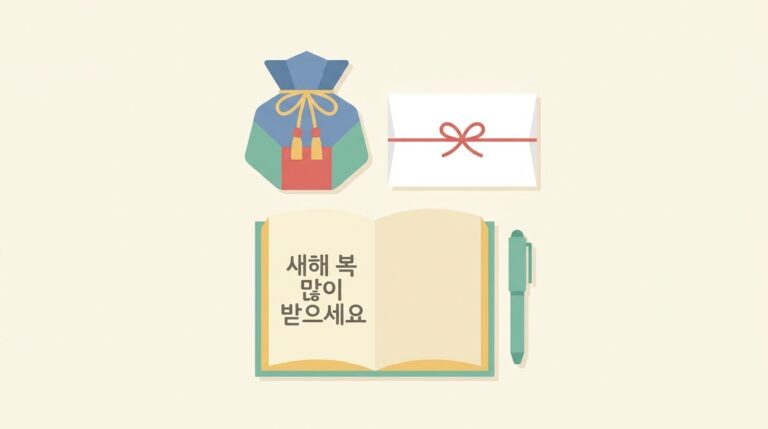
Don’t Panic at Korean New Year! How to Receive Sebaetdon Politely
Phase 1: Empathy & Storytelling Opening
안녕하세요! 매일한글 에디터입니다. Have you ever watched a warm family scene in a K-Drama like Reply 1988 where children perform deep bows in colorful Hanbok and grandparents hand over crisp white envelopes with bright smiles? That magical pocket money is called 세뱃돈 (Sebaetdon)!
If you find yourself invited to a Korean household during 설날 (Seollal – Lunar New Year), you might freeze: How deep should I bow? What do I say to the elders? Can I open the envelope right away? Don’t worry! Receiving Sebaetdon is actually a heartwarming exchange of love and blessing. By learning just three simple A1-level phrases and basic manners, you’ll melt the hearts of any Korean host family or elders you meet.
Phase 2: 3 Core Expressions Deep Dive
1. 새해 복 많이 받으세요 (Saehae bok mani badeuseyo)
- Pronunciation: Sae-hae bok mah-nee bah-deu-seh-yo (Think: Say-hey, soak in money & bless-you!)
- Meaning: Literal: “Please receive a lot of New Year luck/blessings.” | Nuance: “Happy New Year!”
- K-Culture Moment: Said right after finishing the deep formal bow (세배, Sebae) in front of grandparents or parents.
- Editor’s Insight: The word 복 (Bok) encompasses good health, wealth, and happiness. You can say this to literally anyone on New Year’s day!
- Situation Spectrum: Casual ⚠️ | Semi-formal ✅ | Formal ✅
- 🤔 Think About It: In English, we simply wish a “Happy” New Year, but Korean invites the person to actively “receive abundant fortune”. How does this show community support?
2. 감사합니다 (Gamsahamnida)
- Pronunciation: Gam-sah-hahm-nee-dah (Think: Gahm-sah-harm-knee-dah)
- Meaning: Literal: “Gratitude is done.” | Nuance: “Thank you very much.”
- K-Culture Moment: Spoken with two hands holding the envelope when an elder gives you your pocket money.
- Editor’s Insight: Always keep your voice warm and clear. At the A1 level, a heartfelt 감사합니다 while bowing your head slightly makes the best impression.
- Situation Spectrum: Casual 🚫 | Semi-formal ✅ | Formal ✅
- 🤔 Think About It: Why does Korean emphasize formal gratitude even when receiving gifts from close grandparents?
3. 건강하세요 (Geonganghaseyo)
- Pronunciation: Gun-gang-hah-seh-yo (Think: Gun-gahng-ha-say-yo)
- Meaning: Literal: “Please be healthy.” | Nuance: “Stay healthy and well!”
- K-Culture Moment: After elders give pocket money and heartfelt words (덕담, Deokdam), you return the blessing by wishing them good health.
- Editor’s Insight: Korean elders love hearing this more than “get rich”! It shows genuine care for their longevity.
- Situation Spectrum: Casual ⚠️ | Semi-formal ✅ | Formal ✅
- 🤔 Think About It: Why is health considered the highest blessing in traditional Korean culture?
Phase 3: Textbook Korean vs Real Korean
Situation 1: Wishing elders a good new year
- 📖 교과서 한국어 (Textbook): 새해 복을 많이 받으시기를 진심으로 기원합니다. (Saehae bogeul mani badeusigireul jinsimeuro giwonhamnida. – “I sincerely pray you receive much New Year luck.”)
- 🗣️ 진짜 한국어 (Real-life): 새해 복 많이 받으세요! (Saehae bok mani badeuseyo!)
- 💡 왜 다를까?: The textbook phrase is too stiff for real family gatherings. 새해 복 많이 받으세요 is perfectly polite, natural, and standard for all ages.
Situation 2: Expressing appreciation for the envelope
- 📖 교과서 한국어 (Textbook): 주신 용돈을 소중하게 잘 사용하겠습니다. (Jusin yongdoneul sojunghage jal sayonghagetseumnida. – “I will use the allowance you granted with precious care.”)
- 🗣️ 진짜 한국어 (Real-life): 감사합니다! 잘 쓸게요. (Gamsahamnida! Jal sseulgeyo.)
- 💡 왜 다를까?: Real natives express gratitude warmly and simply. 잘 쓸게요 (I’ll use it well) sounds sweet, respectful, and appreciative.
Phase 4: K-Culture Deep Dive & Non-verbal Manners
4-1. 눈치 (Nunchi) & Two-Hand Rule
- Receive with Two Hands: When an elder hands you an envelope or cash, always hold out both hands with palms facing up, bowing your head slightly.
- No Peeking!: Never open the envelope in front of the elder. Put it into your pocket or bag gently with both hands and check it later in private.
4-2. Cultural Code: Tteokguk & Age
- On Seollal morning, Koreans eat a bowl of 떡국 (Tteokguk), sliced white rice cake soup. The white oval cakes symbolize purity, a fresh start, and prosperity (resembling old coins). Eating one bowl jokingly means you officially turn one year older!
Phase 5: Real Role-play Scenario
Setting: Living room on Lunar New Year morning. Halmeoni (Grandmother) is sitting on a cozy floor cushion.
Characters: Halmeoni (Warm, generous grandmother) & You (Polite guest/learner).
- Turn 1: 할머니: 어서 오렴! 떡국은 먹었니? (Eoseo oryeom! Tteokgugeun meogeonni?) 🎭 Smiling warmly and patting the floor
- Turn 2: You: 네! 새해 복 많이 받으세요. (Ne! Saehae bok mani badeuseyo.) 🎭 Bowing down respectfully on the floor
- Turn 3: 할머니: 아이고, 착하다. 올 한 해도 건강하고 공부 열심히 해라! (Aigo, chakhada. Ol han haedo geonganghago gongbu yeolsimhi haera!) 🎭 Nodding gently with blessing
- Turn 4: You: 네, 할머니도 건강하세요! (Ne, halmeonido geonganghaseyo!) 🎭 Smiling with eye contact
- Turn 5: 할머니: 자, 이건 우리 착한 손주 세뱃돈이다. (Ja, igeon uri chakhan sonju sebaetdonida.) 🎭 Handing over a crisp white envelope
- Turn 6: You: 우와, 감사합니다! (Uwa, gamsahamnida!) 🎭 Reaching out both hands and receiving the envelope
- Turn 7: 할머니: 맛있는 거 사 먹어라. (Masinneun geo sa meogeora.) 🎭 Tapping your shoulder tenderly
- Turn 8: You: 네! 잘 쓸게요. (Ne! Jal sseulgeyo.) 🎭 Bowing head lightly and putting envelope safely in pocket
🔀 Interactive Choice Point
Halmeoni hands you the envelope. What should you do next?
* Option A: Take it with one hand and immediately rip it open to count the 50,000 KRW bills.
(Feedback: 🚫 Bad! Opening money in front of elders looks greedy and breaches traditional Nunchi etiquette.)
* Option B: Receive it with both hands, bow slightly, say “감사합니다 (Gamsahamnida)”, and put it into your pocket.
(Feedback: ✅ Best! Perfectly respectful and demonstrates Korean manners!)
* Option C: Wave your hands frantically and say “No, no, I cannot take your money!” and refuse to touch it.
(Feedback: ⚠️ Risk! Refusing repeatedly makes the elder feel uncomfortable; graceful acceptance with gratitude is preferred.)
Phase 6: 10-Second Emotion Shadowing Drill
Practice matching the rhythm and intonation with these emotional cues:
[🙇 정중하고 맑게 - Respectful & Clear]
새해 복 / 많이 / 받으세요! (Saehae bok / mani / badeuseyo!)-
[😊 환하게 웃으며 - Bright & Grateful]
감사합니다! / 잘 쓸게요. (Gamsahamnida! / Jal sseulgeyo.) -
[💖 다정하고 진심으로 - Warm & Sincere]
할머니, / 건강하세요! (Halmeoni, / geonganghaseyo!)
Phase 7: K-Culture Mini Dictionary
- 세배 (Sebae) | Traditional New Year deep bow performed to elders on Seollal.
- 세뱃돈 (Sebaetdon) | Pocket money given by elders to children/young adults after receiving Sebae.
- 떡국 (Tteokguk) | Sliced rice cake soup eaten on New Year’s day to celebrate turning a year older.
- 덕담 (Deokdam) | Words of blessing, wisdom, and encouragement shared during holiday greetings.
Phase 8: Traveler’s Survival Kit
Survival Expressions TOP 3
- 1. 새해 복 많이 받으세요! (Saehae bok mani badeuseyo!) | Pro Tip: Use this to store clerks, taxi drivers, and neighbors on Seollal morning!
- 2. 감사합니다! (Gamsahamnida!) | Pro Tip: Say this with two hands whenever receiving any gift or food.
- 3. 맛있는 거 많이 드세요! (Masinneun geo mani deuseyo! – “Eat lots of delicious food!”) | Pro Tip: A cute, natural phrase to say to friends.
Editor’s Travel Note
During the Seollal holiday weekend, major train tickets (KTX) sell out months ahead, and expressways experience massive gridlocks known as 귀성길 (Gwiseong-gil). If traveling within Seoul, check public transit schedules using the Naver Map Subway & Bus App Guide. Many independent shops close on the holiday, so plan museum and department store visits in advance!
Phase 9: “One Step Deeper” (Reflective Essay)
In Korean culture, money inside a New Year’s envelope is never seen as a mere financial transaction. Rather, it acts as a physical talisman carrying the elder’s hopes for your prosperous and healthy year ahead. By combining a deep bow (세배) with words of gratitude, young people show reverence while elders pass down blessings and protection to the next generation.
💬 Your Turn: Does your culture have a tradition of gifting lucky money or special tokens during the New Year? Share your experience in the comments below!
Phase 10: FAQ & Avoiding Misunderstandings
Q: How much money is normally given as Sebaetdon?
A: For young children, 10,000 KRW to 20,000 KRW is common. For middle/high school students, 30,000 to 50,000 KRW is standard. For university students or young adults, 50,000 to 100,000 KRW is customary.
Q: Do adults receive Sebaetdon too?
A: Usually, unmarried young adults or students receive Sebaetdon. Once you get a job and start earning, you often switch roles and give pocket money envelopes to your parents and grandparents!
Q: What should I wear when doing the bow (Sebae)?
A: While traditional 한복 (Hanbok) is ideal, neat and modest casual clothes (like a clean sweater and slacks) are completely fine.
🚨 Common Mistakes Warning
- Mistake: Handing or receiving money with one single hand.
Correct Action: Always use two hands when giving or receiving. - Mistake: Opening the envelope and counting cash right in front of the giver.
Correct Action: Bow, thank them, and slip the envelope quietly into your pocket. - Mistake: Bowing with your left hand on top for men, or right hand on top for women.
Correct Action: For traditional New Year bows: Men put left hand on top, Women put right hand on top.
Phase 11: Action Missions
- 🥉 Bronze Mission: Say “새해 복 많이 받으세요!” 5 times out loud in front of the mirror with a bright smile.
- 🥈 Silver Mission: Record an audio clip of your greeting and send it to your Korean language exchange partner or friend.
- 🥇 Gold Mission: Use “감사합니다, 잘 쓸게요!” while holding an item with both hands in real life.
- 🎮 K-Culture Mission: Watch a Seollal special episode of your favorite K-variety show (like Running Man or I Live Alone) and spot the moment the cast bows and exchanges Deokdam.
Phase 12: Interactive Quiz Challenge
1. Situation Quiz
You just performed your Sebae bow to your Korean friend’s grandmother, and she offers you an envelope. What is the most polite response?
* (A) “얼마예요? (How much is it?)”
* (B) “감사합니다! 할머니, 건강하세요. (Thank you! Grandma, stay healthy.)”
* (C) “안 받을게요. (I will not take it.)”
2. Fill in the Blank
Complete the iconic New Year greeting:
새해 ____ 많이 받으세요! (Saehae ____ mani badeuseyo!)
3. True or False
True or False: It is polite to open your Sebaetdon envelope immediately and thank the elder for the exact amount inside. (T / F)
👉 Click to reveal answers & explanations!
- Answer: (B) – Expressing gratitude and wishing the elder good health is the most polite, heartwarming response!
- Answer: 복 (Bok) – 복 means good fortune and blessing. (새해 복 많이 받으세요!)
- Answer: False – Always put the envelope away politely and check it later in private!







