

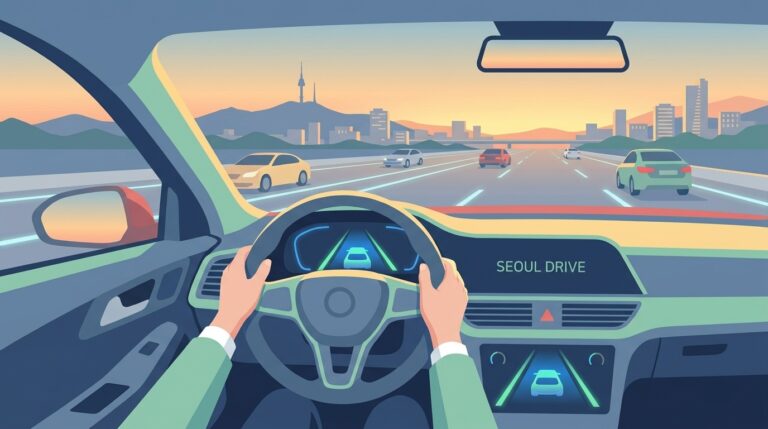
Mastering Korean Driving Nuances: Why Blindly Trusting ADAS (자율 주행 보조) Can Get You in Trouble
Phase 1: Empathy & Storytelling Opening
안녕하세요! 매일한글 (Daily Hangul) editor here!
Picture this: You are cruising along the scenic Olympic Expressway (올림픽대로) at dusk. The sunset paints the Han River in shades of crimson and gold, K-Indie is playing softly through the speakers, and you engage the Smart Cruise Control (스마트 크루즈 컨트롤) and Highway Driving Assist (HDA) on your rental Genesis GV70. The steering wheel practically guides itself, keeping you centered in the lane. You relax, take your hands off the wheel for just a second to open a canned iced coffee, and think, “Wow, Korean automotive tech is incredible!”
Suddenly, the expressway curves near the Seongsu Bridge interchange. An aggressive taxi abruptly executes a kalchigi (칼치기, reckless cut-in), while worn-out lane markers vanish under construction glare. The dashboard frantically beeps with red warning lights: “핸들을 잡으십시오” (Please grip the steering wheel)! Your heart leaps into your throat as the system abruptly hands total control back to you at 80 km/h.
At a C2 proficiency level, mastering Korean isn’t merely about knowing the word for “steering wheel” (핸들) or “lane” (차선). It is about mastering the refined, high-stakes vocabulary of advanced situational awareness, understanding the unwritten communicative etiquette between driver and passenger, and knowing how to assertively warn others when modern automotive technology meets its unpredictable limits on dynamic Korean roads.
Based on real feedback from seasoned expatriates and C2 test candidates, this masterclass equips you with native-level phrasing, deep socio-cultural insights, and high-register idiomatic agility for navigating South Korea’s high-tech highways.
Phase 2: In-Depth Analysis of 3 Key Expressions
1. 주행 보조 기능만 맹신하다간 큰 코 다쳐요 (한글)
- Pronunciation: Juhaeng bojo gineungman maengsinhada-gan keun ko dachyeoyo (Phonetic vibe: “Joo-haeng bo-jo gee-neung-mahn mang-shin-ha-dah-gahn koon koh dah-chyuh-yo”)
- Meaning: Literal: “If you blindly trust driver-assist functions, your big nose will get hurt.” / Nuance: “Relying blindly on ADAS features will lead to severe trouble or disastrous consequences.”
- K-Culture Moment: Frequently heard in modern automotive K-vlogs and automotive review channels like Motorgraph or Autogear, where expert hosts warn viewers that Level 2 autonomous features are merely assistive, not self-driving.
- Editor’s Insight: The idiom 큰 코 다치다 (to suffer a major blow / regret an arrogant miscalculation) paired with 맹신하다 (to trust blindly / hold uncritical faith) elevates your Korean into sophisticated, analytical discourse.
- Situation Spectrum: Casual: ✅ | Semi-formal: ✅ | Formal: ⚠️
- 🤔 Think About It: How does the conceptual metaphor of “hurting one’s nose” reflect Korean perceptions of losing face or suffering humbling consequences through overconfidence?
2. 스티어링 휠을 상시 파지하고 전방 주시를 게을리하지 마세요 (한글)
- Pronunciation: Seutieoring hwireul sangsi pajihago jeonbang jusireul geeullihaji maseyo (Phonetic vibe: “Seu-tee-uh-ring hweel-eul sang-shee pah-jee-hah-go jun-bahng joo-shee-reul geh-ool-lee-hah-jee mah-seh-yo”)
- Meaning: Literal: “Always hold the steering wheel and do not neglect forward attentiveness.” / Nuance: “Keep your hands firmly on the wheel at all times and maintain undivided focus on the road ahead.”
- K-Culture Moment: The standardized voice prompt and legal disclaimer utilized by high-end Hyundai/Kia navigation systems and highway safety broadcasts along the Gyeongbu Expressway.
- Editor’s Insight: Notice the Hanja-derived vocabulary: 파지하다 (把持하다) means to grip/hold firmly with hands, while 전방 주시 (前方注視) means vigilant forward gaze. Using these terms demonstrates native-grade legal and technical precision.
- Situation Spectrum: Casual: 🚫 | Semi-formal: ✅ | Formal: ✅
- 🤔 Think About It: Compare the directness of English “Keep your hands on the wheel” with the Korean formal construction “게을리하지 마세요” (do not be negligent). What does this reveal about institutional accountability in Korean culture?
3. 아무리 스마트 크루즈라도 돌발 상황엔 기계보다 사람이 빨라야죠 (한글)
- Pronunciation: Amuri seumateu keurujurado dolbal sanghwang-en gigyeboda sarami ppallayajyo (Phonetic vibe: “Ah-moo-ree seu-mah-teu koo-roo-joo-rah-doh dol-bahl sang-hwang-en gee-gyeh-boh-dah sah-rahm-ee pahl-lah-yah-jyo”)
- Meaning: Literal: “No matter how smart the cruise control is, in sudden unexpected situations, a human must be faster than a machine.” / Nuance: “Regardless of advanced driver assistance, human instinct must override automation when the unexpected occurs.”
- K-Culture Moment: An experienced driver consoling a younger colleague during a dramatic road trip scene in a modern corporate K-Drama (like Agency or Doctor Cha).
- Editor’s Insight: The connective particle ~라도 combined with 돌발 상황 (unexpected/sudden event) highlights pragmatic human agency over technological complacency.
- Situation Spectrum: Casual: ✅ | Semi-formal: ✅ | Formal: ✅
- 🤔 Think About It: In an ultra-wired society like Korea, why is human intuition (순발력) still venerated over automated safety systems?
Phase 3: Textbook Korean vs. Real Korean
Situation 1: Warning the driver that lane recognition is drifting near highway construction
- 📖 교과서 한국어 (Textbook): “차선 유지 기능이 불안정하므로 직접 운전대를 조작하십시오.” (Chaseon yuji gineung-i buranjeonghameuro jikjeop unjeondaereul jojakhasipsio. / “Because the lane-keep function is unstable, operate the steering wheel directly.”)
- 🗣️ 진짜 한국어 (Real-Life C2 Native): “여기 공사 구간이라 센서 튀니까 얼른 핸들 잡아요!” (Yeogi gongsa gugan-ira senseo twinikka eolleun haendeul jabayo! / “This is a construction zone so the sensors are glitching out; grab the wheel quick!”)
- 💡 왜 다를까? (Why the Difference?): Natives use the vivid colloquial verb 튀다 (literally ‘to bounce/spark’, used here to describe erratic sensor misreading or software drift) instead of stiff formal descriptions like 불안정하다.
Situation 2: Reprimanding a passenger/driver who is daydreaming while HDA is active
- 📖 교과서 한국어 (Textbook): “자율 주행 중에도 운전자는 전방을 계속 주시해야 합니다.” (Jayul juhaeng jung-edo unjeonjaneun jeonbang-eul gyesok jusihayeoya hamnida. / “Even during autonomous driving, the driver must continue to look forward.”)
- 🗣️ 진짜 한국어 (Real-Life C2 Native): “아무리 HDA 켜놨어도 멍때리다간 순식간에 사고 나요.” (Amuri HDA kyeonwasseodo meongttaeridagan sunsikgan-e sago nayo. / “Even if you have HDA on, if you zone out, you’ll crash in the blink of an eye.”)
- 💡 왜 다를까? (Why the Difference?): Natural Korean incorporates expressive slang idioms like 멍때리다 (to zone out/space out) and temporal adverbs like 순식간에 (in an instant) to communicate urgency and authentic concern.
Phase 4: K-Culture Deep Dive & Non-Verbal Etiquette
4-1. 눈치 (Nunchi) & Non-Verbal Driving Etiquette
In Korea, being inside a car is considered an extension of social space. If you are sitting in the front passenger seat (조수석, josuseok), cultural etiquette dictates that you act as an active co-pilot.
* The Co-Pilot Nunchi: Sleeping in the josuseok while the driver navigates heavy traffic or dense fog is considered poor form (매너가 아니다).
* Physical Posture: When the driver activates ADAS, a culturally attuned passenger does not loudly celebrate “Look, no hands!” but rather maintains subtle eye contact on the road.
* Visual Confirmation: If you notice sudden brake lights ahead that the radar might miss, you lightly point with a flat palm (never an abrupt pointing finger, which can startle the driver) and say softly: “앞에 서행하네요” (Ap-e seohaenghaneyo – “Traffic is slowing down ahead”).
4-2. Cultural Code: The Reality of Korean Highway Infrastructure
South Korea boasts one of the most advanced digital highway networks in the world, featuring C-ITS (Cooperative Intelligent Transport Systems) and section speed enforcement cameras (구간 단속). However, topography plays a massive role: over 70% of the Korean peninsula is mountainous.
When driving through the numerous tunnels of Gangwon Province on the Seoul-Yangyang Expressway, GPS and sensor reflection can cause lane-centering systems to suddenly disengage without loud alarms. Furthermore, the notorious Bbali-Bbali (빨리빨리, fast-paced) merging culture in metropolitan hubs like Gangnam or Busan means that adaptive cruise control following distances are often exploited by other vehicles cutting in abruptly. Total reliance on ADAS in Korea is not just a technological risk; it runs counter to the fundamental Korean defensive driving philosophy (방어운전).
Phase 5: Real-Life Roleplay Scenario
Setting: Driving along the winding, rain-slicked Yeongdong Expressway (영동고속도로) in a Genesis GV80 during Friday evening rush hour.
Characters:
* 팀장 민준 (Team Leader Min-jun): Confident senior manager testing out the car’s smart features.
* 지우 (Ji-woo – You): Advanced international colleague acting as the vigilant co-pilot.
- Turn 1: 민준
- Korean: “지우 씨, 이번에 나온 신형 HDA2 기능 진짜 대박인데요? 차선 변경까지 알아서 척척 해주네요.” (한글)
- Romanization: “Ji-woo ssi, ibeon-e naon sinhyeong HDA2 gineung jinjja daebag-indeyo? Chaseon byeongyeong-kkaji araseo cheokcheok haejuneyo.”
- Translation: “Ji-woo, this new HDA2 feature is really something else, isn’t it? It even changes lanes completely on its own without hesitation.”
🎭 Action:Min-jun takes both hands completely off the steering wheel and leans back comfortably.
- Turn 2: 지우 (You)
- Korean: “기술이 정말 좋아지긴 했네요. 그래도 빗길이라 노면이 미끄러운데 핸들은 잡고 계시는 게 좋지 않을까요?” (한글)
- Romanization: “Gisuri jeongmal joajigin haenneyo. Geuraedo bitgirira nomyeon-i mikkeureounde haendeureun japgo gyesineun ge joji aneulkkayo?”
- Translation: “The technology has certainly improved. Still, the road surface is slippery from the rain, so wouldn’t it be better to keep your hands on the wheel?”
🎭 Action:You look attentively at the puddles forming on the highway lane markers.
- Turn 3: 민준
- Korean: “에이, 지우 씨도 참 보수적이시네! 알아서 간격 다 띄우고 브레이크도 칼같이 잡는데 뭘 걱정해요.” (한글)
- Romanization: “Ei, Ji-woo ssido cham bosujeogisine! Araseo gangyeok da ttiugo beureikeudo kalgachi jamneunde mwol geokjeonghaeyo.”
- Translation: “Come on, Ji-woo, you’re quite conservative! It adjusts the following distance automatically and brakes with razor precision, what’s there to worry about?”
🎭 Action:Min-jun waves a dismissive hand with a relaxed grin.
- Turn 4: 지우 (You)
- Korean: “팀장님, 전방에 터널 진입로인데 빗물 때문에 차선 인식이 갑자기 끊길 수도 있어요. 주행 보조 장치만 맹신하다간 돌발 상황에 대처하기 힘들어요.” (한글)
- Romanization: “Timjangnim, jeonbang-e teoneol jinimro-inde binmul ttaemune chaseon insig-i gapjagi kkeunkkil sudo isseoyo. Juhaeng bojo jangchiman maengsinhada-gan dolbal sanghwang-e daecheohagi himdeureoyo.”
- Translation: “Team Leader, there’s a tunnel entry ahead and the lane recognition might cut out abruptly due to rainwater glare. If we blindly trust driver assistance, it will be difficult to react to sudden variables.”
🎭 Action:You point calmly toward the flickering digital overhead traffic sign indicating tunnel maintenance.
- Turn 5: 민준
- Korean: “설마 대기업 최신 플래그십 차량인데 그런 기초적인 오류가 나겠… 엇! 삐- 소리 뭐지?” (한글)
- Romanization: “Seolma daegieop choesin peullaegeusip charyang-inde geureon gichojeog-in oryoga naget… Eot! Ppi- sori mweoji?”
- Translation: “No way, this is a conglomerate’s latest flagship vehicle, would such a basic glitch really occur… Whoa! What’s that beeping sound?”
🎭 Action:The dashboard flashes an amber alert icon and the vehicle begins drifting slightly toward the right barrier.
- Turn 6: 지우 (You)
- Korean: “스티어링 휠 바로 파지하세요! 차선 이탈 경고 떴어요!” (한글)
- Romanization: “Seutieoring hwil baro pajihaseyo! Chaseon ital gyeonggo tteosseoyo!”
- Translation: “Grip the steering wheel immediately! The lane departure warning just triggered!”
🎭 Action:You keep your voice composed yet firm, anchoring the atmosphere without screaming.
- Turn 7: 민준
- Korean: “휴… 깜짝이야! 물웅덩이 지나면서 센서가 순간적으로 차선을 놓쳤나 봐요. 지우 씨 말 들을 걸 그랬네요.” (한글)
- Romanization: “Hyu… kkamjjag-iya! Murungdeong-i jinamyeonseo senseoga sunganjeog-euro chaseon-eul nochyeonna bwayo. Ji-woo ssi mal deureul geol geuraenneyo.”
- Translation: “Phew… that gave me a fright! The sensor must have momentarily lost the lane while hitting that puddle. I really should have listened to you.”
🎭 Action:Min-jun grabs the steering wheel firmly with both hands, his expression turning serious.
- Turn 8: 지우 (You)
- Korean: “사고 안 나서 다행이에요. 아무리 시스템이 똑똑해도 안전 운전 책임은 결국 사람 몫이니까요.” (한글)
- Romanization: “Sago an naseo dahaeng-ieyo. Amuri siseutem-i ttokttokhaedo anjeon unjeon chaegim-eun gyeolguk saram mogs-inikkayo.”
- Translation: “I’m so relieved we avoided an accident. No matter how smart the system is, the ultimate responsibility for safe driving belongs to the human.”
🎭 Action:You hand Min-jun a bottle of water with a warm, reassuring smile.
🔀 Interactive Decision Point
Suppose Min-jun reaches for his smartphone to check an urgent work email while HDA is engaged on the straight expressway stretch. How do you intervene?
- Option A: “팀장님, HDA 켜두셨어도 스마트폰 조작은 도로교통법 위반일 뿐더러 시야 분산돼서 정말 위험해요. 제가 대신 확인해 드릴게요.”
- Option B: “핸들도 안 잡고 폰까지 보시면 진짜 죽어요! 당장 폰 내려놓으세요!”
- Option C: “팀장님 바쁘시니까 그냥 폰 보세요. 차가 알아서 잘 가겠죠.”
Detailed Outcome Analysis:
- Option A (Best Choice): ⭐⭐⭐⭐⭐
- Feedback: Exemplary C2 communicative mastery! It combines formal legal awareness (도로교통법 위반), logical risk mitigation (시야 분산), and polite hierarchical deference by offering to check the phone on his behalf.
- Option B (Bad Choice): ⭐⭐
- Feedback: While safety-focused, the emotional intensity (진짜 죽어요) and direct imperative (내려놓으세요) breach traditional organizational politeness norms toward a senior supervisor (팀장님), potentially causing loss of face.
- Option C (Risk Choice): ❌
- Feedback: Dangerous passivity! It reinforces complacency in automated systems, endangering everyone in the vehicle.
Phase 6: 10-Second Emotional Shadowing Drill
Practice reading these sentences aloud, matching the authentic Korean pitch contours and emotional intentions marked by the slash (/) pause indicators.
[🧐 단호하고 침착하게 / Firm & Composed]- “주행 보조 기능은 / 어디까지나 보조일 뿐이니까, / 항상 스티어링 휠을 / 직접 파지하셔야 합니다.” (한글)
- (Juhaeng bojo gineung-eun / eodikkajina bojo-il ppuninikka, / hangsang seutieoring hwireul / jikjeop pajihasyeoya hamnida.)
[😰 진땀 빼며 다급하게 / Urgent with a quick adrenaline rush]- “조심하세요! / 앞차 급정거하는데 / 센서 반응 늦어요, / 직접 브레이크 밟으세요!” (한글)
- (Josimhaseyo! / Apcha geupjeonggeohaneunde / senseo baneung neojeoyo, / jikjeop beureikeu balbeuseyo!)
[😌 안도하며 부드럽게 / Relieved & Cordial]- “휴, / 다행히 센서가 다시 잡혔네요. / 그래도 목적지 도착할 때까지 / 전방 주시 계속해요.” (한글)
- (Hyu, / dahaenghi senseoga dasi japhyeonneyo. / Geuraedo mokjeokji dochakhal ttaekkaji / jeonbang jusi gyesokhaeyo.)
Phase 7: K-Culture Mini-Dictionary
| # | Term (한글 / Romanization) | Precise Translation | In-Depth Sociolinguistic Usage |
|---|---|---|---|
| 1 | 맹신 (盲信) (Maengsin) |
Blind faith / Uncritical reliance | Used in analytical and business discussions when someone places total, unexamined trust in technology, data, or rumors (e.g., AI 번역 맹신, 자율 주행 맹신). |
| 2 | 전방 주시 (前方注視) (Jeonbang Jusi) |
Forward road vigilance / Eye-on-the-road | A core legal and civic term appearing in Korean traffic law, insurance dispute evaluations, and safe driving campaigns. |
| 3 | 조수석 매너 (助手席 매너) (Josuseok Maeneo) |
Co-pilot passenger etiquette | The unspoken cultural code governing the front-seat passenger, including staying awake, managing navigation, handling toll cards, and assisting the driver. |
| 4 | 칼치기 (Kalchigi) |
Reckless lane-weaving / Aggressive cut-in | Derived from the slicing motion of a knife (칼); describes vehicles darting rapidly between tightly packed cars on Korean expressways. |
Phase 8: Traveler’s Survival Driving Kit
Top 3 Survival Phrases for Drivers in Korea
- “내비게이션 안내 음성 다시 켜주세요.” (한글)
- Naebigeisyeon annae eumseong dasi kyeojuseyo. (Romanization)
- Pro Tip: If the GPS audio is muted, ADAS speed-trap alerts won’t chime. Use this when renting a car.
- “구간 단속 시작 지점이니까 크루즈 속도 100에 맞출게요.” (한글)
- Gugan dansok sijak jijeom-inikka keuruju sokdo baek-e matchulgeyo. (Romanization)
- Pro Tip: Section speed cameras calculate average speed over several kilometers. Setting Smart Cruise Control exactly to the speed limit is standard practice.
- “하이패스 차로로 진입하니까 차선 변경하지 마세요.” (한글)
- Haipaeseu charoro jiniphanikkan chaseon byeongyeonghaji maseyo. (Romanization)
- Pro Tip: Blue road lines indicate Hi-Pass electronic toll collection. Automated lane-keep systems can get confused near toll plazas.
Editor’s Travel & Tech Note
When driving in South Korea, foreign Google Maps functionality is severely restricted due to national security data regulations. You should download and rely on Tmap Navigation App Download or KakaoNavi Installation Guide. Both apps integrate real-time lane-by-lane guidance, sudden obstacle warnings, and specialized alerts for automated driving systems.
Phase 9: “한 발 더 깊이” (One Step Deeper)
South Korea’s rapid transformation into a global powerhouse of electric vehicles and autonomous mobility has created a fascinating cultural paradox. While society ardently embraces bleeding-edge convenience—from automated valet parking to Highway Driving Assist—the collective moral consciousness regarding public safety remains deeply grounded in communal responsibility (공동체적 책임의식).
In Korean jurisprudence and social consensus, an accident caused during semi-autonomous driving is never blamed on the machine; it is viewed as a lapse in the driver’s duty of care (주의의무 태만). To drive in Korea is to participate in a dynamic, shared social contract where attentiveness is not merely self-preservation, but an act of mutual respect for fellow road users.
💬 Your Turn: Have you ever experienced a sudden ADAS disengagement while driving in your home country or in Korea? How would you describe that split-second feeling in Korean? Share your story in the comments below!
Phase 10: FAQ & Common Mistakes (FAQ Schema)
Q: What is the official Korean legal stance on taking both hands off the wheel while using Level 2 ADAS (HDA)?
A: Under Article 48 of the Korean Road Traffic Act (도로교통법 제48조 – 안전운전 의무), drivers are legally required to maintain proper control of the vehicle’s steering and braking mechanisms at all times. Taking both hands off the steering wheel can result in fines and liability in the event of a traffic collision, as Level 2 systems are legally classified strictly as driver assistance, not full autonomous driving.
Q: How do I politely warn a Korean colleague or elder who is driving too recklessly with autonomous features active?
A: Use honorific softening markers (-시겠어요, -는 편이 좋을 것 같습니다). For example: “팀장님, 이 구간이 도로 굴곡이 심해서 센서 오작동 위험이 높다고 들었습니다. 안전을 위해 수동 조작해 주시는 편이 좋을 것 같습니다.” This frames the intervention as a critique of the road/sensor conditions rather than their personal driving ability.
Q: What does the slang term “자율 주행 놀이” (playing autonomous driving) mean?
A: It is a critical internet term used to describe reckless drivers who film social media videos sitting in the backseat or eating ramen while letting ADAS steer the vehicle. It carries heavy social stigma and public condemnation across Korean online communities.
🚨 흔한 실수 (Common Mistakes) Warning Board
| Mistake | Incorrect Korean Usage | Correct Native Action & Phrasing |
|---|---|---|
| 1. Confusing ADAS with 100% Autonomy | “이 차 이제 100% 완전 자율 주행이에요!” | Say: “이 차는 레벨 2 주행 보조 시스템이 탑재되어 있어요.” (Differentiate 주행 보조 from 완전 자율 주행). |
| 2. Misusing ‘핸들을 놓다’ | “운전할 때 핸들을 놓으세요.” (Sounds like giving up or throwing away the wheel). | Say: “핸들에서 손을 떼다” (To take hands off the wheel) or “핸들을 파지하다” (To hold the wheel). |
| 3. Ignoring the Nuance of ‘경보’ vs ‘알림’ | Calling an emergency collision buzzer a simple 알림 (notification). | Use “충돌 경보 (Collision Alarm)” or “이탈 경고 (Departure Warning)” to convey correct urgency. |
Phase 11: Action Missions & Engagement
- 🥉 Bronze Mission (Solo Practice): Record yourself reciting the 3 shadowing sentences from Phase 6 with accurate pitch pauses and emotional urgency.
- 🥈 Silver Mission (Social Engagement): Leave a comment below explaining the difference between 자율 주행 (Autonomous Driving) and 주행 보조 (Driving Assistance) using the connective particle ~에 불과하다 (is nothing more than).
- 🥇 Gold Mission (Real-World Application): Next time you ride in a car or taxi in Korea (or watch a driving scene in a modern K-Drama), identify whether the driver keeps both hands on the wheel and mentally formulate a C2-level safety reminder in Korean.
🎮 K-Culture Mission: Watch an episode of a Korean car review show (such as 오토기어 or 모터그래프) on YouTube. Spot how many times the host mentions “전방 주시 태만” (negligence of forward attentiveness) during their ADAS road tests!
Phase 12: Interactive Quiz Challenge
1. Situational Judgment Quiz
You are riding in the passenger seat with your Korean business partner who says: “고속도로에서는 차가 다 알아서 가니까 태블릿으로 결재 서류 좀 볼게요.” What is the most sophisticated and culturally tactful response?
* A) “네, 기술이 좋으니 편하게 서류 보세요.”
* B) “대표님, 고속도로 주행 보조 장치도 돌발 상황까지는 완벽히 대처하지 못하니까 서류는 제가 들고 있을 테니 전방 주시 부탁드립니다.”
* C) “운전 중에 딴짓하시면 감옥 갑니다.”
2. Fill-in-the-Blank (C2 Advanced Grammar)
주행 보조 시스템을 지나치게 _______________ 예기치 못한 센서 오류 발생 시 대형 사고로 이어질 수 있습니다.
* (A) 맹신하다가는
* (B) 맹신하더라도
* (C) 맹신할지언정
3. Cultural True / False
In Korean traffic culture and insurance law, if an accident occurs while Highway Driving Assist (HDA) is turned on, the automobile manufacturer automatically absorbs 100% of the legal liability. (True / False)
👉 Click here to reveal answers & in-depth explanations!
- Situational Judgment Answer: B
Explanation: Option B exhibits flawless C2 executive etiquette. It acknowledges the technological benefit while clearly warning against systemic limits (돌발 상황 대처), offering practical assistance (서류는 제가 들고 있을 테니) while urging road vigilance (전방 주시). -
Fill-in-the-Blank Answer: (A) 맹신하다가는
Explanation: The grammatical pattern -다가는 is used to warn that if a certain negative action or state continues (in this case, blindly trusting the system), a disastrous or undesirable outcome will inevitably follow. -
Cultural True / False Answer: False
Explanation: Under current Level 2 automation legislation in South Korea, the driver maintains full legal responsibility (운전자 과실 책임) for vehicle operation. The manufacturer is not liable for accidents caused by driver inattention during ADAS operation.







