

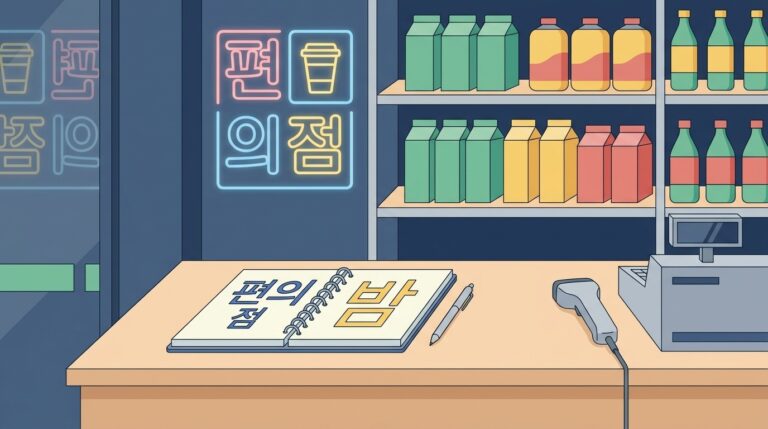
Phase 1: 공감 (Story-Immersive Opening)
안녕하세요! 매일한글 에디터입니다.
Picture this: It is 11:30 PM in Seoul. After a long walk through the neon-lit alleys of Hongdae, you step into a brightly lit CU or GS25. You grab a bottle of iced milk tea, noticing the bright red 1+1 (One-Plus-One) promotional tag on the shelf. You feel triumphant! You walk up to the counter, place the single bottle on the counter, and tap your card.
Suddenly, the cashier halts mid-scan, looks at you intently, and says at lightning speed: “Sonim, igeo won-plus-won-inde hana deo gajyeo-osigess-eoyo?” (손님, 이거 1+1인데 하나 더 가져오시겠어요? / Customer, this is 1+1, do you want to bring one more?). Before you can process whether you can swap it for the chocolate flavor next to it, they follow up with: “Tongshinsa halin-ina jeok-lip kadeu isseuseyo?” (통신사 할인이나 적립 카드 있으세요? / Do you have telecom discount or membership points?).
You freeze, offer an awkward smile, wave your hand dismissively, and end up paying full price for just one item—missing out on the free drink and the 10% telecom discount you were actually eligible for!
Sound familiar? You are not alone. Navigating the modern Korean pyeon-ui-jeom (편의점) requires far more than basic survival vocabulary; it requires cultural literacy, situational speed, and advanced conversational nuance. In this guide, tailored specifically for high-intermediate to advanced (C1) learners, we will unpack the exact vocabulary, subtext, and unspoken social etiquette needed to master Korean convenience store promotions and carrier discounts like an authentic local.
Phase 2: Core Expressions Deep Dive (C1 Level Nuance)
1. 이거 교차 증정 돼요? (Igeo gyocha jeungjeong dwaeyo?)
- Pronunciation: [I-geo gyo-cha jeung-jeong dwae-yo?] (Sound analogy: ‘Gyo-cha’ sounds like ‘Go-Chai’ spoken swiftly; ‘Jeung-jeong’ sounds like ‘Jung-Jung’ with deep nasal vowels)
- Meaning: Literal: “Is cross-gifting possible for this?” | Nuanced Meaning: “Can I mix and match different flavors or variants within this 1+1/2+1 promotion?”
- K-Culture Moment: Seen frequently in slice-of-life K-Dramas when college students debate whether they can pair a spicy Samgak-gimbap with a tuna-mayo one under the same multi-buy promotion tag.
- Editor’s Insight: The Sino-Korean word 교차 (交叉 – Gyocha) means ‘intersection’ or ‘alternation’, while 증정 (贈呈 – Jeungjeong) refers to giving a complimentary gift. Combining them into 교차 증정 is the ultimate industry insider phrase that immediately signals you understand Korean retail mechanisms.
- Situation Spectrum: Casual: ✅ | Semi-formal: ✅ | Formal: ⚠️
- 🤔 Think About It: In many Western stores, promotional items must strictly be identical barcodes unless marked as “mix & match.” Why does Korean retail culture make flavor cross-matching a standard consumer expectation?
2. 통신사 멤버십 할인 적용해 주세요. (Tongshinsa membeoship halin jeok-yonghae juseyo.)
- Pronunciation: [Tong-shin-sa mem-beo-ship ha-lin jeok-yong-hae ju-se-yo.] (Sound analogy: ‘Tong-shin-sa’ rhymes with ‘Song-in-sight’ minus the g)
- Meaning: Literal: “Please apply telecom membership discount.” | Nuanced Meaning: “I have a barcode for SKT/KT/LG U+; please scan it before I pay to deduct the partnership discount.”
- K-Culture Moment: A quintessential scene in YouTube vlogs showing young Seoulites flashing their smartphone lock screens to shave 100~200 KRW off midnight ramyun runs.
- Editor’s Insight: Note the verb 적용하다 (Jeok-yong-hada – to apply/implement). At a C1 level, instead of simply asking “Halin dwaeyo?” (Is there a discount?), using “Hal-in jeok-yong-hae juseyo” demonstrates sophisticated, direct transactional agency.
- Situation Spectrum: Casual: ⚠️ | Semi-formal: ✅ | Formal: ✅
- 🤔 Think About It: How does the deep integration between telecom conglomerates (SK, KT, LG) and retail chains reflect the chaebol-centered ecosystem of South Korean daily life?
3. 남은 하나는 어플에 ‘킵’해 둘 수 있나요? (Nameun hananeun eopeul-e kip-hae dul su innayo?)
- Pronunciation: [Na-meun ha-na-neun eop-peul-e kip-hae dul su in-na-yo?] (Sound analogy: ‘Kip’ is adopted directly from English ‘Keep’ with a sharp Korean final bilabial stop [ㅂ])
- Meaning: Literal: “Can I ‘keep’ the remaining one stored in the mobile application?”
- Nuanced Meaning: “I want to buy this 1+1 deal right now, but take only one item physically and store the voucher for the second item in my GS25/CU mobile app wallet for later.”
- K-Culture Moment: Trending across Korean social media lifestyle reels where solo dwellers optimize small studio apartments by “digital stocking” convenience store drinks in their apps instead of cramming their tiny fridges.
- Editor’s Insight: Korea’s convenience store technology allows customers to leave promotional +1 items in digital inventory (e.g., GS25’s Na-man-ui Naengjanggo / My Own Refrigerator). Using the Konglish loan verb 킵하다 (Kip-hada) shows peak urban cultural fluency.
- Situation Spectrum: Casual: ✅ | Semi-formal: ✅ | Formal: 🚫
- 🤔 Think About It: What does the emergence of ‘digital fridge storage’ say about South Korea’s hyper-dense single-person household (일인 가구) demographic?
Phase 3: Textbook Korean vs. Real Native Korean
Situation 1: Inquiring about a promotion rule
- 📖 Textbook Korean: 이 음료수를 하나 더 무료로 받을 수 있습니까? (I eumryosureul hana deo muryoro badeul su isseumnikka? / May I receive one more of this beverage for free?)
- 🗣️ Real Native Korean: 이거 1+1(원플원) 행사 교차 적용 돼요? (Igeo won-peul-won haengsa gyocha jeok-yong dwaeyo? / Does this 1+1 deal allow cross-flavor selection?)
- 💡 Why the difference? Textbook phrasing relies heavily on grammatical passives and overly stiff vocabulary (무료로 받다). Native speakers rely on the standard industry jargon (1+1 행사, 교차 적용) for crisp, fast communication at busy checkout lines.
Situation 2: Presenting your telecom discount
- 📖 Textbook Korean: 저는 통신사 카드가 있습니다. 깎아 주십시오. (Jeoneun tongshinsa kadeuga isseumnida. Kkakka jusipshio. / I have a telecommunications card. Please reduce the price.)
- 🗣️ Real Native Korean: KT(케이티) 바코드 찍고 결제할게요. (Kei-ti bakodeu jjikgo gyeoljehalgeyo. / I will scan my KT barcode first, then pay.)
- 💡 Why the difference? The verb 깎다 (to haggle/cut price) is unnatural in modern retail. Seoul checkout counters run on ultra-fast Palli-palli sequencing: stating the specific carrier brand and the physical action (바코드 찍다) keeps the line moving seamlessly.
Phase 4: K-Culture Deep Dive & Non-Verbal Manners
4-1. 눈치 (Nunchi) & Checkout Etiquette
Korean convenience store counters are ultra-compact zones where efficiency is king. When applying promotions:
1. Pre-loading Barcodes: Do not wait until the cashier announces the total amount to unlock your phone, search for your carrier app, and fumble through biometric login. Have the barcode on screen while approaching the counter.
2. The 2-Hand Scan Presentation: Extend your phone screen face-up toward the scanner with both hands (or your right hand supported by your left wrist), maintaining polite eye contact.
3. The Quick Step-Aside: If you ask for 교차 증정 and need to fetch another flavor, immediately say “잠시만요, 얼른 가져올게요!” (Just a second, I will grab it right away!) and move briskly to avoid stalling the queue.
4-2. Cultural Code Analysis: The 24-Hour Micro-Economy
In Korean society, the convenience store is far more than a shop; it is a collaborative sanctuary for late-night study sessions, post-drinking hangouts, and budget-conscious dining. Innovations like 1+1 / 2+1 promotions are competitive retention strategies between giants GS25, CU, and 7-Eleven. Understanding their promotional calendar (which resets on the 1st day of each month) and partnering apps is considered an essential adult financial life hack (짠테크 – frugal tech) among millennials and Gen Z.
Phase 5: Real-World Roleplay Scenario
- Setting: 10:45 PM. A bustling GS25 branch near Sinchon Station.
- Characters:
- You (C1 Korean Speaker): Buying energy drinks and snacks for an overnight project.
- Minho (Veteran Part-timer): Swift, professional, scanner in hand.
[Dialogue]
- You: 안녕하세요! 이거 핫식스 2+1 행사 맞죠? 다른 맛으로 교차 증정 되나요?
(Annyeonghaseyo! Igeo Hatsikseu tu-plus-won haengsa matjyo? Dareun maseuro gyocha jeungjeong doenayo?)
“Hello! This Hot6 is on a 2+1 promo, right? Can I cross-match with a different flavor?”
🎭 [Smiling politely while setting down two blue cans and one green can] -
Minho: 네, 같은 가격대 교차 가능하세요. 포스기에 찍어드릴게요.
(Ne, gateun gagyeokdae gyocha ganeunghaseyho. Poseugie jjikeodeurilgeyo.)
“Yes, cross-matching is possible for the same price tier. Let me scan them on the POS machine for you.”
🎭 [Beeping the items rapidly with the laser barcode scanner] -
You: 아, 그런데 제가 지금 두 캔만 마실 거라서요. 한 캔은 어플에 킵 가능한가요?
(A, geureonde jega jigeum du kaenman masil georaseoyo. Han kaeneun eopeure kip ganeunghangayo?)
“Ah, but I’m only drinking two cans tonight. Can I keep one stored in the mobile app?”
🎭 [Showing the 'My Own Refrigerator' member QR code on smartphone] -
Minho: 네, 어플 보관 바코드 먼저 찍어주시면 한 개는 전자 보관함으로 들어갑니다.
(Ne, eopeul bogwan bakodeu meonje jjikeojushimyeon han gaeneun jeonja bogwanhameuro deureogamnida.)
“Sure, scan your app storage barcode first, and one item will go into your digital locker.”
🎭 [Pointing the scanner toward your screen] -
You: 찍었습니다! 그리고 통신사 제휴 할인도 같이 적용되나요?
(Jjigeosseumnida! Geurigo tongshinsa jehyu halindo gachi jeok-yongdoenayo?)
“Scanned! And can telecom partnership discount be applied alongside this?”
🎭 [Switching tabs on screen to display telecom membership] -
Minho: 행사 상품은 통신사 할인은 중복 적용 안 되시고요, 멤버십 포인트 적립만 가능하세요.
(Haengsa sangpumeun tongshinsa halineun jungbok jeok-yong an doeshigoyo, membeoship pointeu jeongnimman ganeunghaseyho.)
“For promotional bundle items, carrier discounts cannot be double-applied, but membership points can still be accumulated.”
🎭 [Explaining calmly while checking the POS screen prompt] -
You: 아, 그렇군요! 그럼 포인트 적립만 해주시고, 카카오페이로 결제할게요.
(A, geureokgunyo! Geureom pointeu jeongnimman haejushigo, Kakaopeiro gyeoljehalgeyo.)
“Ah, I see! Then just accumulate points, please, and I will pay via Kakao Pay.”
🎭 [Tapping the dynamic QR payment screen] -
Minho: 네, 결제 완료되셨습니다. 보관하신 음료는 유효기간 30일 이내에 전국 매장에서 찾아가시면 됩니다!
(Ne, gyeolje wanryodoesyeosseumnida. Bogwanhashin eumryoneun yuhyogigan samsibil inaee jeonguk maejang-eseo chajagasimyeon doemnida!)
“Payment completed. You can redeem your stored drink at any branch nationwide within the 30-day expiration window!”
🎭 [Handing over receipt with two hands]
🔀 Interactive Choice Point
The cashier informs you: “이거 행사 상품이라 통신사 할인은 중복 안 돼요.” (This is an event item, so telecom discount cannot be combined.) How do you respond?
- Option A: “왜 안 돼요? 법적으로 할인해 줘야 하는 거 아닌가요?” (Wae an dwaeyo? Beopjeogeuro halinhae jwoya haneun geo aningayo? / Why not? Aren’t you legally obligated to discount it?)
- ❌ Bad: Creates immediate awkward friction. Promotional items are universally excluded from double-discounts across Korean retailers.
- Option B: “아, 몰랐어요. 그럼 그냥 다 취소하고 안 살게요.” (A, mollasseoyo. Geureom geunyang da chwisohago an salgeyo. / Ah, I didn’t know. Then cancel everything, I won’t buy it.)
- ⚠️ Risk: Overly dramatic for a minor standard rule, holding up the queue unnecessarily.
- Option C: “아, 중복은 안 되는군요! 그럼 적립만 부탁드릴게요.” (A, jungbogeun an doeneungunyo! Geureom jeongnimman butakdeurilgeyo. / Ah, double perks don’t apply! Then please just accrue points.)
- ✅ Best: Culturally polished, demonstrates high social intelligence (Nunchi), and completes checkout smoothly.
Phase 6: 10-Second Emotion Shadowing Drill
Master the intonation, cadence, and emotional delivery of real-world convenience store interactions. Pay attention to pauses (/) and rhythmic shifts.
[😊 Polished & Inquiring]
저기요, / 이거 원플원 행사 / 교차 증정 가능한가요?
(Jeogiyo, / igeo won-peul-won haengsa / gyocha jeungjeong ganeunghangayo?)-
[💡 Quick Realization & Natural Transition]
아, 중복 할인은 안 되죠? / 그럼 포인트 적립으로 진행해 주세요.
(A, jungbok halineun an doejo? / Geureom pointeu jeongnip-euro jinhaenghae juseyo.) -
[📱 Tech-Savvy & Confident]
남은 증정품 한 개는 / 어플로 킵해 둘게요!
(Nameun jeungjeongpum han gaeneun / eopeul-lo kip-hae dulgeyo!)
Phase 7: K-Culture Mini Dictionary
- 교차 증정 (Gyocha Jeungjeong) | Cross-promotion / Multi-flavor redemption
Usage: Refers to picking different flavors or variants within the same promotional price category during 1+1 or 2+1 sales. - 나만의 냉장고 / 킵 (Na-man-ui Naengjanggo / Kip) | Digital App Storage Feature
Usage: Storing physical complimentary promotional items as digital coupons in brand apps (e.g., GS25, Pocket CU) for later redemption. - 통신사 제휴 (Tongshinsa Jehyu) | Telecom Carrier Partnership
Usage: The strategic discount alliance between major telecom networks (SK Telecom, KT, LG U+) and convenience store franchises. - 중복 적용 (Jungbok Jeok-yong) | Overlapping / Double Application of Benefits
Usage: Applying two discounts simultaneously (e.g., promotional price drop + telecom membership discount). Usually restricted (중복 불가).
Phase 8: Traveler’s Survival Kit
TOP 3 Survival Expressions
- 1. 영수증은 버려주세요. (Yeongsujeungeun beoryeojuseyo.)
Pro Tip: Use this standard phrase if you don’t need a paper receipt; the cashier will instantly recycle it for you. - 2. 봉투 필요하세요? -> 봉투 한 장만 주세요. (Bongtu piryohaseyo? -> Bongtu han jangman juseyo.)
Pro Tip: Disposable plastic/paper bags incur a mandatory 100~200 KRW charge in Korea. Always specify “Juseyo” (give me one) or “Gwaenchanayo” (I’m fine). - 3. 2+1이라 세 개 채워 오셔야 해요. (Tu-plus-won-ira se gae chaewo osyeoya haeyo.)
Pro Tip: If a cashier says this, you only brought two items; go quickly grab the third free item before payment concludes.
Editor’s Travel Note: Essential Apps & Digital Payments
- Download Convenience Apps: Before your trip, download 우리동네GS (My Neighborhood GS) and 포켓CU (Pocket CU) to browse monthly 1+1 listings and check real-time stock for viral items (like Dubai chocolate or limited-edition desserts).
- Payment Methods: T-Money transit cards, Apple Pay (Hyundai Card linked), Kakao Pay, and Naver Pay are universally accepted at all franchised convenience store POS terminals across Korea.
Phase 9: 한 발 더 깊이 (One Step Deeper: Reflective Essay)
In South Korea, the convenience store is a mirror reflecting the hyper-digitized, hyper-efficient modern collective consciousness. Unlike traditional markets where prices were negotiated through interpersonal rapport (Jeong / 정), the modern pyeon-ui-jeom transforms everyday purchasing into an algorithmic micro-optimization game. Korean consumers take pride in mastering complex combinations of carrier discounts, multi-buy cross promotions, and app inventory storage. This intersection of tech-savvy convenience and respect for communal speed demonstrates how contemporary Korean culture balances rapid urban individualism with seamless social synchrony.
💬 Your Turn: What is the promotion system like at convenience stores in your home country? Have you ever experienced a system where you can digitally ‘store’ physical items in an app? Share your thoughts below!
Phase 10: FAQ & Common Mistakes
Q: Can foreign tourists use telecom discounts at Korean convenience stores?
A: Telecom discounts (SKT, KT, LG U+) are reserved for domestic monthly mobile subscribers. If you are using a temporary tourist eSIM or pre-paid SIM card, you cannot claim telecom barcode discounts. However, promotional in-store deals (1+1, 2+1) apply automatically to everyone regardless of nationality!
Q: What happens if I forget to pick up the ‘+1’ item before paying?
A: Once the transaction is finalized on the POS machine, cashiers cannot easily retroactively add the complimentary item without voiding and re-billing the whole transaction. Always ensure all promotional items are placed on the counter before tapping your card.
Q: Can I mix brands in a 1+1 promotion?
A: No. 교차 증정 is strictly restricted to products under the same manufacturer, brand line, and identical retail price point (e.g., swapping Almond Pepero for Choco Pepero during a Pepero promo).
🚨 Common Mistakes Alert Board
- Mistake: Handing over a single item during a 1+1 sale expecting the cashier to halve the price.
Correct Action: Bring both items to the counter, or explicitly request app storage (킵). - Mistake: Demanding carrier discount after card approval.
Correct Action: Present your membership barcode before inserting your credit card. - Mistake: Confusing 1+1 (Buy 1 Get 1 Free) with 2+1 (Buy 2 Get 1 Free).
Correct Action: Check the physical shelf tag carefully; for 2+1 you must bring a total of 3 items to the register.
Phase 11: Action Missions & Engagement
- 🥉 Bronze Mission (Solo Mastery): Practice saying “이거 교차 증정 돼요?” 5 times in front of the mirror with crisp, natural rhythm under 2 seconds.
- 🥈 Silver Mission (Social Sharing): Screenshot a Korean convenience store promotional flyer online, circle two flavors, and caption it on Instagram/Threads using the sentence “이거 교차 증정 되나요?”
- 🥇 Gold Mission (Real-World Execution): Walk into a Korean convenience store, locate a 1+1 or 2+1 beverage deal, pick different flavors, and successfully complete checkout using our Phase 5 dialogue!
- 🎮 K-Culture Media Mission: Watch an episode of a Korean reality show (like Omniscient Interfering View or I Live Alone) and spot how celebrities use convenience store mobile apps to redeem stored vouchers!
Phase 12: Interactive Quiz Challenge
Q1. Situational Judgment:
You pick up two bottles of green tea marked with a “2+1” yellow tag. What is the correct next step before going to the counter?
(A) Head straight to the checkout; the cashier will give you a 33% cash refund.
(B) Grab one more qualifying bottle from the shelf so that you have three bottles total.
(C) Ask the cashier to exchange the two bottles for a completely different product category.
Q2. Fill-in-the-blank:
가: 이 음료수 다른 맛으로 가져와도 되나요?
나: 네, 같은 가격대 제품이면 ______ 증정 가능하세요.
(A) 직접 (B) 교차 (C) 왕복
Q3. True or False:
In Korean convenience stores, promotional discounts (like 1+1) and telecom carrier partnership discounts can always be stacked together on the exact same item. (True / False)
👉 Click here to reveal Answers & Explanations!
- Q1 Answer: (B)
Explanation: In a 2+1 promotion, you must present a total of 3 items at the register to receive the third one complimentary. - Q2 Answer: (B) 교차
Explanation: 교차 증정 (Gyocha Jeungjeong) means cross-matching qualifying flavors/items within a bundle sale. - Q3 Answer: False
Explanation: Most Korean convenience stores prohibit double discounting (중복 할인 불가) on items that are already under 1+1 or 2+1 promotions; you may usually only accrue basic membership points.







