

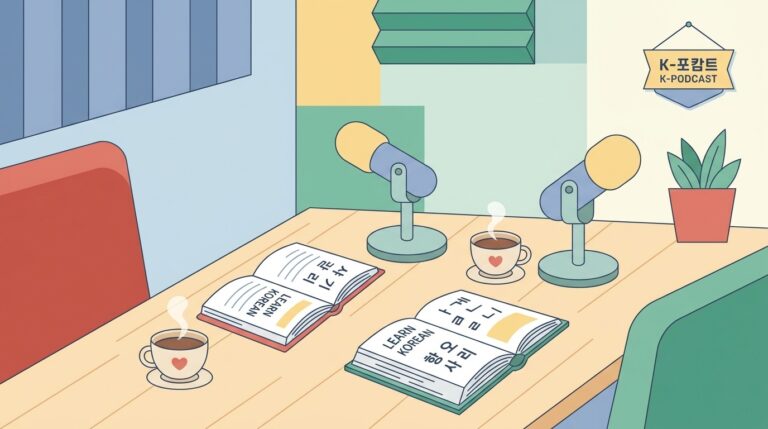
Phase 1: 공감 (Story Immersion Opening)
안녕하세요! 매일한글 에디터입니다.
Imagine this: You are sitting in a sunlit indie cafe in Yeonnam-dong with your headphones on, tuning into a top-ranking Korean literature podcast like Bookjeok Bookjeok (북적북적) or Kim Young-ha’s Reading Club. You have already conquered standard grammar, passed advanced TOPIK exams, and can comfortably order food or argue about K-drama plot twists. But as the hosts begin dissecting a bestselling novel, you suddenly hit an invisible linguistic wall. They are not merely summarizing plot points; they are talking about how a narrative “결이 맞다” (resonates with an aesthetic grain), analyzing the “행간” (subtext) of an author’s prose, and debating whether a character’s emotional trajectory possesses “핍진성” (verisimilitude).
Many of our advanced C2 learners come to us with this exact frustration: “I understand every isolated vocabulary word in the dictionary, but I feel completely lost when Korean intellectuals exchange critique effortlessly on podcasts!” In modern Korea, literary criticism has escaped the ivory tower of academia and blossomed into a dynamic, accessible podcast culture. Mastering this high-register, nuanced discourse is the ultimate gateway to becoming a true cultural insider. Drawing directly from our 10-year coaching archive and real feedback from bilingual translators, this guide will empower you to articulate abstract commentary with authentic native flair.
Phase 2: 핵심 표현 3선 심층 분석 (Top 3 Core Expressions)
1. 행간을 읽다 (Haenggan-eul ikda)
- Pronunciation: [Haeng-ga-neul ik-dda] (Think of ‘haeng’ like ‘hang’ in English, and ‘gan’ like the ‘gun’ in ‘bargain’ followed by crisp ‘ik-da’)
- Meaning: Literal: “To read between the printed lines” | Real Nuance: To perceive unspoken literary intentions, implicit social critique, or psychological undercurrents that aren’t overtly stated.
- K-Culture Moment: Frequently heard when podcast panelists debate poetic ambiguities or understated prose in modern Korean feminist literature: “이 소설은 행간을 읽어야 작가의 진짜 메시지가 보여요.” (I soseor-eun haenggan-eul ilgeoya jakga-ui jinjja mesijiga boyeoyo. / “You have to read between the lines of this novel to see the author’s true message.”)
- Editor’s Insight: Unlike the basic English phrase “read between the lines” which can sound cautionary, the Korean 행간을 읽다 is an artistic compliment denoting deep textual comprehension.
- Situation Spectrum: Casual ⚠️ | Semi-formal ✅ | Formal ✅
- 🤔 Think About It: Why does Korean high-context culture place so much aesthetic value on what is left unsaid rather than explicit textual exposition?
2. 결이 맞다 / 결을 같이하다 (Gyeori matda / Gyeoreul gat-ihada)
- Pronunciation: [Gyeo-ri mat-dda / Gyeo-reul ga-ti-ha-da] (Pronounce ‘gyeol’ like a swift ‘gy-uhl’, capturing the subtle glide)
- Meaning: Literal: “The wood grain/texture aligns” | Real Nuance: To share an organic stylistic harmony, philosophical resonance, or thematic sensibility.
- K-Culture Moment: Used by literary critics to compare classic and contemporary authors: “한강 작가의 초기 단편과 이 신작은 정서적 결을 같이합니다.” (Han Kang jakga-ui chogi danpyeon-gwa i sinjag-eun jeongseojeok gyeoreul gat-ihamnida. / “Author Han Kang’s early short stories and this new work share the same emotional grain.”)
- Editor’s Insight: 결 originally refers to the natural grain in wood or marble. Calling an argument or literary tone 결이 곱다 (fine-grained) or 결이 맞다 reflects a uniquely tactile Korean aesthetic worldview.
- Situation Spectrum: Casual ✅ | Semi-formal ✅ | Formal ✅
- 🤔 Think About It: In your native tongue, do you describe intellectual compatibility using tactile or physical metaphors like texture and grain?
3. 핍진성을 확보하다 (Pipjinseong-eul hwakbohata)
- Pronunciation: [Pip-jjin-seong-eul hwak-ppo-ha-da] (Crisp plosive ‘pip’ transitioning into tense ‘jjin’)
- Meaning: Literal: “To secure verisimilitude / lifelikeness” | Real Nuance: To make a fictional world, dialogue, or speculative setting feel persuasively authentic and internally consistent.
- K-Culture Moment: A staple phrase on culture analysis shows when evaluating Webtoons, Sci-Fi novels, or K-Dramas: “SF 장르이지만 인물들의 현실적 갈등 덕분에 핍진성을 확보했어요.” (SF jangneu-ijiman inmuldeur-ui hyeonsiljeok galdeung deokbune pipjinseong-eul hwakbohaesseoyo. / “Although it is a Sci-Fi genre, it secures plausibility thanks to the characters’ realistic conflicts.”)
- Editor’s Insight: Beginners say 현실적이다 (realistic), but advanced critics distinguish 사실성 (raw factual accuracy) from 핍진성 (the internal artistic believability within fiction).
- Situation Spectrum: Casual 🚫 | Semi-formal ✅ | Formal ✅
- 🤔 Think About It: How does separating ‘real-world factuality’ from ‘literary plausibility’ elevate the standard of creative criticism?
Phase 3: 교과서 한국어 vs 진짜 한국어 (Textbook vs. Native)
Situation 1: Expressing that a critique or interpretation was uniquely insightful
- 📖 교과서 한국어: 이 비평은 매우 새롭고 훌륭한 해석입니다. (I bipyeong-eun maeu saeropgo hullyunghan haeseogimnida.) – “This critique is a very new and excellent interpretation.”
- 🗣️ 진짜 한국어: 작품의 맹점을 날카롭게 짚어낸 독창적인 독해네요. (Jakpum-ui maengjeom-eul nalkaropge jipeonaen dokchangjeogin dokhaeneyo.) – “That’s an original reading that sharply pinpoints the work’s blind spots.”
- 💡 왜 다를까?: Native Korean book podcasters rarely use generic words like 새롭다 (new) or 좋다 (good). Instead, they employ specialized analytical metaphors such as 독해 (hermeneutic reading) and 맹점을 짚다 (highlighting blind spots).
Situation 2: Commenting on how deeply relatable a novel feels
- 📖 교과서 한국어: 주인공의 마음에 아주 많이 공감했어요. (Juingong-ui maeum-e aju mani gonggamhaesseoyo.) – “I related very much to the protagonist’s feelings.”
- 🗣️ 진짜 한국어: 주인공의 내면 심리가 피부에 와닿을 정도로 생생했어요. (Juingong-ui naemyeon simniga pibu-e wadaheul jeongdoro saengsaenghaesseoyo.) – “The protagonist’s inner psychology was so vivid it practically touched my skin.”
- 💡 왜 다를까?: In intellectual yet intimate audio media, speakers favor sensory somatic idioms (피부에 와닿다 – to strike close to home/touch the skin) over dry cognitive statements.
Phase 4: K-Culture 딥다이브 & 비언어적 매너 (Deep Dive & Manners)
4-1. 눈치 (Nunchi) & Intellectual Body Language
When engaging in Korean literary salons, podcast recordings, or book clubs (독서 모임) in trendy neighborhoods like Hapjeong or Mangwon:
* The Reflective Nod & Pause: When another speaker shares a profound interpretation, never cut in immediately. Tilt your head slightly, gaze downward for a brief second to show you are “digesting” the thought, and softly utter “아, 그렇게도 볼 수 있겠네요…” (Ah, that is one way to look at it).
* Non-Confrontational Disagreement: Koreans rarely say “I disagree” in cultural reviews. Instead, frame your alternative reading as an additive layer: “그 시각에 덧붙여서, 저는 작가가 의도한 다른 지점에 주목해 봤는데요…” (Adding to that angle, I also paid attention to a different focal point the author intended…).
4-2. The Podcast Revolution of K-Literature
Literary criticism in Korea underwent a massive cultural democratization through independent podcasts and publisher-backed channels (such as Changbi, Munhakdongne, and MinumsaTV). What was once confined to dense academic journals is now debated over craft beer, specialty pour-overs, and digital comments. Following the global acclaim of authors like Han Kang, Bora Chung, and Cho Nam-joo, podcasts serve as the living laboratory where everyday readers deconstruct feminist narratives, post-humanism, and socioeconomic alienation through accessible, witty conversation.
Phase 5: 실전 롤플레이 시나리오 (Interactive Roleplay Scenario)
Setting: A cozy, acoustic studio in Hapjeong. You are a guest panelist on the popular literary podcast “밤의 문장들” (Sentences of the Night) alongside host Minji (민지).
- 민지: “오늘 다룬 소설, 결말 부분에서 주인공이 내린 선택에 대해 패널님은 어떻게 보셨나요?” (Oneul darun soseol, gyeolmal bubun-eseo juingong-i naerin seontaeg-e daehae paeneolnim-eun eotteoke bosyeonnayo? / “How did you view the choice our protagonist made in the novel’s ending?”)
🎭 안경을 고쳐 쓰며 기대 어린 눈빛으로 마이크를 넘긴다. -
Learner (You): “저는 그 결말이 단순한 비극이 아니라, 인물의 주체성을 회복하는 과정이라고 해석했어요.” (Jeoneun geu gyeolmari dansunhan bigeugi anira, inmul-ui jucheseong-eul hoebokhaneun gwajeong-irago haeseokhaesseoyo. / “I interpreted that ending not as a mere tragedy, but as a process of restoring the character’s agency.”)
🎭 손을 가볍게 모아 쥐며 진지한 톤으로 발언을 시작한다. -
민지: “오, 주체성의 회복이라! 흥미롭네요. 하지만 전개 과정의 개연성이 부족했다는 비판도 있는데요?” (O, jucheseong-ui hoebog-ira! Heungmiromneyo. Hajiman jeongae gwajeong-ui gaeyeonseong-i bujokhaetdaneun bipando inneundeyo? / “Oh, restoration of agency! Interesting. However, some critics argue the plot development lacked plausibility?”)
🎭 찻잔을 내려놓으며 비평적 호기심을 드러낸다. -
Learner (You): “표면적인 서사만 보면 그럴 수 있지만, 텍스트의 행간을 읽어보면 인물의 심리적 핍진성은 충분히 확보되었다고 봅니다.” (Pyomyeonjeogin seosaman bomyeon geureol su itjiman, tekseuteu-ui haenggan-eul ilgeobomyeon inmul-ui simnijeok pipjinseong-eun chungbunhi hwakbodoeeotdago bomnida. / “If you only look at the surface narrative that might seem true, but reading between the lines shows the character’s psychological verisimilitude was fully secured.”)
🎭 차분하게 미소를 지으며 고개를 끄덕인다. -
민지: “역시! 텍스트 이면의 정서를 정확하게 짚어내셨군요. 두 인물의 관계성도 참 독특했죠?” (Yeoksi! Tekseuteu imyeon-ui jeongseoreul jeonghwakhage jipeonaesyeotgunyo. Du inmul-ui gwangweseongdo cham dokteukhaetjyo? / “As expected! You pinpointed the emotional undercurrent perfectly. The relationship dynamic between the two characters was quite unique as well, wasn’t it?”)
🎭 감탄하며 팟캐스트 큐시트에 메모를 적는다. -
Learner (You): “맞아요. 전혀 다른 성향이지만 상처를 공유한다는 점에서 두 사람의 결이 맞닿아 있었어요.” (Majayo. Jeonhyeo dareun seonghyang-ijiman sangcheoreul gongyuhandaneun jeom-eseo du saram-ui gyeori matda-a isseosseoyo. / “Indeed. Despite their contrasting temperaments, their emotional grain resonated in the way they shared trauma.”)
🎭 목소리에 온기를 담아 청취자를 응시한다. -
민지: “청취자분들도 무릎을 탁 치실 만한 통찰이네요. 다음 주에도 우리 방송과 결을 같이해 주실 거죠?” (Cheongchwijabundeuldo mureup-eul tak chisil manhan tongcharineyo. Daeum jue-do uri bangsong-gwa gyeoreul gatihae jusil geojyo? / “That is an insight that will make our listeners slap their knees in agreement. You’ll join our broadcast’s wavelength again next week, right?”)
🎭 밝은 웃음을 터뜨리며 마무리를 유도한다. -
Learner (You): “물론이죠. 청취자분들과 함께 깊이 있는 독서의 기쁨을 나눌 수 있어 영광입니다.” (Mullonijyo. Cheongchwijabundeul-gwa hamkke gipi inneun dokseo-ui gippeum-eul nanul su isseo yeonggwang-imnida. / “Of course. It’s an honor to share the joy of profound reading with our listeners.”)
🎭 두 손으로 헤드폰을 살짝 누르며 화답한다.
🔀 인터랙티브 분기점 (Interactive Choice)
Minji asks: “이번 챕터에 나타난 비유적 장치에 대해 청취자들에게 한 줄 평을 남겨주신다면요?” (If you had to leave a one-line summary for listeners on the metaphorical devices in this chapter?)
- Option A: “작가가 은유를 아주 많이 써서 읽기가 참 어려웠지만 유익했습니다.” (The author used too many metaphors so it was difficult to read, but beneficial.)
- Option B: “일상적인 사물에 시대적 아픔을 투영하여 서사의 밀도를 한층 끌어올린 탁월한 메타포였습니다.” (It was an outstanding metaphor that projected historical pain onto mundane objects, elevating narrative density.)
- Option C: “비유가 너무 길어서 솔직히 웹소설처럼 가독성은 좀 떨어지네요.” (The metaphors were too long, so frankly the readability is worse than web novels.)
Feedback:
* Option A (Bad): Grammatically correct, but sounds like an elementary school book report. Lacks C2 analytical precision.
* Option B (Best ✅): Brilliant! Utilizing terms like 투영하다 (project/reflect) and 서사의 밀도 (narrative density) immediately establishes you as a master-tier critic.
* Option C (Risk ⚠️): While candid critique is allowed, this registers as culturally dismissive without analytical justification, clashing with the thoughtful podcast tone.
Phase 6: 10초 감정 섀도잉 드릴 (Shadowing Drill)
Practice reading these sentences aloud, following the slash marks / for natural breath pauses and matching the emotional cues:
[🧐 깊은 사유와 확신을 담아 / Deep Contemplation & Conviction]
“표면적인 서사 너머의 / 행간을 읽어낼 때, / 비로소 문학의 진정한 울림이 / 시작됩니다.”
(Pyomyeonjeogin seosa neomeo-ui / haenggan-eul ilgeonael ttae, / biroso munhag-ui jinjeonghan ullim-i / sijakdoemnida.)
“When we read between the lines / beyond the surface narrative, / only then does the true resonance / of literature begin.”-
[✨ 지적 희열을 느끼며 / Intellectual Delight & Discovery]
“이 소설이 확보한 서사적 핍진성은 / 독자로 하여금 / 낯선 세계관에 온전히 몰입하게 / 만듭니다.”
(I soseor-i hwakbohan seosajeok pipjinseong-eun / dongjaro hayeogeum / natseon segyegwan-e onjeonhi moriphage / mandeumnida.)
“The narrative plausibility secured by this novel / causes the reader / to immerse themselves fully / in an unfamiliar fictional universe.”
Phase 7: K-Culture 미니 사전 (Mini Dictionary)
- 서사 (Seosa / Narrative): Beyond a simple “story” (이야기), it denotes the overarching architectural arc, thematic trajectory, and socio-historical weight of a work.
- 메타포 (Metapo / Metaphor): While loanwords are common, in Korean literary critique, 메타포 often signifies profound philosophical allegories embedded across recurring motifs.
- 문해력 (Munhaeryeok / Textual Literacy): A massive buzzword in Korean media today; refers to the critical ability to comprehend, contextualize, and interpret complex textual nuances.
- 덕질하듯 읽기 (Deokjil-hadeut ikgi / Fandom-Style Reading): The contemporary cultural phenomenon of consuming literature with the passionate, forensic detail of K-Pop fandoms (making character relationship charts, collecting special publisher editions).
Phase 8: 여행자를 위한 생존 키트 (Culture Seeker’s Survival Kit)
Top 3 Literary Salon Survival Phrases:
- “이 구절이 마음에 깊이 남았어요.” (I gujeor-i maeum-e gipi namasseoyo.)
- Meaning: “This passage resonated deeply within my heart.”
- Pro Tip: Use this during independent bookstore author talks to begin a heartfelt question.
- “추천해 주실 만한 평론집이나 문예지가 있을까요?” (Chucheonhae jusil manhan pyeongnonjib-ina mun-yejiga isseulkkayo?)
- Meaning: “Is there an essay collection or literary journal you could recommend?”
- Pro Tip: Asking for 문예지 (literary journals like Axt or Littor) instantly earns respect from indie bookstore curators.
- “작품 속 화자의 태도에 대해 어떻게 생각하시나요?” (Jakpum sok hwaja-ui taedo-e daehae eotteoke saenggakasinayo?)
- Meaning: “What are your thoughts on the narrator’s attitude in the work?”
Editor’s Travel Note:
When visiting Seoul’s literary hubs (such as Gwanghwamun Kyobo Book Centre, or indie bookshops in Seochon and Yeonhui-dong), don’t just buy translated books. Explore the audio scene: open the Podbbang audio app download page or search Korean literary tags on Spotify to listen to live episodes before visiting book clubs. For indie book tours, utilize the Naver Map app for bookshops and search “독립서점” (independent bookshop) to uncover community literary salons.
Phase 9: “한 발 더 깊이” (Reflective Essay)
In traditional Korean poetics and modern literary debates, reading is rarely viewed as a solitary, insulated pursuit; it is treated as a dynamic communal act. The meteoric rise of book podcasts and YouTube essays represents a democratization of intellectual authority—moving criticism away from authoritative professors into the warm, collective sphere of citizen-readers. When Koreans describe a reading experience as 결이 맞다, they are acknowledging a shared emotional fabric across distinct individual lives. Literature becomes the mirror through which modern Koreans negotiate loneliness, high-pressure urban life, and collective healing.
💬 Your Turn: Which Korean novel, film, or K-drama script felt most “결이 맞다” (emotionally aligned with your personal grain)? Let us know in the comments below!
Phase 10: FAQ & 오해 방지 (FAQ Schema)
Q: Is it disrespectful to disagree with a host’s interpretation on a Korean literary podcast?
A: Not at all! However, Korean intellectual culture values collaborative dialectic over confrontational debate. Instead of saying “틀렸습니다” (That is wrong), soften your delivery with “그 해석도 흥미롭지만, 다른 측면에서 조명해 본다면…” (That interpretation is intriguing too, but if we shed light on it from another aspect…).
Q: What is the exact difference between 사실성 (Sasilseong) and 핍진성 (Pipjinseong)?
A: 사실성 means factual truthfulness to real-world reality (e.g., a documentary). 핍진성 is literary verisimilitude—whether events make intuitive, believable sense within the rules of that fictional universe, even in high fantasy or Sci-Fi.
Q: Can I use high-level terms like ‘행간을 읽다’ in daily casual conversation with friends?
A: Yes, but context matters. If used humorously when dissecting a friend’s ambiguous text message (“너 카톡 메시지에서 행간을 읽어야 하니?”), it demonstrates witty, native-level banter!
🚨 흔한 실수 (Common Mistakes) 경고판:
- Mistake: Using 비평 (literary criticism) and 비난 (blame/personal attack) interchangeably.
- Correct Action: Always use 비평 (Bipyeong) or 평론 (Pyeongnon) when discussing artistic analysis.
- Mistake: Direct literal translation of “I have mixed feelings” as “나는 섞인 감정을 가졌다” (Incorrect).
- Correct Action: Say “복합적인 감정이 드네요” (Bokhapjeogin gamjeong-i deuneyo).
- Mistake: Overusing dry written-style endings like ~다/이다 in live podcast speech.
- Correct Action: Soften with analytical spoken endings like ~다고 봅니다 or ~라는 생각이 스치네요.
Phase 11: 액션 미션 & 참여 유도 (Action Mission)
- 🥉 Bronze Mission: Listen to a 5-minute clip of a Korean literary podcast on YouTube or audio platforms and shadow the phrase: “텍스트의 행간을 읽어내는 작업이 참 매력적입니다.”
- 🥈 Silver Mission: Write a two-sentence book or K-drama critique on your social media using the expression “결이 맞다” or “핍진성을 확보하다”.
- 🥇 Gold Mission: Participate in an online Korean book forum or leave a thoughtful comment on a Korean booktuber’s channel employing at least two expressions learned today.
- 🎮 K-Culture Mission: Find a scene in a K-drama where characters visit an indie bookstore or debate a script, and spot how they politely qualify their personal opinions.
Phase 12: 인터랙티브 퀴즈 챌린지 (Interactive Quiz)
1. Situational Judgment
Which expression is most natural when complimenting a novel’s realistic worldbuilding in a high-fantasy setting?
* A) 사실성이 100% 실화 같아요.
* B) 판타지 장르임에도 세계관의 핍진성을 탁월하게 확보했어요.
* C) 줄거리가 너무 길어서 읽기 힘들어요.
2. Fill-in-the-Blank
“작가가 직접적으로 말하지 않은 슬픔을 이해하려면 문장의 ( )을/를 읽어야 합니다.”
3. True or False
In Korean literary discussions, using the word 결 (grain) can refer to the aesthetic, emotional, or philosophical tone shared between people or artworks. (True / False)
👉 Click to view Answers & Explanations
- Answer: B | 핍진성 (Pipjinseong) is the exact theoretical and aesthetic term used for believable fictional worldbuilding.
- Answer: 행간 (Haenggan) | 행간을 읽다 means to read between the lines.
- Answer: True | 결이 맞다 or 결을 같이하다 beautifully illustrates harmonic resonance in artistic and interpersonal contexts.







