

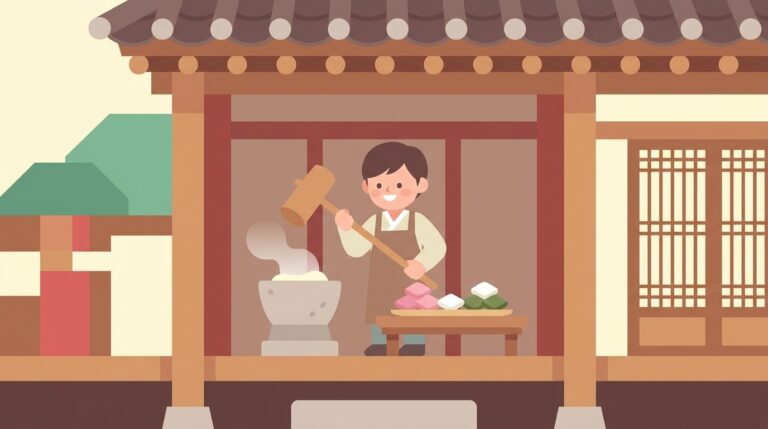
Phase 1: Empathy (Story-Immersive Opening)
안녕하세요! 매일한글 에디터입니다. Have you ever stepped into a charming Hanok workshop in Insadong, surrounded by the warm, sweet aroma of toasted sesame oil and freshly steamed sweet rice, only to freeze when the smiling master artisan hands you a giant wooden mallet?
Making traditional Korean rice cake (tteok) is one of the most memorable cultural experiences you can have in Korea. But when your hands are covered in sticky rice dough, and you’re not sure whether to pound harder or roll the dough in roasted bean powder (injulmi gomul), textbook Korean like “이것을 어떻게 합니까?” feels stiff and awkward.
Based on real feedback from over 500 international travelers who joined cultural workshops in Seoul, this guide will equip you with natural, friendly A2-level Korean expressions. You will effortlessly ask questions, laugh along with your workshop host, and make delicious rice cakes without breaking a sweat!
Phase 2: Top 3 Essential Expressions (In-Depth Analysis)
1. 떡메 한번 쳐봐도 돼요? (Tteokme hanbeon chyeobwado dwaeyo?)
- Pronunciation: [Tteok-me han-beon chyeo-bwa-do dwoe-yo?] (Sounds like: “Tuck-meh han-bun chyeo-bwah-doh dway-yo”)
- Meaning: “May I try pounding with the mallet once?”
- Literal: Tteok-mallet once try-hitting is-it-okay?
- Real Nuance: A polite, cheerful way to ask for a turn at pounding the steamed rice.
- K-Culture Moment: In variety shows like 2 Days & 1 Night or Running Man, cast members shout this enthusiastically whenever they visit a folk village to test their strength!
- Editor’s Insight:
~아/어 봐도 돼요?is the golden beginner pattern for asking permission (“May I try…?”). Adding한번(once) softens your request and makes you sound super polite. - Situation Spectrum:
- Casual: 떡메 한번 쳐봐도 돼? (Friends only) ⚠️
- Semi-formal: 떡메 한번 쳐봐도 돼요? (Workshop instructors, elders) ✅
- Formal: 떡메를 한번 쳐보아도 되겠습니까? (Broadcast/Speeches) 🚫
- 🤔 Think About It: In English, you might say “Can I try?”, but in Korean, specifying the action noun (떡메 치기, mallet-pounding) shows you are genuinely engaged in the unique cultural process.
2. 반죽이 너무 달라붙어요. (Banjugi neomu dallabuteoyo.)
- Pronunciation: [Ban-ju-gi neo-mu dal-la-bu-teo-yo] (Sounds like: “Bahn-joo-gee nuh-moo dal-lah-boo-tuh-yo”)
- Meaning: “The dough is sticking (to my hands) too much.”
- Literal: Dough too-much clings.
- Real Nuance: A gentle cue to your teacher that you need help, more sesame oil, or more dusting powder.
- K-Culture Moment: Seen frequently in traditional cooking segments on Korean morning shows when guests make Chuseok Songpyeon for the first time!
- Editor’s Insight:
달라붙다means “to stick tightly”. When you say this with an apologetic smile, the instructor will instantly rush over with sesame oil (chamgireum) to save your hands. - Situation Spectrum:
- Casual: 반죽이 너무 달라붙어. ⚠️
- Semi-formal: 반죽이 너무 달라붙어요. ✅
- Formal: 반죽이 심하게 달라붙습니다. 🚫
- 🤔 Think About It: Instead of saying “I made a mistake”, Koreans often state the objective state of the object (“The dough is sticking”) to maintain harmony in the room.
3. 모양을 어떻게 만들어요? (Moyangeul eotteoke mandeureoyo?)
- Pronunciation: [Mo-yang-eul eo-tteo-ke man-deu-reo-yo?] (Sounds like: “Moh-yahng-ul uh-ttuh-keh mahn-doo-ruh-yo”)
- Meaning: “How do I shape this?”
- Literal: Shape how do I make?
- Real Nuance: Asking for a step-by-step demonstration of traditional folding and pinching techniques.
- K-Culture Moment: Think of historical K-Dramas where palace maidens learn to shape half-moon Songpyeon delicately with their fingers.
- Editor’s Insight:
어떻게(how) +만들어요(do I make) is your all-time versatile formula for any craft or cooking workshop in Korea. - Situation Spectrum:
- Casual: 모양 어떻게 만들어? ⚠️
- Semi-formal: 모양을 어떻게 만들어요? ✅
- Formal: 모양을 어떻게 만드는 것입니까? 🚫
- 🤔 Think About It: Did you know there is a famous Korean proverb saying that shaping pretty rice cakes (Songpyeon) means you will have a pretty daughter or handsome son in the future?
Phase 3: Textbook Korean vs. Real Korean
Situation 1: Asking if it is hot
- 📖 교과서 한국어 (Textbook): 이것의 온도가 매우 뜨겁습니까? (Igeoseui ondoga maeu tteugeopseumnikka? – Is the temperature of this very hot?)
- 🗣️ 진짜 한국어 (Real-life): 이거 많이 뜨거워요? (Igeo mani tteugeowoyo? – Is this very hot?)
- 💡 왜 다를까?: Native speakers rarely use technical nouns like “temperature” (온도) in casual settings; instead, they directly use descriptive adjectives with conversational demonstratives (이거).
Situation 2: Asking for more sweet coating powder
- 📖 교과서 한국어 (Textbook): 고물을 더 제공해 주시겠습니까? (Gomureul deo jegonghae jusigesseumnikka? – Would you provide more coating powder?)
- 🗣️ 진짜 한국어 (Real-life): 고물 조금만 더 주세요! (Gomul jogeumman deo juseyo! – Just a little more powder, please!)
- 💡 왜 다를까?: “제공하다” (to provide) sounds like a formal corporate contract. In a warm workshop,
조금만 더 주세요sounds polite, humble, and friendly.
Phase 4: K-Culture Deep Dive & Non-Verbal Manners
4-1. 눈치 (Nunchi) & Hands-on Etiquette
- Two Hands for the Mallet: When the master hands you the heavy wooden mallet (tteokme), always receive it with two hands and a slight bow. Never swing it wildly; wait for the instructor’s rhythmic signal (“하나, 둘, 셋!”).
- Sesame Oil Readiness: When shaping tteok, rub a drop of sesame oil on your plastic gloves beforehand. Don’t touch shared tools with sticky gloves—watch the instructor’s timing (눈치) before grabbing the wooden trays.
4-2. Cultural Code: The Spirit of ‘Jeong’ and Rice Cakes
In Korea, tteok is never made or eaten alone. Historically, making rice cakes required two people: one swinging the mallet with strength and one quickly flipping the hot dough with wet hands (tteok-son). This teamwork created deep community bonding (정, Jeong). Even today, Koreans gift rice cakes when moving to a new neighborhood (이사떡) or celebrating a baby’s 100th day (백일떡).
Phase 5: Real-Life Roleplay Scenario
Setting: Master Kim’s Traditional Tteok Atelier in Bukchon Hanok Village. The scent of sweet red beans and toasted mugwort fills the room.
Characters:
* Master Kim (김 장인): A cheerful 60-year-old traditional food master.
* You (Alex): An enthusiastic traveler learning to make Injeolmi.
Dialogue:
1. Master Kim: 🎭 Smiling warmly while pointing to the steaming wooden mortar
자, 이제 밥을 찧을 시간이에요! 누가 먼저 해볼까요?
(Ja, ije babeul jjieul siganieyo! Nuga meonjeo haebolkkayo?)
“Now, it’s time to pound the rice! Who wants to try first?”
- You: 🎭 Raising hand eagerly
저요! 떡메 한번 쳐봐도 돼요?
(Jeoyo! Tteokme hanbeon chyeobwado dwaeyo?)
“Me! May I try pounding with the mallet?” -
Master Kim: 🎭 Handing over the mallet with both hands
그럼요! 제가 반죽을 뒤집을 때 구령에 맞춰서 치세요.
(Geureomyo! Jega banjugeul dwijibeul ttae guryeonge matchwoseo chiseyo.)
“Of course! Strike in rhythm with my count when I flip the dough.” -
You: 🎭 Swinging the mallet gently in rhythm
네! 하나, 둘, 셋! 영차!
(Ne! Hana, dul, set! Yeongcha!)
“Yes! One, two, three! Heave-ho!” -
Master Kim: 🎭 Nodding in admiration
아주 잘하시네요! 자, 이제 도마로 가져가서 모양을 만들어 볼까요?
(Aju jalhasineyo! Ja, ije domaro gajyeogaseo moyangeul mandeureo bolkkayo?)
“You’re doing great! Now, shall we take it to the cutting board and shape it?” -
You: 🎭 Touching the dough, looking slightly flustered
선생님, 반죽이 손에 너무 달라붙어요!
(Seonsaengnim, banjugi sone neomu dallabuteoyo!)
“Teacher, the dough is sticking to my hands too much!” -
Master Kim: 🎭 Applying a drop of fragrant sesame oil to your gloves
참기름을 살짝 바르면 괜찮아요. 자, 콩고물을 듬뿍 묻히세요.
(Chamgireumeul saljjak bareumyeon gwaenchannayo. Ja, konggomureul deumpuk muthiseyo.)
“Apply a little sesame oil and it’ll be fine. Now, coat it generously with bean powder.” -
You: 🎭 Tasting a freshly cut piece and smiling brightly
와, 진짜 쫄깃쫄깃하고 고소해요! 감사합니다!
(Wa, jinjja jjolgit-jjolgithago gosohaeyo! Gamsahamnida!)
“Wow, it is so delightfully chewy and nutty! Thank you!”
🔀 Interactive Branch Point
The instructor asks: “콩고물이 더 필요한가요? (Do you need more bean powder?)” What do you say?
- Option A: “네, 고물 조금만 더 주세요!” (Yes, just a little more powder, please!)
- 👉 Feedback [BEST]: Perfect! Polite, natural, and accurately communicates your need.
- Option B: “더 줘.” (Give more.)
- 👉 Feedback [BAD]: Oops! This is blunt banmal (informal speech). You might sound rude to the teacher.
- Option C: “고물을 더 생산해 주십시오.” (Please manufacture more powder.)
- 👉 Feedback [RISK]: Way too robotic! The teacher might chuckle at the industrial vocabulary.
Phase 6: 10-Second Emotion Shadowing Drill
Read these out loud matching the exact emotional tone indicated in brackets!
[😊 기쁘고 신나게 / Enthusiastic & Eager]- 저요! / 떡메 한번 / 쳐봐도 돼요?
(Jeoyo! / Tteokme hanbeon / chyeobwado dwaeyo?)
- 저요! / 떡메 한번 / 쳐봐도 돼요?
[🥺 살짝 당황하며 귀엽게 / Slightly Panicked & Cute]- 선생님, / 반죽이 너무 / 달라붙어요!
(Seonsaengnim, / banjugi neomu / dallabuteoyo!)
- 선생님, / 반죽이 너무 / 달라붙어요!
[😋 감탄하며 행복하게 / Delighted & Delicious]- 와! / 진짜 쫄깃쫄깃하고 / 맛있어요!
(Wa! / Jinjja jjolgit-jjolgithago / masisseoyo!)
- 와! / 진짜 쫄깃쫄깃하고 / 맛있어요!
Phase 7: K-Culture Mini Dictionary
- 떡메 (Tteokme): Traditional wooden rice mallet | The large wooden hammer used to pound steamed rice on a wooden slab (tteokpan) to make the texture chewy.
- 고물 (Gomul): Tteok coating powder | Delicious toppings such as roasted soybean powder (konggomul), red bean crumbs, or black sesame powder.
- 송편 (Songpyeon): Half-moon rice cake | A traditional rice cake filled with sesame seeds, sugar, or chestnuts, steamed on pine needles during Chuseok.
- 쫄깃쫄깃 (Jjolgit-jjolgit): Chewy / Springy texture | The ultimate onomatopoeia describing the elastic, bouncy texture loved by Korean foodies.
Phase 8: Traveler’s Survival Kit
Survival Expressions TOP 3
- 포장 상자 있어요? (Pojang sangja isseoyo? – Do you have a takeout box?)
- Pro Tip: Rice cakes harden if left open. Ask for a box or plastic pouch (비닐봉투) right away.
- 오늘 안에 먹어야 해요? (Oneul ane meogeoya haeyo? – Should I eat this today?)
- Pro Tip: Fresh traditional tteok contains no preservatives and is best eaten within 24 hours.
- 사진 찍어 주실 수 있어요? (Sajin jjigeo jusil su isseoyo? – Could you take a picture for me?)
- Pro Tip: Hold the mallet with both hands for the most iconic cultural photo!
Editor’s Travel Note
- Booking Workshops: Most traditional workshops in Bukchon or Insadong require reservations. Search for workshops using the Naver Map app navigation to find local craft houses.
- Cash & Cards: Almost all Seoul studios accept international credit cards, but small market stalls prefer card payments or mobile transport card top-ups via convenience stores.
Phase 9: “One Step Deeper” (Reflective Essay)
Making tteok is fundamentally an art of community synchronization. One person swings the heavy wooden mallet with raw force, while the partner swiftly turns the piping-hot dough between strikes without flinching. This high-stakes rhythm requires absolute mutual trust and intuitive harmony—what Koreans call 호흡 (hoheup, breathing together). When you share tteok at the end of class, you are not just tasting food; you are partaking in a centuries-old ritual of communal warmth and Jeong.
💬 Your Turn: What traditional food in your home country requires teamwork or special tools to prepare? Share your story in the comments below!
Phase 10: FAQ & Avoiding Misunderstandings
Q: Can I take the rice cakes I made back to my hotel?
A: Yes! Most workshops provide small food boxes (도시락 통). Keep them at room temperature for the day, and do not put them in the hotel fridge overnight as they will turn rock-hard.
Q: What if I have peanut or sesame allergies?
A: Tell your host before class begins by saying: “견과류 알레르기가 있어요” (Gyeongwaryu allereogiga isseoyo – I have a nut allergy) or “참깨 알레르기가 있어요” (Chamkkae allereogiga isseoyo – I have a sesame allergy).
Q: Is it rude to eat the freshly pounded dough right away?
A: Not at all! In fact, the chef will usually cut a warm slice and hand it to you immediately. Eating it with a big reaction (“진짜 맛있어요!”) is considered great manners.
🚨 흔한 실수 (Common Mistakes) Warning Board
- ❌ Mistake 1: Saying “반죽이 붙었어요” in a demanding tone when stuck.
- ✅ Correct Action: Use a polite, friendly tone: “선생님, 참기름 좀 더 발라주세요” (Teacher, please apply a bit more sesame oil).
- ❌ Mistake 2: Swinging the mallet without looking at the instructor’s hand.
- ✅ Correct Action: Always pause and wait for their vocal cue (“하나, 둘, 셋!”).
- ❌ Mistake 3: Calling all coating powders “설탕” (sugar).
- ✅ Correct Action: Use the culinary word “고물” (gomul) or “콩가루” (konggaru – bean flour).
Phase 11: Action Missions & Engagement
- 🥉 Bronze Mission (Solo Practice): Practice saying
떡메 한번 쳐봐도 돼요?three times in the mirror with an energetic posture. - 🥈 Silver Mission (Social Share): Share your favorite chewy Korean dessert photo on Instagram or Threads and caption it with the Korean word
#쫄깃쫄깃. - 🥇 Gold Mission (Real-Life Action): Book a traditional tteok or cooking class during your trip to Korea and ask the master:
모양을 어떻게 만들어요?in Korean.
🎮 K-Culture Mission: Watch an episode of a Korean historical drama (like Mr. Queen or Under the Queen’s Umbrella) and spot the scene where characters share festive rice cakes!
Phase 12: Interactive Quiz Challenge
1. Situational Judgment Quiz
Your rice cake dough is sticking all over your hands during class. What is the most natural thing to say?
* A) 반죽을 버리세요. (Throw away the dough.)
* B) 반죽이 너무 달라붙어요! (The dough is sticking too much!)
* C) 이것은 나쁜 떡입니다. (This is bad rice cake.)
2. Fill-in-the-Blank
“선생님, 떡메 한번 ______ 돼요?” (Teacher, may I try pounding the mallet once?)
* Hint: Verb for hitting/pounding in the trial form.
3. True / False Cultural Quiz
- (T/F) In Korea, making pretty Songpyeon is traditionally believed to bring you a pretty daughter or handsome son.
👉 Click here to check the answers and explanations!
- Answer: B –
반죽이 너무 달라붙어요!is the natural, polite way to inform your instructor that the dough is clinging. - Answer: 쳐봐도 –
치다(to hit) +~어 보다(to try) +~도 되다(permission) =쳐봐도 돼요. - Answer: TRUE – This is a beloved Korean folk belief shared every Chuseok festival when families gather to make rice cakes together!







