

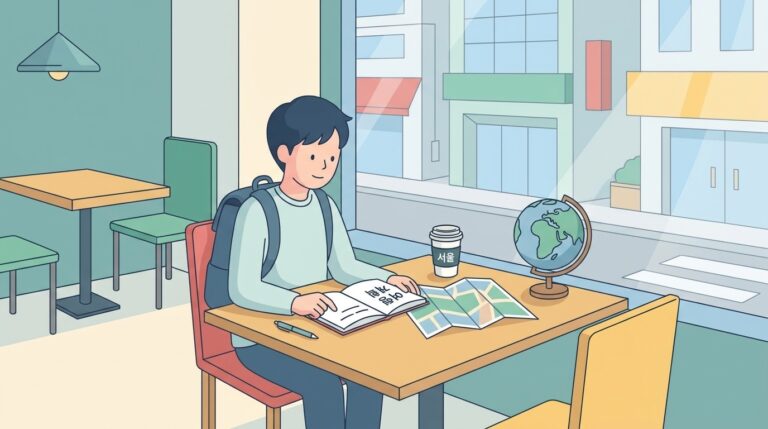
Phase 1: Empathy (Story Immersion Opening)
안녕하세요! 매일한글 에디터입니다. (Hello! I’m your editor from Daily Hangul.)
Picture this: You are sitting at a rooftop café in Yeonnam-dong on a breezy Friday evening. The sky is turning shades of apricot and lavender, and the neon lights of Seoul are slowly waking up. You’re chatting with your Korean friends over iced Americanos when someone sighs after a grueling workweek and asks: “앞으로 진짜 하고 싶은 거 있어?” (What is something you genuinely want to do in the future?).
Your heart races because you have an answer: you want to pack your bags, leave everything behind for a year, and travel the entire globe. But suddenly, your mind freezes. You know the textbook word 세계 (world) and 여행 (travel), but how do native speakers actually express this grand life aspiration without sounding like a robotic grammar worksheet? Do you say 계획입니다? Is 꿈 too childish?
Expressing future dreams and bucket-list wishes is one of the most intimate, bonding conversations you can have in Korea. It bridges the gap between polite casual acquaintances and real soulmates. Today, based on real feedback from intermediate learners who felt stuck in formal grammar loops, we are going to unlock natural, evocative ways to say “세계 일주를 하는 것이 꿈이다” (My dream is to travel around the world). Let’s dive right in!
Phase 2: Core Expressions Deep Dive
1. 세계 일주를 하는 것이 제 꿈이에요. (Se-gye il-ju-reul ha-neun geos-i je kkum-i-e-yo.)
- Pronunciation: se-gye eel-joo-reul ha-neun geo-she je kkoom-ee-eh-yo. (Pro-tip: pronounce 꿈 (kkum) with a tense double ‘k’, like the ‘k’ in skate rather than a soft English ‘k’.)
- Meaning: Literal: “Doing a round-the-world tour is my dream.” / Real Nuance: “Traveling around the world is my ultimate dream / bucket list goal.”
- K-Culture Moment: You will hear this exact phrasing on variety shows like Adventure by Accident (태어난 김에 세계일주) when cast members share why they stepped out of their comfort zones to backpack across South America or Madagascar.
- Editor’s Insight: 세계 일주 (se-gye il-ju) specifically means circumnavigating the globe, which carries a far more adventurous and grand tone than simply 해외여행 (hae-oe-yeo-haeng – overseas trip).
- Situation Spectrum:
- Casual (반말): ⚠️ (Change to 내 꿈이야)
- Semi-formal (해요체): ✅ (Perfect for dates, drinks, and social clubs)
- Formal (하십시오체): ⚠️ (Use 제 꿈입니다 in interviews)
- 🤔 Think About It: In English, we often say “I want to travel the world,” focusing on the action. Why do you think Korean often frames lifelong wishes through the noun 꿈 (dream) combined with ~는 것 (the act of)?
2. 언젠가는 꼭 배낭여행을 떠나고 싶어요. (Eon-jen-ga-neun kkok bae-nang-yeo-haeng-eul tteo-na-go sip-eo-yo.)
- Pronunciation: un-jen-ga-neun kkok beh-nang-yeo-heng-eul dduh-na-go sheep-uh-yo.
- Meaning: Literal: “Someday, definitely, I want to leave for a backpacking trip.” / Real Nuance: “One day, I am definitely going to pack a backpack and set off.”
- K-Culture Moment: Think of youth dramas like Twenty-Five Twenty-One where characters daydream about breaking away from societal pressures and just roaming freely.
- Editor’s Insight: Notice the verb 떠나다 (tteonada) instead of 가다 (gada). 떠나다 conveys a romantic sense of departure and liberation.
- Situation Spectrum:
- Casual: ⚠️ (Use 떠나고 싶어)
- Semi-formal: ✅ (Very natural and expressive)
- Formal: ✅ (Polite enough for team ice-breakers)
- 🤔 Think About It: How does adding emotional adverbs like 언젠가는 (someday) and 꼭 (surely/definitely) soften your ambition while making it sound sincere?
3. 돈 모아서 해외로 훌쩍 떠나려고요. (Don mo-a-seo hae-oe-ro hul-jjeok tteo-na-ryeo-go-yo.)
- Pronunciation: don mo-ah-seo heh-weh-ro hool-jjuk dduh-na-ryuh-go-yo.
- Meaning: Literal: “I plan to save money and leave overseas spontaneously.” / Real Nuance: “My plan is to save up some cash and just take off abroad.”
- K-Culture Moment: Frequently heard among office workers in K-Dramas unwinding at a Pojangmacha (street tent bar) dreaming of quitting their corporate grind.
- Editor’s Insight: 훌쩍 (hul-jjeok) is an onomatopoeia/mimetic word evoking a light, spontaneous, unburdened leap. It adds a native flair that textbooks never teach!
- Situation Spectrum:
- Casual: ⚠️ (Use 떠나려고)
- Semi-formal: ✅ (Super natural among peers and colleagues)
- Formal: 🚫 (A bit too colloquial for official business presentations)
- 🤔 Think About It: Notice the ending ~려고요 (~ryeogoyo). It implies an ongoing intention rather than a rigid deadline, reflecting conversational flexibility.
Phase 3: Textbook Korean vs. Real Korean
Situation 1: Talking About Your Ultimate Bucket List
- 📖 Textbook Korean: 저는 미래에 세계 여행을 할 계획이 있습니다. (Jeo-neun mi-rae-e se-gye yeo-haeng-eul hal gye-hoek-i it-seumnida.)
- 🗣️ Real Korean: 제 버킷리스트 1순위가 세계 일주예요! (Je beo-kit-ri-seu-teu il-sun-wi-ga se-gye il-ju-ye-yo!)
- 💡 Why the difference?: Real speakers borrow the trendy loanword 버킷리스트 (bucket list) and rank it with 1순위 (first priority) to sound enthusiastic rather than like a bureaucratic planner.
Situation 2: Expressing a Wish to Escape Routine
- 📖 Textbook Korean: 저는 직장을 그만두고 외국으로 가고 싶습니다. (Jeo-neun jik-jang-eul geu-man-du-go oeguk-euro ga-go sip-seumnida.)
- 🗣️ Real Korean: 진짜 다 접고 훌쩍 떠나고 싶어요. (Jin-jja da jeop-go hul-jjeok tteo-na-go sip-eo-yo.)
- 💡 Why the difference?: 다 접다 (to fold everything up / put everything aside) is a vivid Korean idiom for setting aside daily stress to pursue an adventure.
Phase 4: K-Culture Deep Dive & Non-Verbal Manners
4-1. Nunchi & Body Language
When Koreans talk about big personal dreams like traveling the world, modesty meets passion.
* Eye Contact & Gazing: When introducing a dream, Koreans often tilt their head slightly and gaze slightly upward into the distance as if visualizing the scenery, before making warm eye contact.
* Hand Gestures: Lightly pressing your palm against your chest when saying “제 꿈이에요” emphasizes authenticity and vulnerability.
4-2. Cultural Code Analysis: The “World Tour” Phenomenon in Korea
In modern South Korea, 세계 일주 (world travel) is no longer just a luxury—it has evolved into a cultural symbol of self-discovery. With mega-popular YouTube creators like Pani Bottle (빠니보틀) and travel entertainment programs, the concept of stepping away from the intense 갓생 (God-saeng / hyper-productive life) to explore the world resonates deeply with young adults. Sharing that your dream is to travel the world signals open-mindedness, boldness, and a free spirit.
Phase 5: Real-Life Roleplay Scenario
Setting: A cozy craft beer pub in Euljiro, Seoul. The tables are glowing under warm amber lamps. You are chatting with your Korean colleague, Ji-min.
- Ji-min: 혹시 일 안 할 때 꼭 해보고 싶은 거 있어요? (Hok-si il an hal ttae kkok hae-bo-go sip-eun geo it-seo-yo?)
- 🎭 Taking a sip of her beer and leaning in with curious eyes.
- You: 사실 제 오랜 버킷리스트가 하나 있어요. (Sa-sil je o-raen beo-kit-ri-seu-teu-ga ha-na it-seo-yo.)
- 🎭 Smiling with anticipation.
- Ji-min: 오, 뭔데요? 완전 궁금해요! (O, mwon-de-yo? Wan-jeon gung-geum-hae-yo!)
- 🎭 Clapping hands together lightly.
- You: 세계 일주를 하는 것이 제 꿈이에요. (Se-gye il-ju-reul ha-neun geos-i je kkum-i-e-yo.)
- 🎭 Speaking with a warm, genuine sparkle in your eyes.
- Ji-min: 대박! 세계 일주요? 어느 나라부터 가고 싶어요? (Dae-bak! Se-gye il-ju-yo? Eo-neu na-ra-bu-teo ga-go sip-eo-yo?)
- 🎭 Eyes widening with excitement.
- You: 남미랑 유럽부터 배낭 메고 훌쩍 떠나고 싶어요. (Nam-mi-rang Yu-reop-bu-teo bae-nang me-go hul-jjeok tteo-na-go sip-eo-yo.)
- 🎭 Gesturing as if strapping on a backpack.
- Ji-min: 진짜 멋있어요! 꼭 이루셨으면 좋겠어요. (Jin-jja meot-i-sseo-yo! Kkok i-ru-syeot-seu-myeon jo-ket-seo-yo.)
- 🎭 Raising her glass for a cheer.
- You: 응원해 줘서 고마워요! 건배할까요? (Eung-won-hae jwo-seo go-ma-wo-yo! Geon-bae-hal-kka-yo?)
- 🎭 Clinking glasses cheerfully.
🔀 Interactive Choice Point
What would you say next to keep the conversation flowing?
* Option A: “지민 씨는 꿈이 뭐예요?” (What about your dream, Ji-min?)
* Option B: “돈이 없어서 절대 못 가요.” (I have no money so I can never go.)
* Option C: “내일 당장 사표 낼 거예요!” (I will submit my resignation letter tomorrow!)
Feedback:
* Option A (Best! 🌟): Perfect conversational flow! Turning the question back shows high social empathy and 눈치 (Nunchi).
* Option B (Bad ⚠️): Shuts down the excited mood too abruptly with extreme negativity.
* Option C (Risk ⚡): Might sound too shocking unless said with very obvious playful sarcasm!
Phase 6: 10-Second Emotional Shadowing Drill
Practice reading these rhythmically with the pause markers (/) and emotional directions:
[✨ 눈을 반짝이며 설레게 / Excitedly]- “언젠가는 / 꼭 / 배낭 하나 메고 / 세계 일주를 떠날 거예요!”
(Eon-jen-ga-neun / kkok / bae-nang ha-na me-go / se-gye il-ju-reul tteo-nal geo-ye-yo!)
- “언젠가는 / 꼭 / 배낭 하나 메고 / 세계 일주를 떠날 거예요!”
[😌 간절하고 다정하게 / Sincere & Dreamy]- “돈을 차곡차곡 모아서 / 해외로 / 훌쩍 떠나는 게 / 제 꿈이에요.”
(Don-eul cha-gok-cha-gok mo-a-seo / hae-oe-ro / hul-jjeok tteo-na-neun ge / je kkum-i-e-yo.)
- “돈을 차곡차곡 모아서 / 해외로 / 훌쩍 떠나는 게 / 제 꿈이에요.”
Phase 7: K-Culture Mini Dictionary
- 세계 일주 (Se-gye il-ju): Around-the-world travel. Used when discussing comprehensive, long-term global journeys crossing continents.
- 버킷리스트 (Beo-kit-ri-seu-teu): Bucket list. Widely used in daily casual chats, dating conversations, and New Year resolutions.
- 훌쩍 떠나다 (Hul-jjeok tteo-na-da): To take off without hesitation or heavy baggage. Perfect for expressing a desire for a refreshing getaway.
- 갓생 (God-saeng): A blend of ‘God’ and ‘생 (life)’. Refers to living a diligent, productive life—often contrasted humorously with the urge to drop everything and travel.
Phase 8: Traveler’s Survival Kit
Survival Expressions TOP 3
- 혹시 추천해 주실 만한 여행지가 있나요? (Hok-si chu-cheon-hae ju-sil man-han yeo-haeng-ji-ga in-na-yo?)
- Pro Tip: Use this when asking locals for hidden gems in Korea!
- 여기서 공항철도 타려면 어디로 가야 해요? (Yeo-gi-seo gong-hang-cheol-do ta-ryeo-myeon eo-di-ro ga-ya hae-yo?)
- Pro Tip: Essential for getting back onto the AREX airport train smoothly.
- 사진 한 장만 찍어주실 수 있으세요? (Sa-jin han jang-man jjik-eo-ju-sil su it-eu-se-yo?)
- Pro Tip: Koreans are famously dedicated photographers who will take photos from multiple angles for you!
Editor’s Travel Note
For getting around Korea seamlessly while planning your travel budget, download the [Naver Map Navigation App on iOS/Android] rather than Google Maps for real-time transit routes, and keep a climate card or T-Money transport card loaded at any convenience store.
Phase 9: One Step Deeper (Reflection)
In Korean culture, the balance between social responsibility (책임감) and personal dreams (자아실현) is constantly evolving. In the past, career stability was prioritized above all else. Today, expressing a dream like 세계 일주 is viewed as a courageous pursuit of personal happiness and life perspective. Sharing your dreams in Korean is not just practicing grammar—it is sharing your worldview.
💬 Your Turn: If you could fly to any destination tomorrow, where would you go? Tell us in the comments in Korean using: “저는 [장소]로 훌쩍 떠나고 싶어요!”
Phase 10: FAQ & Common Mistakes
Q: What is the difference between 세계 여행 and 세계 일주?
A: 세계 여행 (se-gye yeo-haeng) means traveling to various countries in the world generally, while 세계 일주 (se-gye il-ju) specifically means going all the way around the world on a connected journey.
Q: Can I use “제 꿈은 ~입니다” in casual chats?
A: It is grammatically correct, but sounds slightly formal or essay-like. In casual conversation, “~하는 게 제 꿈이에요” sounds much smoother and warmer.
Q: How do I say “bucket list item” naturally?
A: You can say “버킷리스트 중 하나예요” (It’s one of my bucket list items).
🚨 Common Mistakes Warning Board
- Mistake: Saying “저는 세계 일주를 하고 싶다” to a friend.
- Correct Action: Conjugate to conversational endings: “세계 일주 하고 싶어” (casual) or “세계 일주 하고 싶어요” (polite).
- Mistake: Misplacing the verb connector in ~는 것이 (e.g., 세계 일주 한 것이 꿈이다 -> implies you already did it!).
- Correct Action: Use present modifier 하는 것 for ongoing/future wishes.
- Mistake: Overusing 미래에 (in the future) in every sentence.
- Correct Action: Use 언젠가는 (someday) or 앞으로 (moving forward) for natural nuance.
Phase 11: Action Missions & K-Culture Challenge
- 🥉 Bronze Mission: Write your top 1 travel dream in your notebook: “[나라 이름]에 가는 것이 제 꿈이에요.”
- 🥈 Silver Mission: Record a 5-second voice memo saying: “언젠가는 꼭 세계 일주를 떠날 거예요!” and check your rhythm.
- 🥇 Gold Mission: Next time you talk to a Korean language exchange partner or tutor, ask them: “버킷리스트 1순위가 뭐예요?”
🎮 K-Culture Challenge: Search on YouTube for “세계일주 브이로그” (World tour vlog) and see if you can spot the words 배낭여행 or 버킷리스트 in the titles!
Phase 12: Interactive Quiz Challenge
1. Situational Judgment
You want to casually tell your Korean friend that leaving for a spontaneous trip is your dream. Which sentence is most natural?
– A) 저는 여행을 갈 계획을 보유하고 있습니다.
– B) 돈 모아서 훌쩍 여행 떠나는 게 제 꿈이에요.
– C) 세계 일주를 완료했습니다.
2. Fill-in-the-Blank
“언젠가는 꼭 배낭여행을 ________ 싶어요.” (I want to set off on a backpacking trip.)
– Word clue: (떠나고 / 먹고 / 일하고)
3. True or False
In Korean conversation, 세계 일주 refers specifically to traveling around the world in a full loop/circuit. (True / False)
👉 Click to reveal answers & explanations!
- Answer: B | 돈 모아서 훌쩍 여행 떠나는 게 제 꿈이에요 is natural and conversational. Option A is overly bureaucratic, and Option C is past tense.
- Answer: 떠나고 | 떠나고 싶어요 means “want to leave/set off on a journey.”
- Answer: True | 일주 (一週) literally means making a complete round/circuit around the world!







