

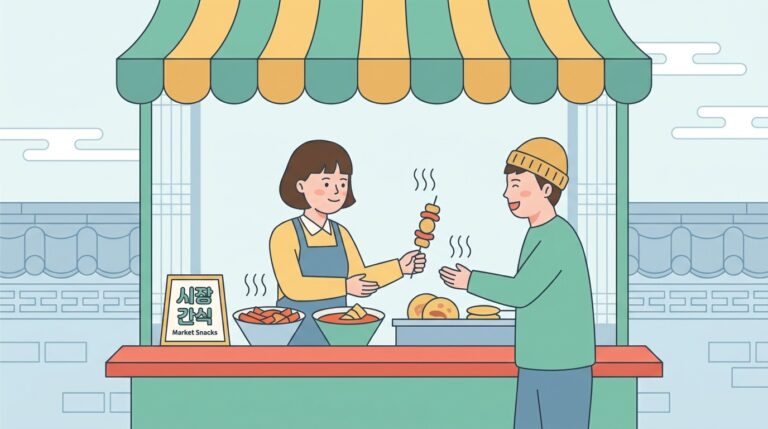
Navigating Korean Traditional Markets: Master Cash, Cards, and the Art of the Discount
Phase 1: Empathy & Story-Driven Opening
안녕하세요! 매일한글 에디터입니다.
Picture this: You are standing in the middle of Gwangjang Market (광장시장) or Mangwon Market (망원시장) on a crisp Friday evening. The air is thick with the mouthwatering aroma of sizzling bindaetteok (mung bean pancakes), freshly glazed dakgangjeong (sweet crunchy chicken), and bubbling tteokbokki. You spot an incredible street stall piled high with artisan snacks. You eagerly reach into your pocket, pull out your sleek overseas credit card, and suddenly freeze.
You see a tiny handwritten sign with bank account numbers taped to the counter. The stall owner—a warm, bustling Imo-nim (auntie)—is rapidly serving customers who are handing over crisp 1,000-won bills or tapping their smartphone banking apps. You wonder: Is it rude to pay for a 3,000 won snack with a card? Can I ask for a small discount if I pay cash? How on earth do locals use bank transfers at street carts?
If you have ever felt that split-second hesitation at a Korean market stall, you are definitely not alone. For intermediate Korean learners, the challenge is no longer just saying “이거 주세요” (Give me this). It is mastering the social rhythm of payment etiquette, understanding the concept of Jeong (정), and speaking with the natural confidence of a local insider. This guide is crafted from real field experiences and learner feedback to help you navigate traditional market transactions with absolute poise.
Phase 2: Core Expressions Deep Dive (B2 Intermediate)
Let’s break down three vital expressions that will elevate your market interactions from awkward textbook learner to savvy cultural insider.
1. 현금으로 계산하면 조금 깎아주실 수 있나요?
- Hangul & English: 현금으로 계산하면 조금 깎아주실 수 있나요? (Hyeongeumeuro gyesanhamyeon jogeum kkakka jusil su innayo? / If I pay in cash, could you give me a small discount?)
- Pronunciation: Hyeon-geum-eu-ro gye-san-ha-myeon jo-geum kka-kka-ju-sil su in-na-yo? (Think of kka-kka like a sharp, brisk “caw-caw” sound produced with tension in your throat).
- Meaning: Literal: “If calculating with cash, can you cut [the price] a little?” / Real Nuance: A polite, customary way to ask for a cash bargain without sounding demanding.
- K-Culture Moment: You will hear this frequently in variety shows like I Live Alone (나 혼자 산다) or Sixth Sense whenever cast members go vintage shopping or visit Dongdaemun and traditional alleys.
- Editor’s Insight: The verb 깎다 (to cut/shave) is used for discounts. Notice the word 조금 (a little)—adding softening words makes the request friendly rather than aggressive.
- Situation Spectrum:
- Casual (Friends/Peers): 🚫 Too formal
- Semi-formal (Market vendors/Shop owners): ✅ Perfect balance of politeness and charm
- Formal (Upscale department stores): 🚫 Do not use here; fixed prices apply
- 🤔 Think About It: In many Western supermarkets, bargaining is strictly forbidden. Why do you think Korean market bargaining is viewed as a social connection rather than just a transaction?
2. 카드 결제도 되나요, 아니면 계좌이체 해드릴까요?
- Hangul & English: 카드 결제도 되나요, 아니면 계좌이체 해드릴까요? (Kadeu gyeoljedo doenayo, animyeon gyejwajiche haedeurilkkayo? / Do you accept card, or would you prefer I do a bank transfer?)
- Pronunciation: Ka-deu gyeol-je-do doe-na-yo, a-ni-myeon gye-jwa-i-che hae-deu-ril-kka-yo?
- Meaning: Literal: “Is card payment also possible, or shall I do an account transfer for you?” / Real Nuance: A considerate phrase showing you understand the vendor might prefer avoiding card processing fees on small amounts.
- K-Culture Moment: In K-Dramas like When the Camellia Blooms (동백꽃 필 무렵), neighborhood market vendors regularly exchange direct bank transfers via mobile apps instead of card swipes.
- Editor’s Insight: 계좌이체 (bank transfer) is ubiquitous in modern Korea. Almost every market stall has a laminated bank account number (국민, 신한, 농협, etc.) posted near the register.
- Situation Spectrum:
- Casual (Close buddies): ⚠️ A bit too formal
- Semi-formal (Market stalls, street pop-ups): ✅ Highly recommended & thoughtful
- Formal (Official business counter): ⚠️ Use standard payment terms
- 🤔 Think About It: How does the prevalence of instant digital banking in Korea reshape traditional cash-only street markets into hybrid digital spaces?
3. 잔돈은 안 주셔도 괜찮아요
- Hangul & English: 잔돈은 안 주셔도 괜찮아요. (Jandoneun an jusyeodo gwaenchanayo. / You can keep the change / No need to give me the change.)
- Pronunciation: Jan-do-neun an ju-syeo-do gwaen-cha-na-yo.
- Meaning: Literal: “Even if you do not give small change, it is okay.” / Real Nuance: A warm, gracious gesture when buying small street food items or receiving extra portions (dum).
- K-Culture Moment: Seen in wholesome travel documentaries where travelers show gratitude to elder vendors for their generous hospitality.
- Editor’s Insight: Korea does not have a tipping culture. Giving extra money outright can cause confusion or embarrassment, but saying “keep the small change” (under 500–1,000 KRW) after receiving a warm bonus portion is perceived as gracious.
- Situation Spectrum:
- Casual: ✅ Friendly
- Semi-formal (Street food carts, elder vendors): ✅ Very warm and polite
- Formal (Taxis, high-end dining): ⚠️ Taxis are fine, high-end dining unnecessary
- 🤔 Think About It: How does refusing small change differ from Western tipping culture in terms of emotional motivation (Jeong vs. mandatory service charge)?
Phase 3: Textbook Korean vs. Real-World Korean
Let’s examine how traditional textbook Korean contrasts with what is actually spoken in vibrant marketplaces.
Situation 1: Inquiring about Card Payments
- 📖 Textbook Korean: “여기서 신용카드를 사용할 수 있습니까?” (Yeogiseo sinyongkadeureul sayonghal su itsseumnikka? / Can credit cards be used here?)
- 🗣️ Real-World Korean: “사장님, 이거 카드도 돼요?” (Sajangnim, igeo kadeudo dwaeyo? / Boss, can I use a card for this?)
- 💡 Why the Difference? Traditional market vendors foster an approachable community vibe. The military-style formal ending -습니까 creates unnecessary distance. Using 사장님 (boss/owner) paired with the soft -돼요? sounds natural, respectful, and friendly.
Situation 2: Asking for a Small Bargain or Freebie
- 📖 Textbook Korean: “가격을 할인해 주십시오.” (Gagyeogeul harinhae jusipsio. / Please discount the price.)
- 🗣️ Real-World Korean: “현금으로 낼 테니까 덤 좀 더 얹어주세요~” (Hyeongeumeuro nael tenikka deom jom deo eonjeojuseyo~ / I’ll pay in cash, so please throw in a little extra bonus!)
- 💡 Why the Difference? Asking outright for a price reduction can sometimes feel cold. Instead, savvy Korean shoppers leverage 덤 (a free bonus item/extra scoop) or mention paying in cash as a win-win relational exchange.
Phase 4: K-Culture Deep Dive & Non-Verbal Manners
4-1. Nunchi (눈치) & Gestures
- The Two-Handed Hand-Off (두 손으로 건네기): When handing over a card or cash, always use both hands—or place your left hand lightly under your right forearm/wrist. Handing over payment with one casual hand can feel dismissive to elder merchants.
- Reading the Stall Environment: Look for a card terminal (POS machine) or a taped sign with a bank account number. If you only see an open wooden cash drawer and a laminated bank slip, having cash or your mobile banking app ready displays high Nunchi.
4-2. Cultural Codes: Jeong (정) and Dum (덤)
Traditional markets in Korea are not just centers of commerce; they are the living heartbeat of Jeong (social affection and bonding). When an older vendor likes your polite attitude and bright greetings, they might suddenly toss two extra dumplings into your bag or pour a deeper ladle of broth. This bonus is called 덤 (Dum). The proper response is not to ask “How much for the extra?” but to bow slightly, smile broadly, and say: “우와, 감사히 잘 먹겠습니다!” (Wow, thank you, I will enjoy this!).
Phase 5: Real-World Roleplay Scenario
Setting: Mangwon Market on a bustling afternoon. You are standing in front of a famous fried snack stall run by an energetic, friendly vendor (Imo-nim).
🎭 Characters:
- You: A curious, polite intermediate Korean learner.
- Imo-nim (이모님): The warm stall owner frying fresh hotteok and twikim.
- Turn 1 (You): “사장님, 안녕하세요! 이 튀김 세트 하나랑 떡볶이 1인분 포장해 주세요.” (Sajangnim, annyeonghaseyo! I twigim seteuhana-rang tteokbokki il-inbun pojanghae juseyo. / Hello boss! Please pack one of this fried snack set and one portion of tteokbokki to go.)
🎭 Smiling and pointing at the crisp fried snacks - Turn 2 (Imo-nim): “어 그래요! 튀김은 바로 튀겨줄 테니까 2분만 기다려요~ 총 8,000원이에요.” (Eo geuraeyo! Twigimeun baro twigyeojul tenikka ibunman gidaryeoyo~ Chong palcheon-wonieyo. / Alright! I will fry the snacks right now, wait 2 minutes~ Total is 8,000 won.)
🎭 Tossing battered squid into sizzling oil - Turn 3 (You): “혹시 카드 결제도 되나요, 아니면 계좌이체 해드릴까요?” (Hoksi kadeu gyeoljedo doenayo, animyeon gyejwajiche haedeurilkkayo? / By any chance, do you take card, or would you prefer a bank transfer?)
🎭 Holding phone with banking app ready - Turn 4 (Imo-nim): “아이고, 카드도 되는데 계좌이체 해주면 내가 더 고맙지! 저기 계좌번호 적혀 있어요.” (Aigo, kadedo doeneunde gyejwajiche haejumyeon naega deo gomapji! Jeogi gyejwabeonho jeokhyeo isseoyo. / Oh dear, card works, but if you do a bank transfer I’d be much more thankful! The account number is written over there.)
🎭 Pointing with a plastic spatula toward the sign - Turn 5 (You): “네! 방금 8,000원 보냈어요. 확인해 보세요.” (Ne! Banggeum palcheon-won bonaesseoyo. Hwaginhae boseyo. / Done! I just sent 8,000 won. Please check.)
🎭 Showing the transfer confirmation screen respectfully with both hands - Turn 6 (Imo-nim): “어머, 싹싹하게 한국말도 잘하네! 기다려준 게 고마워서 김말이 하나 덤으로 더 넣었어요!” (Eomeo, ssakssakhage hangukmaldo jalhane! Gidaryeojun ge gomaweoseo gimmari hana deomeuro deo neoeosseoyo! / Oh my, you speak such sweet and pleasant Korean! Since you waited nicely, I threw in an extra seaweed roll as a bonus!)
🎭 Packing the bag with an extra hot snack - Turn 7 (You): “우와, 덤까지 주시고 정말 감사해요! 맛있게 잘 먹을게요!” (Uwa, deomkkaji jusigo jeongmal gamsahaeyo! Masitge jal meogeulgeyo! / Wow, thank you so much for the extra bonus! I will enjoy it thoroughly!)
🎭 Bowing with a happy expression - Turn 8 (Imo-nim): “맛있게 먹고 또 와요, 학생!” (Masitge meokgo tto wayo, haksaeng! / Enjoy it and come back again, student!)
🎭 Waving warmly
🔀 Interactive Branching Point
What should you do if you only have a 50,000 KRW bill and buy a 2,000 KRW single hotteok?
- Option A: Silently hand over the 50,000 won bill without saying anything.
- Feedback (Risk): While the vendor will give you change, it drains their small bills reserve early in the day, which can cause subtle tension.
- Option B: Say: “사장님, 큰 돈밖에 없어서 죄송해요. 잔돈 괜찮으실까요?” (Sajangnim, keun donbakke eopseoseo joesonghaeyo. Jandon gwaenchaneusilkkayo? / Boss, I’m sorry I only have a large bill. Is change okay?)
- Feedback (Best): Demonstrates exceptional situational awareness (Nunchi) and courtesy. The vendor will gladly make change.
- Option C: Say: “잔돈 없으시면 그냥 카드 긁을게요.” (Jandon eopseusimyeon geunyang kadeu geulgeulgeyo. / If you don’t have change, I’ll just swipe a card.)
- Feedback (Bad): Sounds blunt and demanding for a tiny 2,000 KRW street transaction.
Phase 6: 10-Second Emotion Shadowing Drill
Practice these lines out loud with the specified rhythmic pauses (/) and emotional tone!
[😊 Bright & Courteous]
“사장님, / 여기 카드 결제도 돼요, / 아니면 현금으로 드릴까요?”
(Sajangnim, / yeogi kadeu gyeoljedo dwaeyo, / animyeon hyeongeumeuro deurilkkayo?)-
[😉 Playfully Charming & Sweet]
“현금으로 계산할 테니까 / 덤 하나만 얹어주세요~”
(Hyeongeumeuro gyesanhal tenikka / deom hanaman eonjeojuseyo~) -
[🙏 Heartfelt & Grateful]
“잔돈은 안 주셔도 괜찮아요, / 맛있게 잘 먹겠습니다!”
(Jandoneun an jusyeodo gwaenchanayo, / masitge jal meokgetseumnida!)
Phase 7: K-Culture Mini Dictionary
- 계좌이체 (Gyejwajiche): Direct bank wire transfer. In Korean commerce, customers use apps like Toss, KakaoBank, or standard mobile banking to send funds instantly by typing the account number.
- 덤 (Dum): An extra bonus item or portion given for free out of affection (Jeong). It symbolizes generosity and customer rapport in traditional markets.
- 깎아주다 (Kkakka-juda): To reduce a price or give a discount. Derived from the verb 깎다 (to cut/peel).
- 눈치 (Nunchi): The art of gauging others’ moods, thoughts, and unspoken social cues to act appropriately and smoothly.
Phase 8: Traveler’s Survival Kit
TOP 3 Survival Phrases
- “포장해 주세요.” (Pojanghae juseyo.)
- Meaning: Please wrap it to go / Takeout, please.
- Pro Tip: Essential when you want to take delicious market bites back to your hotel or picnic by the Han River.
- “영수증은 버려주세요.” (Yeongsujeungeun beoryeojuseyo.)
- Meaning: Please throw away the receipt.
- Pro Tip: In fast-moving market stalls, vendors appreciate not having to hand over paper slips if you don’t need them.
- “얼마예요?” (Eolmayeyo?)
- Meaning: How much is it?
- Pro Tip: Pair this with pointing your two index fingers politely toward the dish.
Editor’s Travel Note
- App Tip: Download the Naver Map App for real-time market stall reviews and subway exit navigation. Most international Visa/Mastercards work in established market stores, but smaller carts with wheels (노점) often accept only cash or domestic wire transfer.
- ATM Tip: Look for “Global ATM” marked on Woori Bank or Shinhan Bank machines near market entrances to withdraw crisp 10,000 KRW and 5,000 KRW bills before entering.
Phase 9: “One Step Deeper” (Cultural Reflection)
Korea is famously one of the most cashless societies in the world, with near-universal adoption of contactless payments and credit cards. Yet, traditional markets remain special cultural sanctuaries where human touch and financial agility co-exist. When you step into a market and negotiate gently or offer cash/transfer, you are participating in a timeless social ritual of mutual respect and shared prosperity.
💬 Your Turn: Have you ever negotiated or used mobile bank transfers in another country? How do traditional markets in your hometown handle small payments compared to Korea? Share your thoughts below!
Phase 10: FAQ & Avoiding Misunderstandings
Q: Is it illegal for a market vendor to refuse a credit card in Korea?
A: By Korean financial law, registered businesses with fixed store spaces above certain revenue thresholds must accept cards. However, informal street carts (노점상) and micro-stalls operated by elderly merchants are often exempt or lack terminal infrastructure. Offering cash or bank transfer in those small carts is customary.
Q: Can foreign tourists use Korean bank transfer (계좌이체)?
A: Most traditional bank transfers require a Korean domestic bank account (via apps like Toss or KakaoPay). If you are traveling on a short-term visa without a local bank account, carrying 10,000-won and 1,000-won cash bills is the safest and most convenient option.
Q: How much can I reasonably ask to discount without being rude?
A: In traditional markets, bargaining is meant for rounding off odd numbers (e.g., asking to pay 18,000 won instead of 19,000 won) or asking for an extra piece (덤). Demanding massive 30-50% discounts like in some tourist bazaars is considered disrespectful in Korea.
🚨 Common Mistakes Warning Board
- Mistake 1: Swiping a card for a 1,000 KRW skewer without asking.
- Correct Action: Ask first: “사장님, 1,000원인데 카드 결제 괜찮으세요?” (Is card okay for 1,000 won?).
- Mistake 2: Tossing money onto the counter with one hand.
- Correct Action: Hand money directly using both hands while making polite eye contact.
- Mistake 3: Aggressively arguing over set food prices.
- Correct Action: If bargaining, do it with a cheerful smile and accept a polite refusal graciously.
Phase 11: Action Mission & Community Engagement
- 🥉 Bronze Mission (Solo Practice): Stand in front of a mirror and practice saying: “사장님, 계좌이체 해드릴까요?” using natural two-handed gestures 5 times.
- 🥈 Silver Mission (Social Share): Post a photo of your favorite Korean street food on Instagram or Threads and write the caption using the word 덤 (Dum)!
- 🥇 Gold Mission (Real-World Action): Visit your local Korean grocery store or a market in Korea, pay with cash, and politely say: “잔돈은 안 주셔도 괜찮아요!”
🎮 K-Culture Mission: Watch an episode of a Korean food travel show (such as Street Food Fighter or Pencil & Paper Gourmet Trips) and count how many times merchants offer extra food (덤) to their guests!
Phase 12: Interactive Quiz Challenge
Test your market payment skills with these three quick questions!
- [Situation Judgment] You are buying 4,500 won worth of hotteok at a street stall. You only have a 50,000 won bill. What is the most polite approach?
- A) Hand it over silently.
- B) Say “사장님, 큰 돈밖에 없어서 죄송해요. 잔돈 괜찮으세요?”
- C) Demand they give you a free drink for using a big bill.
- [Fill-in-the-Blank] Complete the phrase asking for a small bonus item:
- “현금으로 낼 테니까 _____ 좀 더 얹어주세요!”
- [True / False] In Korea, leaving a 20% cash tip on the table at a traditional market restaurant is considered standard etiquette.
- (True / False)
👉 Click to reveal answers & explanations!
- Answer: B — Acknowledging the large bill with polite consideration prevents inconvenience for the vendor.
- Answer: 덤 (Deom / Dum) — The classic Korean cultural concept of a free bonus portion!
- Answer: False — Korea does not have a tipping system. Leaving cash on tables can cause the server to chase you down the street thinking you forgot your money!







