

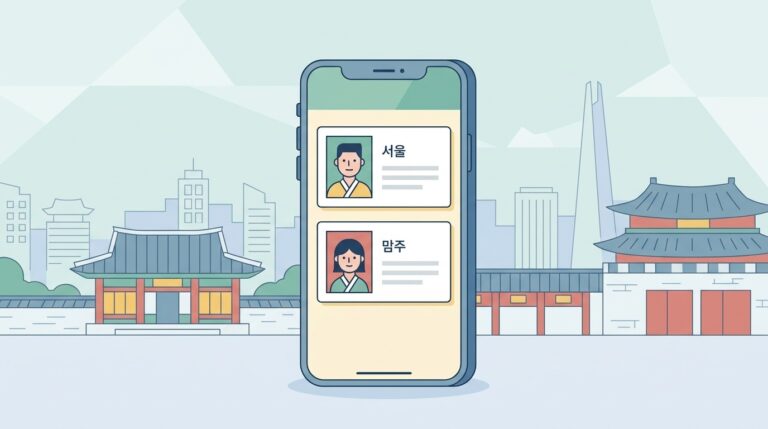
Phase 1: Empathy (Story-Immersive Opening)
안녕하세요! Welcome back to Daily Hangul! As your resident cultural navigator, let me paint a scenario that gives nearly every working professional in Seoul mild cold sweats.
Imagine this: It’s a Saturday evening in Hongdae. You just posted an aesthetic weekend vibe photo on your KakaoTalk profile—cocktail in hand, rocking leather jackets with close friends. But on Monday morning at 8:58 AM, your department head (부장님) leans over your cubicle, sips his black coffee, and remarks with a subtle smirk: “주말에 아주 힙하게 노시던데요? 체력 좋아서 이번 주 야근도 문제없겠어.” (“Looked like you had quite a hip weekend! With that stamina, overtime this week won’t be an issue, right?”)
In South Korea’s hyper-connected ecosystem where KakaoTalk is simultaneously your Slack, WhatsApp, family group chat, and dating messenger, privacy is an art form. This is precisely why 멀티 프로필 (Multi-Profiles) emerged as a digital survival tool. At a C2 mastery level, understanding multi-profiles isn’t just about app settings; it’s about mastering the sociolinguistic line (선, seon) between your professional persona (본캐) and personal authenticity (부캐). Based on feedback from expatriate managers and seasoned bilingual professionals in Korea, this masterclass unpacks the high-context nuances needed to navigate Korean digital boundaries effortlessly.
Phase 2: Core Expressions Deep Dive
1. 공과 사를 칼같이 구분하다 (Gong-gwa sareul kal-gachi gubunhada)
- Pronunciation: Gong-gwa sa-reul kal-ga-chi gu-bun-ha-da (Sounds like: Gong-gwa sah-reul kahl-gah-chee goo-boon-hah-dah — imagine the crisp slice of a chef’s knife: kal-gachi means literally “like a knife”).
- Meaning: Literal: “To distinguish public and private affairs like a knife.” / Nuance: “To draw an uncompromising, razor-sharp boundary between professional duty and personal life.”
- K-Culture Moment: Frequently heard in modern office K-dramas like Search: WWW or Agency when an assertive female executive rejects intrusive after-work drinking demands.
- Editor’s Insight: At the C2 level, using 칼같이 (knife-like) elevates standard expressions like 분리하다 (to separate) into native-grade rhetorical flair. It denotes efficiency, emotional discipline, and high boundary awareness.
- Situation Spectrum:
- Casual (Friends): ✅ “나 카톡 멀티 프로필로 공과 사 칼같이 구분하잖아.” (I divide public and personal life with surgical precision using Kakao multi-profiles.)
- Semi-formal (Colleagues): ✅ “업무 효율을 위해서라도 공과 사는 칼같이 구분하는 편이에요.”
- Formal (Interviews/Executives): ⚠️ (Use 공사를 철저히 분리하여 업무에 임합니다 instead).
- 🤔 Think About It: In Western cultures, “compartmentalization” is often assumed by using different platforms (e.g., Slack vs. iMessage). Why does Korean digital culture require compartmentalization within the exact same app?
2. 선을 넘지 않도록 세팅해 두다 (Seoneul neomji antorok setinghae duda)
- Pronunciation: Seon-eul neom-ji an-to-rok se-ting-hae du-da (Sounds like: Sun-eul num-jee ahn-toh-rohk seh-ting-hae doo-dah).
- Meaning: Literal: “To set things up in advance so that lines are not crossed.” / Nuance: “Proactively configuring digital filters to prevent awkward social boundary violations.”
- K-Culture Moment: A scene in a contemporary youth drama where a junior employee carefully assigns different profile pictures to blind dates versus university alumni.
- Editor’s Insight: 선 (Seon – Line) is a fundamental cultural pillar in Korean interpersonal dynamics (Nunchi). Crossing the line (선을 넘다) implies a breach of social hierarchy or privacy. Combining it with 세팅해 두다 illustrates a savvy, premeditated digital strategy.
- Situation Spectrum:
- Casual: ✅ “동기들한테는 기본 프로필 열고, 상사들한텐 선 안 넘게 멀티 프로필 걸어놨지.”
- Semi-formal: ✅ “불필요한 오해를 피하려고 사전에 선을 넘지 않도록 세팅해 뒀어요.”
- Formal: 🚫 (Slightly too colloquial due to the loanword 세팅).
- 🤔 Think About It: Does setting distinct profiles for coworkers imply distrust, or is it considered a polite form of emotional consideration in modern Korea?
3. 본캐와 부캐를 철저히 분리하다 (Bonkaewa bukaereul cheoljeohi bunrihada)
- Pronunciation: Bon-kae-wa bu-kae-reul cheol-jeo-hi bun-ri-ha-da (Sounds like: Bohn-keh-wah boo-keh-reul chul-juh-hee boon-ree-hah-dah).
- Meaning: Literal: “To thoroughly segregate the main character and sub-character.” / Nuance: “To maintain a flawless boundary between one’s primary professional identity and personal alter-ego.”
- K-Culture Moment: Popularized by variety shows like Hangout with Yoo (놀면 뭐하니?), where Yoo Jae-suk adopted producer or singer alter-egos, this gaming term (Main Character / Secondary Character) has become corporate survival slang.
- Editor’s Insight: C2 Korean requires mastery of cultural buzzwords converted into standard sociological discourse. Saying your Kakao profile protects your 부캐 (creative hobbies, nightlife, fan culture) immediately marks you as someone immersed in Seoul’s contemporary zeitgeist.
- Situation Spectrum:
- Casual: ✅ “회사 사람들은 내 부캐 절대 몰라야 해.”
- Semi-formal: ✅ “요즘은 워라밸만큼이나 본캐와 부캐의 분리가 필수적이죠.”
- Formal: ⚠️ (Replace with 직무적 자아와 개인적 자아의 균형 in corporate boardrooms).
- 🤔 Think About It: How does cultivating a “sub-character” in the digital realm reshape personal freedom within collectivist cultures?
Phase 3: Textbook Korean vs Real Korean
Situation A: Explaining why you hide your personal photos from coworkers
- 📖 Textbook Korean:
- 저는 직장 동료들에게 저의 사생활 사진을 보여주고 싶지 않아서 다른 프로필을 사용합니다.
- (Jeoneun jikjang dongnyodeurege jeoui sasaenghwal sajineul boyeojugo sipji anaseo dareun peuropireul sayonghamnida.)
- 🗣️ Real Native Korean (C2 Level):
- 괜히 사생활 노출돼서 입방아에 오르내리기 싫으니까, 회사용 프로필은 무난한 풍경 사진으로 박아뒀어요.
- (Gwaenhi sasaenghwal nochuldwaeseo ipbang-ae oreunaerigi sireunikka, hoesayong peuropireun munanhan punggyeong sajineuro bagadwosseoyo. – “I don’t want my private life exposed and gossiped about, so I just locked in a generic landscape photo for my work profile.”)
- 💡 Why is it different?: Native speakers use idiomatic compounds like 입방아에 오르내리다 (to be the subject of office gossip) and dynamic verbs like 박아두다 (to decisively set/pin something) rather than passive, literal textbook explanations.
Situation B: Asking a trusted colleague if they use separate profiles
- 📖 Textbook Korean:
- 당신도 카카오톡에서 멀티 프로필 기능을 활용하여 사생활을 보호하고 있습니까?
- (Dangsindo kakaotogeseo meolti peuropil gineungeul hwalyonghayeo sasaenghwareul bohogo itsseumnikka?)
- 🗣️ Real Native Korean (C2 Level):
- 대리님도 거래처나 상사용으로 멀티 프로필 따로 파서 관리하세요?
- (Daerinimdo georaecheona sangsayong-euro meolti peuropil ttaro paseogwallihaseyo? – “Assistant Manager, do you also carve out separate multi-profiles for clients and bosses?”)
- 💡 Why is it different?: Real Korean uses the colloquial verb 파다 (literally “to dig/carve out”, here meaning to create an account/profile) and addresses people by title rather than unnatural direct pronouns like 당신.
Phase 4: K-Culture Deep Dive & Non-Verbal Manners
4-1. Nunchi & KakaoTalk Digital Etiquette
In Korea, your KakaoTalk status message (상태 메시지), profile image (프사), and background music (프로필 뮤직) are read like non-verbal body language.
* The Blank Profile Dilemma: An entirely empty profile (기본 프사) can signal depression, social withdrawal, or passive-aggressive protest after an argument. If assigned to a boss, they might suspect you blocked them.
* The Corporate Sweet Spot: For your workplace multi-profile, standard etiquette dictates a crisp ID photo, a subtle nature photograph, or an inoffensive architectural shot with either no status message or a neutral polite quote (“감사하는 마음으로”).
* The Read Receipt Game (숫자 1): Deleting the “1” badge at 11:00 PM without replying (읽씹) is a major social transgression toward seniors. Conversely, deliberately ignoring the message without opening it (안읽씹) until 8:45 AM the next day is considered the tactful art of defensive digital Nunchi.
4-2. Cultural Code: Hyper-Connectivity vs. Digital Gyeokjo (격조/Distance)
Korean society transitioned into hyper-connectivity faster than almost any other nation. KakaoTalk integrated bank transfers, gift vouchers, taxi dispatch, and corporate communications under one hood. This created a phenomenon called 카톡 피로도 (KakaoTalk Burnout).
Multi-profiles are not an act of deception; they represent the digital evolution of 격식 (Formal Decorum). In traditional Korean etiquette, one changes speech levels (존댓말/반말) depending on social distance. A multi-profile is simply the visual grammatical conjugation of your digital identity.
Phase 5: Real-Life Roleplay Scenario
- Setting: A trendy café in Yeouido during lunch break.
- Characters:
- 민우 (Min-woo): Senior Associate at a fintech firm, master of corporate camouflage.
- 유진 (You / Eugene): Newly promoted project manager wanting to navigate boundaries without creating friction.
[Scene Start]

민우: 유진 씨, 지난주 주말에 서핑 다녀온 사진 본사 단톡방에 실수로 띄운 거 아니죠?
(Yujin ssi, jinanju jumare seoping danyeoon sajin bonsa dantokbange silssuro ttiun geo anijyo?)
"Eugene, you didn't accidentally post those surfing photos into the headquarters group chat last weekend, did you?"
🎭 [Smirks teasingly while stirring his iced Americano]

유진: 앗, 설마요! 저 입사하자마자 팀장님이랑 임원분들은 멀티 프로필로 묶어놨거든요.
(At, seolmayo! Jeo ipsahajamaja timjangnimirang imwonbundeureun meolti peuropillo mukkeonwatgeodeunyo.)
"Ah, no way! As soon as I joined, I grouped the team leader and executives into a multi-profile."
🎭 [Pats chest in relief, laughing softly]

민우: 오, 눈치 빠른데? 근데 멀티 프로필 설정할 때 기본 배경은 뭐로 해뒀어요?
(O, nunchi ppareunde? Geunde meolti peuropil seoljeonghal ttae gibon baegyeong-eun mworo haedwosseoyo?)
"Oh, quick on your feet! But what did you set as your default background for them?"
🎭 [Raises an eyebrow curiously]

유진: 그냥 깔끔한 제주도 바다 풍경이랑 '오늘도 화이팅'이라는 문구로 통일했어요.
(Geunyang kkalkkeumhan Jejudo bada punggyeong-irang 'oneuldo hwaiting'iraneun mung-guro tong-ilhaesseoyo.)
"I unified it with a clean Jeju ocean view and the phrase 'Cheer up today as well'."
🎭 [Shows phone screen proudly]

민우: 아주 정석이네. 너무 휑하면 차단당한 줄 알고 서운해하는 상사들도 있거든.
(Aju jeongseogine. Neomu hwenghamyeon chadandanghan jul algo seounhaehaneun sangsadeuldo itgeodeun.)
"Total textbook perfection. If it's too barren, some superiors feel offended thinking they got blocked."
🎭 [Nods approvingly]

유진: 맞아요. 지난번에 다른 부서 동기는 프사를 아예 내렸다가 한소리 들었대요.
(Majayo. Jinanbeone dareun buseo dong-gineun peusareul aye naeryeottaga hansori deureottaeyo.)
"Exactly. Last time, a peer in another department took down his profile photo completely and got scolded."
🎭 [Lowers voice conspiratorially]

민우: 크크, 공과 사를 그렇게 극단적으로 가르면 역효과 나지. 유진 씨처럼 유연하게 선을 그어야 롱런하는 거야.
(Keukeu, gong-gwa sareul geureoke geukdanjeogeuro gareumyeon yeokhpyogwa naji. Yujin ssicheoreom yuyeonhage seoneul geueoya rongreonhaneun geoya.)
"Haha, if you slice public and private life that drastically, it backfires. Drawing the line flexibly like you do is how you last long-term."
🎭 [Taps the table in agreement]

유진: 선배님한테 전수받은 노하우 덕분이죠. 커피는 제가 살게요!
(Seonbaenimhante jeonsubadeun nohau deokbunijyo. Keopineun jega salgeyo!)
"It's all thanks to the know-how passed down from you, Sunbae. Coffee's on me!"
🎭 [Smiles brightly and pulls out corporate card]
🔀 Interactive Branching Point
Your team leader suddenly asks you in a private chat: “유진 씨, 카톡 프로필 보니까 배경이 늘 똑같네? 요즘 무슨 취미 있어요?” (“Eugene, looking at your Kakao profile, your background is always the same? Do you have any hobbies these days?”). How do you respond?
- Option A: “팀장님 보시는 프로필은 회사용 멀티 프로필이라서요! 제 찐 프로필은 따로 있습니다.”
- ❌ Bad (Social Suicide): Overly direct. Calling out your own multi-profile destroys the polite illusion and embarrasses your superior.
- Option B: “아, 제가 사진 바꾸는 데 워낙 둔해서요! 주말엔 주로 조용히 전시회 다니거나 러닝 하면서 리프레시합니다.”
- 🏆 Best (Master of Nunchi): Seamlessly deflects by attributing the static profile to personal habit (둔해서), then provides a harmless, wholesome hobby that reinforces a positive corporate image.
- Option C: “네, 사생활은 회사에 공유하고 싶지 않아서 기본으로 해뒀습니다.”
- ⚠️ Risk (Passive-Aggressive): While honest, this creates immediate relational tension and labels you as uncooperative within the collectivist group framework.
Phase 6: 10-Second Emotion Shadowing Drill
Practice these natural rhythm pauses (/) with exact emotional pitch control:
- [🧊 차분하고 단호하게 – Calm and Resolute]
- “공과 사는 / 칼같이 구분해야 / 서로 피곤할 일이 / 안 생겨요.”
- (Gong-gwa saneun / kal-gachi gubunhaeya / seoro pigonhal iri / an saeng-gyeoyo.)
- “Only when public and private life / are sliced like a knife / can we prevent / mutually exhausting situations.”
- [🤫 은밀하고 능숙하게 – Conspiratorial & Savvy]
- “상사들 계정은 / 진작에 멀티 프로필로 / 싹 다 묶어놨죠 / 센스 있게.”
- (Sangsadeul gyejeong-eun / jinjage meolti peuropillo / ssak da mukkeonwatjyo / senseu itge.)
- “As for the bosses’ accounts / I bundled them all into multi-profiles long ago / completely clean / with good sense.”
- [😅 너스레를 떨며 – Playful Deflection]
- “제 찐 프사는 / 너무 봉인 해제 상태라 / 회사분들껜 / 절대 공개 불가예요!”
- (Je jjin peusaneun / neomu bong-in haeje sangtaera / hoesabundeulkken / jeoldae gonggae bulgayeoyo!
- “My real profile / is in total unsealed party mode / so toward coworkers / disclosure is absolutely impossible!”)
Phase 7: K-Culture Mini Dictionary
- 프사 (Peusa) / 배사 (Baesa)
- Meaning: Contractions for 프로필 사진 (Profile Picture) and 배경 사진 (Background Wallpaper).
- Usage Context: Essential daily slang. “너 프사 언제 바꿨어?” (“When did you change your profile pic?”)
- 안읽씹 (An-ik-ssip) vs. 읽씹 (Ik-ssip)
- Meaning: 안읽씹 (Not reading and ignoring) vs. 읽씹 (Reading and ignoring).
- Usage Context: High-level workplace politics. 안읽씹 maintains plausible deniability (“I was in meetings”), whereas 읽씹 is an overt social snub.
- 본캐 (Bon-kae) & 부캐 (Bu-kae)
- Meaning: Main character / Sub-character.
- Usage Context: Used to express professional versus side-hustle or creative identities without negative connotations.
- 박제하다 (Bakje-hada)
- Meaning: Literally “to taxidermy / preserve”; digitally “to screenshot and archive someone’s post/chat for exposure.”
- Usage Context: Why multi-profiles are vital: “단톡방에 쓴 거 박제당하기 전에 지워.” (“Delete what you wrote in the group chat before it gets screenshotted forever.”)
Phase 8: Expat & Professional Survival Kit
TOP 3 Workplace Kakao Survival Expressions
- “확인했습니다. 명일 업무 시간 내로 처리 후 회신드리겠습니다.”
- (Hwaginhaesseumnida. Myeong-il eopmu sigan naero cheori hu hoesindeurigesseumnida.)
- Pro Tip: The ultimate boundary defense for after-hours work messages. Acknowledges receipt while anchoring the execution strictly to tomorrow’s business hours.
- “퇴근 후라 세부 확인이 어려워, 출근 즉시 확인 후 보고드리겠습니다.”
- (Twegeun hura sebu hwagani eoryeowo, chulgeun jeuksi hwagin hu bogodeurigesseumnida.)
- Pro Tip: Politely signals that your work laptop is closed and you are physically disconnected.
- “사내 메신저로 관련 자료 송부드렸으니 편하실 때 확인 부탁드립니다.”
- (Sanae mesinjeoro gwanryeon jaryo songbodeuryeosseuni pyeonhasil ttae hwagin butakdeurimnida.)
- Pro Tip: Pushes personal KakaoTalk interactions back into the authorized corporate domain (Slack, Dooray, Teams).
Editor’s Travel & Expat Tech Note
- Multi-Profile Configuration Guide: When opening the app, ensure you verify your identity via 카카오톡 지갑 인증 (Kakao Wallet Certification) to unlock up to 3 distinct multi-profile slots.
- App Navigation: For real-time subway routing without business distractions, use the standalone 네이버 지도 앱 다운로드 (Naver Map Official Download) instead of Kakao-linked services when trying to stay low-profile during travel.
Phase 9: A Step Deeper (Reflective Essay)
In classical Confucian philosophy, relationships are governed by distinct duties and relational distances (오륜, Oryun). Far from being a modern Western invention of atomic individualism, the contemporary Korean practice of establishing multi-profiles on KakaoTalk is arguably a digital reconstitution of these traditional social spheres. When Koreans curate different digital facades for their parents, superiors, and intimate peers, they are not behaving hypocritically; rather, they are fulfilling the cultural imperative of 체면 (Social Face) and situational decorum. In a society that never sleeps, the multi-profile is our digital sanctuary—a quiet space where collective harmony and personal freedom strike an elegant truce.
💬 Your Turn: Have you ever experienced cross-cultural misunderstandings due to KakaoTalk or instant messenger etiquette in Korea? How do you manage your digital boundaries? Drop your thoughts in the comments below!
Phase 10: FAQ & Common Mistakes
Q: If I assign someone to a Multi-Profile, can they find out?
A: No. KakaoTalk never sends a notification. However, if your multi-profile looks suspiciously empty (no Kakao Story, no background music, no history) while you are known to be active online, an observant Korean colleague might deduce it using Nunchi. Keep a mild, generic photo uploaded.
Q: Can I use Multi-Profiles for Kakao group chats (단톡방)?
A: Yes! When joining or participating in a group chat, you can select which specific profile is visible to the members of that chat room, effectively shielding your identity from large networking circles.
Q: What is the biggest faux pas when managing Kakao profiles with Korean bosses?
A: Uploading provocative party photos, complaining about company workload in your status message, or setting melancholic K-indie break-up tracks as your profile BGM during high-stakes project weeks.
🚨 Common Mistakes Warning Board
- The “All-or-Nothing” Blank Profile: Blanking out your photo completely when stressed.
- Correct Action: Keep a default serene nature image to maintain corporate composure.
- Late-Night Read-Receipt Trap: Opening a boss’s message at 1:00 AM out of curiosity.
- Correct Action: Use notification bar previews or airplane mode tricks if you cannot respond immediately.
- Accidental Cross-Posting: Updating your main profile thinking it won’t affect clients who weren’t assigned to a multi-profile.
- Correct Action: Set your “Default Profile” to the conservative corporate one, and make your “Multi-Profile” the private one for trusted intimates.
Phase 11: Action Missions
- 🥉 Bronze Mission (Solo Practice): Draft three different status messages in Korean: one for your boss, one for your romantic partner, and one for your gym buddies.
- 🥈 Silver Mission (Social Engagement): Check your KakaoTalk friend list and sort your contacts into professional and personal categories.
- 🥇 Gold Mission (Real-world Execution): Create a secondary Kakao multi-profile with a tasteful landscape photo, and switch your professional contacts to this profile.
- 🎮 K-Culture Mission: Watch an episode of an office K-Drama (e.g., Misaeng or Gaus Electronics) and identify how characters use mobile communication to show deference to their superiors.
Phase 12: Interactive Quiz Challenge
Test your mastery of Korean digital nuances!
1. Contextual Judgment Quiz
Your senior manager (차장님) sends you a Kakao message on Sunday at 3:00 PM: “유진 씨, 월요일 회의 자료 초안 어디까지 됐지?” What is the most culturally adept C2 response?
👉 Click to reveal Answer & Explanation
- Correct Answer: “차장님, 주말 보내시는데 송구합니다. 현재 90% 완성되었으며, 내일 출근 즉시 8시 30분까지 최종 점검 후 출력해 책상에 올려두겠습니다!”
- Explanation: Acknowledges the disruption politely (주말 보내시는데 송구합니다), provides a precise metric (90%), and establishes firm execution at the start of the workday rather than engaging in endless weekend chatting.
2. Fill-in-the-Blank
Complete the native idiom for drawing a clean boundary between professional and private life:
* “그 사람은 회사에서 (_____)을/를 칼같이 구분하기로 유명하다.”
👉 Click to reveal Answer & Explanation
- Correct Answer: 공과 사 (Gong-gwa sa – Public and Private affairs).
- Explanation: The paired hanja phrase 공과 사 is the definitive standard paired with 칼같이 구분하다.
3. True or False Cultural Quiz
Statement: In Korean digital culture, deleting a profile picture entirely (기본 프사로 전환) is universally viewed as a neutral design preference and carries no emotional subtext.
👉 Click to reveal Answer & Explanation
- Correct Answer: False.
- Explanation: In high-context Korea, suddenly scrubbing your profile picture is frequently interpreted as an emotional distress signal (심경의 변화), relationship breakup, or silent protest, prompting friends to ask “무슨 일 있어?” (“Did something happen?”).






