

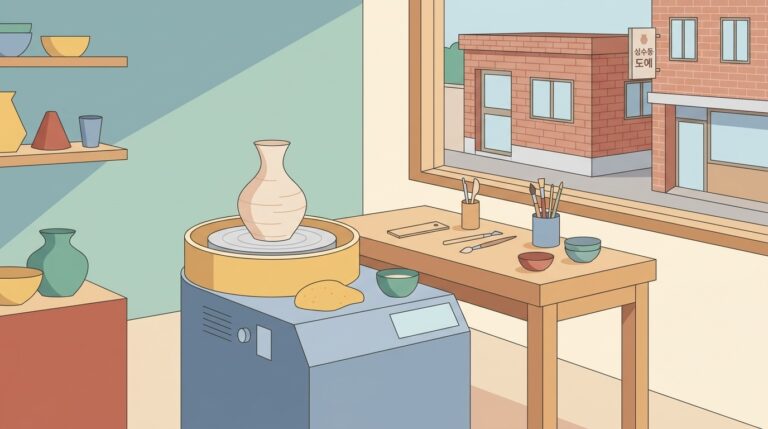
Finding Your ‘Sohwakhaeng’: The Master-Level Guide to Navigating Korean One-Day Artisan Workshops
Phase 1: Empathy (Story Immersion)
안녕하세요! 매일한글 에디터입니다. (Hello! I am your Daily Hangul editor.)
Picture this: You step off the bustling cobblestone alleyways of Seongsu-dong into a sun-drenched, minimalist ceramics studio scented with damp terracotta and subtle cedarwood. Four students sit quietly around spinning pottery wheels. The artisan instructor approaches your workstation, gently touches the clay rim you’ve been shaping, and makes a subtle, warm observation with an arched eyebrow and a soft smile.
At the C2 proficiency level, you don’t merely want to ask “이거 얼마예요?” (How much is this?) or say “재미있어요” (It is fun). You want to articulate the nuanced tactile friction of the clay, engage in witty self-effacing banter about your lack of manual dexterity, and converse about the contemporary Korean philosophy of Sohwakhaeng (소확행, small but certain happiness) without sounding like a robotic textbook.
Many advanced Korean learners hit a pragmatic wall when entering these intimate lifestyle spaces. You know how to debate economic policy or discuss formal news broadcasts, yet casual, atmospheric banter (스몰토크) in an artisanal workshop feels elusive. This guide is built directly on real feedback from advanced expatriates and lifestyle learners who wanted to bridge that exact gap. Let’s master the authentic verbal and non-verbal nuances of Korean one-day workshops together.
Phase 2: Core Expressions Deep Dive
1. 손재주가 남다르시네요 (Sonjaejuga namdareusineyo)
- Pronunciation: [Son-jae-jju-ga nam-da-reu-si-ne-yo] (Sounds like “sohn-jeh-joo-gah nahm-dah-reu-she-neh-yo”)
- Meaning: “You have an extraordinary flair with your hands” / “You have a distinct natural dexterity.”
- K-Culture Moment: Heard frequently in artisan variety shows like I Live Alone (나 혼자 산다) when guests visit leathercraft, baking, or perfumery workshops and display unexpectedly deft craftsmanship.
- Editor’s Insight: While beginners might say “손을 잘 써요” (which sounds uncomfortably literal and unnatural), 손재주 specifically encapsulates innate artistic handicraft skill. Pairing it with 남다르다 (to be extraordinary / set apart from others) delivers an elegant, high-register compliment that sounds effortless and gracious.
- Situation Spectrum: Casual ✅ | Semi-formal ✅ | Formal ✅
- 🤔 Think About It: In Korean social etiquette, compliments about inherent craft skill are often met with modest deflection rather than immediate agreement. How does your native language handle spontaneous praise during collaborative hobbies?
2. 온전히 나에게 집중하는 힐링의 시간이었어요 (Onjeonhi na-ege jipjunghaneun hilling-ui sigan-ieosseoyo)
- Pronunciation: [On-jeon-hi na-e-ge jip-jung-ha-neun hil-ling-eui si-gan-i-eoss-eo-yo] (Rhymes with “ohn-john-hee nah-eh-geh jeep-joong-hah-noon heal-ling-ee she-gahn-ee-uss-oh-yo”)
- Meaning: “It was a truly restorative time where I could focus entirely on myself.”
- K-Culture Moment: Commonly featured in lifestyle vlog reflections and calm documentary narrations exploring modern Seoulites escaping urban burnout (번아웃).
- Editor’s Insight: 온전히 means “wholly, purely, without defect or distraction.” In Korea’s hyper-connected society, framing hobby classes as an intentional act of sensory self-care (나에게 집중하는 시간) expresses sophisticated emotional self-awareness.
- Situation Spectrum: Casual ✅ | Semi-formal ✅ | Formal ⚠️
- 🤔 Think About It: Why has the loanword 힐링 (Healing) evolved in Korean to signify existential decompression and mindful detachment rather than medical recovery?
3. 투박하지만 그게 또 핸드메이드의 묘미죠 (Tubakhajiman geuge tto haendeumeideu-ui myomijyo)
- Pronunciation: [Tu-bak-ha-ji-man geu-ge tto haen-deu-me-i-deu-ui myo-mi-jyo] (Sounds like “too-bahk-hah-jee-mahn goo-geh toh hen-doo-meh-ee-doo-eui myoh-mee-joh”)
- Meaning: “It’s a bit rustic and unpolished, but that’s precisely the charming quirk of handmade goods.”
- K-Culture Moment: Used by seasoned participants when an asymmetrical ceramic bowl or a slightly uneven leather stitch is revealed at the end of a workshop.
- Editor’s Insight: 투박하다 describes an earthy, raw, unrefined aesthetic (similar to the Japanese wabi-sabi), while 묘미 refers to the subtle, unique charm or secret zest of an activity. It demonstrates that you appreciate beauty in imperfection.
- Situation Spectrum: Casual ✅ | Semi-formal ✅ | Formal 🚫
- 🤔 Think About It: Contrast the perfectionist craft ethos with this celebration of 투박함 (rustic charm). How does this linguistic balance reflect modern Korea’s shifting values toward individuality?
Phase 3: Textbook Korean vs. Real Native Korean
Scenario 1: Asking the instructor if your work is salvageable after a slip
- 📖 Textbook Korean: 선생님, 제가 이것을 잘못 만들었습니까? 고칠 수 있습니까? (Seonsaengnim, jega igeoseul jalmot mandeureossseumnikka? Gochil su itsseumnikka? – “Teacher, did I make this incorrectly? Can you fix it?”)
- 🗣️ Real C2 Korean: 선생님, 제가 너무 힘을 줬는지 살짝 찌그러졌는데, 수습 가능할까요? (Seonsaengnim, jega neomu himeul jwonneunji saljjak jjigeureojyeonneunde, suseup ganeunghalkkayo? – “Teacher, I think I applied too much pressure and warped it slightly. Is this salvageable?”)
- 💡 Why it differs: Textbook Korean sounds interrogative and stiff. Advanced native speakers utilize epistemic softening (~는지), vivid sensory descriptors (찌그러지다), and administrative-turned-colloquial rescue vocabulary (수습하다 – to salvage/clean up a mess).
Scenario 2: Wrapping up the class with deep aesthetic satisfaction
- 📖 Textbook Korean: 오늘 수업은 저에게 큰 행복과 기쁨을 주었습니다. (Oneul sueob-eun jeo-ege keun haengbok-gwa gippeum-eul jueossseumnida. – “Today’s class gave me great happiness and joy.”)
- 🗣️ Real C2 Korean: 복잡한 생각 싹 비우고, 간만에 제대로 힐링하고 가요. (Bokjaphan saenggak ssak biugo, ganmane jedaero hillinghago gayo. – “I completely emptied out my cluttered thoughts; it’s been ages since I had such a genuine therapeutic recharge before heading out.”)
- 💡 Why it differs: Native C2 speakers prefer dynamic sensory verbs (생각을 싹 비우다 – to clear thoughts completely) and idiomatic lifestyle markers (간만에 제대로 – genuinely after a long time) over abstract textbook declarations of happiness.
Phase 4: K-Culture Deep Dive & Non-Verbal Manners
4-1. 눈치 (Nunchi) & Atelier Gestures
One-day classes in Korea are communal yet quietly personal spaces. To project cultural finesse:
* The Reciprocal Glance: When neighboring students complete a tricky step, offer a discreet approving nod (끄덕임) and a soft smile rather than loud cheers, which preserves the studio’s acoustic calm.
* Two-Handed Tool Etiquette: When sharing carving tools, heat guns, or fragrance droppers, pass them with both hands or with your right hand supported lightly at the elbow/wrist by your left hand (공손한 손 자세).
* The Humble Pivot: When the teacher compliments your piece, gently touch the back of your neck or tilt your head slightly and say, “선생님이 거의 다 살려주셨죠” (The teacher pretty much rescued it all).
4-2. Cultural Code: The Boom of ‘Sohwakhaeng’ One-Day Classes
In an era dominated by hyper-competitive corporate sprints (갓생 – God-life productivity culture), Korean young professionals have embraced one-day workshops—ranging from traditional mother-of-pearl crafts (자개공예) to custom bespoke perfumery (나만의 향수 만들기)—as tactical sanctuaries. It represents a shift from conspicuous consumption to tactile mindfulness: creating something tangible with one’s own hands within a finite two-hour window provides guaranteed micro-accomplishment (소확행).
Phase 5: Live Roleplay Scenario
Setting: Atelier Wolha (달빛 공방), a quiet boutique ceramics workshop tucked away in Ikseon-dong. Classical Lo-Fi melodies drift through the air.
Characters:
* 민 공방장 (Master Potter Min): An observant, warm artisan in her late 30s wearing a charcoal linen apron.
* You (C2 Craft Enthusiast): An advanced Korean learner perfecting a hand-built white porcelain tea bowl (달항아리 다기).
민 공방장: 흙을 다루실 때 손 끝 감각이 아주 섬세하시네요. 물레 돌아가는 속도랑 호흡이 딱 맞아요.
(Heulgeul darusil ttae son kkeut gamgagi aju seomsehasi-neyo. Mulle doraganeun sokdorang hohobi ttak majayo.)
[Your fingertip sensitivity when handling the clay is remarkably delicate. Your breathing matches the wheel's rotation perfectly.]
🎭 행동: 민 공방장이 당신의 손 모양을 유심히 지켜보며 따뜻하게 고개를 끄덕인다.

You: 아이고, 과찬이세요. 사실 손에 힘을 어디까지 빼야 할지 몰라서 계속 눈치만 보고 있었거든요.
(Aigo, gwachan-iseyo. Sasil sone himeul eodikkaji ppaeya halji mollaseo gyesok nunchiman bogo isseotgeodeunyo.)
[Oh, you flatter me! Honestly, I didn't know how much tension to release from my hands, so I was just scanning the room nervously.]
🎭 행동: 부끄러운 듯 살짝 웃으며 페달에서 발을 떼고 흙 묻은 앞치마를 쳐다본다.

민 공방장: 하하, 전혀 그렇게 안 보여요. 지금 형태가 아주 단아하게 잘 빠졌어요. 굽을 조금 더 깎아낼까요?
(Haha, jeonhyeo geureohge an boyeoyo. Jigeum hyeongtaega aju dan-ahage jal ppajyeosseoyo. Gubeul jogeum deo kkakka-naelkkayo?)
[Haha, it doesn't look like that at all. The shape has emerged very elegantly. Shall we trim the foot ring a bit more?]
🎭 행동: 스펀지로 다기 바닥의 물기를 가볍게 닦아낸다.

You: 네, 밑부분이 살짝 투박한 느낌도 좋은데, 선생님 손길 닿아서 좀 더 날렵해지면 완벽할 것 같아요.
(Ne, mitbubuni saljjak tubakhan neukkimdo joeunde, seonsaengnim songil dahaseo jom deo nallyeophaejimyeon wanbyeokhalk geot gatayo.)
[Yes, I like this slightly rustic base, but if your touch makes it a bit more sleek, it would be truly perfect.]
🎭 행동: 두 손으로 조각칼을 공손하게 건넨다.

민 공방장: 좋습니다. 평소에 복잡했던 잡념들은 좀 비워지셨나요?
(Jotsseumnida. Pyeongsoe bokjaphaetdeon jamnyeomdeureun jom biwojisyeonnayo?)
[Sounds great. Have you managed to clear away the cluttered thoughts from your daily routine?]
🎭 행동: 칼 끝으로 섬세하게 여분의 점토를 깎아낸다.

You: 네, 온전히 손끝 촉감에만 몰입하다 보니까 시간 가는 줄도 몰랐어요. 찐 힐링이네요.
(Ne, onjeonhi sonkkeut chokgam-eman moriphada bonikka sigan ganeun juldo mollasseoyo. Jjin hilling-ineyyo.)
[Yes, being completely immersed in the tactile touch of my fingertips made time fly. This is genuine restorative healing.]
🎭 행동: 완성되어 가는 다기를 보며 깊은 숨을 내쉰다.

민 공방장: 가마에서 구워져 나오면 유약 색감이 훨씬 오묘해질 거예요. 3주 뒤에 기대하셔도 좋습니다.
(Gama-eseo guwojyeo naomyeon yuyak saekgami hwolssin omyo-haejil geoyeyo. Samju dwie gidaehasiyeodo jotsseumnida.)
[Once it's fired in the kiln, the glaze depth will become far more wondrously subtle. You can look forward to it in three weeks.]
🎭 행동: 조심스럽게 건조대 선반으로 완성작을 옮긴다.

You: 정성껏 구워주세요! 제 첫 작품이라 벌써부터 애착이 남다르네요.
(Jeongseongkkeot guwojuseyo! Je cheot jakpum-ira beolsseobuteo aechagi namdareuneyo.)
[Please fire it with care! Since it's my very first piece, I already feel an extraordinary attachment to it.]
🎭 행동: 두 손을 모아 가볍게 목례한다.
🔀 Interactive Choice Point
The instructor says: “어머, 다기 주둥이 부분이 살짝 비대칭으로 나왔는데, 다시 빚으실래요?” (Oh dear, the spout of the tea bowl came out slightly asymmetrical. Would you like to reshape it?)
- Option A: “아닙니다. 제가 원래 완벽한 대칭보다는 비대칭의 자연스러움을 선호해서 이대로 굽고 싶습니다.” (Formal, overly defensive, sounds like an academic essay.)
- ⚠️ Feedback (Risk): Correct grammar, but overly rigid and argumentative for a cozy studio setting.
- Option B: “아니에요! 살짝 삐뚤빼뚤한 게 오히려 핸드메이드 감성 제대로인 것 같아서 이대로 갈게요!” (Energetic, natural mimetic word usage 삐뚤빼뚤, captures modern casual aesthetic.)
- ✨ Feedback (Best): Perfect native colloquial phrasing! Demonstrates playful self-acceptance and emotional fluency.
- Option C: “선생님이 알아서 고쳐주시면 안 돼요? 귀찮아요.” (Blunt, demanding, violates relational harmony.)
- 🚫 Feedback (Bad): Highly discourteous. Undermines the spirit of personal craftsmanship and disrespects the instructor.
Phase 6: 10-Second Emotional Shadowing Drill
Practice reading these out loud, observing the emotional delivery and the slash (/) pause markers!
[🌿 평온하고 차분하게 / Calm & Mindful]
“복잡한 일상에서 벗어나서 / 온전히 흙의 감촉에 집중하니까 / 머릿속이 맑아지네요.”
(Bokjaphan ilsang-eseo beoseonaseo / onjeonhi heulgui gamchoge jipjunghanikka / meoritsogi malgajineyo.)-
[✨ 감탄하며 겸손하게 / Gracious & Modest]
“제가 손재주가 워낙 없어서 걱정했는데 / 선생님 덕분에 / 그럴듯한 작품이 나왔어요!”
(Jega sonjaejuga wonak eopseoseo geokjeonghaenneunde / seonsaengnim deokbune / geureoldeushan jakpumi nawasseoyo!) -
[😊 유쾌하고 애착 가득하게 / Playful & Fondly Attached]
“조금 삐뚤빼뚤해도 / 제 손때 묻은 첫 작품이라 / 볼수록 정이 가네요.”
(Jogeum ppittulppaettulhaedo / je sonttae mudeun cheot jakpumira / bolsurok jeongi ganeyo.)
Phase 7: K-Culture Mini Dictionary
- 소확행 (Sohwakhaeng) | Small but Certain Happiness
- Originating from a Haruki Murakami essay and adapted widely into contemporary Korean discourse, it refers to accessible micro-luxuries (e.g., a two-hour baking class, a warm pastry) that alleviate systemic work fatigue.
- 금손 vs. 똥손 (Geumson vs. Ttongson) | “Golden Hands” (Master Artisan) vs. “Dung Hands” (Hopelessly Clumsy)
- Essential self-deprecating slang used in workshops. Saying “저 완전 똥손인데 괜찮을까요?” immediately breaks the ice with instructors.
- 물멍 / 흙멍 (Mul-meong / Heuk-meong) | Zoning out while gazing at water / clay
- The noun suffix -멍 denotes a meditative state of staring blankly at sensory elements to reset an overstimulated brain.
- 애착템 (Ae-chak-tem) | Cherished Item of Deep Emotional Attachment
- A compound of 애착 (attachment) and 아이템 (item). Commonly used to describe a handmade ceramic cup or perfume you crafted yourself.
Phase 8: Traveler’s Survival Kit for Booking & Classes
Top 3 Survival Expressions
- 초보자도 무리 없이 따라갈 수 있는 난이도인가요?
(Choboja-do muri eopsi ttaragal su inneun nan-ido-ingayo?)
Pro Tip: Use when messaging workshops on Instagram or booking platforms to assess required prerequisite skills. - 혹시 굳는 데 / 완성까지 기간이 얼마나 소요되나요?
(Hoksi ginneun de / wanseong-kkaji gigani eolmana soyodoenayo?)
Pro Tip: Crucial for travelers making ceramics, soaps, or leathercraft that require curing or kiln firing before departure. - 해외 배송이나 픽업 일정 조율이 가능할까요?
(Hae-oe baesong-ina pik-eop iljeong joyuri ganeunghalkkayo?)
Pro Tip: Essential for ensuring your delicate finished pieces reach your hotel or international address.
Editor’s Travel Note
- Top Booking Apps: Download and book through platforms like the 솜씨당 (Somsidang) 원데이 클래스 예약 앱 or search curated local studios via the 네이버 지도 (Naver Map) 앱. Search using the query
성수동 원데이클래스(Seongsu-dong one-day class) or망원동 공방(Mangwon-dong atelier). - Payment & Manners: Most boutique studios prefer payment via Naver Pay or local credit cards at reservation. Arrive 10 minutes early; arriving late disrupts the delicate step-by-step group demonstration.
Phase 9: A Step Deeper (Reflective Insight)
In hyper-compressed modern societies, leisure often risks becoming another metric of performative achievement. However, the Korean one-day class phenomenon represents a fascinating socio-cultural counter-movement. By stepping into an atelier where physical materials resist instant digital gratification—where clay warps if rushed and perfume accords need patience to balance—participants reclaim tactile autonomy. It is not about becoming a professional potter or perfumer in two hours; it is about legitimizing non-productive, delicate time spent solely for oneself.
💬 Your Turn: Have you ever experienced 소확행 while engaging in an artistic hobby? What craft class would you love to take in Korea? Share your thoughts below in Korean!
Phase 10: FAQ & Common Mistakes
Q: Can I speak informally (반말) to the workshop teacher if they are younger than me?
A: Absolutely not. Regardless of relative age, artisan instructors are addressed with high respect as 선생님 (Teacher) or 작가님 (Artist/Author) using polished 해요체 or 하십시오체.
Q: What is the subtle difference between “체험” and “클래스” in workshop names?
A: 체험 (Che-heom) implies a light, experiential activity oriented toward tourists or families with minimal technique instruction. 원데이 클래스 (One-day Class) suggests a more focused, technique-driven lifestyle lesson targeting adults.
Q: How do I politely decline an instructor’s offer to completely take over and fix my flawed piece?
A: Say with a warm smile: “조금 어설퍼도 제 손으로 직접 마무리해보고 싶어요. 지켜봐 주실 수 있나요?” (Even if it’s a bit clumsy, I’d like to finish it directly with my own hands. Could you watch over me?)
🚨 Common Mistakes Alert
| Mistake | Why It Fails | Correct Native Action |
|---|---|---|
| Calling the studio owner 사장님 (Business Boss) | Strips away the creative, artisanal identity of the craftsperson. | Address them as 선생님 (Teacher) or 작가님 (Artist). |
| Saying “이거 망했어요” (This is ruined/destroyed) too dramatically | Creates awkward social tension in a peaceful workshop. | Soften with humor: “살짝 제 통제를 벗어났네요” (It slipped slightly out of my control). |
| Staying totally silent out of fear of making grammar mistakes | Deprives you of nuanced technical feedback and warm connection. | Use hedging starters: “제가 감이 잘 안 잡히는데…” (I haven’t quite gotten the hang of it yet…). |
Phase 11: Action Missions
- 🥉 Bronze Level: Practice the Phase 6 Shadowing Drills 3 times, focusing on natural pauses at the
/marks. - 🥈 Silver Level: Leave a comment below using the words 소확행, 손재주, and 힐링 in a coherent 2-sentence personal reflection.
- 🥇 Gold Level: Search an actual Korean craft studio on Instagram (e.g., searching
#도예원데이클래스), and leave an inquiry using the phrase: “초보자도 원활하게 참여 가능한지 문의드립니다!” - 🎮 K-Culture Mission: Watch an episode of a Korean hobby variety show (e.g., I Live Alone or Omniscient Interfering View) and write down 2 distinct aesthetic descriptors the cast members use when examining handmade crafts.
Phase 12: Interactive Quiz Challenge
Test your situational mastery and cultural intuition!
1. [Situational Judgment] You are in a fragrance workshop in Hannam-dong and want to express that the scent balance is subtle and complex rather than overly strong. Which phrase is best?
* (A) 냄새가 너무 심하지 않고 복잡해요.
* (B) 향이 자극적이지 않고 잔향이 참 오묘하네요.
* (C) 향수 성능이 아주 훌륭해서 기쁩니다.
2. [Fill in the Blank] Fill in the blank with the appropriate C2-level idiom of attachment:
“비록 모양은 조금 삐뚤빼뚤하지만, 제 _________ 묻은 작품이라 더 정이 가요.”
* (A) 발자국 (Footprint)
* (B) 손때 (Hand-wear / Touch of hands)
* (C) 귓등 (Back of ear)
3. [True / False Cultural Nuance] In modern Korean craft culture, self-deprecatingly referring to yourself as a 똥손 (Ttongson) is considered rude and offensive to the instructor.
* (A) True
* (B) False
👉 Click here to reveal answers and explanations!
Answer Key & Explanations
-
Answer: (B)
Explanation: 오묘하다 (mysterious, profound, subtly exquisite) and 잔향 (lingering base scent/dry-down) are the gold standard aesthetic terms in modern Korean perfumery. Option (A) uses 냄새 (which can denote unpleasant odors), and (C) sounds like an engineering review. -
Answer: (B) 손때
Explanation: 손때가 묻다 literally means “to be touched and worn by one’s hands over time,” signifying warm, affectionate familiarity and personal dedication. -
Answer: (B) False
Explanation: Calling oneself a 똥손 is a widely accepted, endearing piece of self-effacing humor that breaks tension and invites the teacher to guide you with extra warmth!







