

Talk About K-Drama Endings Like a Real Native
Phase 1: Empathy (Story-Driven Opening)
안녕하세요! 매일한글 에디터입니다. (Hello! I am your Daily Hangul editor.)
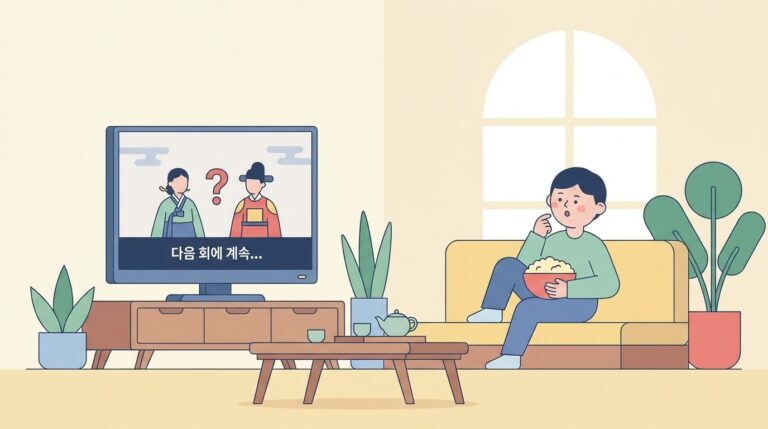
Picture this: It is 2:00 AM on a Sunday. You are curled up under your blanket, eyes glued to your screen, watching the penultimate episode of your favorite K-drama. The music swells, the screen fades to black on a massive cliffhanger, and your jaw drops. You immediately grab your phone to text your Korean friend who recommended this show. You want to ask, “Wait, do they end up together? How does it end?!”
However, you freeze. In your textbook, you learned stiff phrases like “결말을 알고 싶습니다” (I desire to know the conclusion), which sounds like you are submitting a formal police report rather than venting drama excitement! If you simply say “끝?” (End?), your friend might not grasp the sheer emotional rollercoaster you are on.
As a Korean culture navigator with over a decade of tutoring global fans, I have seen so many learners struggle with this exact moment. Talking about dramas is the ultimate bonding bridge in Korean social life. In this lesson, you will master natural, lively A2-level Korean expressions to say you are dying to know the ending, politely forbid spoilers, and chat about plot twists just like a Seoul local!
Phase 2: Core 3 Expressions Deep Dive
1. 결말이 너무 궁금해요! (Gyeolmari neomu gunggeumhaeyo!)
- Pronunciation: Gyeol-ma-ri neo-mu goong-goom-hae-yo! (Sounds like: Gyul-mah-ree nuh-moo goong-goom-heh-yoh!)
- Meaning: Literal: “The conclusion is very wonder-inducing!” | Natural: “I am so curious about the ending!” / “I am dying to know how it ends!”
- K-Culture Moment: Used right when a cliffhanger drops at the end of episode 15 and you are discussing theories with friends over iced Americanos.
- Editor’s Insight: ‘궁금하다’ (gung-geum-ha-da) expresses that ticklish, restless curiosity inside your heart. Adding ‘너무’ (neomu – so/very) makes your excitement super authentic.
- Situation Spectrum: Casual: ⚠️ (Say 결말 너무 궁금해!) | Semi-formal: ✅ | Formal: ✅
- 🤔 Think About It: In English, we say “I want to know,” focusing on our active desire. Korean often describes the internal emotional state (“It is curious to me”). How does shifting from action to feeling change the mood?
2. 어떻게 끝나요? (Eotteoke kkeunnnayo?)
- Pronunciation: Eo-tteo-ke kkeun-na-yo? (Sounds like: Uh-tuh-keh kkeun-nah-yoh? Notice the soft n sound in 끝나요!)
- Meaning: Literal: “How does it finish?” | Natural: “How does it end?”
- K-Culture Moment: Asking your friend who already finished the series whether your favorite couple makes it, without asking for every single plot detail.
- Editor’s Insight: The question ending ‘-나요?’ (-nayo?) softens your inquiry, making you sound friendly and conversational rather than demanding.
- Situation Spectrum: Casual: ⚠️ (Say 어떻게 끝나?) | Semi-formal: ✅ | Formal: ✅
- 🤔 Think About It: Why does Korean have multiple ways to ask questions (-나요?, -어요?, -습니까?) depending on how soft or formal you want to sound?
3. 스포 하지 마세요! (Seupo haji maseyo!)
- Pronunciation: Seu-po ha-ji ma-se-yo! (Sounds like: Spoh hah-jee mah-seh-yoh!)
- Meaning: Literal: “Do not do spo!” | Natural: “No spoilers, please!” / “Don’t spoil it!”
- K-Culture Moment: When your friend smirks and says, “Do you know who the actual villain is?” and you instantly wave your hands in panic.
- Editor’s Insight: ‘스포’ (Seupo) is the quintessential Korean slang abbreviation for ‘스포일러’ (Spoiler). Koreans love 2-syllable abbreviations!
- Situation Spectrum: Casual: ⚠️ (Say 스포 하지 마!) | Semi-formal: ✅ | Formal: 🚫 (In formal writing, use 스포일러를 삼가 주세요)
- 🤔 Think About It: Modern Korean incorporates English loanwords by shortening them into catchy two-syllable terms. What shortened slang words exist in your native language?
Phase 3: Textbook Korean vs. Real Korean
Situation 1: Asking how a story concludes
- 📖 교과서 한국어 (Textbook): 결말을 알고 싶습니다. (Gyeolmareul algo sipseumnida. – I desire to know the ending.)
- 🗣️ 진짜 한국어 (Real-Life): 결말 어떻게 돼요? (Gyeolmal eotteoke dwaeyo? – How does the ending turn out?)
- 💡 왜 다를까? (Why is it different?): Textbook phrasing sounds like an interrogation or an academic inquiry. In everyday conversations, native speakers ask “어떻게 돼요?” (How does it become/turn out?) to keep the dialogue warm and natural.
Situation 2: Stopping someone from ruining the ending
- 📖 교과서 한국어 (Textbook): 결말을 말하지 마십시오. (Gyeolmareul malhaji masipsio. – Do not speak of the conclusion.)
- 🗣️ 진짜 한국어 (Real-Life): 쉿! 스포 금지예요! (Swit! Seupo geumji-yeyo! – Shh! Spoilers forbidden!)
- 💡 왜 다를까? (Why is it different?): Instead of long negative imperative verbs, Koreans love playful, punchy sign-like expressions such as “스포 금지” (No spoilers allowed) with a finger across their lips.
Phase 4: K-Culture Deep Dive & Non-Verbal Manners
4-1. 눈치 (Nunchi) & Gestures
When talking about K-dramas with Korean friends, non-verbal cues are half the fun:
* 귀 막기 (Covering your ears): If someone threatens a spoiler, humorously cover your ears with both hands and shake your head while saying “안 들려요!” (I can’t hear you!).
* 손사래 치기 (Hand wave of refusal): Gently wave your open hand left and right across your chest while saying “스포 금지!” to signal a polite, playful boundary.
4-2. Cultural Code: 본방사수 vs. 정주행
K-Drama viewers in Korea generally fall into two camps: those who practice 본방사수 (Bon-bang-sa-su, defending the original live broadcast by watching at the exact airtime) and those who wait until the entire series finishes to do a 정주행 (Jeong-ju-haeng, uninterrupted binge-watching from episode 1 to the end). If you are talking to a “본방사수” fan, beware: they have already seen the latest twist, so protect yourself with “스포 하지 마세요!”
Phase 5: Real-World Roleplay Scenario
Setting: A trendy cafe in Hongdae, Seoul. You are having coffee with your Korean friend Minwoo (민우), who is an obsessive K-Drama watcher.
- 민우 (Minwoo): 너 요즘 그 드라마 봐? 🎭 [눈을 반짝이며 커피를 내려놓는다]
(Neo yojeum geu drama bwa?)
“Are you watching that drama these days?” - 나 (Learner): 응! 어제 15화까지 봤어요. 🎭 [상기된 얼굴로 끄덕이며]
(Eung! Eoje sibohwa-kkaji bwasseoyo.)
“Yes! I watched up to episode 15 yesterday.” - 민우 (Minwoo): 대박! 나 어제 마지막 화 본방사수했잖아. 🎭 [의기양양한 미소를 지으며]
(Daebak! Na eoje majimak hwa bonbangsasu-haetjana.)
“No way! You know I watched the live finale yesterday, right?” - 나 (Learner): 진짜요? 결말이 너무 궁금해요! 🎭 [두 손을 모으며 기대에 찬 눈빛으로]
(Jinjja-yo? Gyeolmari neomu gunggeumhaeyo!)
“Really? I am dying to know the ending!” - 민우 (Minwoo): 결말 진짜 반전이야. 알려줄까? 🎭 [장난기 가득한 표정으로 귓속말하듯 다가온다]
(Gyeolmal jinjja banjeon-iya. Allyeojulkka?)
“The ending is a massive plot twist. Want me to tell you?” - 나 (Learner): 아, 안 돼요! 스포 하지 마세요! 🎭 [손사래를 치며 웃는다]
(A, an dwaeyo! Seupo haji maseyo!)
“Ah, no way! Don’t spoil it, please!” - 민우 (Minwoo): 알겠어, 쉿! 해피엔딩인지만 말해줄게. 🎭 [입술에 손가락을 대며]
(Algesseo, swit! Haepi-ending-injiman malhae-julge.)
“Alright, shh! I will only tell you if it is a happy ending.” - 나 (Learner): 좋아요! 그것만 알려줘요. 🎭 [안도하며 웃음 짓는다]
(Joayo! Geugeotman allyeojwoyo.)
“Great! Just tell me that much.”
🔀 Interactive Decision Point
How would you respond if Minwoo insists on revealing the ending?
- Choice A: “다 말해줘요! 결말 어떻게 돼요?” (Da malhaejwoyo! Gyeolmal eotteoke dwaeyo? – Tell me everything! How does it end?)
- 👉 Feedback: Good if you crave immediate answers! It keeps the hype going, but you might lose the thrill of watching the finale yourself.
- Choice B: “스포 금지! 나중에 내가 직접 볼래요.” (Seupo geumji! Najunge naega jikjeop bollaeyo. – No spoilers! I want to see it myself later.)
- 👉 Feedback (Best!): Perfect conversational Korean! It sets a friendly boundary while showing you respect your own viewing experience.
- Choice C: “결말을 알고 싶지 않습니다.” (Gyeolmareul algo sipji anseumnida. – I do not desire to know the ending.)
- 👉 Feedback (Awkward): Grammatically correct, but far too stiff for a friendly cafe hangout. Minwoo might think you are upset.
Phase 6: 10-Second Emotion Shadowing Drill
Practice reading these lines aloud with the rhythmic pauses marked by /:
- [🥺 호기심 가득하게 / Overflowing with Curiosity]
결말이 / 너무 / 궁금해요!
(Gyeol-ma-ri / neo-mu / goong-goom-hae-yo!)
“I am dying / to know / the ending!” -
[😱 다급하게 귀를 막으며 / Panicking & Covering Ears]
안 돼요! / 스포 / 하지 마세요!
(An dwae-yo! / Seu-po / ha-ji ma-se-yo!)
“No way! / Spoilers / do not do, please!” -
[😊 눈을 반짝이며 / Eyes Sparkling with Hope]
제발 / 해피엔딩이면 / 좋겠어요!
(Je-bal / hae-pi-en-ding-i-myeon / jo-kes-seo-yo!)
“Please / if it is a happy ending / that would be wonderful!”
Phase 7: K-Culture Mini Dictionary
- 정주행 (Jeong-ju-haeng)
- Meaning: Binge-watching a series from start to finish.
- Usage: “주말에 드라마 정주행했어요.” (I binge-watched the drama over the weekend.)
- 반전 (Ban-jeon)
- Meaning: A dramatic plot twist or unexpected reversal.
- Usage: “마지막 회에 진짜 큰 반전이 있어요.” (There is a really big twist in the final episode.)
- 본방사수 (Bon-bang-sa-su)
- Meaning: Defending and watching the live broadcast premiere as it airs.
- Usage: “오늘 밤 10시에 본방사수할 거예요!” (I will watch the live broadcast tonight at 10 PM!)
- 떡밥 (Tteok-bap)
- Meaning: Plot bait, clues, or foreshadowing hints dropped by writers.
- Usage: “드라마 속 떡밥이 다 풀렸어요.” (All the plot clues in the drama were resolved.)
Phase 8: Survival Kit for Travelers
Top 3 Drama-Fan Survival Phrases
- 1. “이 드라마 재미있어요?” (I drama jaemi-isseoyo?)
- Pro Tip: Ask this to staff at cafes or convenience stores if you notice a drama playing on TV.
- 2. “해피엔딩이에요, 새드엔딩이에요?” (Haepi-ending-ieyo, saedeu-ending-ieyo?)
- Pro Tip: A quick, spoiler-free check to prepare your tissue box before watching.
- 3. “스포일러 조심해 주세요!” (Seupoilleo josimhae juseyo!)
- Pro Tip: Use this polite phrase if a tour guide or friend starts talking about a drama filming location you haven’t finished watching.
Editor’s Travel Note
If you are visiting famous K-Drama filming spots around Seoul (such as the Bukchon Hanok Village or Hangang Park), make sure you check accurate routes on [Naver Map app navigation for Korean travel routes]. Also, remember to wear earbuds if you are watching drama episodes on public subways or buses—watching with sound on the train is considered bad etiquette!
Phase 9: A Deeper Step (Cultural Insight)
In Korean culture, watching a drama is rarely an isolated hobby; it is a shared emotional experience grounded in 공감 (Gong-gam, emotional resonance) and 정 (Jeong, relational bond). When Koreans discuss cliffhangers and endings, they are not just sharing plot points—they are building camaraderie through shared tension and vulnerability. Asking “결말이 너무 궁금해요!” is an invitation to connect, laugh, and speculate together.
💬 Your Turn: What was the most shocking K-Drama ending you have ever witnessed? How would you react in Korean if someone tried to spoil it? Leave your answer in the comments below!
Phase 10: FAQ & Common Mistakes
Q: Can I use the slang “스포” (Seupo) in a professional or formal workplace setting?
A: It is best avoided in formal business presentations or professional reports. In formal Korean, use the full word “스포일러” (seupoilleo) or “결말 정보” (geolmal jeongbo – ending information).
Q: What is the exact difference between “끝” (Kkeut) and “결말” (Gyeolmal)?
A: “끝” (kkeut) simply means “end” or “finish” in a general sense (e.g., the end of a class, line, or road). “결말” (gyeolmal) specifically refers to the narrative conclusion or outcome of a story, novel, drama, or movie.
Q: How do I ask if the lead actors end up dating in Korean?
A: You can naturally ask: “둘이 이어져요?” (Duri ieojyeoyo? – Do the two end up together/connected?).
🚨 Common Mistakes Alert Board
- ❌ Mistake: Saying “스포일 하지 마세요” (Seupoil haji maseyo).
- ✅ Correct Action: Use “스포 하지 마세요” (Seupo haji maseyo) or the full form “스포일러 하지 마세요”.
- ❌ Mistake: Saying “결말을 원해요” (Gyeolmareul wonhaeyo – I want the ending).
- ✅ Correct Action: Say “결말이 궁금해요” (Gyeolmari gunggeumhaeyo – I am curious about the ending). In Korean, curiosity is preferred over demanding desire.
- ❌ Mistake: Confusing “궁금해요” (I’m curious) with “이상해요” (It’s weird/strange).
- ✅ Correct Action: Remember that ‘궁금’ (gung-geum) starts with ‘G’ for ‘Guessing/curious’!
Phase 11: Action Missions
- 🥉 Bronze Mission (Solo Drill): Look into your mirror, put your hands to your face in dramatic suspense, and say “결말이 너무 궁금해요!” 3 times with real emotion.
- 🥈 Silver Mission (Social Share): Post a screenshot of your favorite K-Drama cliffhanger on your Instagram or TikTok story with the caption: #스포금지 #결말궁금해요.
- 🥇 Gold Mission (Real Life): Next time you chat with a Korean friend or language exchange partner, ask them: “그 드라마 결말 어떻게 돼요?”
- 🎮 K-Culture Mission: Go to YouTube, search for your favorite Korean drama recap video, and see if you can spot comments saying “결말 대박” (The ending was awesome) or “스포 주의” (Spoiler warning)!
Phase 12: Interactive Quiz Challenge
1. Situational Quiz: You are chatting with your Korean tutor about a mystery thriller drama. You want to ask how it turns out in a polite, natural way. What should you say?
* A) 결말을 내놓으십시오.
* B) 결말 어떻게 돼요?
* C) 스포 다 해주세요.
2. Fill-in-the-Blank: Complete the anti-spoiler phrase:
“쉿! 제발 [ ________ ] 하지 마세요!”
3. True or False: “정주행” (Jeong-ju-haeng) means watching a drama live at the exact time it airs on television. (True / False)
👉 Click to reveal answers & explanations!
- Answer: B) 결말 어떻게 돼요?
- Explanation: Option A is an aggressive command (“Hand over the ending”), and Option C asks for all spoilers. Option B is polite, warm, and natural for A2 learners!
- Answer: 스포 (또는 스포일러)
- Explanation: “스포 하지 마세요!” is the quintessential Korean way to say “Don’t spoil it!”
- Answer: False
- Explanation: Watching live broadcast on TV is 본방사수 (Bon-bang-sa-su). 정주행 (Jeong-ju-haeng) means binge-watching multiple episodes in a row!
- Explanation: Watching live broadcast on TV is 본방사수 (Bon-bang-sa-su). 정주행 (Jeong-ju-haeng) means binge-watching multiple episodes in a row!







