

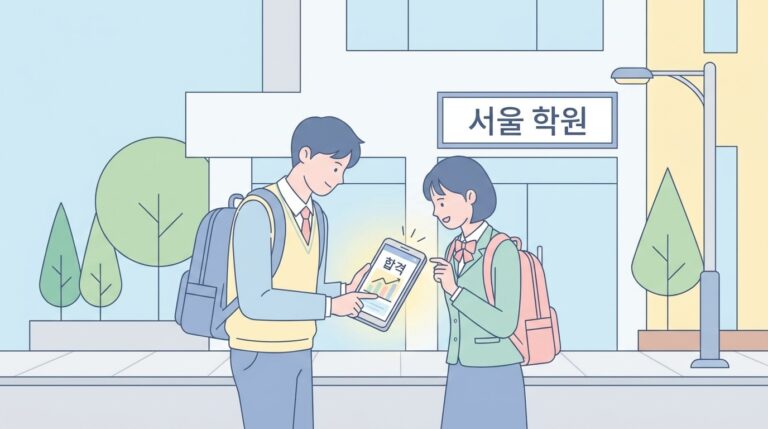
Checking Test Rankings in Korea: Talk About Scores Like a Local!
Phase 1: Empathy (Story Immersion)
안녕하세요! 매일한글 에디터입니다. (Hello! I’m your Daily Hangul editor.)
Have you ever watched hit K-dramas like Crash Course in Romance or SKY Castle? Picture this: midterms just ended at a bustling high school or private academy (hagwon) in Seoul’s Gangnam district. Students huddle around the bulletin board or stare intensely at their phones. Whispers echo through the hallway: “Did you check your rank?”
For many international learners living in Korea or taking language courses at university, test result day can be surprisingly intense. In Korea, relative grading is very common, meaning your score matters, but your ranking (등수 – deungsu) often matters even more! Asking someone about their rank can feel like navigating an emotional minefield if you don’t know the right tone.
Today, we will break down natural, polite, and realistic ways to talk about exam rankings so you never feel awkward on score release day.
Phase 2: 3 Key Expressions Deep Dive
1. 몇 등 했어요? (Myeot deung haesseoyo?)
- Pronunciation: [Myeot deung hae-sseo-yo?] (Sounds like ‘Myut’ + ‘deung’ + ‘hae-ssuh-yo’)
- Meaning: Literal: “What rank did you do?” | Nuance: “What rank did you get?”
- K-Culture Moment: Classmates sitting together after receiving their report cards (성적표), curiously checking each other’s standing.
- Editor’s Insight: Use this with classmates or friends of similar age. It is polite because of the ‘-요’ ending, but still asks for private information, so read the room before asking!
- Situation Spectrum: Casual: ✅ | Semi-formal: ✅ | Formal: ⚠️
- 🤔 Think About It: In your country, is it normal to ask friends about exact class rankings, or do you only share letter grades?
2. 등수 나왔어요? (Deungsu nawasseoyo?)
- Pronunciation: [Deung-su na-wa-sseo-yo?] (Sounds like ‘Deung-soo’ + ‘na-wah-ssuh-yo’)
- Meaning: Literal: “Did the rank come out?” | Nuance: “Are the rankings out yet? / Did you get the ranking results?”
- K-Culture Moment: Asking a friend when you see them refreshing the school portal app anxiously.
- Editor’s Insight: This is a safe, polite way to start the conversation without directly prying into their personal score first.
- Situation Spectrum: Casual: ✅ | Semi-formal: ✅ | Formal: ✅
- 🤔 Think About It: Why is asking “Are rankings out?” more gentle than asking “Did you pass?” in high-pressure school environments?
3. 이번에 성적 많이 올랐어요! (Ibeone seongjeok mani ollasseoyo!)
- Pronunciation: [I-beon-e seong-jeok ma-ni ol-la-sseo-yo?] (Sounds like ‘Ee-bun-eh’ + ‘sung-juck’ + ‘mah-nee’ + ‘ohl-lah-ssuh-yo’)
- Meaning: Literal: “This time, grades went up a lot!” | Nuance: “My grades/rank improved a lot this term!”
- K-Culture Moment: Calling your mom or texting your study buddy with a proud smile after seeing your midterm results.
- Editor’s Insight: Koreans appreciate humility. Saying your score improved is viewed as sharing hard work rather than bragging about being number one.
- Situation Spectrum: Casual: ✅ | Semi-formal: ✅ | Formal: ✅
- 🤔 Think About It: How does celebrating progress (성적 상승) build positive relationships compared to boasting about pure rank?
Phase 3: Textbook Korean vs. Real Korean
Situation 1: Asking your study buddy if results are posted
- 📖 교과서 한국어: 시험 등수를 확인하셨습니까? (Siheom deungsureul hwaginhayeosseumnikka? – “Have you verified the examination ranking?”)
- 🗣️ 진짜 한국어: 등수 확인했어? (Deungsu hwaginhaesseo? – “Did you check your rank?”)
- 💡 왜 다를까?: The textbook phrase is overly stiff for peer-to-peer interactions. Native speakers drop grammatical particles like ‘를’ and use friendly, conversational endings.
Situation 2: Asking someone how they placed
- 📖 교과서 한국어: 당신의 석차는 몇 위입니까? (Dangsinui seokchaneun myeot wiimnikka? – “What rank is your standing?”)
- 🗣️ 진짜 한국어: 몇 등 나왔어? (Myeot deung nawasseo? – “What rank did you get?”)
- 💡 왜 다를까?: Words like 석차 (seokcha) are formal administrative terms seen on documents. In real speech, everyone uses 등수 (deungsu) or 몇 등 (myeot deung).
Phase 4: K-Culture Deep Dive & Non-verbal Manners
4-1. 눈치 (Nunchi) & Gestures on Score Day
When grades are released in Korea, practicing Nunchi (reading the room) is vital:
* Covering the Paper: Students often fold or cover their report card (성적표) with their forearm while peeking. Do not lean over to look at someone else’s paper without permission.
* The Modest Smile: If you ranked high (like top 5%), avoid cheering loudly in the classroom. Instead, give a modest smile and say, “운이 좋았어요” (Un-i jo-asseo-yo – I was lucky) to maintain harmony with peers who might be upset.
4-2. Cultural Code: Daechi-dong Hagwon & Relative Grading
In Korean middle and high schools, test results are frequently judged on a curve (상대평가). In areas famous for education fever like Daechi-dong or Mok-dong, getting a 95 score might still mean ranking 15th if the test was easy! Because of this, asking about ranking is a shared cultural ritual that connects classmates going through the same intense study routines.
Phase 5: Real-Life Roleplay Scenario
Setting: Outside a Korean university classroom right after the final exam results were uploaded on the portal app. Alex meets his classmate Minji holding her phone.
- Turn 1 (Alex): 민지 씨, 기말고사 등수 나왔어요? (Minji ssi, gimalgosa deungsu nawasseoyo? / “Minji, did the final exam rankings come out?”)
🎭 Checking his phone screen anxiously - Turn 2 (Minji): 네, 방금 포털에 떴어요! 알렉스 씨는 확인했어요? (Ne, banggeum poteore tteosseoyo! Alex ssi-neun hwaginhaesseoyo? / “Yes, it just popped up on the portal! Alex, did you check?”)
🎭 Showing her screen with a surprised expression - Turn 3 (Alex): 방금 확인했어요. 혹시 몇 등 했어요? (Banggeum hwaginhaesseoyo. Hoksi myeot deung haesseoyo? / “I just checked. By any chance, what rank did you get?”)
🎭 Lowering his voice politely - Turn 4 (Minji): 저 이번에 3등 했어요! 지난번보다 올랐어요. (Jeo ibeone sam-deung haesseoyo! Jinanbeonboda ollasseoyo. / “I got 3rd place this time! It went up compared to last time.”)
🎭 Smiling softly with relief - Turn 5 (Alex): 와, 대단해요! 축하해요, 민지 씨! (Wa, daedanhaeyo! Chukahaeyo, Minji ssi! / “Wow, that’s amazing! Congratulations, Minji!”)
🎭 Giving a light clap and two thumbs up - Turn 6 (Minji): 고마워요. 알렉스 씨는 시험 잘 봤어요? (Gomawoyo. Alex ssi-neun siheom jal bwasseoyo? / “Thank you. Did you do well on the exam, Alex?”)
🎭 Asking with a gentle and caring tone - Turn 7 (Alex): 저도 지난 학기보다 성적 많이 올랐어요! (Jeodo jinan hakgiboda seongjeok mani ollasseoyo! / “My grades improved a lot compared to last semester, too!”)
🎭 Beaming proudly - Turn 8 (Minji): 우리 둘 다 열심히 했네요. 오늘 맛있는 거 먹으러 가요! (Uri dul da yeolsimhi haenneyo. Oneul masinneun geo meogeureo gayo! / “We both worked hard. Let’s go eat something delicious today!”)
🎭 Pointing toward the cafeteria happily
🔀 Interactive Decision Point
If your friend looks upset after checking their rank, what should you say?
- Option A: “몇 등 했길래 표정이 안 좋아요?” (What rank did you get that makes your face look bad?)
- Feedback (Bad): Too blunt and lacks empathy. It puts your friend on the spot.
- Option B: “이번 시험 진짜 어려웠죠? 고생 많았어요.” (This exam was really tough, right? You worked so hard.)
- Feedback (Best): Perfect Nunchi! It validates their effort without demanding private score details.
- Option C: “저는 1등 했는데, 다음엔 더 열심히 해봐요.” (I got 1st place, try harder next time.)
- Feedback (Risk): Highly arrogant! This can severely damage friendship in Korean social culture.
Phase 6: 10-Second Emotion Shadowing Drill
Practice these natural rhythm pauses (/) and emotions aloud:
[🤫 조심스럽고 낮게 - Quiet & considerate]- 혹시 / 등수 / 확인했어요? (Hoksi / deungsu / hwaginhaesseoyo?)
[😊 기쁘고 신나게 - Joyful & excited]- 대박! / 저 이번에 / 1등 했어요! (Daebak! / Jeo ibeone / il-deung haesseoyo!)
[🥺 아쉽지만 담담하게 - Modest & reflective]- 등수는 조금 아쉽지만 / 다음 시험 / 열심히 할게요! (Deungsuneun jogeum aswipjiman / daeum siheom / yeolsimhi halgeyo!)
Phase 7: K-Culture Mini Dictionary
- 등수 (Deungsu) | Ranking / Class rank | Used constantly during school evaluations and entrance exams.
- 1등 (Il-deung) | 1st place / Top rank | Often used casually to mean “the best” (e.g., “이 식당이 우리 동네 1등이에요”).
- 성적표 (Seongjeokpyo) | Report card / Grade transcript | The official document issued at the end of midterms and finals.
- 열공 (Yeolgong) | Slang: Studying passionately (열심히 공부) | Commonly exchanged as a cheer: “오늘도 열공!” (Happy studying today!).
Phase 8: Survival Kit for Learners
Survival Expressions TOP 3
- 결과 언제 나와요? (Gyeolgwa eonje nawasseoyo? / “When do the results come out?”)
- Pro Tip: Use this when talking to administration staff or academy teachers.
- 시험 잘 봤어요? (Siheom jal bwasseoyo? / “Did your test go well?”)
- Pro Tip: A much safer opening question than directly asking for exact ranks.
- 수고 많으셨어요! (Sugo maneusyeosseoyo! / “You did a great job / Thank you for your hard work!”)
- Pro Tip: The golden phrase to say to classmates right after finishing any exam.
Editor’s Travel & Campus Note
When studying in Korea or visiting university districts like Sinchon or Anam, download Everytime Campus App for university community updates and Naver Map Navigation to find quiet 24-hour study cafes (스터디카페).
Phase 9: “One Step Deeper” (Cultural Reflection)
In Korean society, ranking is closely tied to the concept of collective benchmarking. Because Korea developed rapidly through education and merit, comparing results is seen as a driver for self-improvement rather than mere competition. However, modern Korean youth increasingly focus on individual growth and personal satisfaction over rigid rankings.
💬 Your Turn: How does your culture view school rankings and academic competition? Share your thoughts in the comments below!
Phase 10: FAQ & Common Mistakes
Q: Is it rude to ask an older Korean student (선배) about their rank?
A: Yes, it can be sensitive. Unless you are very close, it is much more polite to ask “시험 잘 보셨어요?” (Did your exam go well?) rather than asking for specific ranks.
Q: What is the difference between ‘등수’ (Deungsu) and ‘점수’ (Jeomsu)?
A: 점수 refers to your raw score (e.g., 90 points out of 100), while 등수 refers to your relative rank among peers (e.g., 3rd place in class).
Q: Can I use ‘몇 등 했어?’ with my Korean teacher?
A: No! With teachers, use formal honorifics: “제 등수가 어떻게 되나요?” (Je deungsuga eotteoke doenayo? / “How is my class standing?”).
🚨 Common Mistakes Warning Board
- Mistake: Asking “몇 위예요?” in casual conversations.
- Correction: Say “몇 등 했어요?”. 위 (wi) is mostly used in sports broadcasts or official charts.
- Mistake: Bragging loudly about ranking high in front of struggling classmates.
- Correction: Show empathy with “운이 좋았어요” (I was fortunate) and buy them a snack.
- Mistake: Forgetting the counter word 등 (deung).
- Correction: Always attach the Sino-Korean numbers to 등: 1등 (Il-deung), 2등 (I-deung), 3등 (Sam-deung).
Phase 11: Action Missions
- 🥉 Bronze Mission (Self Practice): Say “이번에 성적 많이 올랐어요!” out loud 5 times with a bright voice in front of a mirror.
- 🥈 Silver Mission (Social Practice): Leave a comment under a Korean study YouTube vlog cheering them with “오늘도 열공하세요!”.
- 🥇 Gold Mission (Real Life): Next time test results come out, ask your Korean study partner: “등수 나왔어요?”.
- 🎮 K-Culture Mission: Watch an episode of a high school K-drama (Extraordinary You, Crash Course in Romance) and listen for the moment a character says 1등 or 성적!
Phase 12: Interactive Quiz Challenge
1. Situational Judgment:
You want to ask your friend in your Korean language class if the exam rankings have been posted. What is the most natural sentence?
* A) 몇 위입니까?
* B) 등수 나왔어요?
* C) 1등 하셨습니까?
🔍 Click for Answer & Explanation
Answer: B) 등수 나왔어요?
Explanation: B is natural, polite, and universally used among classmates. A is too formal/archaic for speech, and C is an awkward assumption.
2. Fill in the Blank:
“저 이번 중간고사에서 _____ 했어요! (I got 1st place in the midterm exam!)”
* Hint: Use the Sino-Korean number for ‘1’ + ranking unit.
🔍 Click for Answer & Explanation
Answer: 1등 (일등 / Il-deung)
Explanation: In Korean, class standings use Sino-Korean numbers (1등 = 일등, 2등 = 이등, 3등 = 삼등).
3. True or False:
In Korean culture, it is considered polite to immediately show your high score to everyone in the room as soon as you receive it.
🔍 Click for Answer & Explanation
Answer: False
Explanation: Reading the room (눈치) and remaining humble is highly valued in Korean social etiquette.






