

안녕하세요! 매일한글 에디터입니다.
Picture this: You are wandering through the vibrant alleyways of Jongno in Seoul on a crisp autumn evening. The warm, savory aroma of simmering broth draws you into a bustling, decades-old restaurant. You open the wooden-framed menu with confidence, ready to order delicious Korean boiled meat, but your eyes freeze on two distinct dishes: 수육 (Suyuk) and 보쌈 (Bossam).
Both look like tender, succulent slices of steamed and boiled meat. Yet one comes with vibrant stacks of cabbage and seasoned spicy radish, while the other arrives swimming in a gentle, clear broth or paired with chives and dipping sauces. To make matters more confusing, your Korean friends passionately debate which one to order depending on whether they want soju or makgeolli. You might wonder: “Aren’t they both just boiled pork? What makes them so fundamentally different, and how do I order them without sounding like a total beginner?”
Over the past ten years of coaching intermediate learners, I have seen so many students freeze at this exact menu dilemma. Understanding the culinary and cultural nuance between Suyuk and Bossam is not just about satisfying your appetite—it is an intermediate (B2) cultural milestone that unlocks authentic conversational mastery. In this guide, we will break down the linguistic differences, cultural backstories, table manners, and real-world expressions so you can order, enjoy, and talk about Korean steamed and boiled meats like a seasoned local.
Phase 2: Core Expressions Deep Dive (핵심 표현 3선)
1. 쌈 싸 먹다 (Ssam ssa meokda)
- Pronunciation: [Ssam-ssa-meok-da] (Think of a crisp ‘ssam’ sound, like packing a tight gift wrap)
- Meaning: Literally “to wrap and eat”; colloquially refers to the entire cultural practice of assembling meat, sauces, and garnishes inside a fresh leafy green.
- K-Culture Moment: Seen in nearly every Korean mukbang and K-Drama family dinner scene, where someone lovingly prepares a huge, overflowing leaf wrap and feeds it directly into someone else’s mouth to express deep affection.
- Editor’s Insight: While Western dining often serves salad alongside protein, Korean dining synthesizes them into one single, explosive bite. Saying “쌈 싸 먹으니까 진짜 맛있어요!” (Ssam ssa meogeunikka jinjja masisseoyo! / It tastes truly amazing when wrapped in greens!) marks you instantly as someone who understands the harmony of Korean textures.
- Situation Spectrum: Casual (✅) | Semi-formal (✅) | Formal (⚠️)
- 🤔 Think About It: In many Western culinary cultures, dissecting food with a knife and fork into small portions is polite. Why does Korean culture value the bold act of eating an entire fist-sized wrap in a single mouthful?
2. 잡내를 잡다 (Jamnae-reul japda)
- Pronunciation: [Jam-nae-reul jap-da] (Pronounce ‘jap’ quickly, like catching a flying ball)
- Meaning: Literally “to catch the unpleasant smell”; refers to eliminating gamey or pungent odors in boiled meats using aromatic herbs, garlic, ginger, and doenjang (soybean paste).
- K-Culture Moment: Celebrity chefs like Baek Jong-won constantly emphasize this phrase on cooking reality shows when judging the quality of Suyuk and Bossam broths.
- Editor’s Insight: The difference between mediocre boiled meat and gourmet meat comes down to 잡내 (jamnae). When you compliment a restaurant owner with “고기 잡내가 전혀 안 나고 깔끔하네요!” (Gogi jamnaega jeonhyeo an nago kkalkkeumhaneyo! / The meat has no gamey smell at all and tastes so clean!), the chef will know you are a true food connoisseur.
- Situation Spectrum: Casual (✅) | Semi-formal (✅) | Formal (✅)
- 🤔 Think About It: How does your native language describe off-flavors in meat, and what culinary methods in your culture are used to balance strong natural game scents?
3. 곁들여 먹다 (Gyeotdeullyeo meokda)
- Pronunciation: [Gyeot-deul-lyeo meok-da] (Flow smoothly from ‘gyeot’ to ‘deul-lyeo’)
- Meaning: Literally “to accompany and eat”; refers to pairing a main dish with specific side condiments or banchan designed to enhance digestion and flavor.
- K-Culture Moment: When ordering Suyuk, the server might suggest pairing it with fermented shrimp sauce or chives: “부추랑 새우젓을 곁들여 드셔보세요.” (Buchurang sae-ujeoseul gyeotdeullyeo deusyeoboseyo. / Try eating it paired with chives and salted shrimp sauce.)
- Editor’s Insight: Bossam and Suyuk are defined not just by how the meat is cooked, but by what is paired with them. Bossam is traditionally paired with spicy Bossam-kimchi and radish salad, while Suyuk is paired with warm seasoned chives (buchu) or dipping soy sauce.
- Situation Spectrum: Casual (✅) | Semi-formal (✅) | Formal (✅)
- 🤔 Think About It: Why does Korean cuisine place such heavy structural importance on complementary pairing (gyeotdeurim) rather than serving a standalone centerpiece?
Phase 3: Textbook Korean vs. Real Korean (교과서 vs 진짜 한국어)
Situation 1: Describing the tender texture of the boiled meat
- 📖 교과서 한국어: 이 고기는 아주 부드럽고 맛있습니다. (I gogineun aju budeureopgo masitseumnida. / This meat is very soft and delicious.)
- 🗣️ 진짜 한국어: 고기가 진짜 야들야들해서 입에서 살살 녹네요! (Gogiga jinjja yadeul-yadeulhaeseo ibeseo salsal nongneyo! / The meat is so tender and velvety, it literally melts in my mouth!)
- 💡 왜 다를까? Intermediate and advanced Korean native speakers use vivid mimetic words (의태어) like 야들야들하다 (soft, tender, slightly springy) to describe perfectly simmered pork or beef, rather than the generic adjective 부드럽다.
Situation 2: Asking for a refill of wrapping greens and spicy radish
- 📖 교과서 한국어: 채소와 김치를 더 주실 수 있습니까? (Chaesowa gimchireul deo jusil su itseumnikka? / Can you give me more vegetables and kimchi?)
- 🗣️ 진짜 한국어: 이모님, 쌈채소랑 무말랭이 리필 좀 부탁드려요! (Imo-nim, ssamchaesorang mumallaengi ripil jom butakdeuryeoyo! / Auntie, could we please get a refill on the wrapping greens and seasoned dried radish?)
- 💡 왜 다를까? In authentic dining environments, addressing the veteran waitstaff warmly as 이모님 (Imo-nim) and specifying the exact side dish name (쌈채소, 무말랭이) creates instant rapport and ensures you get the exact banchan you need.
Phase 4: K-Culture Deep Dive & Non-Verbal Manners
4-1. 눈치 (Nunchi) & Dining Etiquette for Ssam
Eating wrapped food (ssam) is an art form in Korea with subtle non-verbal rules:
1. The One-Bite Rule: Never bite a ssam in half! Biting into a wrap halfway often causes the fillings, juices, and ssamjang sauce to spill out onto the table or your clothes, which is considered clumsy. Build your wrap to a size that fits entirely into your mouth.
2. Hand Cleanliness & Mindfulness: Before picking up perilla leaves (kkaennip) or lettuce, always use the wet wipe (mul-tisyu) provided. If dining with seniors or colleagues, use two hands when receiving a basket of fresh greens or passing the communal dish.
3. The Sae-ujeot (Salted Shrimp) Touch: When eating pork Suyuk or Bossam, dipping a slice lightly in sae-ujeot is not just tasty—it signals to your companions that you understand Korean traditional medicine (Hanbang), where salted shrimp enzymes assist in digesting rich pork fat.
4-2. Cultural Code: The Kimjang Heritage vs. The Broth Heritage
Why do Suyuk and Bossam exist as separate menu items when both are boiled/steamed meats?
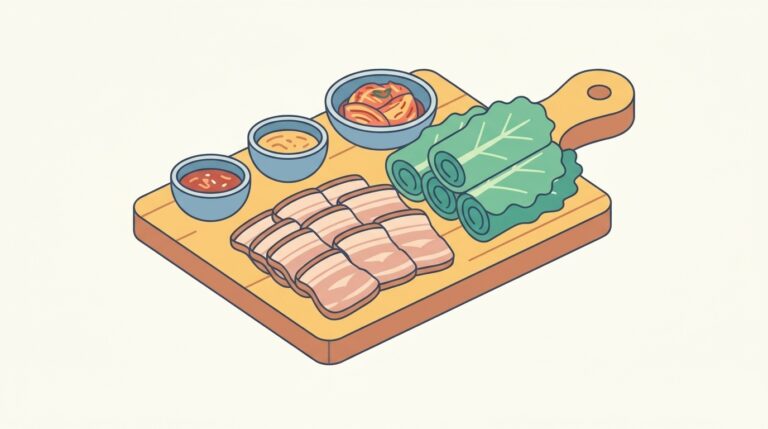
* Bossam (보쌈 – Wrapped Meat): Historically rooted in 김장 (Kimjang), the seasonal autumn kimchi-making tradition. After days of labor making fresh kimchi, families boiled fresh pork belly (Samgyeopsal) or pork shoulder (Moksal) and enjoyed it wrapped inside freshly salted cabbage leaves and sweet spicy radish relish.
* Suyuk (수육 – Boiled Meat Slices): Originating from the Sino-Korean word 수육 (熟肉 – cooked/boiled meat), Suyuk can be made from either high-grade beef (like brisket, shank, or tendon) or pork. It is commonly simmered in rich broth and served hot on a shallow platter, often accompanied by warm soup at traditional Seolleongtang (ox bone soup) or Gukbap eateries.
Phase 5: Real-World Roleplay Scenario (실전 롤플레이)
Setting: You and a Korean friend enter Jongno Halmeoni Bossam, an authentic restaurant with low wooden tables, steaming brass pots, and the energetic laughter of local diners.
Characters:
* You (Alex): B2 Korean learner excited to order real food.
* Imo-nim (이모님): The warm, quick-witted restaurant owner wearing a colorful floral apron.
[1] Imo-nim: 🎭 [Wiping down the table briskly and setting down two metal cups]
    어서 와요! 두 분이세요? 뭐로 준비해 드릴까?
    (Eoseo wayo! Du bun-iseyo? Mworo junbihae deurilkka? / Welcome! Table for two? What can I get started for you?)

[2] Alex: 🎭 [Smiling warmly while pointing toward the menu board]
    이모님, 보쌈이랑 수육 중에서 고민 중인데요. 둘이 어떻게 달라요?
    (Imo-nim, bossamirang suyuk jung-eseo gomin jung-indeyo. Duri eotteoke dallayo? / Auntie, we are debating between Bossam and Suyuk. How are the two different?)

[3] Imo-nim: 🎭 [Chuckling with pride while gesturing with her tongs]
    우리 집 보쌈은 방금 삶은 삼겹살에 굴김치가 나가고, 수육은 부드러운 양지살을 따뜻한 육수에 자작하게 얹어줘!
    (Uri jip bossameun banggeum salmeun samgyeopsare gulgimchiga nagago, suyugeun budeureoun yangjisareul ttatteut-han yuksue jajakhage eonjeojwo! / Our Bossam comes with freshly boiled pork belly and fresh oyster kimchi, while our Suyuk serves tender beef brisket laid gently in warm broth!)

[4] Alex: 🎭 [Nodding enthusiastically with newfound understanding]
    아, 그렇군요! 그럼 오늘은 신선한 배추김치랑 쌈 싸 먹고 싶으니까 보쌈 중(中) 자로 주세요.
    (A, geureokgunyo! Geureom oneureun sinseonhan baechugimchirang ssam ssa meokgo sipeunikka bossam jung jaro juseyo. / Ah, I see! Then since we want to wrap fresh cabbage kimchi today, please give us a Medium Bossam.)

[5] Imo-nim: 🎭 [Writing on the order pad and winking]
    탁월한 선택! 고기 비계랑 살코기 비율은 반반으로 섞어줄까?
    (Tagwolhan seontaek! Gogi bigyerang salkogi biyureun banbaneuro seokkeojulkka? / Excellent choice! Would you like a half-and-half mix of fatty and lean meat?)

[6] Alex: 🎭 [Appreciating the thoughtful question]
    네! 퍽퍽하지 않게 살코기랑 비계 골고루 섞어주시면 감사하겠습니다.
    (Ne! Peokpeokhaji anke salkogirang bigye golgoru seokkeojusimyeon gamsahagesseumnida. / Yes! Please balance the lean meat and fat evenly so it isn't dry, thank you.)

[7] Imo-nim: 🎭 [Returning quickly with a massive platter of steaming pork and glistening red kimchi]
    자, 뜨거울 때 새우젓 살짝 찍어서 쌈 싸서 먹어봐요. 끝내줘!
    (Ja, tteugeoul ttae sae-ujeot saljjak jjigeoseo ssam ssaseo meogeobwayo. Kkeutnaejwo! / Here, wrap it up with a light dip of salted shrimp while it's steaming hot. It's out of this world!)

[8] Alex: 🎭 [Wrapping a bite and tasting it, clapping lightly in admiration]
    우와, 잡내도 하나도 안 나고 고기가 입에서 살살 녹네요! 정말 맛있어요!
    (Uwa, jamnaedo hanado an nago gogiga ibeseo salsal nongneyo! Jeongmal masisseoyo! / Wow, there is no gamey smell at all and the meat melts in my mouth! It is truly delicious!)
🔀 Interactive Branching Moment
After finishing your first plate of meat, you still have plenty of fresh kimchi and salted cabbage left. What do you say to the server?
- Option A: “저기요, 고기만 조금 더 추가할 수 있나요?” (Jeogiyo, gogiman jogeum deo chugahal su innayo? / Excuse me, can we add just an extra portion of meat?)
- Option B: “이모님, 남은 김치 버려주세요.” (Imo-nim, nameun gimchi beoryeojuseyo. / Auntie, please throw away the leftover kimchi.)
- Option C: “여기 김치 리필 공짜 맞죠? 더 주세요!” (Yeogi gimchi ripil gongjja matjyo? Deo juseyo! / Kimchi refills are free here, right? Give me more!)
Feedback Analysis:
- Option A [BEST]: Perfect etiquette! In most Bossam restaurants, you can order a 고기 추가 (Meat Add-on) separately without paying for a whole new set platter. Highly natural and cost-effective.
- Option B [BAD]: Avoid this. Asking staff to throw away delicious specialty Bossam kimchi while dining sounds dismissive of their culinary craftsmanship.
- Option C [RISK]: Be careful! While ordinary side-dish kimchi is free in Korean restaurants, high-end Bossam kimchi made with raw oysters or specialty radish often incurs a small add-on charge (보쌈김치 추가 비용).
Phase 6: 10-Second Emotion Shadowing Drill (감정 섀도잉 드릴)
Practice reading these sentences aloud, pausing at the slashes (/) and matching the indicated emotional tones:
[😋 Mouth-watering anticipation]
“보쌈 고기가 / 김이 모락모락 나는 게 / 진짜 맛있어 보여요!”
(Bossam gogiga / gimi morak-morak naneun ge / jinjja masisseo boyeoyo! / The bossam meat is steaming hot and looks utterly delicious!)-
[🤩 Pure culinary delight]
“새우젓에 살짝 찍어서 / 알배기 배추에 싸 먹으니까 / 입에서 살살 녹아요!”
(Sae-ujeose / saljjak jjigeoseo / albaegi baechue ssa meogeunikka / ibeseo salsal nogayo! / Dipping it lightly in salted shrimp and wrapping it in sweet cabbage makes it melt in my mouth!) -
[🙏 Polite, friendly request]
“이모님, / 살코기 위주로 / 조금만 더 썰어주실 수 있을까요?”
(Imo-nim, / salkogi wijuro / jogeumman deo sseoreojusil su isseulkkayo? / Auntie, could you slice just a bit more with mostly lean meat?)
Phase 7: K-Culture Mini Dictionary (미니 사전)
- 명이나물 (Myeong-i namul) [Myeong-i pickled wild garlic leaf]: Often served at premium Suyuk and Bossam spots. Its tangy, sweet, and garlicky soy marinade cuts through the rich pork fat with perfection.
- 무말랭이 (Mumallaengi) [Seasoned dried radish strips]: The signature crunchy companion to Bossam. Sun-dried radish strips rehydrated in spicy red pepper paste provide an essential textural contrast to soft steamed meat.
- 새우젓 (Sae-ujeot) [Salted fermented tiny shrimp]: The quintessential savory dip for boiled pork. Rich in lipolytic enzymes that aid fat breakdown, making digestion smoother.
- 삶다 vs. 찌다 (Samda vs. Jjida) [To Boil vs. To Steam]: While both dishes are categorized under steamed/boiled delicacies, 삶다 involves submerging the meat directly in aromatic broth, whereas 찌다 uses rising steam over boiling water.
Phase 8: Traveler’s Survival Kit (여행자 생존 키트)
Top 3 Practical Phrases
- 비계 적은 부위로 주실 수 있나요?
Romanization: Bigye jeogeun buwiro jusil su innayo?
Pro Tip: If you dislike fatty pork, say this upon ordering to request a leaner cut like tenderloin or front leg. - 고기 추가 하나 해주세요.
Romanization: Gogi chuga hana hae-juseyo.
Pro Tip: When you have leftover kimchi and lettuce but ran out of meat slices, use this phrase to order meat only. - 남은 음식 포장해 갈 수 있을까요?
Romanization: Nameun eumsik pojanghae gal su isseulkkayo?
Pro Tip: Bossam portions are often generous. Korean restaurants will happily pack leftovers into neat containers for you.
Editor’s Travel Note
When hunting for authentic Bossam and Suyuk in Seoul, bypass generic tourist areas and explore historic food alleys like the Jongno 3-ga Bossam Alley or Mapo’s traditional pork street. Install the 네이버 지도 앱 다운로드 to search for keywords like 수육 맛집 (Suyuk gourmet restaurant) or 보쌈 정식 (Bossam lunch set). If traveling solo, look for 보쌈 정식 (Bossam Set Menu) during weekday lunch hours (11:30 AM – 2:00 PM), which serves a generous single-portion platter with soup and rice for under 12,000 KRW!
Phase 9: A Step Deeper (한 발 더 깊이)
In many global dining formats, food is divided into individual portions before serving. Korean Ssam and boiled meat platters, however, celebrate the communal table. The act of gathering around a single wooden board of sliced Bossam, choosing individual leaf combinations, and occasionally hand-wrapping a ssam for a friend or elder (쌈을 싸주다) is an intimate expression of 정 (Jeong)—the uniquely Korean bond of shared warmth, empathy, and collective care.
💬 Your Turn: Have you ever experienced a dining tradition where you assemble every bite by hand at the table? How did wrapping your food change the way you socialized with your dining companions? Share your thoughts in the comments below!
Phase 10: FAQ & Common Mistakes (자주 묻는 질문)
Q: Can Suyuk be made from beef, or is it always pork?
A: Suyuk can be made from either beef (소고기 수육) or pork (돼지고기 수육). In fact, famous cold noodle (Naengmyeon) and ox-bone soup (Seolleongtang) restaurants almost exclusively serve premium beef Suyuk made from brisket, tendon, or cheek.
Q: Why is Bossam usually more expensive than regular Suyuk or Samgyeopsal?
A: Bossam requires extensive prep work. Beyond boiling thick slabs of premium pork belly in herbal aromatic broths, restaurants hand-craft seasonal Bossam-kimchi filled with pears, chestnuts, raw oysters, and pine nuts, which raises the preparation cost.
Q: Is it rude to leave the outer cabbage leaves behind if I get full?
A: Not at all! Koreans prioritize finishing the protein and kimchi. However, do not leave half-eaten pieces of wraps on your plate; only take the leaf you intend to eat in one go.
🚨 Common Mistakes Alert (흔한 실수 TOP 3)
- Mistake: Cutting your Bossam wrap in half with your teeth and spilling sauce.
- Correct Action: Layer small amounts of meat, garlic, and ssamjang inside a modest-sized leaf so you can pop the entire wrap into your mouth in one clean bite.
- Mistake: Assuming Bossam Kimchi (보쌈김치) is always free for unlimited refills.
- Correct Action: Always check the menu for a
김치 추가(Kimchi Add-on) fee, as freshly rolled Bossam kimchi is a specialty artisan item.
- Correct Action: Always check the menu for a
- Mistake: Drenching boiled meat in heavy red sauce instead of trying Sae-ujeot.
- Correct Action: Place a tiny fermented shrimp directly on the pork slice first to appreciate the subtle, savory balance of traditional seasoning.
Phase 11: Action Mission (액션 미션)
- 🥉 Bronze Level (Solo Practice): Stand in front of a mirror and practice saying the sentence: “고기가 잡내도 안 나고 야들야들해서 맛있어요!” three times with natural rhythm and intonation.
- 🥈 Silver Level (Social Practice): Next time you watch a K-Drama eating scene or cook Korean food, snap a photo/story and tag
@DailyHanguldescribing whether the dish shown is Suyuk or Bossam. - 🥇 Gold Level (Real-world Challenge): Visit a Korean restaurant or market, order a Bossam set or Suyuk dish in Korean, and specify your meat preference using “살코기랑 비계 반반으로 섞어주세요”!
🎮 K-Culture Mission: Watch an episode of the Korean variety show I Live Alone (나 혼자 산다) or a Kimjang episode of a K-Drama. Spot the moment boiled pork is brought out right after kimchi making, and notice what side dishes are on the table!
Phase 12: Interactive Quiz Challenge (인터랙티브 퀴즈)
Q1. [Situational Judgment] You are at a traditional Seolleongtang soup restaurant and want warm, sliced beef tendon and brisket served in a shallow broth. What should you order?
* (A) 돼지 보쌈 (Dwaeji Bossam)
* (B) 모둠 수육 (Modum Suyuk)
* (C) 제육볶음 (Jeyuk Bokkeum)
Q2. [Fill in the Blank] Fill in the Korean verb for wrapping food into leaves:
“상추에 고기랑 쌈장을 넣고 [쌈을 ____ ____] 맛있게 먹었어요.”
Q3. [True / False Cultural Check]
Bossam is historically linked to the seasonal Kimjang tradition, where boiled pork is paired with freshly prepared spicy cabbage and radish.
* (True / False)
👉 Click here for Answers & Explanations
- Q1 Answer: (B) 모둠 수육 (Modum Suyuk)
Explanation: At soup and noodle eateries, boiled assorted beef cuts (brisket, tendon) in light broth are called Suyuk. Bossam is pork wrapped with specialty kimchi. - Q2 Answer: 싸서 먹으면 / 싸 먹으면
Explanation: The core collocation is 쌈을 싸 먹다 (to assemble a wrap and eat it). - Q3 Answer: True
Explanation: Bossam is intimately tied to Kimjang, celebrating the hard labor of kimchi-making with freshly simmered pork.







