

How to Politely Say ‘I Can’t Handle Spicy Food’ in Korea
Phase 1: Empathy (Story-driven Opening)
안녕하세요! (Annyeonghaseyo!) I’m your Korean culture navigator from Daily Hangul.
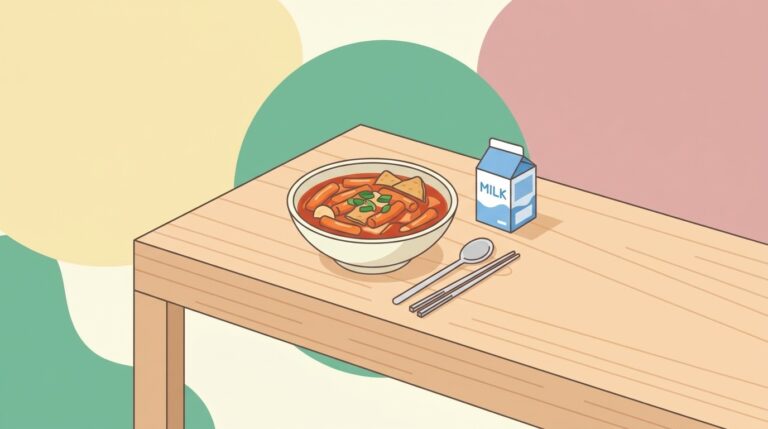
Picture this: You are sitting at a bustling Tteokbokki (spicy rice cake) spot in Hongdae with your Korean friends. The bubbling red sauce looks heavenly, and the smell makes your mouth water. Your friend smiles and hands you a fork, saying, “It’s not that spicy at all! Just try it!” You take one bite, and within three seconds, your ears are ringing, tears well up in your eyes, and your tongue feels like it just touched volcanic lava. Meanwhile, your friends are happily chatting away, completely unfazed.
If you have ever panicked while looking at a vibrant crimson stew in a Korean restaurant, you are definitely not alone. Many intermediate Korean learners know how to say “매워요” (It’s spicy), but in real-life social dining situations, expressing your spice tolerance naturally—without sounding rude or completely ruling out dining with locals—requires subtle conversational nuance. This guide is crafted directly from our classroom feedback to give you the exact real-world phrases, manners, and survival hacks you need to eat confidently across Korea!
Phase 2: Top 3 Core Expressions Deep Dive
1. 저 매운 거 잘 못 먹어요. (Jeo maeun geo jal mot meogeoyo.)
- Pronunciation: [Jeo mae-un geo jal mot meo-geo-yo] (Sounds like: “Juh may-oon guh jahl moht muh-guh-yo”)
- Meaning: Literal: “I cannot eat spicy things well.” vs. Actual: “I have a low spice tolerance / I’m not good with spicy food.”
- K-Culture Moment: Seen in endless variety shows like Running Man when guests sheepishly confess their food weaknesses before a spicy street food challenge.
- Editor’s Insight: Using “잘 못” (jal mot) creates a soft, modest tone instead of a blunt “I don’t eat this” (안 먹어요). It sounds humble and polite.
- Situation Spectrum: Casual: ✅ | Semi-formal: ✅ | Formal: ⚠️
- 🤔 Think About It: In English, we often say “I hate spicy food” or “I can’t eat spicy,” but Korean favors framing it as a lack of personal skill (“I can’t do it well”). Why do you think Korean communication prefers softening food refusals this way?
2. 덜 맵게 해주실 수 있나요? (Deol maepge haeju-sil su innayo?)
- Pronunciation: [Deol maep-ge hae-ju-sil su in-na-yo] (Sounds like: “Duhl mape-geh heh-joo-sheel soo een-nah-yo?”)
- Meaning: Literal: “Can you do it less spicy?” vs. Actual: “Could you please make it less spicy / tone down the heat?”
- K-Culture Moment: Standard line used when ordering Dakgalbi (spicy stir-fried chicken) or Jjambbong (spicy noodle soup) at local Korean eateries.
- Editor’s Insight: The magic word here is 덜 (deol), which means “less”. Adding “-해 주실 수 있나요?” transforms a simple demand into a polite customer request that chefs gladly accommodate.
- Situation Spectrum: Casual: ✅ | Semi-formal: ✅ | Formal: ✅
- 🤔 Think About It: Notice how asking for a custom spice adjustment in Korea is common, yet polite phrasing is essential so you don’t imply the chef’s signature flavor profile is flawed.
3. 제가 맵찔이라서요… (Jega maepjjiliraseoyo…)
- Pronunciation: [Je-ga maep-jji-ri-ra-seo-yo] (Sounds like: “Jeh-gah mape-jee-ree-rah-suh-yo”)
- Meaning: Literal: “Because I am a spice-wimp…” vs. Actual: “I’m a total wimp when it comes to spice, haha.”
- K-Culture Moment: Widely popularized on YouTube and TikTok food vlogs where idols and creators self-deprecatingly admit their low spice endurance before drinking milk.
- Editor’s Insight: 맵찔이 (Maepjjiri) is modern Korean slang blending 맵다 (spicy) + 찔이 (wimp/weakling). Adding “-라서요” (because of…) turns it into an endearing, humorous excuse among peers and younger coworkers.
- Situation Spectrum: Casual: ✅ | Semi-formal: ⚠️ | Formal: 🚫
- 🤔 Think About It: Self-deprecating humor often breaks cultural ice in Korea instantly. How does calling yourself a “spice wimp” change the dinner atmosphere compared to a strict dietary declaration?
Phase 3: Textbook Korean vs. Real Korean
Situation 1: Ordering custom spice level at a restaurant
- 📖 Textbook Korean: 이 음식을 맵지 않게 요리해 주십시오. (I eumsig-eul maepji an-ge yorihae jusipsio. / Please cook this food not spicy.)
- 🗣️ Real Korean: 사장님, 이거 신라면보다 덜 맵게 되나요? (Sajangnim, igeo Sinramyeonboda deol maepge doenayo? / Boss, can you make this less spicy than Shin Ramyun?)
- 💡 Why it’s different: Koreans measure spice levels against Shin Ramyun as the universal baseline. Using this benchmark gives the kitchen staff an exact target level rather than vague textbook requests.
Situation 2: Explaining your limit to friends during dinner
- 📖 Textbook Korean: 저는 매운 음식을 섭취할 수 없습니다. (Jeoneun maeun eumsig-eul seopchwihal su eopseumnida. / I am unable to consume spicy food.)
- 🗣️ Real Korean: 저 완전 맵찔이라서 순한맛으로 시켜도 돼요? (Jeo wanjeon maepjjiliraseo sunhanmaseuro sikyeodo dwaeyo? / I’m a total spice baby, do you mind if we order the mild flavor?)
- 💡 Why it’s different: Textbook Korean uses clinical vocabulary like “섭취” (consumption). Real conversations use playful slang (
맵찔이) and practical menu terms like순한맛(mild flavor).
Phase 4: K-Culture Deep Dive & Non-Verbal Manners
4-1. Nunchi (눈치) & Gestures
When turning down spicy food or asking for modifications, body language shows politeness and sincerity:
1. The Hand Wave & Shy Smile: Wave one hand slightly near your chest with a self-conscious smile while saying “저 매운 거 잘 못 먹어요…” This signals you love the food concept, just not the heat level.
2. The Two-Hand Menu Pointing: When asking for 안 맵게 (not spicy), hold the menu with both hands and point gently with an open palm or your index finger.
3. The Sympathy Reaction: If your dining partners love spicy food, don’t say “That looks terrible.” Instead, say “우와, 대단하세요!” (Wow, you’re amazing!) to acknowledge their spice skills.
4-2. Cultural Code: The “Shin Ramyun Scale”
In Korea, spice is not just a flavor—it is a cultural sport and social bonding ritual. From Buldak Bokkeum Myeon challenges to late-night stress-relieving Tteokbokki, hot food represents catharsis (스트레스 해소). When Koreans ask you, “Do you like spicy food?”, their definition of “a little spicy” usually equals a standard packet of Shin Ramyun. Knowing how to communicate your exact threshold prevents misunderstandings and ensures you enjoy shared meals comfortably.
Phase 5: Real-Life Roleplay Scenario
Setting: A vibrant Dakgalbi (stir-fried chicken) restaurant in Sinchon.
NPC: Minji (Your friendly Korean classmate and passionate foodie).
- Minji: 🎭 (Looking eagerly at the red menu board) 오늘 시험 끝났으니까 매운 닭갈비 먹고 스트레스 풀자! 어때?
(Oneul siheom kkeutnasseunikka maeun dakgalbi meokgo seuteureseu pulja! Eottae? / Since exams finished today, let’s blow off steam with spicy Dakgalbi! What do you think?) - You: 🎭 (Hesitating and scratching your cheek) 어… 민지야, 나 사실 매운 거 잘 못 먹거든.
(Eo… Minji-ya, na sasil maeun geo jal mot meokgeodeun. / Uh… Minji, to be honest, I’m not very good with spicy food.) - Minji: 🎭 (Surprised) 아, 진짜? 많이 매운 거 아예 안 돼?
(A, jinjja? Mani maeun geo aye an dwae? / Oh, really? You can’t do anything super spicy at all?) - You: 🎭 (Making a small pinching gesture with fingers) 응, 내가 완전 맵찔이라서… 조금만 매워도 땀나.
(Eung, naega wanjeon maepjjiliraseo… jogeumman maewodo ttamna. / Yeah, I’m a total spice wimp… I sweat even with a tiny bit of spice.) - Minji: 🎭 (Nodding warmly) 그렇구나! 그럼 맵기 조절 물어보자. 여기 순한맛도 있대.
(Geureokuna! Geureom maepgi jojeol mureoboja. Yeogi sunhanmatdo itdae. / I see! Then let’s ask for the spice adjustment. They have a mild flavor here.) - You: 🎭 (Calling the server politely) 저기요, 사장님! 이거 제일 안 맵게 해주실 수 있나요?
(Jeogiyo, sajangnim! Igeo jeil an maepge haeju-sil su innayo? / Excuse me, boss! Could you please make this the least spicy possible?) - Server: 🎭 (Smiling cheerfully) 네! 간장 베이스로 순하게 해드릴게요. 치즈 추가해 드릴까요?
(Ne! Ganjang be-iseuro sunhage haedeurilgeyo. Chijeu chugahae deurilkkayo? / Sure! I’ll make it mild with a soy sauce base. Would you like to add cheese?) - You: 🎭 (Relieved and happy) 네, 치즈 사리 추가해 주세요! 감사합니다!
(Ne, chijeu sari chugahae juseyo! Gamsahamnida! / Yes, please add a cheese topping! Thank you!)
🔀 Interactive Decision Branch
What would you say if the waiter asks: “신라면 정도 맵기인데 괜찮으세요?” (It’s about Shin Ramyun level, is that okay?)
- Option A: “네, 저 신라면도 매워서 그것보다 덜 맵게 해주세요.” (Yes, even Shin Ramyun is spicy for me, so please make it milder than that.)
- Feedback [Best]: Clear, polite, and uses the exact cultural baseline to guarantee food you can eat.
- Option B: “맛없으니까 그냥 딴 거 주세요.” (That tastes bad so just give me something else.)
- Feedback [Bad]: Extremely blunt and insults the food’s taste rather than explaining your spice tolerance.
- Option C: “네, 괜찮아요! 다 먹을 수 있어요!” (Yes, it’s fine! I can eat everything!)
- Feedback [Risk]: Unless you want to spend the rest of the night drinking pitchers of cold barley tea and holding ice cubes, don’t bluff!
Phase 6: 10-Second Emotion Shadowing Drill
Practice these with natural rhythm and pauses (/ indicates a breath pause):
[🥺 Hesitant & Honest]
저… / 매운 음식을 / 잘 못 먹어서요…
(Jeo… / maeun eumsig-eul / jal mot meogeoseoyo…)[🙏 Polite Request]
사장님, / 덜 맵게 / 해주실 수 있나요?
(Sajangnim, / deol maepge / haeju-sil su innayo?)[😄 Playful & Friendly]
제가 완전 맵찔이라서 / 치즈 꼭 넣어야 돼요!
(Jega wanjeon maepjjiliraseo / chijeu kkok neoeoya dwaeyo!)
Phase 7: K-Culture Mini Dictionary
- 맵찔이 (Maepjjiri) | Noun | Slang for someone with zero spice tolerance. Perfect for humorous social bonding.
- 순한맛 (Sunhanmat) | Noun | Mild flavor level on menus (opposite of 매운맛 – spicy flavor, or 아주 매운맛 – extremely spicy).
- 치즈 사리 (Chijeu Sari) | Noun | Cheese topping added to stews or stir-fries to neutralize intense chili heat.
- 쿨피스 (Coolpis) | Noun | A famous sweet peach/plum yogurt drink stocked at spicy restaurants to quench tongue fires immediately.
Phase 8: Traveler’s Survival Kit
Top 3 Survival Phrases
- 안 맵게 해주세요. (An maepge hae-juseyo.) — Please make it not spicy. (Pro Tip: Use this at food stalls and street markets).
- 하얀 국물로 변경 되나요? (Hayan gungmullo byeongyeong doenayo?) — Can I change this to clear/white broth? (Pro Tip: Great for noodle soups and hot pots).
- 물 좀 더 주실 수 있나요? (Mul jom deo jusil su innayo?) — Could I have some more water, please?
Editor’s Travel Note
When hunting for food in Korea, never rely on Google Maps alone because many local hidden gems and their spice customizations are missing. Search restaurants directly using the Naver Map app download to read Korean customer reviews. Search for the keyword 안 매운 (not spicy) or 순한맛 in customer photos before visiting!
Phase 9: Going Deeper (Thought Essay)
In Korean society, sharing a single boiling pot of stew (찌개) or a pan of Dakgalbi represents communal unity (정, Jeong). When everyone dips their spoons into the same dish, eating the same flavor creates an unspoken feeling of togetherness. This is why admitting you cannot eat spicy food once felt like you were separating yourself from the group. Today, however, modern Korean dining celebrates personal preference. By saying “저 맵찔이에요” with a smile, you honor your own comfort while inviting everyone to laugh and share a delightful meal together.
💬 Your Turn: What is the spiciest dish you have ever encountered in Korea or at a Korean restaurant? Did you survive, or did you need three glasses of milk? Tell us in the comments below!
Phase 10: FAQ & Common Mistakes
Q: Does saying “안 맵게 해주세요” make the dish completely non-spicy?
A: Not always! In traditional red-pepper-based recipes, “안 맵게” often means the cook reduces extra chili flakes, but the base broth may still contain mild chili paste (Gochujang). If you cannot eat any chili at all, ask if there is a soy sauce (간장) or non-spicy alternative.
Q: Can I use the slang word “맵찔이” in a formal business lunch?
A: It’s best avoided in formal company. In business dining with clients or senior executives, use the semi-formal phrase: “제가 매운 음식을 잘 못 먹는 편입니다” (I tend not to eat spicy food very well).
Q: What should I drink if my mouth is burning from spicy Korean food?
A: Avoid chugging cold water—it often spreads chili oils. Order a sweet lacto-drink like Coolpis (쿨피스), milk, or ask for extra steamed egg (계란찜, Gyeranjjim).
🚨 Common Mistakes Warning Board
- Mistake: Saying “이거 안 먹어요” (I don’t eat this) flatly when served spicy food.
Correct Action: Say “제가 매운 걸 잘 못 먹어서요, 죄송해요” (I’m not good with spice, I’m sorry) so you don’t sound dismissive of the host’s hospitality. - Mistake: Assuming “보통맛 (Normal Flavor)” means non-spicy.
Correct Action: In Korea, “보통맛” is usually spicy (Shin Ramyun level). Always order순한맛(Mild flavor). - Mistake: Mispronouncing
덜(less) as더(more).
Correct Action: Be careful! Saying “더 맵게 해주세요” means “Make it MORE spicy!” Emphasize the ‘L’ sound: 덜 (Deol).
Phase 11: Action Missions
- 🥉 Bronze Mission (Solo Practice): Stand in front of your mirror and practice saying “저 매운 거 잘 못 먹어요. 덜 맵게 해주실 수 있나요?” smoothly 5 times in 20 seconds.
- 🥈 Silver Mission (Social Challenge): Watch your favorite K-Drama food scene or K-Pop variety show clip. Find a moment someone comments on spicy food and write down the phrase in your study notes.
- 🥇 Gold Mission (Real-World Application): Next time you order at a Korean restaurant (or order K-food online), request your dish with “순한맛으로 부탁드립니다!” (Mild flavor, please!).
🎮 K-Culture Mission: Search YouTube for “아이돌 맵찔이” (Idol spice wimps) to watch hilarious compilations of K-pop stars handling spicy ramen challenges while using these exact phrases!
Phase 12: Interactive Quiz Challenge
1. Situation Judgment: You are ordering Tteokbokki at a snack cart, and you want zero chili heat. Which phrase is best?
* A) 더 맵게 해주세요! (Deo maepge hae-juseyo!)
* B) 하나도 안 맵게 가능할까요? (Hanado an maepge ganeunghalkkayo?)
* C) 맵찔이라서 음식을 버려주세요. (Maepjjiliraseo eumsig-eul beoryeojuseyo.)
2. Fill in the Blank:
“사장님, 제가 매운 음식을 잘 ______ 먹어서, 조금만 ______ 맵게 해주세요.”
3. True / False Culture Check:
* In Korea, “보통맛 (Normal flavor)” on a spicy stew menu means 100% spice-free with no chili paste. (True / False)
🔍 Click here to reveal Answers & Explanations!
- Answer: B
Explanation: “하나도 안 맵게 가능할까요?” politely asks if it can be made without any spice. Option A asks for more spice, and Option C is inappropriate. - Answer: 못 / 덜
Complete sentence: “사장님, 제가 매운 음식을 잘 못 먹어서, 조금만 덜 맵게 해주세요.” (Boss, I can’t eat spicy food well, so please make it a little less spicy.) - Answer: False
Explanation: “보통맛” is typically calibrated to the average Korean palate, which already includes a kick comparable to Shin Ramyun. Choose순한맛for a truly mild meal!







