

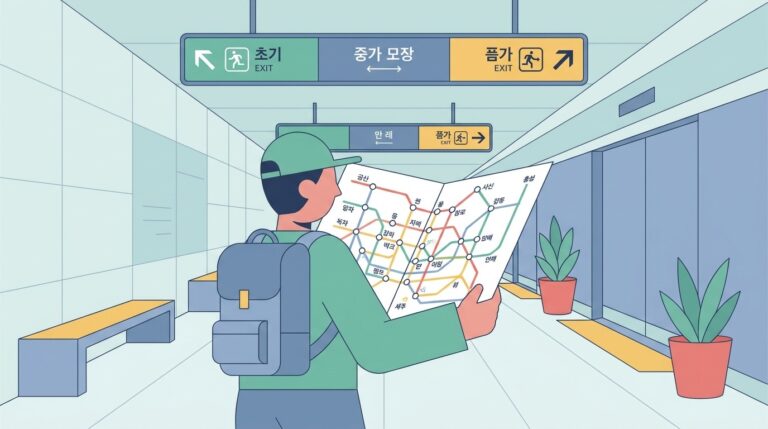
Conquering the Seoul Subway Map: A Beginner’s Survival Guide
Phase 1: Empathy & Story Opening
안녕하세요! I’m your editor at Daily Hangul. Picture this: you just landed in Seoul, ready to explore Hongdae or find that famous K-Drama filming spot. You step down into the vibrant, bustling subway station, look up at the massive Seoul subway map, and freeze. Over twenty colorful lines intertwine like a giant bowl of rainbow noodles. Station names flash by in Hangul, numbers, and colors. Your phone battery is at 12%, and you feel completely lost while commuters zoom past you.
Don’t panic! Even native Koreans pause to double-check their transfer lines. Learning just three essential phrases will transform this overwhelming maze into your personal playground. Based on real feedback from hundreds of beginners, this guide will give you the confidence to read subway maps, ask locals for quick directions, and ride the Seoul Metro like a true local.
Phase 2: Top 3 Core Expressions
1. 어디예요? (Eodiyeyo?)
- Pronunciation: [Eo-di-ye-yo?] (Think: “Uh-dee-yea-yo?”)
- Meaning: “Where is it?” (Direct: Where is)
- K-Culture Moment: In K-Dramas like Crash Landing on You, characters lost in a new city point to a spot on their map and ask this exact polite phrase.
- Editor’s Insight: This is the swiss-army knife of Korean travel. Just say any place name or subway line + 어디예요? (e.g., “Line 2 어디예요?”).
- Situation Spectrum: Casual: ⚠️ | Semi-formal: ✅ | Formal: ✅
- 🤔 Think About It: In English, we often start with “Excuse me, could you tell me where…” In Korean, a quick, polite noun + 어디예요? is natural, concise, and highly effective.
2. 이쪽으로 가요? (Ijjogeuro gayo?)
- Pronunciation: [I-jjo-geu-ro ga-yo?] (Think: “Ee-jjo-geu-roh gah-yo?”)
- Meaning: “Do I go this way?”
- K-Culture Moment: You’re standing in front of two platform stairs pointing toward Gangnam or City Hall, double-checking with a friendly commuter.
- Editor’s Insight: 이쪽 (Ijjok) means “this direction”. Adding 가요? (Do we go?) makes a super handy confirmation question.
- Situation Spectrum: Casual: ⚠️ | Semi-formal: ✅ | Formal: ✅
- 🤔 Think About It: Notice how Korean creates spatial clarity by using directional pointers (이쪽 = this way, 그쪽 = that way, 저쪽 = over there).
3. 몇 호선이에요? (Myeot hoseonieyo?)
- Pronunciation: [Myeot ho-seo-ni-e-yo?] (Think: “Myut ho-sun-ee-eh-yo?”)
- Meaning: “Which line is it?”
- K-Culture Moment: When K-Pop fans coordinate meetups at Olympic Park, they always ask this to confirm whether to take Line 5 or Line 9.
- Editor’s Insight: 호선 (hoseon) refers to subway line numbers (e.g., 1호선 = Line 1, 2호선 = Line 2). 몇 means “which/how many”.
- Situation Spectrum: Casual: ⚠️ | Semi-formal: ✅ | Formal: ✅
- 🤔 Think About It: Seoul subway lines have distinct colors and numbers. Koreans frequently use line numbers (호선) to navigate rather than station names alone.
Phase 3: Textbook Korean vs. Real Korean
Situation 1: Asking which direction to take on the subway platform
- 📖 Textbook Korean: 이 전철은 홍대입구역 방향으로 운행합니까? (I jeoncheoreun hongdaeipguyeok banghyangeuro unhaenghamnigga? – Does this electric train operate in the direction of Hongik University station?)
- 🗣️ Real Korean: 홍대 가려면 이쪽으로 가요? (Hongdae garyeomyeon ijjogeuro gayo? – Do I go this way to get to Hongdae?)
- 💡 Why is it different? Real Koreans drop overly stiff nouns like “electric train” (전철) and replace complex directional grammar with conversational travel goals.
Situation 2: Asking for the transfer location
- 📖 Textbook Korean: 어디에서 환승해야 합니까? (Eodieseo hwanseunghaeya hamnikka? – Where must I transfer?)
- 🗣️ Real Korean: 어디서 갈아타요? (Eodiseo garatayo? – Where do I transfer / change lines?)
- 💡 Why is it different? 갈아타다 (garatada) is the natural, native everyday verb for switching buses or trains, whereas 환승 (hwanseung) is formal Sino-Korean.
Phase 4: K-Culture Deep Dive & Non-Verbal Manners
4-1. Nunchi (눈치) & Body Gestures at Subway Maps
When standing before a giant station map or touch-screen directory, Korean subway etiquette is fast and considerate. Avoid blocking the middle of the ticket gates while reading your map. Step slightly to the side next to a pillar. When asking a station attendant or fellow commuter, point gently with your whole open palm (not a single sharp finger) towards the map screen, tilt your head slightly in a friendly bow, and ask politely.
4-2. Cultural Code: The Color-Coded Subway Civilization
Seoul’s subway is an international marvel celebrated in variety shows like Running Man and Welcome, First Time in Korea?. Each line has a distinct signature color: Line 2 is bright green (the iconic loop line around the city), Line 3 is warm orange, and Line 4 is sky blue. Locals navigate by color and number long before reading station names. Look out for the colored floor stickers that guide transfer paths seamlessly!
Phase 5: Real-World Roleplay Scenario
Setting: Myeongdong Station platform. You are trying to find Line 2 to go to Hongdae, holding up your subway map app.
Character: Minho (A friendly university student with earbuds hanging around his neck).
- You: 저기요, 실례합니다! (Jeogiyo, sillyehamnida! / Excuse me!)
- 🎭 Action: Holding up your map app with a polite smile.
- Minho: 네, 무슨 일이세요? (Ne, museun iriseyo? / Yes, how can I help you?)
- You: 홍대 가고 싶어요. 몇 호선이에요? (Hongdae gago sipeoyo. Myeot hoseonieyo? / I want to go to Hongdae. Which line is it?)
- Minho: 홍대는 2호선(초록색) 타셔야 해요! (Hongdaeneun ihoseon(choroksaek) tasyeoya haeyo! / For Hongdae, you need to take Line 2, the green line!)
- You: 아, 2호선이요! 여기서 어디로 가요? (A, ihoseoniyo! Yeogiseo eodiro gayo? / Ah, Line 2! Where do I go from here?)
- Minho: 저기 초록색 화살표 보이시죠? 저쪽으로 가세요. (Jeogi choroksaek hwasalpyo boisijyo? Jeojjogeuro gaseyo. / See that green arrow over there? Go that way.)
- You: 이쪽으로 가면 갈아탈 수 있어요? (Ijjogeuro gamyeon garatal su isseoyo? / If I go this way, can I transfer?)
- Minho: 네, 맞아요! 동대문역사문화공원역에서 갈아타세요! (Ne, majayo! Dongdaemun-yeoksa-munhwa-gongwon-yeogeseo garataseyo! / Yes, that’s right! Transfer at Dongdaemun History & Culture Park station!)
🔀 Interactive Decision Point
How do you thank Minho and conclude the conversation?
- Option A: “감사합니다! 좋은 하루 보내세요!” (Gamsahamnida! Joeun haru bonaeseyo! – Thank you! Have a nice day!)
- Option B: “고마워, 안녕!” (Gomawo, annyeong! – Thanks, bye!)
- Option C: Say nothing and run immediately toward the stairs.
Feedback:
* Option A (Best): Perfect! Polite, warm, and natural for an A1 speaker. Leaves a wonderful impression.
* Option B (Risk): 고마워 and 안녕 are casual language (반말), which sounds disrespectful to someone you just met.
* Option C (Bad): Koreans value polite closure after someone pauses to guide you.
Phase 6: 10-Second Emotion Shadowing Drill
[😊 Politeness & Curiosity]저기요, / 홍대역이 / 어디예요?
(Jeogiyo, / Hongdaeyeogi / eodiyeyo?)[🤔 Clarifying & Checking]이쪽으로 / 가면 / 2호선 나와요?
(Ijjogeuro / gamyeon / ihoseon nawayo?)[🤩 Relief & Delight]아! / 여기서 / 갈아타는군요!
(A! / Yeogiseo / garataneungunyo!)
Phase 7: K-Culture Mini Dictionary
- 노선도 (Noseondo): Subway map / Route map. Look for this word on platform walls or kiosk screens.
- 환승역 (Hwanseung-yeok): Transfer station. Stations where two or more colorful lines cross.
- 출구 (Chulgu): Exit. Seoul stations have numbered exits (e.g., 3번 출구 = Exit 3), vital for meeting friends.
- 방면 (Bangmyeon): “Bound for / Direction”. Written on platform signs to show the destination direction.
Phase 8: Traveler’s Survival Kit
Top 3 Survival Phrases
- 1. 몇 번 출구예요? (Myeot beon chulguyeyo?) – Which exit is it?
- Pro Tip: Always ask which exit number is closest to your destination.
- 2. 2호선 어디서 타요? (Ihoseon eodiseo tayo?) – Where do I board Line 2?
- Pro Tip: Use when you’re inside a huge transfer station like Seoul Station.
- 3. 반대 방향이에요? (Bandae banghyang-ieyo?) – Is it the opposite direction?
- Pro Tip: Use if the platform looks unfamiliar after swiping your card.
Editor’s Travel Note
Before hopping on the train, make sure to download the Naver Map Navigation App. Unlike generic global map apps, Korean map applications display live train arrival times, exact car numbers for fastest transfers, and subway exit numbers.
Phase 9: A Step Deeper (Reflection)
In Korea, subway stations are dynamic community hubs equipped with convenience stores, bakeries, clothing shops, and even libraries. Asking someone for help at a subway map is viewed as a natural community interaction. When a local helps you navigate, replying with a genuine smile and 감사합니다 (Gamsahamnida) connects you directly to Korea’s warm culture of helping travelers.
💬 Your Turn: Have you ever gotten lost on public transportation abroad? Which Seoul subway line are you most excited to ride? Leave your thoughts in the comments below!
Phase 10: FAQ & Common Mistakes
Q: Can I use colors instead of numbers when asking for subway lines?
A: Yes! If you forget the number for Line 2, you can say 초록색 라인 어디예요? (Choroksaek rain eodiyeyo? / Where is the green line?). Locals will instantly understand.
Q: What should I do if I tap into the wrong subway platform direction?
A: Look for a small “Help” button (도움벨) at the gate or tap out and re-enter the opposite turnstile within 5 minutes—in Seoul Metro, re-entry within 5 minutes on the same line is free!
Q: How do I say the destination station name correctly?
A: Attach 역 (yeok – station) after the place name. For example: 강남역 (Gangnam-yeok), 명동역 (Myeongdong-yeok).
🚨 Common Mistakes Alert!
- Mistake: Forgetting to add ~요 (yo) at the end of questions.
- Correct Action: Always end your requests with ~어디예요? or ~가요? to stay polite.
- Mistake: Looking only at English station names.
- Correct Action: Match the station numbers (e.g., 239 for Hongdae) on the map if Hangul feels unfamiliar.
- Mistake: Asking “Line 2 어디?” without politeness endings.
- Correct Action: Say “Line 2 어디예요?” (Ihoseon eodiyeyo?).
Phase 11: Action Missions
- 🥉 Bronze Mission (Solo Practice): Look at a Seoul subway map online and locate Line 2 (Green) and Line 4 (Sky Blue). Say out loud: “2호선 어디예요?”
- 🥈 Silver Mission (Social Share): Share this guide on Instagram or X with your favorite Seoul landmark destination.
- 🥇 Gold Mission (Real Life Action): Next time you enter a Seoul subway station, navigate all the way to your destination exit using only Hangul signs and the phrase “이쪽으로 가요?”.
- 🎮 K-Culture Mission: Watch any modern K-Drama episode and spot a subway sign board—identify the line color!
Phase 12: Interactive Quiz Challenge
Question 1: You are standing in the station and want to ask someone where Line 4 is. What do you say?
👉 Click to see the answer!
Answer: 4호선 어디예요? (Sahoseon eodiyeyo?)
Explanation: 4호선 means Line 4, and 어디예요? means ‘Where is it?’.
Question 2 (True / False): In Korea, 갈아타요 means ‘to get off the subway and go home’.
👉 Click to see the answer!
Answer: False
Explanation: 갈아타요 (Garatayo) means ‘to transfer / switch trains or buses’.
Question 3 (Fill in the blank): Complete the phrase: “Do I go this way?” → 이쪽으로 ____? (gayo?)
👉 Click to see the answer!
Answer: 가요 (gayo)
Explanation: 이쪽으로 가요? literally translates to ‘Do I go toward this side/direction?’.







