

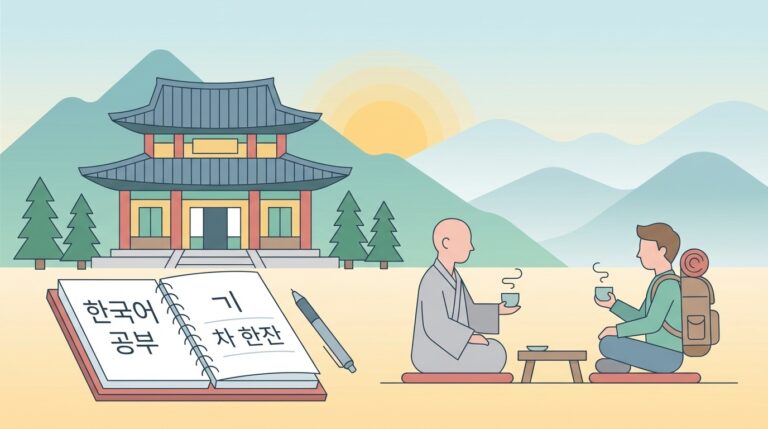
Finding Inner Peace at Dawn: The Ultimate Guide to Korean Temple Stay and 108 Bows
Phase 1: Empathy (Story-Immersive Opening)
안녕하세요! This is your Daily Hangul editor. Imagine waking up at 4:30 AM in a misty, ancient Buddhist temple perched high on Mount Odaesan. The brisk mountain air fills your lungs, the wooden bell (Moktak, 목탁) rhythms echo through the dawn, and you find yourself standing on a lotus-patterned mat inside the main prayer hall (Daeungjeon, 대웅전). You are about to embark on the 108 Bows (108배)—a profound spiritual practice of letting go of worldly illusions.
For many advanced learners, experiencing a Korean temple stay and engaging in a formal tea meditation (Chadam, 차담) with a monk is the pinnacle of cultural immersion. Yet, navigating temple etiquette, articulating profound internal states, and using the correct Buddhist honorific nuances can feel intimidating. Have you ever felt your mind racing while trying to politely describe your spiritual fatigue or inner calmness to a venerable monk? You are not alone. This guide is crafted from authentic monastic dialogues and feedback from our C1 learners who sought deeper spiritual and linguistic grounding in Korea.
Phase 2: Core Expressions Deep Dive
1. 마음을 비우다 (Maeumeul biuda)
- Pronunciation: [Mae-um-eul bi-u-da] (Sounds like “May-oom-eul bee-oo-da”)
- Meaning: Literal: “To empty one’s mind/heart” | Nuance: To let go of obsessive thoughts, stress, and worldly attachments.
- K-Culture Moment: Seen frequently in healing reality programs like Three Meals a Day or temple stay episodes when celebrities escape the frantic pace of Seoul.
- Editor’s Insight: At the C1 level, pair this with verb endings like
~고자or~기 위해(e.g., 복잡한 일상에서 벗어나 마음을 비우고자 절을 찾았습니다 – “I visited the temple to empty my cluttered mind away from hectic daily life”). - Situation Spectrum: Casual: ⚠️ | Semi-formal: ✅ | Formal: ✅
- 🤔 Think About It: In English, we often say “clear your head.” In Korean, it’s 마음 (mind/heart). Why do you think Korean cultural philosophy connects mental clarity with the heart center?
2. 번뇌를 내려놓다 (Beonnoe-reul naeryeonota)
- Pronunciation: [Beon-noe-reul nae-ryeo-no-ta] (Sounds like “Bun-no-eh-reul neh-ryeo-no-tah”)
- Meaning: Literal: “To lay down defilements/agonies” | Nuance: To surrender chronic anxieties, existential dilemmas, and worldly cravings during meditation.
- K-Culture Moment: Monks in K-dramas often use this when guiding troubled protagonists through meditative prostrations.
- Editor’s Insight: 번뇌 (Klesha/defilement) is a sophisticated Sino-Korean term (
煩惱). Using it during Chadam reveals a refined command of philosophical Korean. - Situation Spectrum: Casual: 🚫 | Semi-formal: ⚠️ | Formal: ✅
- 🤔 Think About It: How does phrasing emotional pain as “something to set down” (내려놓다) change your relationship with stress compared to “fighting it”?
3. 차 한잔의 여유를 가지다 (Cha hanjan-ui yeoyureul gajida)
- Pronunciation: [Cha han-jan-ui yeo-yu-reul ga-ji-da] (Sounds like “Chah hahn-jahn-wee yuh-yoo-reul gah-jee-dah”)
- Meaning: Literal: “To have the leisure of a cup of tea” | Nuance: To cultivate a serene, unhurried space for mindfulness and contemplation.
- K-Culture Moment: Common in Korean slow-life documentaries when discussing Dado (다도, Tea Ceremony).
- Editor’s Insight: 여유 (Yeoyu) implies not just physical free time, but a spacious, composed mindset.
- Situation Spectrum: Casual: ✅ | Semi-formal: ✅ | Formal: ✅
- 🤔 Think About It: What constitutes true 여유 in your daily routine, and how does tea culture represent that in your native society?
Phase 3: Textbook Korean vs. Real Korean
Situation 1: Describing the sensation during 108 Bows
- 📖 Textbook Korean: 108배는 매우 힘들지만 기분이 좋습니다. (108baeneun maeu himdeuljiman gibuni joeusseumnida. / 108 bows are very hard but feel good.)
- 🗣️ Real Korean: 절을 거듭할수록 번뇌는 사라지고 마음이 한결 차분해지네요. (Jeoreul geodeeophalsurok beonnoeneun sarajigo maeumi hangyeol chabunhaejineyo. / As I continue each prostration, my mental clutter dissolves and my heart feels noticeably calmer.)
- 💡 Why the Difference? C1 speakers use nuanced transition patterns like
~ㄹ수록(the more… the more) and sensory descriptors like한결(noticeably/much more) to convey introspective transformation.
Situation 2: Inquiring about tea etiquette during a monk conversation (차담)
- 📖 Textbook Korean: 차를 어떻게 마십니까? (Chareul eotteoke masimnikka? / How do you drink the tea?)
- 🗣️ Real Korean: 스님, 다도를 행할 때 마음가짐에 대해 한 말씀 청해도 될까요? (Seunim, dadoreul haenghal ttae maeumgajime daehae han malsseum cheonghaedo doelkkayo? / Venerable Monk, may I ask your guidance on the state of mind one should maintain during tea ceremony?)
- 💡 Why the Difference? In formal monastic settings, using honorific humbling phrases like
한 말씀 청하다demonstrates profound respect and elevated cultural awareness.
Phase 4: K-Culture Deep Dive & Non-Verbal Manners
4-1. Nunchi & Temple Manners (눈치와 예절)
- Hapjang (합장 – Pressing Palms): Whenever passing a monk or entering a hall, press your palms flat in front of your chest at sternum height, gently bow your head at 30 degrees, and whisper 성불하십시오 (Seongbulhasipsio – “May you attain enlightenment”) or maintain a respectful silence.
- Silent Movement (묵언 – Mugeon): In meditation zones, walk softly on the balls of your feet. Avoid stepping directly on the door sill (문턱) of temple halls, as it is considered bad luck and disrespectful.
4-2. Cultural Code: The Art of Dadam (차담)
In Korean traditional tea ceremonies within temples, drinking tea is an extension of meditation (다선일미, 茶禪一味 – “Tea and Zen are of one flavor”). Hold the cup with both hands: the right hand holds the bowl while the left hand gently supports the base. Take small, appreciative sips while savoring color, fragrance, and taste in stillness.
Phase 5: Real-World Roleplay Scenario
Setting: 6:00 AM, the tea room at Woljeongsa Temple. Morning mist floats over the wooden terrace. Venerable Monk Jeong-woo pours freshly brewed green tea into celadon cups.
- 스님 (Monk): 새벽 108배를 마치고 나니 몸과 마음이 좀 어떻습니까? (Saebyeok baekpalbaereul machigo nani momgwa maeumi jom eotteoseumnikka? / 🎭 Gently pouring tea with both hands)
- 나 (Learner): 처음엔 숨이 턱까지 찼는데, 절을 올릴수록 머릿속 잡념이 비워지는 느낌이었습니다. (Cheoeumen sumi teokkkaji chatneunde, jeoreul ollilsurok meoritsok jamnyeomi biwojineun neukkimieosseumnida. / 🎭 Lowering head slightly with palms pressed)
- 스님 (Monk): 허허, 몸을 낮춤으로써 마음을 일으켜 세운 것이지요. 차 한잔 드시지요. (Heoheo, momeul natchumeurosseo maeumeul ireukyeo seun geosijiyo. Cha hanjan deusijiyo. / 🎭 Offering the teacup with a calm smile)
- 나 (Learner): 감사합니다, 스님. 차 향이 무척 그윽하고 맑네요. (Gamsahamnida, seunim. Cha hyangi mucheok geueukhago mangneyo. / 🎭 Holding cup with both hands and appreciating the aroma)
- 스님 (Monk): 차를 마실 때도 호흡을 지켜보며 온전히 현재에 머물러 보십시오. (Chareul masil ttaedo hoheubeul jikyeobomyeo onjeonhi hyeonjaee meomulleo bosipsio. / 🎭 Taking a measured sip)
- 나 (Learner): 네, 일상으로 돌아가서도 이 고요함을 잃지 않도록 수련하겠습니다. (Ne, ilsangeuro doragaseodo i goyohameul ilchi antorok suryeonhagesseumnida. / 🎭 Nodding solemnly with serene posture)
- 스님 (Monk): 참 좋은 원력입니다. 마음에 이는 파도는 억누르는 것이 아니라 그저 바라보는 것입니다. (Cham joeun wollyeogimnida. Maeume ineun padoneun eongnureuneun geosi anira geujeo baraboneun geosimnida. / 🎭 Setting down the bamboo tea whisk)
- 나 (Learner): 귀한 가르침 마음에 깊이 새기겠습니다, 스님. (Gwihan gareuchim maeume gipi saegigesseumnida, seunim. / 🎭 Bowing from the waist in deep gratitude)
🔀 Interactive Choice Point
The monk asks you what attachment you found hardest to let go of during the bows. How do you respond?
* A. 솔직히 스마트폰이랑 일 생각이 너무 나서 집중하기 힘들었습니다. (Casual & too blunt)
* B. 미래에 대한 불안감과 조급함을 내려놓는 것이 참으로 쉽지 않았습니다. (Best: Reflective, C1 vocabulary)
* C. 다리가 아파서 아무 생각도 안 났습니다. (Risk: Overly dismissive of the spiritual context)
Feedback:
* Choice A (Risk): Honest, but misses the opportunity for deeper introspective dialogue with a monastic mentor.
* Choice B (Best): Superb. Uses 불안감 (anxiety), 조급함 (impatience), and 내려놓다 perfectly in a philosophical register.
* Choice C (Bad): Breaks the reflective mood of Chadam.
Phase 6: 10-Second Emotion Shadowing Drill
[🧘 차분하고 경건하게]- 절을 올리며 / 복잡했던 마음을 / 조금씩 비워냅니다.
- (Jeoreul ollimyeo / bokjaphaetdeon maeumeul / jogeumssik biwonaemnida.)
[🍵 감탄하며 그윽하게]- 찻잔에 담긴 온기 덕분에 / 마음속 응어리가 / 사르르 녹아내리네요.
- (Chatjane damgin ongi deokbune / maeumsok eung-eoriga / sareureu noganaerineyo.)
[🙏 진중하고 겸손하게]- 스님의 귀한 말씀 / 가슴 깊이 / 새기도록 하겠습니다.
- (Seunim-ui gwihan malsseum / gaseum gipi / saegidorok hagesseumnida.)
Phase 7: K-Culture Mini Dictionary
- 차담 (Chadam / Tea Meditation Conversation): A traditional monastic gathering where participants drink hand-crafted tea with a monk while engaging in philosophical life consultations.
- 108배 (Baekpalbae / 108 Prostrations): A core Buddhist mindfulness practice of bowing 108 times to eliminate the 108 worldly defilements (번뇌).
- 발우공양 (Barugongyang / Monastic Meal Ritual): Traditional communal eating practiced in Buddhist monasteries using four nested wooden bowls, characterized by absolute silence, mindfulness, and leaving zero waste.
- 묵언수행 (Mugeonsuhaeng / Silent Mindfulness Practice): A vow of silence maintained during specific periods of a temple stay to quiet the internal ego and heighten sensory awareness.
Phase 8: Traveler’s Survival Kit
Top 3 Survival Phrases
- 성불하십시오. (Seongbulhasipsio. / May you attain enlightenment.)
- Pro Tip: The standard, polite greeting used when passing monks and temple volunteers.
- 공양 시간은 몇 시부터입니까? (Gongyang siganeun myeot sibuteoimnikka? / What time is the monastic meal?)
- Pro Tip: Monastic meals (공양) are strictly punctual. Arrive 5 minutes prior.
- 경내에서 사진 촬영이 가능한가요? (Gyeongnaeeso sajin chwaryeongi ganeunghangayo? / Is photography permitted within the temple grounds?)
- Pro Tip: Main worship shrines generally forbid photography of the altars.
Editor’s Travel Note
Before heading to the mountains, be sure to book through the Official Templestay Reservation Portal to secure English-guided programs. Use the Naver Map Transit Guide to check local rural bus connections, as mountain temples often have limited transportation frequencies.
Phase 9: One Step Deeper (Reflective Essay)
In contemporary South Korea—a society often characterized by intense Ppalli-Ppalli (hurry-hurry) efficiency—the temple stay has evolved into a vital cultural sanctuary. Prostrating 108 times is not simply an act of religious piety; it is an embodied act of radical humility. By touching one’s forehead to the floor 108 times, one physically lowers the ego beneath all living beings. In this silence, language ceases to be a tool for transactional hustle and returns to being a vessel for inner truth.
💬 Your Turn: What is one personal habit or worldly worry you would like to “empty out” (비우다) if you joined a 108-bow meditation tomorrow? Share your thoughts below in Korean!
Phase 10: FAQ & Misconceptions
Q: Do I need to be a practicing Buddhist to do 108 Bows during a Temple Stay?
A: Absolutely not. Most temple stay programs in Korea are non-sectarian cultural retreats focused on mindfulness, wellness, and mental decluttering.
Q: What should I wear during the temple stay and 108 bows?
A: Temples provide comfortable uniform vests and baggy pants (수련복). Bring modest inner shirts (no sleeveless tops) and warm socks, as stepping onto temple wooden floors barefoot is considered impolite.
Q: Is speaking strictly forbidden throughout the entire stay?
A: Only during designated silent meditation (묵언) sessions and formal bowl meals (발우공양). Tea conversations (차담) encourage thoughtful speaking.
🚨 Common Mistakes Alert
- Mistake: Stepping on the wooden door threshold (문턱).
- Correct Action: Step over the threshold cleanly without touching it.
- Mistake: Entering the main hall via the central door.
- Correct Action: The center door is reserved for monks. Enter through the side doors (어간문 avoidance).
- Mistake: Leaving even a grain of rice in your bowl during Barugongyang.
- Correct Action: Clean your bowl completely using a slice of pickled radish (단무지) and warm water as instructed.
Phase 11: Action Missions
- 🥉 Bronze Mission: Practice saying the shadowing drill sentence 절을 올리며 복잡했던 마음을 조금씩 비워냅니다 aloud three times with proper prosodic pauses.
- 🥈 Silver Mission: Write a 2-sentence journal entry on social media describing your recent stress and ending with 마음을 비우고 여유를 찾고 싶다.
- 🥇 Gold Mission: Book a weekend templestay in Korea (or visit a local tea house) and use 한 말씀 청해도 될까요? in real conversation.
- 🎮 K-Culture Mission: Watch a documentary or K-drama episode featuring a Korean temple stay and spot the Hapjang (합장) gesture.
Phase 12: Interactive Quiz Challenge
Q1. Context Judgment
Which expression is most natural and polite when asking a monk for life guidance during tea meditation?
1. 스님, 조언 좀 해주세요.
2. 스님, 다도를 나누며 귀한 말씀 한 말씀 청해도 되겠습니까?
3. 차 마시는 법 가르쳐 줘.
👉 Click to reveal Answer & Explanation
Correct Answer: 2
Explanation: Option 2 uses formal, respectful honoring expressions (귀한 말씀, 청하다), which is ideal for C1 monastic discourse.
Q2. Fill in the Blank
템플스테이에서 108배를 올리는 것은 마음속의 __________(을/를) 내려놓고 평안을 찾는 과정이다.
👉 Click to reveal Answer & Explanation
Correct Answer: 번뇌 (Beonnoe – Worldly defilements/worries)
Explanation: 번뇌를 내려놓다 is the exact collocation used in Korean Buddhist meditation.
Q3. True or False
During a traditional temple stay, you should enter the main prayer hall through the large center door.
👉 Click to reveal Answer & Explanation
Correct Answer: False
Explanation: The central door (어간문) is traditionally reserved for monastic leaders. Guests and practitioners always enter through the side doors.






