

Phase 1: Empathy & Storytelling Opening
안녕하세요! Welcome to Daily Hangul! I’m your Korean culture navigator and language bestie.
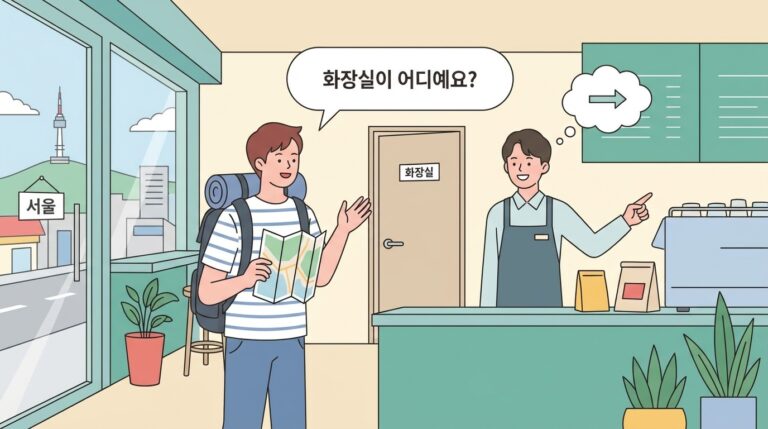
Picture this: You are wandering through the lively, neon-lit streets of Hongdae after enjoying spicy tteokbokki and an iced Americano. Suddenly, nature calls with absolute urgency. You rush into a bustling trendy cafe, your eyes darting frantically. You make eye contact with a barista, but your mind goes blank. In English, you panic-whisper: “Restroom? Where?” The staff looks puzzled for two agonizing seconds.
Every traveler and K-Drama fan has had that sudden cold sweat moment in Korea! Restrooms in Korea can be hidden on half-floors, locked with keypads, or tucked behind side alleys. Learning this one foundational question is not just a language lesson—it is your ultimate survival skill and the key to traveling Korea with absolute confidence. This guide is crafted from real student experiences and local insider insights so you never have to panic again.
Phase 2: 3 Core Expressions In-Depth
1. 화장실 어디예요? (Hwajangsil eodiyeyo?)
- Pronunciation: [Hwa-jang-sil eo-di-ye-yo?] (Think: ‘Hwa’ like ‘Hula hoop’ + ‘Jang’ like ‘Jungle’ + ‘Sil’ like ‘Silver’ / ‘Eo-di-ye-yo’)
- Meaning: Direct: “Restroom where is it?” / Nuance: “Where is the restroom, please?”
- K-Culture Moment: Seen in almost every travel variety show like Running Man or Nana Tour when cast members frantically sprint into rest stops.
- Editor’s Insight: This is the golden standard. Polished, polite, and universally understood across cafes, subway stations, and restaurants.
- Situation Spectrum: Casual ✅ | Semi-formal ✅ | Formal ⚠️
- 🤔 Think About It: Notice how Korean puts the topic (화장실 – Restroom) right at the front! How does putting the main subject first reflect the Korean urge to solve urgent needs quickly?
2. 저기요, 화장실 비밀번호 뭐예요? (Jeogiyo, hwajangsil bimilbeonho mwoyeyo?)
- Pronunciation: [Jeo-gi-yo, hwa-jang-sil bi-mil-beon-ho mwo-ye-yo?]
- Meaning: Direct: “Excuse me, restroom password what is it?” / Nuance: “Excuse me, what is the restroom door code?”
- K-Culture Moment: Classic scene in romantic comedies where characters awkwardly linger at cafe counters reading long Wi-Fi & restroom codes off paper receipts.
- Editor’s Insight: In Korea, many commercial buildings lock their restrooms. The passcode is almost always printed at the bottom of your cafe receipt or written on the front counter!
- Situation Spectrum: Casual ✅ | Semi-formal ✅ | Formal ⚠️
- 🤔 Think About It: Why do you think modern Korean urban spaces widely use electronic door locks (도어락) even for shared restrooms?
3. 저쪽으로 가세요 (Jeojjogeuro gaseyo)
- Pronunciation: [Jeo-jjo-geu-ro ga-se-yo]
- Meaning: Direct: “Toward that way, please go.” / Nuance: “Please head over that way.”
- K-Culture Moment: When helpful convenience store clerks point toward an exit hallway in everyday K-Dramas.
- Editor’s Insight: This is the phrase you will hear most often in response. “저쪽 (jeojjok)” means “that way over there” while “-으로 (-euro)” indicates direction.
- Situation Spectrum: Casual ✅ | Semi-formal ✅ | Formal ✅
- 🤔 Think About It: In English, we say “Go left” or “Go straight”, but Koreans frequently guide you visually by pointing and saying “that direction” first.
Phase 3: Textbook Korean vs. Real Korean
- Situation 1: Asking someone where the restroom is
- 📖 Textbook Korean: 화장실이 어디에 있습니까? (Hwajangsiri eodie itsseumnikka?)
- 🗣️ Real Korean: 저기요, 화장실 어디예요? (Jeogiyo, hwajangsil eodiyeyo?)
- 💡 Why is it different? While the textbook version is grammatically formal, real locals use “저기요 (Excuse me)” combined with “-어디예요?” to sound friendly and natural without stiff military-like endings.
- Situation 2: Asking if a key is needed
- 📖 Textbook Korean: 화장실 열쇠를 주시겠습니까? (Hwajangsil yeolsoereul jusigesseumnikka?)
- 🗣️ Real Korean: 화장실 키 있어요? (Hwajangsil ki isseoyo?)
- 💡 Why is it different? Young Koreans and store staff overwhelmingly use the loanword “키 (Key)” instead of the traditional term “열쇠 (Yeolsoe)” during fast-paced casual interactions.
Phase 4: K-Culture Deep Dive & Non-Verbal Manners
4-1. Nunchi (눈치) & Gestures
When asking for directions in Korea, start by catching eye contact and giving a slight head nod (목례 – mokrye). Raise one hand slightly at chest level when saying “저기요 (Jeogiyo)”. Avoid pointing aggressively with a single index finger when asking or responding; instead, use an open palm facing upward to indicate direction. When someone explains the location, nod rhythmically with “아, 네! 감사합니다! (Ah, yes! Thank you!)”.
4-2. Cultural Code: The Cafe Receipt Secret & Subway Restrooms
In South Korea’s bustling food and cafe culture, private cafe restrooms are frequently secured with digital passcodes. Always check the very bottom of your purchase receipt (영수증) first before asking the counter! Look for terms like 화장실 PW or 비번. Furthermore, Korea’s world-famous subway stations almost always feature clean, accessible public restrooms—some inside the turnstiles and some outside. Look out for the intuitive blue and red gender icons on navigation signs!
Phase 5: Real-Life Roleplay Scenario
Setting: A cozy cafe in Yeonnam-dong, Seoul. You finished your drink and need to find the restroom before taking the subway.
Characters: You (민우 / Minwoo) & Friendly Barista (지수 / Jisoo).
- Turn 1 (Minwoo): 🎭 (Approaching counter with a polite mini-bow) 저기요, 죄송한데요. (Jeogiyo, joesonghandeyo. / Excuse me, I am sorry to bother you.)
- Turn 2 (Jisoo): 🎭 (Smiling warmly) 네, 손님! 뭐 도와드릴까요? (Ne, sonnim! Mwo dowadeurilkkayo? / Yes, customer! How may I help you?)
- Turn 3 (Minwoo): 화장실 어디예요? (Hwajangsil eodiyeyo? / Where is the restroom?)
- Turn 4 (Jisoo): 🎭 (Pointing toward the side door) 매장 나가셔서 오른쪽으로 가세요. (Maejang nagasyeoseo oreunjjogeuro gaseyo. / Go out of the shop and head to the right.)
- Turn 5 (Minwoo): 🎭 (Checking door lock status) 화장실 비밀번호 있어요? (Hwajangsil bimilbeonho isseoyo? / Is there a restroom passcode?)
- Turn 6 (Jisoo): 네, 영수증 밑에 있어요. 일-이-삼-사 별표예요! (Ne, yeongsujeung mite isseoyo. Il-i-sam-sa byeolpyoyeyo! / Yes, it is on the bottom of the receipt. It’s 1-2-3-4-star!)
- Turn 7 (Minwoo): 🎭 (Nodding with relief) 아, 네! 일-이-삼-사 별표요. 감사합니다! (Ah, ne! Il-i-sam-sa byeolpyoyo. Gamsahamnida! / Ah, yes! 1-2-3-4-star. Thank you!)
- Turn 8 (Jisoo): 네, 편하게 다녀오세요! (Ne, pyeonhage danyeooseyo! / Sure, take your time!)
🔀 Interactive Choice Point
What should Minwoo do if the receipt was thrown away?
* Choice A: 저기요, 영수증 버렸는데 비밀번호 다시 알려주실 수 있어요? (Best – Polite and clear)
* Choice B: 화장실 열어줘! (Bad – Impolite banmal / informal speech)
* Choice C: 비밀번호 뭐야? (Risk – Very blunt and lacks honorifics)
Feedback: Choice A is the natural, polite way to ask for the passcode again. Choice B and Choice C drop the honorifics and will sound rude to staff.
Phase 6: 10-Second Emotion Shadowing Drill
- [😰 Urgent & Polite] 저기요… / 화장실 / 어디예요? (Jeogiyo… / hwajangsil / eodiyeyo?)
- [💡 Relieved & Clarifying] 비밀번호가 / 일-이-삼-사 / 맞아요? (Bimilbeonhoga / il-i-sam-sa / majayo?)
- [😊 Grateful & Cheerful] 네, / 정말 / 감사합니다! (Ne, / jeongmal / gamsahamnida!)
Phase 7: K-Culture Mini Dictionary
- 화장실 (Hwajangsil): Restroom / Bathroom. Literally translates to ‘makeup powder room’, combining hygiene and grooming etiquette.
- 비밀번호 / 비번 (Bimilbeonho / Bibeon): Passcode / PIN code. Commonly shortened to ‘비번 (Bibeon)’ in casual everyday conversations.
- 오른쪽 / 왼쪽 (Oreunjjok / Oenjjok): Right side / Left side. Crucial directional vocabulary paired with destination indicators.
- 영수증 (Yeongsujeung): Receipt. The magical paper in cafes containing Wi-Fi access and bathroom door passcodes.
Phase 8: Traveler’s Survival Kit
- Top 3 Survival Expressions:
- 화장실 어디예요? (Hwajangsil eodiyeyo?) – Where is the restroom? | Pro Tip: Use this anywhere—subways, cafes, department stores.
- 휴지 있어요? (Hyuji isseoyo?) – Is there toilet paper? | Pro Tip: Some older subway or market stalls keep toilet paper dispensers outside the stall entrance.
- 남녀 공용이에요? (Namnyeo gong-yong-ieyo?) – Is it unisex? | Pro Tip: Helpful when entering small bistro or pub restrooms.
- Editor’s Travel Note: When navigating Korean streets, Google Maps has limited walking accuracy. Make sure to download and use the Naver Map app on your phone or KakaoMap. Type 화장실 in the search bar to locate nearby open public restrooms in subway stations and parks instantly!
Phase 9: A Step Deeper (Reflection)
In Korean culture, asking for directions is fundamentally viewed as an exchange of care and communal helpfulness (정 – Jeong). Because Korean towns are densely populated, directions are often explained in relation to landmark points rather than cardinal directions (North/South). When you address a stranger with respect using “저기요” and polite endings, you instantly create a safe, warm social bridge.
💬 Your Turn: Have you ever gotten lost looking for a restroom while traveling abroad? How did you manage to ask for help without speaking the local language?
Phase 10: FAQ & Common Mistakes
Q: Is it rude to use a cafe restroom without ordering a drink in Korea?
A: Yes, in general. Most private cafes reserve restrooms for paying customers, which is why doors have passcodes. However, major subway stations and department stores have free, open public restrooms.
Q: What is the difference between ‘화장실 (Hwajangsil)’ and ‘변기 (Byeon-gi)’?
A: ‘화장실’ means the restroom or bathroom as a whole room. ‘변기’ specifically refers to the toilet bowl appliance itself. Always ask for ‘화장실 어디예요?’!
Q: What does the sign ‘화장실 고장’ mean?
A: It means “Restroom Out of Order”. If you see this sign, you’ll need to look for another facility nearby.
🚨 Common Mistakes Warning Board
- Mistake: Asking “Where toilet?” with flat tone. ➡️ Correct Action: Say “저기요, 화장실 어디예요?” (Jeogiyo, hwajangsil eodiyeyo?) with a gentle rising tone.
- Mistake: Throwing away your receipt before checking the door code. ➡️ Correct Action: Check the bottom of the paper slip for numbers with
#or*symbols. - Mistake: Flushing large wads of wet wipes down older building toilets. ➡️ Correct Action: If you see a trash bin next to the toilet with a sign, dispose of paper products in the bin to prevent clogs.
Phase 11: Action Missions
- 🥉 Bronze Mission: Practice saying “저기요, 화장실 어디예요?” 5 times aloud in front of your mirror with a friendly smile.
- 🥈 Silver Mission: Post an Instagram Story or Tweet sharing the phrase 화장실 어디예요? and tag our Daily Hangul study community.
- 🥇 Gold Mission: Walk into your local Korean cafe, Asian grocery store, or language meetup and ask the staff for the restroom direction purely in Korean!
- 🎮 K-Culture Mission: Watch the first episode of your favorite travel K-variety show and listen for the moment a cast member asks 어디예요?.
Phase 12: Interactive Quiz Challenge
1. Situation Quiz: You are at a cafe in Seoul and urgently need the restroom. Which sentence should you say to the clerk?
* A) 화장실 어디야?
* B) 저기요, 화장실 어디예요?
* C) 저기요, 밥 어디예요?
👉 Click to view Answer & Explanation
Answer: B
Explanation: “저기요, 화장실 어디예요?” is the correct, polite beginner-friendly expression. Choice A is informal (반말) and impolite to strangers, while Choice C asks for rice/meals (밥)!
2. Fill-in-the-Blank: Complete the phrase asking for the restroom door password.
* “화장실 [ _______ ] 뭐예요?”
👉 Click to view Answer & Explanation
Answer: 비밀번호 (or 비번)
Explanation: “비밀번호 (Bimilbeonho)” means password or passcode.
3. True or False Cultural Quiz: In Korea, public restrooms in subway stations require you to pay a fee to enter.
* True / False
👉 Click to view Answer & Explanation
Answer: False
Explanation: Korean subway and park public restrooms are 100% free, exceptionally clean, and available for everyone to use.







