

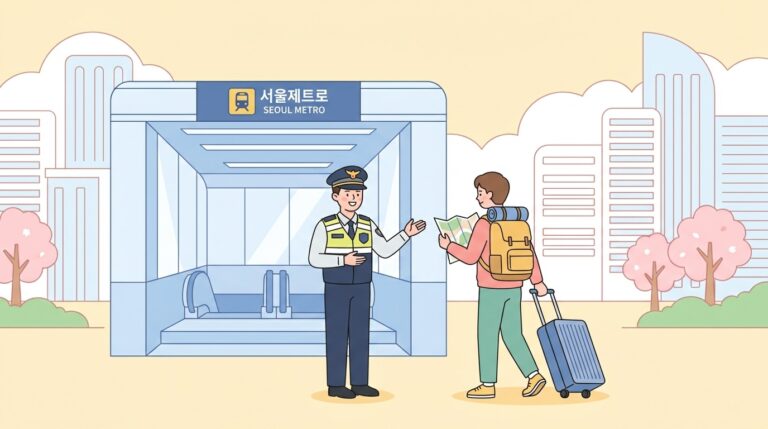
Phase 1: Empathy (Story-Immersive Opening)
안녕하세요! It’s your Daily Hangul editor and cultural navigator here. Picture this: You’re walking through the bustling, neon-lit streets of Hongdae or exploring the historic alleyways of Insadong. You stop for a quick bite of tteokbokki, reach into your bag to pay, and suddenly your heart drops—your wallet is completely gone! While South Korea is widely known as one of the safest countries in the world where people leave laptops unattended at cafes, crowded tourist hotspots or packed subway lines can occasionally lead to lost or pickpocketed belongings.
Panicking in a foreign country when you don’t know the exact words can feel overwhelming. Many learners freeze up because they try to translate complex sentences in their head. But don’t worry! With just a few clear, essential phrases at the A2 level, you can calmly ask for help, explain what happened to a subway station officer or police officer, and get your situation resolved quickly. Let’s make sure you never feel helpless in Korea!
Phase 2: Top 3 Core Expressions Deep-Dive
1. 지갑을 소매치기당했어요. (Jigap-eul somaechigi-danghaesseoyo.)
- Pronunciation: jee-gap-eul so-mae-chee-gee-dang-hae-ssoo-yo (Sounds like jee-gap + so-matchy + dang-hae-seo-yo)
- Meaning: Literal: “I experienced pickpocketing of my wallet.” / Natural: “My wallet was pickpocketed.”
- K-Culture Moment: You’ll hear this dramatic line in crime K-dramas like Taxi Driver or Signal when a bystander realizes their belongings vanished in a crowded market.
- Editor’s Insight: The word 소매치기 (somaechigi) specifically refers to pickpocketing (taking something directly from a pocket/bag unnoticed), while 당하다 (danghada) means to suffer or experience something passive/unfortunate.
- Situation Spectrum: Casual: ⚠️ (Use ‘지갑 털렸어’ with close friends) | Semi-formal: ✅ | Formal: ✅
- 🤔 Think About It: Notice how Korean uses passive-experience verbs (당하다) to indicate you were the receiver of an unfortunate event, rather than just saying “Someone stole my wallet.”
2. 지갑을 잃어버렸어요. (Jigap-eul ireobeoryeosseoyo.)
- Pronunciation: jee-gap-eul ee-ro-buh-ryuh-ssoo-yo (Sounds like ee-ruh + buh-ryuh-saw-yo)
- Meaning: Literal: “I lost away my wallet.” / Natural: “I lost my wallet.”
- K-Culture Moment: A classic trope in romantic comedies where the main character loses their wallet on public transit and has to borrow a subway fare from the love interest.
- Editor’s Insight: If you are not 100% sure whether it was stolen or simply dropped, use this phrase first. Koreans will immediately guide you to the lost-and-found (yusilmul centeo).
- Situation Spectrum: Casual: ⚠️ | Semi-formal: ✅ | Formal: ✅
- 🤔 Think About It: 잃어버리다 (ireobeorida) combines 잃다 (to lose) and 버리다 (to discard/do completely), emphasizing an irreversible accidental loss.
3. 경찰서가 어디에 있어요? (Gyeongchalseo-ga eodie isseoyo?)
- Pronunciation: gyung-chahl-suh-gah uh-dee-eh ees-suh-yo?
- Meaning: Literal: “Where is the police station?” / Natural: “Where is the nearest police station?”
- K-Culture Moment: Protagonists rushing up to convenience store clerks to ask for the nearest local police precinct (pachulso).
- Editor’s Insight: If you need an emergency police substation, you can also look for signs saying 파출소 (Pachulso) or 지구대 (Jigudae) on the street.
- Situation Spectrum: Casual: 🚫 | Semi-formal: ✅ | Formal: ✅
- 🤔 Think About It: How does polite spatial questioning (어디에 있어요) help maintain a respectful, cooperative tone even during an urgent situation?
Phase 3: Textbook Korean vs. Real-Life Korean
Situation 1: Telling an officer your wallet is gone
- 📖 Textbook Korean: 저의 지갑을 도둑맞았으니 도와주십시오. (Jeoui jigap-eul dodukmajasseuni dowajusipsio. – “My wallet has been stolen, so please provide assistance.”)
- 🗣️ Real-Life Korean: 지갑이 없어졌어요! 도와주세요. (Jigabi eopseojyeosseoyo! Dowajuseyo. – “My wallet disappeared! Please help me.”)
- 💡 Why the difference? Textbook honorifics like -sipsio sound overly theatrical in emergencies. Short, clear, polite phrases (-eoyo / -juseyo) convey urgency much faster.
Situation 2: Asking if anyone saw your bag
- 📖 Textbook Korean: 혹시 제 가방을 보신 분이 계십니까? (Hoksi je gabang-eul bosin buni gyesimnikka?)
- 🗣️ Real-Life Korean: 혹시 여기 있던 제 지갑/가방 보셨어요? (Hoksi yeogi itdeon je jigap/gabang bosyeosseoyo?)
- 💡 Why the difference? Natural spoken Korean uses friendly past-honorific endings (보셨어요?) rather than stiff broadcast-style formal interrogatives.
Phase 4: K-Culture Deep-Dive & Non-Verbal Manners
4-1. Nunchi & Emergency Body Language
When reporting an incident in Korea, body language matters:
* Two Hands for Details: When handing over your passport, ID, or phone with photo evidence to a police officer, always offer it with both hands. It shows respect and sincerity.
* Point with Open Palm: If pointing in the direction where the incident occurred, use an open palm rather than a single pointing index finger, which can come across as aggressive.
4-2. Safety Culture: Lost & Found vs. Theft
Korea has an extraordinarily efficient lost property network called Lost112 (경찰청 유실물 통합포털). More often than not, misplaced items in subways and buses are turned in untouched. However, stating clearly whether your item was taken (소매치기당했어요) or misplaced (분실했어요) helps the police immediately check surveillance (CCTV) cameras along the street.
Phase 5: Real-Life Roleplay Scenario
Setting: A subway customer service center near Myeongdong Station. You rush up to Station Officer Min (민 역무원).
- You: 저기요, 도와주세요! (Jeogiyo, dowajuseyo!)
🎭 [Breathless, clutching your bag]Excuse me, please help me! - Officer Min: 네, 무슨 일이세요? 진정하시고요. (Ne, museun iriseyo? Jinjeonghasigoyo.)
🎭 [Looking up calmly with concern]Yes, what happened? Please calm down. - You: 지하철 안에서 지갑을 소매치기당한 것 같아요. (Jihacheol aneseo jigap-eul somaechigi-danghan geot gat-ayo.)
🎭 [Gesturing toward the train platform]I think my wallet was pickpocketed inside the subway train. - Officer Min: 아이고, 언제 타셨어요? 몇 호선이에요? (Aigo, eonje tasyeosseoyo? Myeot hoseon-ieyo?)
🎭 [Opening a logbook]Oh dear, when did you board? Which line was it? - You: 10분 전에 4호선 탔어요. (Sip-bun jeone sa-hoseon taseoyo.)
🎭 [Showing your transit card log on your phone]I took Line 4 about 10 minutes ago. - Officer Min: 지갑 색깔이랑 모양이 어때요? (Jigap saekkkari-rang moyang-i eottaeyo?)
🎭 [Pen ready to write]What color and shape is your wallet? - You: 검은색 가죽 지갑이고, 안에 신용카드가 있어요. (Geomeunsaek gajuk jigap-igo, ane sinyongkadeu-ga isseoyo.)
🎭 [Showing a photo on phone]It’s a black leather wallet, and my credit cards are inside. - Officer Min: 알겠습니다. 제가 바로 유실물 센터랑 역내 순찰팀에 연락할게요. (Algetseumnida. Jega baro yusilmul senteorang yeongnae sunchaltim-e yeollakhalgeyo.)
🎭 [Picking up the radio]Understood. I will contact the Lost & Found center and patrol team right away.
🔀 Interactive Choice Point
Officer Min asks if you would like to report this formally to the nearby police box for CCTV checks. What do you say?
- Choice A: “경찰서로 지금 바로 갈게요. 신고 접수해 주세요.” (I will go to the police station right now. Please file a report.) -> [Best] Direct, proactive, and starts the CCTV verification immediately.
- Choice B: “몰라요. 그냥 찾으면 전화 주세요.” (I don’t know. Just call me if you find it.) -> [Risk] Inaction could delay blocking your stolen cards and tracking transit records.
- Choice C: “야! 너가 찾아내!” (Hey! You find it!) -> [Bad] Extremely rude informal language (Banmal) that creates unnecessary friction.
Phase 6: 10-Second Emotion Shadowing Drill
Practice reading these out loud, pausing at the / marks:
[😰 Anxious & Urgent]저기요, / 제 지갑이 / 없어졌어요! (Jeogiyo, / je jigabi / eopseojyeosseoyo!)[🔍 Serious & Clear]지하철에서 / 소매치기당했어요. / 도와주세요. (Jihacheoreseo / somaechigi-danghaesseoyo. / Dowajuseyo.)[🙏 Polite & Relieved]CCTV / 확인해 주실 수 있나요? / 감사합니다. (CCTV / hwaginhae jusil su innayo? / Gamsahamnida.)
Phase 7: K-Culture Mini Dictionary
- 소매치기 (Somaechigi) | Pickpocket / Pickpocketing | Used to describe the act or the thief operating stealthily in public places.
- 유실물 센터 (Yusilmul Senteo) | Lost & Found Center | Facilities located inside major transit stations and airports to manage recovered belongings.
- 신고 (Singo) | Official Report / Declaration | Crucial word when reporting crimes, lost passports, or emergencies to authorities (신고하다 = to report).
- 지구대 / 파출소 (Jigudae / Pachulso) | Local Police Substation | Neighborhood branch stations accessible 24/7 for immediate public safety needs.
Phase 8: Traveler’s Survival Kit
TOP 3 Emergency Survival Phrases
- 도와주세요! (Dowajuseyo!) – Please help me! (Pro Tip: Use this loudly if you need immediate public attention.)
- 카드 정지해야 해요. (Kadeu jeongjihaeya haeyo.) – I need to suspend/freeze my credit card. (Pro Tip: Say this to hotel staff or a friend to borrow a phone quickly.)
- 경찰을 불러 주세요. (Gyeongchal-eul bulleo juseyo.) – Please call the police. (Pro Tip: Emergency number in Korea is 112 for police, 119 for medical/fire.)
Editor’s Travel Note
- Essential App: Download the official Lost112 Police Lost and Found Portal or use Naver Map Navigation App to search for “파출소” (police box) instantly.
- Card Protection: Contact your bank immediately through online banking apps to lock your cards, then head to the nearest station office for CCTV checks.
Phase 9: A Step Deeper (Reflection)
In South Korea, public spaces function on high social trust. Leaving a phone on a table to reserve a seat is common practice. When an actual theft occurs, it is treated very seriously by local law enforcement, leveraging an extensive network of public CCTV systems. Speaking clearly without hesitation helps authorities rapidly access security footage before the trail goes cold.
💬 Your Turn: Have you ever lost an important item while traveling abroad? What was the first thing you did? Share your experience in the comments below!
Phase 10: FAQ & Common Mistakes
Q: What is the difference between 잃어버렸어요 and 도둑맞았어요?
A: 잃어버렸어요 simply means you lost something (it could be dropped or misplaced). 도둑맞았어요 or 소매치기당했어요 specifically means someone stole or pickpocketed it from you.
Q: Can foreign tourists file a police report without speaking fluent Korean?
A: Yes! When you call 112, you can request an English interpretation service. Furthermore, tourism police centers in Seoul (Myeongdong, Hongdae, Dongdaemun) have multilingual officers ready to assist.
Q: How do I ask to check security cameras in Korean?
A: You can politely ask: “혹시 CCTV 볼 수 있을까요?” (Hoksi CCTV bol su isseulkkayo? – Could I possibly check the CCTV?).
🚨 Common Mistakes Warning Board
- ❌ Saying “내 지갑 훔쳤어요!” to a bystander -> This accuses that specific person directly (“You stole my wallet!”).
- ✅ Correct Action: Say “지갑을 도둑맞았어요” or “지갑을 소매치기당했어요” to state the event neutrally.
- ❌ Forgetting polite endings during stress -> Shouting “도와줘!” is informal and disrespectful to strangers.
- ✅ Correct Action: Always say “도와주세요!”.
- ❌ Confusing emergency numbers -> Calling 911 won’t connect directly on landlines.
- ✅ Correct Action: Dial 112 (Police) or 119 (Ambulance/Fire).
Phase 11: Action Missions
- 🥉 Bronze Mission (Solo): Repeat the 10-Second Emotion Shadowing Drill 3 times until you can say “지갑을 소매치기당했어요” without looking at the romanization.
- 🥈 Silver Mission (Social): Share this phrase on your social media study log or with a study buddy with the tag #DailyHangulSurvival.
- 🥇 Gold Mission (Real-World): Locate the nearest Pachulso (파출소) on a Korean map app and practice reading the emergency signboard.
- 🎮 K-Culture Mission: Watch an episode of a Korean police procedural drama (e.g., Live or Voice) and spot when characters say “신고” or “경찰”.
Phase 12: Interactive Quiz Challenge
Q1. You realize your wallet was picked in a crowded market. Which sentence should you tell the nearby police officer?
* A) 지갑을 소매치기당했어요.
* B) 지갑을 선물했어요.
* C) 지갑을 샀어요.
Q2. Fill in the blank:
“저기요, 근처에 __________가 어디에 있어요?” (Excuse me, where is the nearest police station?)
Q3. [True / False] In Korea, dial 112 for the police and 119 for medical emergencies.
👉 Click here to reveal the answers & explanations!
- Answer: A) 지갑을 소매치기당했어요. (Explanation: Option B means ‘I gifted a wallet’, and C means ‘I bought a wallet’.)
- Answer: 경찰서 (Gyeongchalseo) or 파출소 (Pachulso).
- Answer: True. (112 connects to the police command center, while 119 connects to the fire and emergency rescue services.)







