

Phase 1: Empathy (Storytelling Opening)
안녕하세요! 매일한글 에디터입니다.
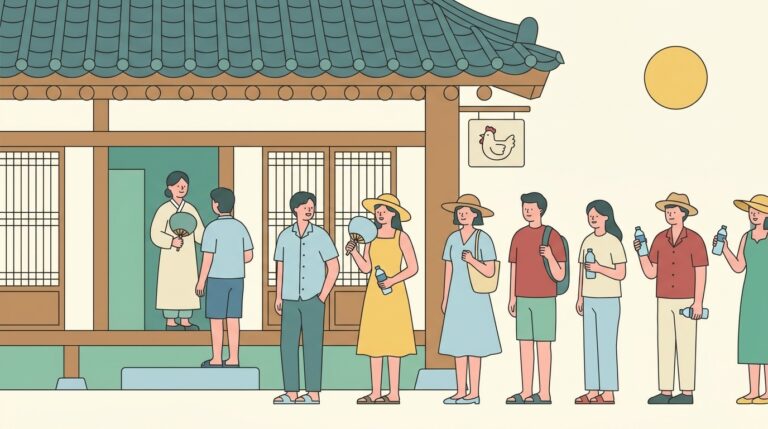
Picture this: It is mid-July in Seoul. The thermometer reads 35°C (95°F) with 85% humidity. You are melting into the asphalt in Jongno, yet you find yourself standing behind fifty eager locals wrapped around an alleyway. What are they queueing for? A steaming, bubbling stone bowl of ginseng chicken soup—Samgyetang (삼계탕).
If you have ever felt utterly confused trying to navigate waiting lists, table calls, or the cultural concept of eating boiling soup on the hottest day of the year (I-yeol-chi-yeol, 이열치열), you are not alone! Many intermediate learners know how to order food, but when faced with a bustling Seoul matjib (맛집) during the peak Boknal season, spontaneous restaurant Korean hits differently. Based on feedback from hundreds of our intermediate students who froze when the restaurant host shouted rapid-fire questions, this guide will transform you from a bewildered tourist into a seasoned dining pro.
Phase 2: Top 3 Core Expressions In-Depth
1. 대기 명단에 이름 올려주세요 (Daegi myeongdane ireum ollyeojuseyo)
- Pronunciation: [Dae-gi myeong-da-ne i-reum ol-lyeo-ju-se-yo] (Think: “Day-gee” like a sunny day, “myeong-dan” rhyming with “neon dawn”)
- Meaning: Literal: “Please raise my name onto the waiting list.” | Actual Nuance: “Please put my name down on the waitlist.”
- K-Culture Moment: In K-dramas like Weightlifting Fairy Kim Bok-joo, characters rush to trendy gourmet spots and instantly look for the clipboard at the entrance to secure their spot.
- Editor’s Insight: At B2 level, avoid simply saying “예약하고 싶어요” (I want to make a reservation). Walk-in waitlists specifically use the verb “올리다” (to put/upload onto a list) or “등록하다” (to register).
- Situation Spectrum: Casual ⚠️ | Semi-formal ✅ | Formal ✅
- 🤔 Think About It: In English, you “put your name on a list”, whereas Korean uses the upward motion verb “올리다” (to raise up onto an official record). How does this reflect the formal tracking of customer queues?
2. 얼마나 기다려야 하나요? (Eolmana gidaryeoya hanayo?)
- Pronunciation: [Eol-ma-na gi-da-ryeo-ya ha-na-yo?] (Rhythm: Eol-ma-na / gi-da-ryeo-ya / ha-na-yo?)
- Meaning: Literal: “How much must I wait?” | Actual Nuance: “Roughly how long is the wait?”
- K-Culture Moment: Commonly heard in reality shows like Omniscient Interfering View where managers scout famous restaurants before filming.
- Editor’s Insight: Use “~야 하나요?” rather than just “기다려요?” to convey a natural intermediate tone inquiring about mandatory waiting conditions politely.
- Situation Spectrum: Casual 🚫 | Semi-formal ✅ | Formal ✅
- 🤔 Think About It: Asking for time estimates in Korea often leads to practical answers based on table turnover rate (Hoejeonyul, 회전율). How does restaurant pacing differ in your culture?
3. 일행이 다 와야 들어갈 수 있나요? (Ilhaeng-i da waya deureogal su innayo?)
- Pronunciation: [Il-haeng-i da wa-ya deu-reo-gal su in-na-yo?]
- Meaning: Literal: “Can we enter only when all party members come?” | Actual Nuance: “Can we be seated only after our entire party arrives?”
- K-Culture Moment: In bustling Seoul restaurants with high foot traffic, hosts often insist that the full group is present before handing over a table.
- Editor’s Insight: “일행” (party/companions) is an essential B2 noun that elevates your dining vocabulary above basic words like “친구들” (friends).
- Situation Spectrum: Casual ⚠️ | Semi-formal ✅ | Formal ✅
- 🤔 Think About It: Why do fast-paced Korean restaurants prioritize full-party seating over letting one person hold a 4-person table?
Phase 3: Textbook Korean vs Real-Life Korean
Situation 1: Inquiring about queue numbers
- 📖 교과서 한국어: 번호표를 주십시오. (Beonhopyoreul jusipsio. – “Please give me a number ticket.”)
- 🗣️ 진짜 한국어: 캐치테이블이나 테이블링으로 등록하면 되나요? (Catchtable-ina Tabling-euro deungnokhamyeon doenayo? – “Should I register via CatchTable or Tabling?”)
- 💡 왜 다를까?: Most modern famous spots in Seoul have swapped paper tickets for digital tablet kiosks using apps like CatchTable or Tabling.
Situation 2: Asking if an outdoor waiting area is available
- 📖 교과서 한국어: 밖에서 기다려야 합니까? (Bakkeseo gidaryeoya hamnikka? – “Must I wait outside?”)
- 🗣️ 진짜 한국어: 대기석 안쪽에 따로 마련되어 있어요? (Daegiseok anjjoge ttaro maryeondoe-eo isseoyo? – “Is there a waiting area set up inside?”)
- 💡 왜 다를까?: In the sweltering heat, intermediate speakers proactively inquire about indoor AC waiting spaces (Daegiseok) using natural vocabulary.
Phase 4: K-Culture Deep Dive & Non-Verbal Manners
4-1. 눈치 (Nunchi) & Gestures
When approaching a crowded Samgyetang restaurant:
1. Check the Entrance Kiosk First: Do not barge straight past the curtain. Pause, glance near the entrance door for an iPad stand (CatchTable/Tabling), and check if other diners are typing on a screen.
2. Hand Signaling Party Size: Hold up two or three fingers at chest level when the staff catches your eye. Avoid waving aggressively over people’s heads.
3. Quick Table Transition: Samgyetang is served boiling hot in earthenware pots (Ttukbaegi, 뚝배기). Keep pathways clear while waiting so servers carrying heavy, scalding trays can pass safely.
4-2. Cultural Code: I-yeol-chi-yeol (이열치열) & Sambok (삼복)
Koreans mark the three hottest days of summer—Cho-bok (초복), Jung-bok (중복), and Mal-bok (말복)—as Sambok. The guiding philosophy is I-yeol-chi-yeol (fighting fire with fire): consuming piping-hot, nutrient-rich chicken soup stuffed with ginseng, glutinous rice, jujubes, and garlic restores vital energy lost through sweat.
Phase 5: Real-Life Roleplay Scenario
Setting: It is Cho-bok afternoon outside a renowned 40-year-old Samgyetang restaurant in Gyeongbokgung. The humidity is soaring, and you approach Imo-nim (이모님), the charismatic, sharp-eyed restaurant host managing the crowd.
- You: 저기요, 사장님! 오늘 대기 팀 얼마나 남았어요? (Jeogiyo, sajangnim! Oneul daegi tim eolmana namasseoyo? / Excuse me, boss! How many waiting teams are left today?) 🎭 [Holding portable mini-fan, peering politely at the tablet]
- Imo-nim: 지금 앞에 열두 팀 있어! 한 삼십 분은 꼬박 걸려요. (Jigeum ape yeoldu tim isseo! Han samsip buneun kkobak geollyeoyo. / There are 12 teams ahead right now! It will take a solid 30 minutes.) 🎭 [Tapping table log with a pen]
- You: 아, 생각보다 빠르네요! 대기 명단에 번호 남기면 카톡으로 알림 오나요? (A, saenggakboda ppareuneyo! Daegi myeongdane beonho namgimyeon Katok-euro allim onayo? / Ah, faster than I thought! If I leave my number on the waitlist, do I get a KakaoTalk notification?) 🎭 [Pulling out smartphone]
- Imo-nim: 응, 카톡으로 호출 가니까 5분 안에 안 오면 취소돼! (Eung, Katok-euro hochul ganikka obun ane an omyeon chwisodoae! / Yes, you’ll get called via KakaoTalk, but if you don’t show within 5 minutes, it gets canceled!) 🎭 [Waving index finger playfully]
- You: 네, 명심할게요. 혹시 일행이 다 와야 착석 가능한가요? (Ne, myeongsimhalgeyo. Hoksi ilhaeng-i da waya chakseok ganeunghan-gayo? / Got it, I will keep that in mind. By any chance, can we sit only when everyone arrives?) 🎭 [Nodding respectfully]
- Imo-nim: 그럼! 회전율 때문에 다 와야 들여보내 줘. (Geureom! Hoejeonyul ttaemune da waya deuryeobonae jwo. / Of course! Because of table turnover, we only let you in when everyone is here.) 🎭 [Cleaning a table spot rapidly]
- You: 알겠습니다! 바로 등록하고 근처 그늘에서 기다릴게요. (Algetseumnida! Baro deungnokhago geuncheo geuneureseo gidarilgeyo. / Understood! I’ll register right away and wait in the nearby shade.) 🎭 [Entering phone number on the screen]
- Imo-nim: 그래, 더우니까 부채질하고 있어, 금방 불러줄게! (Geurae, deounikka buchaejilhago isseo, geumbang bulleojulge! / Alright, fan yourself in the heat, I’ll call you shortly!) 🎭 [Handing over a complimentary paper fan]
🔀 Interactive Choice Point
Your friend texts you saying they are running 10 minutes late, but your KakaoTalk buzzes: “Your table is ready. Please enter.” What do you say to Imo-nim?
- Choice A: “저희 친구가 오고 있는데 먼저 들어가서 삼계탕 2개 주문하고 앉아있어도 될까요?” (Jeohui chin-guga ogo inneunde meonjeo deureogaseo samgyetang dugae jumunhago anjaisseodo doelkkayo?)
- Choice B: “그냥 먼저 들어갈게요! 친구 곧 와요!” (Geunyang meonjeo deureogalgeyo! Chin-gu got wayo!)
- Choice C: “친구 올 때까지 그냥 무한정 밖에서 자리 맡아주시면 안 돼요?” (Chin-gu ol ttaekkaji geunyang muhanjeong bakkeseo jari matajusimyeon an dwaeyo?)
Feedback:
* Choice A (Best): Polite, practical, and offers to order immediately so the kitchen isn’t delayed. The host will usually accommodate this!
* Choice B (Risk): Too abrupt and dismisses house rules. If your friend gets delayed further, the staff may ask you to step aside.
* Choice C (Bad): Unrealistic during peak rush hours; violates restaurant queue etiquette (Nunchi fail).
Phase 6: 10-Second Emotion Shadowing Drill
[🔥 덥고 지쳤지만 정중하게]저기요 / 대기 명단에 / 두 명 등록할 수 있을까요? (Jeogiyo / daegi myeongdane / du myeong deungnokal su isseulkkayo?)[😲 살짝 놀라며 공감하듯]삼십 분 정도 / 걸린다고요? / 생각보다 회전율이 빠르네요! (Samsip bun jeongdo / geollindagoyo? / Saenggakboda hoejeonyuri ppareuneyo!)[😊 감사하며 싹싹하게]네, 카톡 알림 받으면 / 3분 안에 바로 올게요! (Ne, Katok allim badeumyeon / sambun ane baro olgeyo!)
Phase 7: K-Culture Mini Dictionary
- 복날 (Boknal): The three peak energy-replenishing hot days of summer (Chobok, Jungbok, Malbok).
- 이열치열 (I-yeol-chi-yeol): The traditional wellness concept of conquering heat with hot food and drinks.
- 회전율 (Hoejeonyul): Table turnover rate in bustling restaurants; high turnover ensures fresher broth and faster lines.
- 번호표 (Beonhopyo): Queue number slip / digital queue token used to track dining turns.
Phase 8: Traveler Survival Kit
- Top 1: 몇 팀 정도 남았어요? (Myeot tim jeongdo namasseoyo? – How many groups are ahead of us?)
- Top 2: 시원한 자리로 부탁드려요. (Siwonhan jariro butakdeuryeoyo. – A cool seat near the AC, please.)
- Top 3: 포장도 대기해야 하나요? (Pojangdo daegihayeoya hanayo? – Do take-out orders also require waiting in line?)
Editor’s Travel Note:
Before heading out in summer, search for hot spots on the Naver Map app download for iOS and Android. Many popular spots display real-time CatchTable wait counters directly in the app profile!
Phase 9: “One Step Deeper” (Cultural Reflection)
Waiting in a 40-minute line under relentless sunshine to eat boiling chicken soup reveals the uniquely communal spirit of Korean seasonal customs (Jeolgi, 절기). Food in Korea is not simply fuel; it is shared preventative medicine (Yak-sik-dong-won, 약식동원). Participating in the collective sweat of Boknal binds strangers together in mutual endurance and vitality.
💬 Your Turn: Does your home culture have a summer food tradition that seems completely counter-intuitive to outsiders? Share your thoughts below!
Phase 10: FAQ & Common Mistakes
Q: Can I register on CatchTable without a Korean phone number?
A: Many modern restaurant kiosks allow international numbers, but if it requires a local 010 number, politely tell the host: “외국인이라 전화번호가 없는데 현장 대기 가능할까요?” (I am a foreigner without a local number, can I wait on-site?).
Q: Is it rude to ask for extra soup broth (Gukmul)?
A: Not at all! At authentic Samgyetang spots, you can politely say: “국물 리필 조금만 더 부탁드립니다” (Could we please get a little broth refill?).
Q: What if I can’t eat ginseng or medicinal herbs?
A: The herbs are brewed into the stock, so while you can leave the ginseng root uneaten on your plate, it is difficult to remove herbal extracts from the broth itself.
🚨 Common Mistakes Warning Board
- Mistake: Entering the restaurant immediately when a table opens without checking with the host.
- Correct Action: Always wait until your name or KakaoTalk number is actively called.
- Mistake: Holding a 4-person table solo while 3 friends are stuck on the subway.
- Correct Action: Inform the host in advance and be prepared to step aside until your full party arrives.
- Mistake: Ordering one bowl to share between two adults during peak Boknal rush.
- Correct Action: Observe the 1-person-1-order (1인 1식) standard customary in traditional soup restaurants.
Phase 11: Action Mission & Engagement
- Bronze Mission: Practice saying “대기 명단에 두 명 올려주세요” out loud 5 times using natural rhythm pauses.
- Silver Mission: Open your social media or notes app and write down your party size in Korean: “[Number]명 대기할게요!”
- Gold Mission: Visit a Korean soup restaurant this week and successfully register your party using “몇 팀 남았어요?” without switching to English.
- 🎮 K-Culture Mission: Watch an episode of a Korean food variety show (e.g., Baek Jong-won’s Alley Restaurant) and spot how customers greet the host at the entrance.
Phase 12: Interactive Quiz Challenge
1. Situation Judgment: The restaurant is packed and you see an iPad at the door. What should you ask the host?
* A) 메뉴판 먼저 주세요. (Give me the menu first.)
* B) 캐치테이블로 등록하면 되나요? (Should I register via CatchTable?)
* C) 그냥 빈자리에 앉을게요. (I will just sit at an empty seat.)
2. Fill in the blank:
“일행이 다 ________ 들어갈 수 있나요?” (Can we enter only after all our party members arrive?)
3. True / False Culture Quiz:
* I-yeol-chi-yeol (이열치열) means drinking ice water exclusively on hot summer days. (T / F)
👉 Click to Reveal Answers & Explanations
- Answer: B | Always clarify if the tablet system is active before queuing manually.
- Answer: 와야 (from the grammatical pattern ~아/어야: only when [verb] happens).
- Answer: F | I-yeol-chi-yeol means beating the summer heat with hot, nourishing food like Samgyetang!







